• Skip to primary navigation
  • Skip to main content
  • Skip to primary sidebar

John August

  • Arlo Finch
  • Scriptnotes
  • Library
  • Store
  • About

Search Results for: spaces after a period

Scriptnotes, Ep 206: Everything but the dialogue — Transcript

July 17, 2015 Scriptnotes Transcript

The original post for this episode can be found here.

John August: Hello and welcome. My name is John August.

Craig Mazin: My name is Craig Mazin.

John: And this is Episode 206 of Scriptnotes, a podcast about screenwriting and things that are interesting to screenwriters.

Craig, it’s great to be back on the air with you. Last week was a strange episode because it was the first time in the Scriptnotes history where I had not actually listened to the episode before it was aired. So the interview with Alec Berg, I had heard none of it, and suddenly it’s there in my ears as I’m on the treadmill. And I thought it was delightful.

Craig: Well thank you. I was a little worried just because we were winging it technologically. I mean, we were just basically sitting around my laptop because I had stupidly forgotten the microphone and all that other stuff. But, you know, it’s proof that content is king. It doesn’t really matter what it sounds like as long as what people are saying are interesting. And Alec, as always, was fascinating.

John: He’s a great guy. And so thank you for doing that interview. We are back at our real microphones on Skype. We are on different coasts, but it’s more like a normal show this week. This week on the show we’re going to be talking about revenue sharing. We’re going to talk about scene description. And we’re going to talk about reshoots. These are three kind of cool topics. So, I’m eager to get into it.

But first, follow up. On last week’s episode of the show I talked about the USB drives that have all 200 episodes of Scriptnotes on them. I said that you could use the special promo code — what was the promo code, Craig?

Craig: Singularity.

John: I said you could use that promo code and save 20%. I was wrong. It’s 10%, which is $2. I just got math — math is hard for me in my head as I speak. So many people used the code Singularity that we’re almost sold out. So, it may be moot by the time you’re hearing this podcast. We may be sold out of those USB drives. But thank you to everyone who purchased one of those.

Craig: That’s great. I’m glad that people are picking those up. You know, it is our contention that if you don’t have the money to go to film school, but you do have — how much does this thing cost?

John: $20.

Craig: $20, minus ten percent.

John: Yes.

Craig: $18, plus tax, not a bad option. It’s certainly cheaper than the cheapest film school is per day.

John: Yes.

Craig: So, give it a shot.

John: Give it a shot. This week we want to talk about revenue sharing. And this was a topic that got sent into us by a friend on Twitter. I’m sorry, I didn’t look up who actually sent us the link to the article, but I thought it was really interesting because I had not heard about this kind of plan before. So, what’s happening is Paramount Pictures, AMC Theaters, and Cineplex Entertainment are cutting this new deal for two movies that they’re going to be releasing.

First is Paranormal Activity: The Ghost Dimension, and then there’s also Scout’s Guide to the Zombie Apocalypse. And when they release them into theaters, very shortly after being released in the theaters they will be coming out on home video. Now, we’ve seen other movies before that have done sort of day and date, a lot of indie films will do the same weekend they’re out in theaters they’ll be available on iTunes. But this is sort of a special case where it’s going to be wide releases of these movies and then at whatever point it drops below 300 screens it goes out on home video very shortly thereafter.

Craig, what did you make of this?

Craig: Well, it was very interesting. It’s smart, but I want to get into why it’s a very specific targeted strategy. Let’s walk back for a second to the history of this situation. There’s a natural push and pull between the studios and the exhibitors. The studios understand that they make most of their money from the first couple of weeks in exhibition, and then following that they get less and less coming back to them.

The theaters continue to take a pretty healthy piece of the ticket sales, but of course a bucket of popcorn costs just as much on week five of a movie as it does on week one. What concerns the movie theaters is, look, if you give us a movie and then you turn around four weeks later and put it out on digital, people just aren’t going to come to the theater. They’re just going to wait the four weeks because it’s maybe easier than driving to the theater. They’ll just wait and they’ll see it at home. They won’t feel like they’re missing out on an experience. They won’t feel like, you know, oh my god, everyone around me has seen this movie except for me and I’m waiting the three months before it’s available on video.

So, the studios naturally want to shrink the window between theatrical release and digital release. And the exhibitors want it to be as long as possible. So, here’s what Paramount does. They say, look, on these two films what we’re saying to you guys is let us release this thing on digital way earlier than we normally would. We’re going to really shrink that window. But to compensate you for this we’ll give you a piece of what we make on the digital following three months after the initial theatrical release. So we put it out in theaters, 17 days go by, and now it’s still running in your theaters, but you can also watch it digitally at home.

For those people who watch it digitally at home, from that — up until 90 days from the start of the theatrical release — we’ll kick back a little piece of it to you guys. And when I say a little piece, it could be a big piece. We don’t know what the actual percentage is.

And it’s fascinating because, of course, the exhibitors, the theater owners, they have nothing to do with you at home buying the movie. It’s basically the studio buying the right from the theaters to run the movie in the theater and then allow them to sell it to home video. Of course, look at the movies that they’re doing it with, and there’s where it gets —

John: Yeah. So, the two films are Paranormal Activity: The Ghost Dimension and Scout’s Guide to the Zombie Apocalypse. And those are genre movies and there’s a really telling quote from one of the theater owners. Ellis Jacobs says, “Some films generate 99% of their gross in the first four to six weeks of release, followed by a two-month window where they’re completely unavailable to the legitimate marketplace.” And that term “the legitimate marketplace” is really what’s underlying all of this discussion.

When movies are released in the theaters, people go see them in the theaters because that’s the only place to see them, until they show up on torrents. Until everyone is just illegally downloading them. And so there’s always been that period of time where people could download those movies and watch them at home. It just wasn’t legal.

And the studios are saying, listen, we want to actually capture some of that money and be able to make money off of these movies during this time when people are just streaming them, or illegally downloading them.

Craig: That’s right. So, the studios want to shrink the window in part because they want to make more money, and in part because they want to defeat piracy. On these two movies, the exhibitors understand that when they say — I think the quote you said, “99% is within the first four to six weeks of release.” He’s being really generous with that number. My guess is that on a movie like a Paranormal Activity title, 99% of the theatrical gross is within the first three weeks.

Because it’s such an opening night business. It’s very teenage driven. It’s also — they have a high Latino turnout. They have a high African American turnout. We know that Latinos and African Americans are big drivers of early movie-going, like first week of movie-going. They are right on those releases.

So, on a movie like a Paranormal Activity, everybody, Paramount and the theaters, they know that, meh, after 17 days of a theatrical run, a lot of that juice has been squeezed out of the orange anyway. So, this way the theaters are kind of saying, well, we probably weren’t going to make that much money off these movies anyway after 17 days. And since you guys are willing to kick back to us some of that sweet digital money for another 73 days, why not? What you won’t see are any arrangements like this with movies that theoretically play in a more traditional way.

John: Agreed. I think it’s important to understand that the relationship between studios and exhibitors, exhibitors being the theater chains, they are contractual, but there’s also some governmental influence underneath this. Because once upon on a time these used to be vertically integrated companies. And so Paramount used to own its theaters. And if we still were setup that same way, Paramount would have done this a long time ago. Paramount would have recognized that like, listen, why bother with a window. Just get it out there, get a big push, and like next week we should put it on digital.

But they have to have this complicated relationship with their exhibitors now because they’re not allowed to own them, so they have to have a negotiation. And that negotiation has been sometimes favored towards the studios, sometimes favored for their exhibitors, but they need each other, because they’re not allowed to own each other.

And so exhibitors quite reasonably are worried that if the average theater goer understands that a movie is going to be available two weeks after it’s on the big screen, they’re just going to wait and see it at home. And that is really their worry and that’s why they don’t want most films to go this way.

Craig: Yeah. I mean, the theaters and the studios do this interesting dance. It’s a dance of negotiation where the exhibitors desperately want the big movies. The studios want them to take all of their movies, right? So, there’s that whole negotiation. Yeah, you can have The Avengers if you also take this. Right?

Okay, so there’s that part. Then the theater owners obviously want as much time as possible in the theaters exclusively, because that’s why people go to the movie theaters. The companies, of course, want to make money however they can, as fast as they can. Then, the studios really want the exhibitors to make movie theaters as awesome as they can. The studios want movie theaters to be all digital, and have great seats, and to be clean.

They don’t want movie theaters to charge too much for tickets to drive people away, unless it’s a really great movie, then they would love that. If the movie theaters had their druthers, popcorn would be free, because they don’t make any money off of it. And they know that movie goers are annoyed by the high prices of concessions. All these interesting things are going on here. So, far so good — both businesses seem to be okay. It’s a weird thing.

I’ve always felt that the nature of the exhibition arrangement is one of the reasons why you see this remarkable permanency in Hollywood studio corporate history. You have these big five studios and they’ve always been the big five studios and they pretty much always will be because they’re the ones that have the libraries and the negotiation clout with the exhibitors.

John: Yeah. It’s one of those kind of weird oligopoly/olinopsony, what is the equivalent of the oligopoly for the buyer side? There’s a very limited number of buyers. There’s a very limited number of sellers. In this case you have two of the buyers, if you want to call them buyers, the exhibitors, dealing — cutting a deal with one of the big sellers. And it’s an experiment that I think everyone is going to be watching because a lot of studios are making movies that are in this window. A lot of Lions Gate movies feel like they’re kind of in this window.

Craig: I agree. And if it works out mutually to everyone’s success, now, of course, it creates a whole other channel of negotiations because if this works then the next thing that happens is the studios say, well, we’ll do it again, but we’re not going to give you quite as much of the digital. You know, this will always be the way that corporations deal with each other. It is fascinating.

I think from a screenwriter point of view, this is a good deal. Because all of our residuals are for what we call ancillary markets. So the primary or what they call secondary exhibition. Primary exhibition covers theatrical release and curiously enough releases on airplanes.

John: Yup.

Craig: So, we don’t get any money from the run in the theater. We only get money from sale to television, downloads, rentals, etc. This is good for the writers of Paranormal Activity: Ghost Dimension, and the writers of Scout’s Guide to the Zombie Apocalypse because they should get a nice boost on the digital sales. So, from a writing point of view, all of us should be very much in favor of this.

John: Fast forward to the next negotiation and how much do you want to bet the studios want to put a clause in there that defines ancillary markets as being markets that are encountered within like a 90-day window after theatrical. I just feel like there’s going to be some way that they’re going to claim that, well, this is still part of the theatrical release because we’re still sharing the proceeds back with the exhibitors.

Craig: I think they may ask. I mean, the obvious response is —

John: No.

Craig: You can share with anybody whatever you want. But we get a piece of your grosses, period, the end. That’s it. You can give it all to charity. We don’t care what you do with your end.

John: Mm-hmm. But I would not be surprised if this becomes — if this is successful and other studios try to emulate this model — I would not be surprised if we see this kind of hybrid approach being a factor in upcoming negotiations.

Craig: It may very well be. We’ll see. We’ll see. I hope not. Because to me it feels like kind of a big strike issue, unless we can show that this is a minor, minor deal. Like, okay, if you’re giving away 1% and you want to take away 1% of our residuals during that 67 days, I suppose there’s a negotiation there. Maybe. Because it’s minor. But, you know, but — ah…eh…

John: I don’t want us to put a dark cloud over what I think is overall an interesting idea and an interesting experiment because everyone who goes to see these kinds of movies recognizes that there’s something really weird and broken about sort of how long that window is between these kind of movies and when you can find them legally online.

Craig: Yeah.

John: And honestly, all screenwriters want — we’re not getting paid any residuals on those stolen movies, so —

Craig: That’s right.

John: We want those to be converted to legitimate sources.

Craig: That’s one of my beefs with the Writers Guild is that they — we should be as aligned as possible with anti-piracy efforts. Sometimes I feel like we’re not quite there the way that the DGA is. But, yeah, no question. The system is old in a new era. And these sorts of creative solutions will happen more and more, but I do think that they will happen in this way, in a very a la carte way. Because this is not a model that applies to most movies I would even argue. It just applies to some.

John: Yeah. So far we’ve only seen this applied to these kind of special genre movies and as we’ve talked about in previous episodes the day and date releases, home video, and theatrical for indie films, sort of like the Sundance movie —

Craig: Right. Because those movies tend to only be running theatrically in a few cities anyway.

John: Exactly. Cool. Our next topic is something we’ve never actually done before, which is, you know, we’ve done Three Page Challenges where we’ve looked at three pages that listeners have sent in and gone through them. We end up talking a lot about the scene description, but we’ve never really talked about scene description just by itself. And so I thought this week we would go through and take a look at seven examples of produced screenplays, movies you’ve seen, and what those looked like on the page.

And so if you want to read along home with us, there are little snippets that are available. You can follow the links in the show notes at johnaugust.com. And they’re just little graphics that take a screenshot of a piece of the page so that we can talk about what those words were on the page that became the scenes that you saw. So, the six movies that we’re going to look at are Aliens, Erin Brockovich, Ocean’s 11, Unforgiven, Wall-E, Wanted, and Whip It.

So, these are just a random sample I picked this morning of different movies, some of them are what we consider action movies, others are just dramas or comedies. But just a sense of what those words are like on the page and by scene description let’s just talk about our terms here. I’m really referring to everything that’s not the character’s talking.

So, it’s everything that would be on the page to help describe what the movie actually is, but isn’t a character talking. And so those are the action lines, those are how you are moving across the page. What punctuation you’re using. What nouns you’re choosing. What verbs you’re choosing to sort of show how things look.

Craig: Mm-hmm.

John: So, let’s take a look at Aliens. Aliens is really one of those movies that screenwriters of my generation sort of go back to, because it’s one of the first scripts we just read and loved and kind of tried to copy James Cameron’s style.

This is an example from the start of Aliens. This is him describing the Narcissus. I won’t go through all of this, but I’m just going to give you a sense of what it feels like on the page.

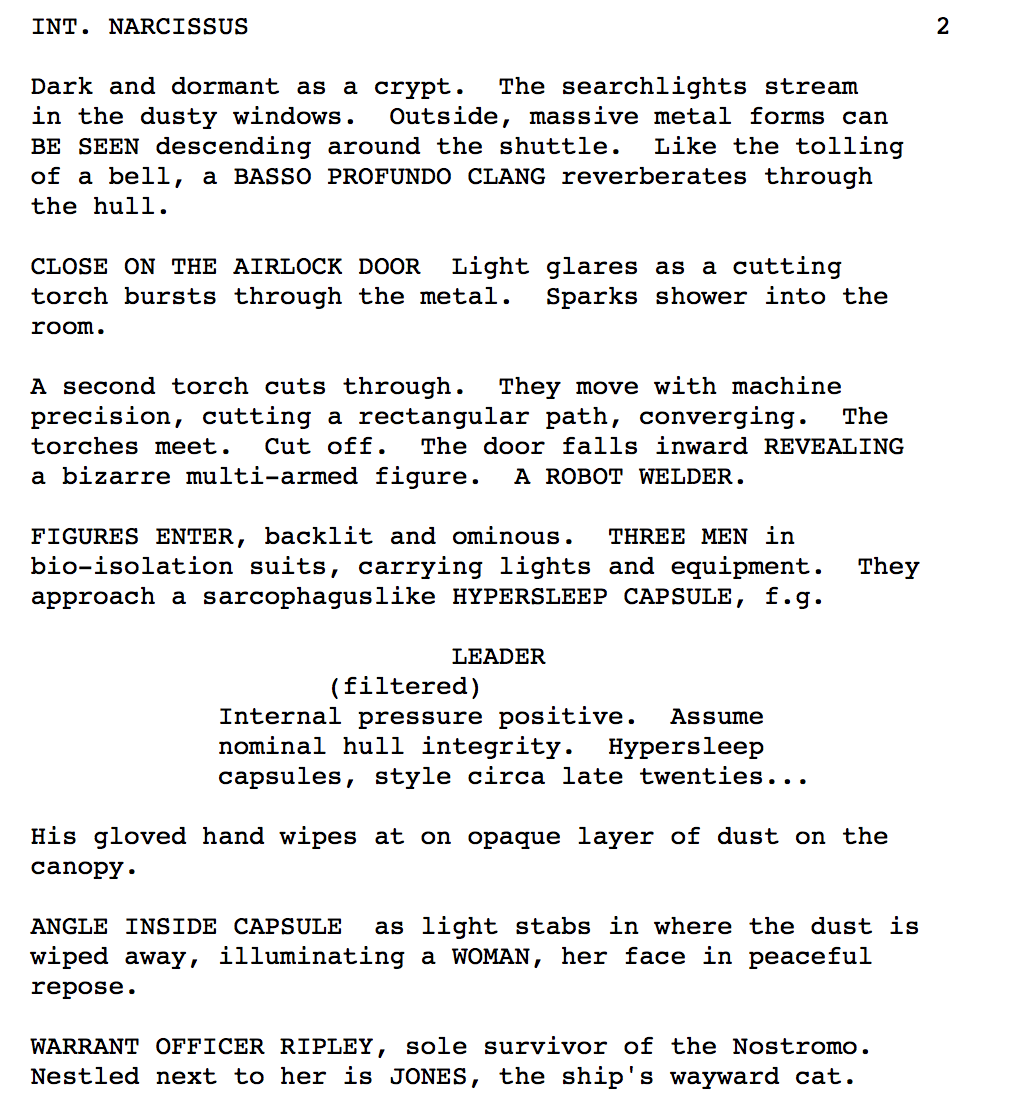
INT. NARCISSUS. There’s no day or night. Just INT. NARCISSUS.

Dark and dormant as a crypt. The searchlights stream in the dusty windows. Outside, massive metal forms can BE SEEN descending around the shuttle. Like the tolling of a bell, a BASSO PROFUNDO CLANG reverberates through the hull.

CLOSE ON THE AIRLOCK DOOR. Light glares as a cutting torch bursts through the metal. Sparks shower into the room.

A second torch cuts through. They move with machine precision, cutting a rectangular path, conversion as the torches meet. Cut off. The door falls inward revealing a bizarre multi-armed figure. A ROBOT WELDER.

So, that’s the very start of Aliens. This is coming to find Ripley in her spaceship. And I remember what that looks like when I saw it in the movie, but this would have given me a very good sense of what this movie felt like. Craig, how do you react to this?

Craig: Well, this to me, I think of this, and I’m not sure if it’s because the script was so influential, or if it’s simply within a tradition that’s longer, this feels like a very typical way of doing things. And I don’t mean to say boring at all. I mean to say this is sort of how you do it. Like when I think of like a good classic way of writing description, it is a little bit prosy, right? He doesn’t shy completely away from prose. “Dark and dormant as a crypt” is evocative.

But he’s using — he’s not writing full, complete sentences. He’s doing a lot of little bursts. Like, “Sparks shower into the room” is a technical sentence, but it’s not like a full, or like the words “Cut off” is a sentence. That obviously is a little bit of a fragment.

So, he kind of goes fragmented at times. Mostly the action description is focusing you on the visuals and on the audio, which is important. So, to me, this is a very classic way of doing things. There’s not a lot of stuff in here — there’s nothing cute. There’s nothing clever or referential to the reader. There’s nothing that you wouldn’t know if you weren’t watching or listening to the movie.

This, frankly, is pretty much the way I like to approach things. Also interesting is his use of capitalization which is very much the way I use it. And it’s when I feel like it.

John: Yeah.

Craig: So, you know, sometimes he’ll say, like he’s using it in a typical way when a new character enters. ROBOT WELDER. THREE MEN. Sometimes he uses it to call out a specific prop. HYPER SLEEP CAPSULE. Sometimes he uses it for a sound, or even an action. Like he says, “Outside, massive metal forms can BE SEEN.” And it’s there just to help you. It’s almost like you can see the camera swinging to it, you know what I mean?

John: Mm-hmm.

Craig: So, this is very classic. I think you could not go wrong if you adopt this as your style.

John: Absolutely. Let’s talk about the literary techniques he’s using. So you have metaphor and simile in here. So, “Dark and dormant as a crypt.” “Like the tolling of a bell.” So, obviously you can’t see metaphor and simile up on a screen, but that’s how you’re trying to create the image in the reader’s head, or create the sound in the reader’s head.

He’s not afraid of referencing the camera. So, it does say, “ANGLE INSIDE CAPSULE,” “f.g.” for foreground, which is not common, but you totally get what’s happening there. This feels like a script that was both written to be shot, and written to be read. He actually has a great appreciation for the person who is spending the time to read the script and is trying to create on the page as close to the experience as what he wants to create on the big screen down the road.

Craig: Right.

John: So, this is terrific on that level.

Craig: Yeah, I agree. And it’s one of the reasons I get so frustrated when so-called script whatevers say, “Don’t do…script…” because what he’s doing here isn’t so much writing a script like, oh, I’m just writing directorial notes for myself. What he’s doing is helping the reader watch a movie. Everything he writes in here, everything, is essentially him describing to you the movie that’s running in his head. So, “Dark and dormant as a crypt” is evocative and I can see it. And then I see, “Searchlights stream in the dusty windows.”

I see all of it, and it’s — even “Like the tolling of a bell, a BASSO PROFUNDO CLANG.” So, some people might not know what a Basso Profundo Clang is, but they know what the tolling of a bell is. So, we’re good.

John: Yeah.

Craig: “Light glares as a cutting torch bursts,” I can see it. It’s all about helping me see, and the angles help me see.

John: The next last paragraph, “ANGLE INSIDE CAPSULE as light stabs in where the dust is wiped away, illuminating a WOMAN, her face in peaceful repose.”

So, here we go. This is a long sentence for what this. So, “Inside the capsule, light stabs.” Great. I totally get what the stabbing is in that case. “As dust is wiped away.” So here it’s like we’ve moved to passive voice kind of here for a second. You know, dust is wiped away. But we’re inside and he’s using the whole sentence to sort of let us know this is a longer shot. We’re inside something. It’s meant to be mysterious and it’s meant to be a little bit more serene inside here. It’s just terrifically well done.

Craig: It’s so good. It’s so good. And it’s so purposeful. Like this is my favorite kind of description, frankly, because it is both creative and utilitarian. I’m a big fan of this sort of thing.

John: Great. Next up we have Erin Brockovich, and here’s a snippet of the script by Susannah Grant.

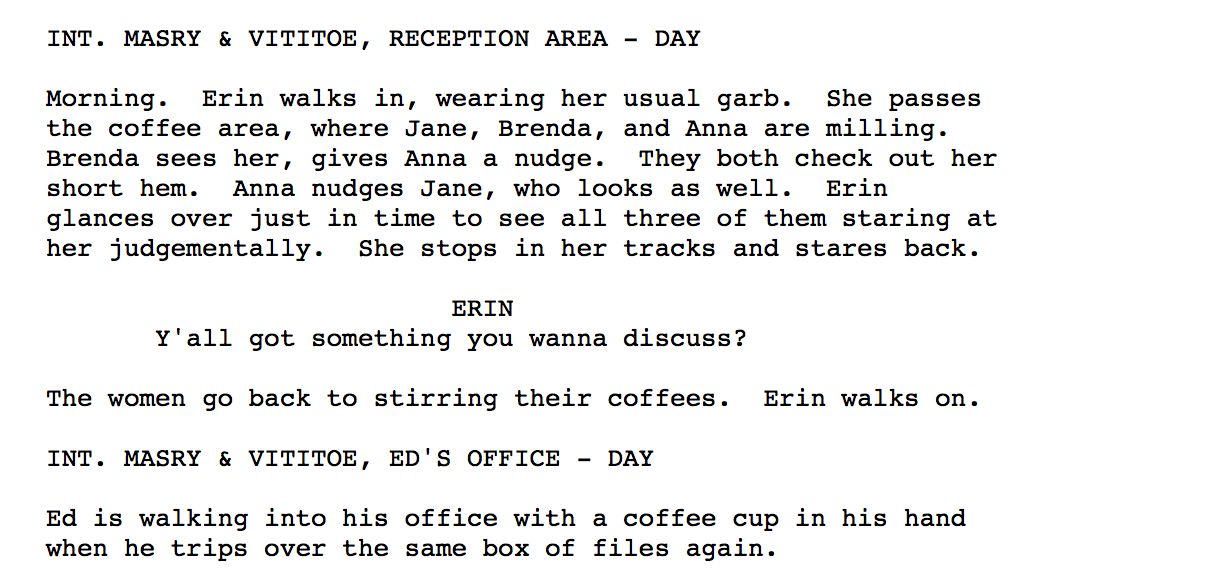
INT. MASRY & VITITOE — lord, I have no idea what the name is — RECEPTION AREA — DAY.

Morning. Erin walks in, wearing her usual garb. She passes the coffee area where Jane, Brenda, and Anna are milling. Brenda sees her, gives Anna a nudge. They both check out her short hem. Anna nudges Jane, who looks as well. Erin glances over just in time to see all three of them staring back at her judgmentally. She stops in her tracks and stares back.

Y’all got something you want to discuss?

The women go back to stirring their coffees. Erin walks on.

Next scene.

INT. ED’S OFFICE — DAY

Ed is walking over to his office with the coffee cup in his hand when he trips over the same box of files again.

So, a very different style here. This first paragraph, all the scene description before Erin talks is just one block. And yet it works really well for me because it gives me the feeling that this is a oner, that basically this is all happening in a single shot. This is all sort of one idea is them looking at her. And then we’re going to circle back around to what her reaction is to them looking at her.

Craig: Yeah. This is a very common way of describing scenes that are not about the camera. The camera should not be noticed here at all.

So, when we look at James Cameron’s opening, it’s incredibly visual because there is no dialogue and it’s entirely about telling the story of the mystery of a space that’s being illuminated and exciting things are going on.

This scene is about people and what’s going on in their heads. And about what looks mean and what looks don’t mean. And looking away and looking at. And in that case this is appropriate because I don’t need to know the angles on that, at all. The angles, frankly, will be incredibly boring and obvious.

It’s entirely about the performance, so in this case I like the fact that the action takes a back seat to the performance. And all of the action is now actually describing what’s happening inside people’s heads, so that when Erin says, “Y’all got something you want to discuss?” and then they go back to stirring their coffees, I know exactly what happened.

You could have done this in dialogue. You know, it could have been whispered. “You see what she’s wearing?” “Y’all got something to discuss?” “No, no, no.” Right?

And so I like that in this case you go, no, no, I don’t want to do that in dialogue. I want to do it in action. Well, this is how you do that in action.

John: Yup. I mean, if you didn’t understand English, you would still understand this scene. And you would understand that they are looking conspiratorially and reacting. And that she says something back that shuts them up. That’s all you really need to know. So, honestly the line of dialogue isn’t especially important for making the scene work.

Craig: Yeah. This is one area where — I don’t want people to think that just because I say you’re allowed to use camera angles means you should always use them. This would be a place where it would be very clunky to suddenly say, “Angle on Erin. She stops in her tracks and stares back.” You just don’t want that. Because it’s a boring shot.

John: Yeah. This makes it seem easy and sort of thrown off in a way that’s just right. I wanted to talk about that last line before we go to the next scene. “The women go back to stirring their coffees. Erin walks on.”

It’s a great example of just varying your sentence length to create a good rhythm on the page. So, those were some long sentences beforehand. It was a big long block. Here we just have two short sentences. “The women go back to stirring their coffees. Erin walks on.” A three-word sentence that lets us know that that scene is done and we’re on to the next thing.

You don’t need a Cut To when you have Erin walks on. That short sentence is your cut to.

Craig: That’s correct. And I would also say that let’s say your intention was that she would say, “Y’all got something you want to discuss?” and then you just for whatever reason wanted to cut away to something else, sometimes I’ll read in scripts where people end a scene on a dialogue line. It’s just a bad idea I think in general. Because you do want the line to land somehow.

Now, here you clearly need it to land, plus Erin is leaving. But I think in action it’s best to begin and end a scene with action.

John: Yeah. And of course you’re not making a blanket —

Craig: No.

John: Recommendation.

Craig: No, it’s just a good —

John: Yeah, so I’m sure you have scripts where you’ve deliberately ended on a line of dialogue and I’ve done it, too, but it’s a very sort of unique special case where you definitely want to leave the feeling that the camera is ending up on that person as they say this line, and you’re not supposed to be getting the reaction. That the next shot is the reaction to what they just said.

Craig: Yeah. I probably even in those circumstances, I’d probably pull a Cut To in there because I want some sense that I know what I’m doing. That it’s intentional.

John: Yeah. I think the Cut To is almost required for doing that technique.

Craig: Yeah. Ooh, I want to read this one.

John: You can read this one. This is Ocean’s 11 by Ted Griffin.

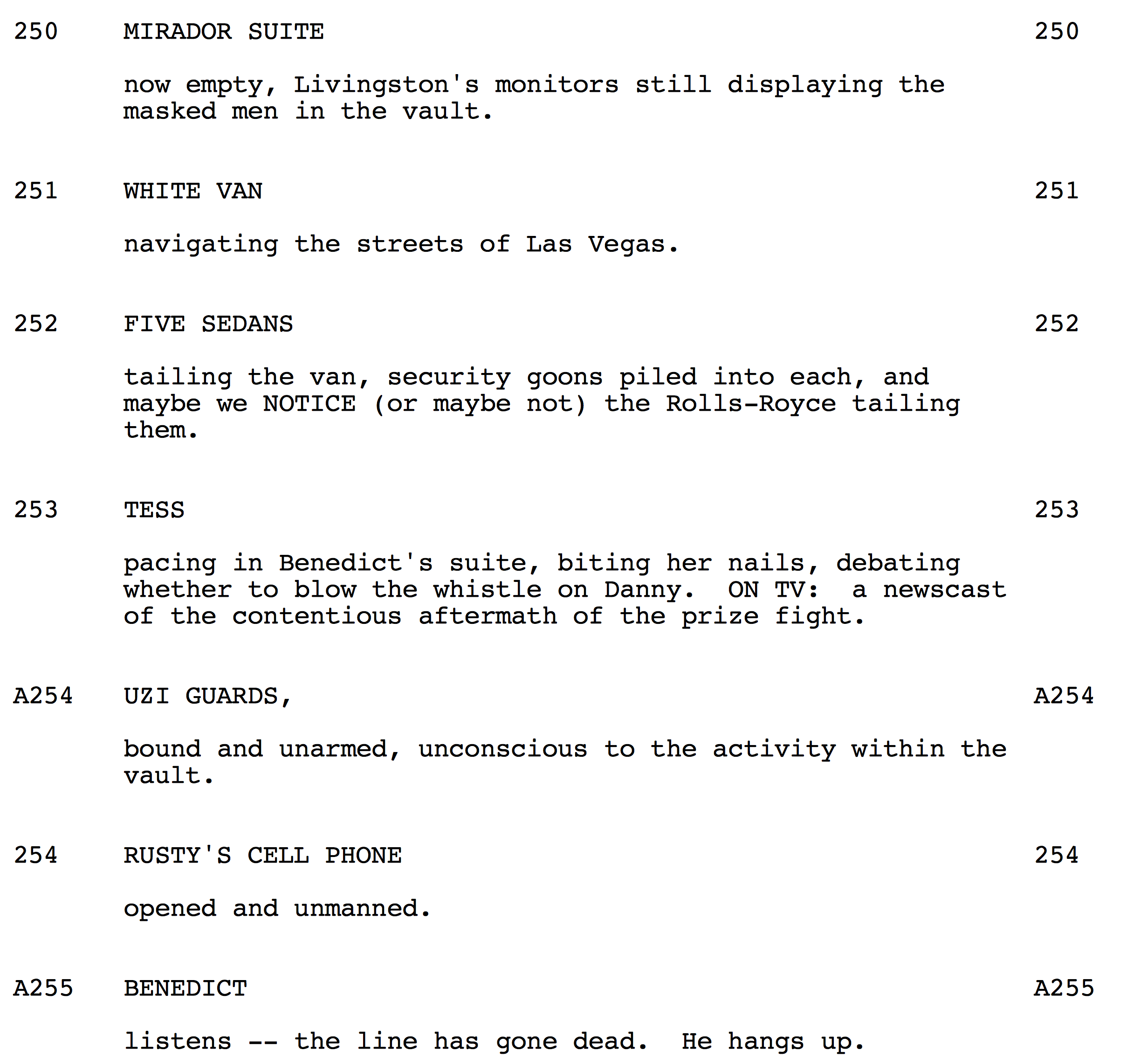
Craig: Right. And here in this little snippet you’ll see that these are all called out as individual scene numbers. So, this is from a production script where everything was numbered. So, I’ll sort of emphasize where things are capitalized.

MIRADOR SUITE. Now empty, Livingston’s monitors still displaying the masked men in the vault.

WHITE VAN. Navigating the streets of Las Vegas.

FIVE SEDANS. Tailing the van, security goons piled into each, and maybe we NOTICE (or maybe not) the Rolls-Royce tailing them.

TESS. Pacing in Benedict’s suite, biting her nails, debating whether to blow the whistle on Danny. ON TV: a newscast of the contentious aftermath of the prize fight.

UZI GUARDS, bound and unarmed, unconscious to the activity within the vault.

RUSTY’S CELL PHONE opened and unmanned.

BENEDICT listens — the line has gone dead. He hangs up.

Ooh, good job.

John: So good.

Craig: Good job, Ted.

John: Good job, Ted Griffin. I wanted to include this because so often you see like, well, the question is like well how do I do a montage, how do I format a montage and, you know, sometimes you do it with bullet points, sort of you quickly go through a list of shots. But this is more commonly what you’re really needing to do in a montage which is you’re moving between different people and different places and they all have to build up to sort of one greater sequence. And this is great example of how you actually do that.

So, you notice that the start of each one he’s in all caps in uppercase doing the where we’re at. So, MIRADOR SUITE, WHITE VAN, FIVE SEDANS, TESS. And then the description right after that is set up in a parallel structure, so it’s always navigating, tailing, pacing. He’s coming with an adjectival, participle phrase to sort of give you a sense of what the action is, but not really the verb. So, it could be, “White van navigates the streets of Las Vegas.” But instead it’s, “White van, navigating the streets of Las Vegas.”

It’s a continuous action that we’re just catching a glimpse of it while it’s going on.

Craig: Yeah. This is all about creating the sense of flow across things that otherwise would be considered fragmented. So, let’s just go right off the bat here. Ted gets rid of INTs and EXTs. Doesn’t need them. Doesn’t want to bother with them. And I don’t blame him at all, especially when you have so many of these in a row. It would be just like word salad to have all these INTs and EXTs, and we don’t need them. We know that the white van navigating the streets of Las Vegas is outside. And we know that Tess in Benedict’s suite is inside.

We’re getting all of that. So, he says, eh, screw all that formality. Don’t need it. I also love that the way it’s running here, there’s a rapidity to it. We can feel the pace of these scenes. We can see — there’s a motion going on to all of this.

And then there’s this interesting — this would fall — I would put this in the school of extreme utility. But, then there are these little twists. For instance, “FIVE SEDANS tailing the van, security goons piled into each, and maybe we NOTICE,” and in parenthesis, “(or maybe not) the Rolls-Royce tailing them,” which is great, because that’s different than what Cameron does. Cameron probably would never write that, because what do you mean, maybe not? Well either we do or we don’t, right?

But actually that is something. Like the instruction there is a careful viewer who is paying attention to that will see it, but otherwise they won’t. We’re not making a deal of it.

John: In the script I just turned in, there’s some scene description of an apartment that we go to the first time. And I call out that there’s some memorabilia from an earlier scene in the set decoration, but it’s not crucial. It’s like it’s a useful thing that’s there that helps sort of connect it to an earlier thing, but it’s not an urgent thing that the viewer doesn’t see it that the world comes crashing to an end.

And so that “or maybe not” is a useful thing. It’s not saying like throwing up your hands like you don’t care. It’s saying that it’s like it’s there and it’s interesting, but it’s not essential.

Craig: Right. Similarly, there’s a thing that probably I don’t think Cameron would do in his description, but I like that Ted does it here. On Tess, “Debating whether to blow the whistle on Danny.” Well, can you film that? Yes, you can.

As long as the screenplay has made it clear that she’s in a position where she would be debating that, what you’re saying there is act like you’re debating that. And I’ll see it. I should be able to see — that’s something that an actor can act. So, I like that that’s there. And then you see that on TV there’s this prize fight going on. So there’s all these layers of stuff.

I love that Rusty’s cell phone is his own scene. It’s just great. Because that — here’s the other thing. Once you start down the road of a pattern for a montage, you’re in that pattern.

John: Yup.

Craig: So, you can’t just suddenly go, okay, now here’s a bunch of things all together in one scene. No. Uzi guards and now Rusty’s cell phone is his own scene, just sitting there, all good, and then you go back to Benedict. “The line has gone dead.” Great. Great. Great.

Just a really good way to move you through this moment. It’s fun. You can feel — like you can almost feel the music through this which is great.

John: Absolutely. Probably a good sign for almost any montage is that you should be able to sense the underlying audio, which is generally music, that’s going to be the bed that’s going to tie all these things together.

And each of these shots feels about the same length, even though they consist of very different material in them.

Circling back to what you said about Tess, “Pacing in Benedict’s suite, biting her nails, debating whether to blow the whistle on Danny.” In all these examples, these are scenes that were already set up someplace else. And so if you’re coming back to something you don’t have to sort of do all the work again to establish who that person was, what they were doing. We had an earlier scene where we saw her. We saw or we knew what her situation was, so we don’t have to do the full recap here. It’s just like, you know, remind us like, oh, she’s debating what she’s going to do.

Craig: Right.

John: Great. We got it.

Craig: Yeah. And it’s really underscoring also how much work the screenplay has done well, because there’s a simplicity and a clarity. There’s no confusion at this point what her pacing is about. That means the screenplay has done its job. So, excellent work there. Ooh, can I read this one, too?

John: You can read this one, too.

Craig: Only because it’s like my favorite and I just feel like maybe I’ll get smarter for having read it. [laughs] So this is a little bit from Unforgiven by David Webb Peoples. Obviously one of the great, great screenplays ever.

BAH-WHOOM! Munny fires and smoke belches out…

Skinny is blown back against the wall and falls to the floor a bloody mess and…

Little Bill is reaching for the Spencer which is leaning against the bar near his leg but he freezes because…

Munny has turned the shotgun on him and Munny sees Ned’s Spencer there and his eyes show how feels about it.

For a moment while the smoke clears the bar is silent and there are nervous glances cast at the bloody body of Skinny but Little Bill keeps his eyes on Munny.

Little Bill says, “Well sir…You are a cowardly sonofabitch because you have just shot down an unarmed man.

Actually, I think in the movie they flipped that. Regardless.

Then….It has become a very formal moment and there are, figuratively speaking, only two people in the room, Munny and Little Bill…and WW Beauchamp is watching them, scared to death, but this is it, what all those Easterners dreamed about, the showdown in the saloon.

John: So much to love here. And so different than some of our other examples. And that’s why I thought we would include it.

Craig: Yeah.

John: So, let’s talk about dot-dot-dot and dash-dash. So, here David Webb Peoples is sort of continuing the continuity of the action by ending each line on a dot-dot-dot. So, and…, and…, because…. So, there’s a cause and effect to each time that we’re cutting.

You know, you don’t necessarily have to believe that each one of these paragraphs is its own shot, but it kind of feels that way.

We’re always in the present tense, and yet look at the choices he’s making about present tense. Skinny is blown against the wall. So, rather than saying the shot blows Skinny back, he is blown back, so we’re seeing the effect of that shot from a previous cut.

Little Bill is reaching for the Spencer which is leaning against the bar near his leg, so we are — so often in screenwriting books they’ll talk about like oh don’t use —

Craig: Get rid of I-N-G. Wah!

John: Yeah, exactly.

Craig: Blech.

John: But here twice in a row, because we’re establishing geography and location and sort of the continuity of a person’s action.

Craig: Right.

John: It’s so fascinating here, I think, where Munny has turned the shotgun on him. So rather than saying Munny turns the shotgun on him, like it has already happened, so we’re coming into a moment that has just happened, so we’re seeing the effect of what has just happened.

Craig: It’s so great. It’s so great. And, you know, this is where these, again, these screenwriting knucklehead gurus out there, I just want to put them all on a spaceship and send them into the sun, because they don’t even understand, ooh, here it comes, they don’t understand —

John: Yup. I knew it was coming.

Craig: They don’t understand the point of verbs. This is a — this is masterful. What peoples is doing here is masterful. And if you pay attention you can see the movie happening because of the verb tenses, right? Little Bill is reaching for the Spencer means when the camera cuts to Bill he’s already in motion. Not reaches for, which means he makes a decision to reach and then reaches. He’s already moving. The thing is already there. And then, but he freezes because Munny has turned the shotgun on him.

Munny has turned the shotgun on him means that Little Bill is discovering something that has happened off-screen that he didn’t realize happened, and that’s so impactful for the audience. Because it means that he’s going to see something first and we’re going to see in his eyes fear. And then we’re going to reveal what he’s scared of.

This is how verbs work, you enormous pile of [laughs] of exploitative —

John: You’re not talking to me. You’re talking to some strawman —

Craig: You exploitative mother-f’ers. “Don’t use I-N-G verbs.” You idiots. Right? So this is what it’s about.

And I love it!

John: Mm-hmm. This last paragraph is so fascinating to me, because “It has become a very formal moment and there are, figuratively speaking,” so it’s a huge long paragraph. This phrase, “it has become a very formal moment,” doesn’t that feel like a slow pullback to you?

Craig: Mm-hmm.

John: It’s like you’re just like you’re recognizing like, oh, we’ve been in these little moments and then suddenly we’re getting bigger and wider and we’re sort of seeing what exactly has happened here.

So, it’s like it’s taking stock of the last few moments and sort of like what the scene is like now. And you don’t have to do this, but in some ways to write to Unforgiven you have to do this, because that’s what the movie feels like.

Craig: Absolutely. And, by the way, I think wrong. I think that this is exactly the order that Little Bill said it in. It’s just maybe he fiddled with a couple of words. But, no, of course, it’s exactly right. So, here’s the deal, right, I love dot-dot-dots. I’m a huge fan of them because what dot-dot-dots do for me is they kind of imply you’re holding your breath. You know, like Walter Murch wrote this great book called In the Blink of an Eye where he talks how the audience will naturally blink where you kind of want to cut, you know.

And that’s just the way our brains work. And similarly, when things like this are happening, it’s common for people to say, “Oh my god, I finally breathed. Like I was holding my breath through that whole thing.” That’s what dot-dot-dot is doing. It’s saying hold your breath. Hold your breath. Hold your breath. And then Little Bill says this, and the way that David Peoples writes this last paragraph it implies you’re breathing now. In fact, we’re going to take our time to breathe and discover this tableau, that it’s now formal. Now, all the action is over and we have entered this new weird thing where two gods among men have dropped all the pretenses and are cutting to the truth.

And then I love this, “And WW Beauchamp is watching them, scared to death that this is, what all those Easterners dreamed about, the showdown in the saloon,” which is something that is acted beautifully in that moment. It’s just great. And there’s nothing wrong. It’s not too wordy, as far as I’m concerned. I feel like this is really bursty, like quick bursts, and exciting, and then when the movie becomes a little bit languid, the action becomes languid.

So this is poetry to me. The use of action is helping imply the pace of the scene itself.

John: Great. Our next example is from Wall-E, which has a similar sort of strange style to it, like sort of not conventional style. But completely suits the movie that Wall-E is. So, Wall-E, if you remember, so much of Wall-E takes place like a silent film. And if you read the script, it sort of feels that way.

So, I’ll describe this to you and if you look at the actual sample, these single sentences are all their own line. So there’s no paragraphs here. They’re all just given their own line. They’re blocked together in some ways to sort of imply a bit of more continuity of action, but they’re all single sentences.

EXT. TRUCK — NIGHT

Wally motors outside.
Turns over his Igloo cooler to clean it out.
Pauses to take in the night sky.
STARS struggle to be seen through the polluted haze.
Wally presses the “Play” button on his chest.
The newly sampled It Only Takes a Moment plays.

The wind picks up.
A WARNING LIGHT sounds on Wally’s chest.
He looks out into the night.
A RAGING SANDSTORM approaches off the bay…

Unfazed, Wally heads back in the truck.
It Only Takes a Moment still gently playing.

…The massive wave of sand roars closer…

Wally raises the door.
Pauses.
WHISTLES for his cockroach to come inside.
The door shuts just as the storm hits.
Obliterates everything in view.

Craig: Well, I love Wall-E. Love Wall-E. I would not recommend that people write traditional screenplays this way. I wouldn’t even recommend people write animated screenplays this way, because this document feels like a notes documents for people who are all working on a movie.

This document feels like it’s in support of reams and reams of storyboards and story art. And on its own is simply not going to do the job. Like, I read this and it doesn’t make me see the movie at all.

It feels like a support document. So, I think that this is a more technical way of doing things within a framework of a storyboarded process, but I don’t think that this would be advisable for a movie where somebody didn’t know your story at all and was going to read it.

John: I disagree with you. I think I could read this document and have a really good sense of what the movie felt like.

And it would take me a little while to get into this strange spare style, but honestly it does feel what certainly the first half of Wall-E feels like to me, which is a bunch of individual shots where he is a small figure against a large landscape or, you know, just he’s center frame and there’s just this giant emptiness around him.

I really dug it. And so even if you were to try to apply some of these lessons to a more conventionally written screenplay, I want to talk about trimming off subjects of sentences because you don’t need them a lot of times.

So, let’s imagine these first couple of sentences where in a more conventionally formatted script. “Wally motors outside. Turns over his Igloo cooler to clean it out. Pauses to take in the night sky.” You don’t need the He’s, you don’t need the It’s, you don’t need Wally’s, as long as you have parallel structure between those sentences, we get it.

And particularly if you’re writing action sequences, you’re very often going to trim off those subjects because we know who’s doing it, so just give us the verb and let’s keep going.

Craig: Yeah, I agree. I do that all the time, and I obviously write in a more traditional sense. Where this doesn’t work for me, if I weren’t familiar with Wall-E, if I didn’t see artwork, I hadn’t been looking at storyboards is things like, it says, “A raging sandstorm approaches off the bay…” but that’s it. It’s just a raging sandstorm. Okay.

And then it’s a “massive wave of sand.” And then it says, “The door shuts just as the storm hits.” It’s so flat and I’m not excited. And I want to be excited in things like that. He says, “Whistles for his cockroach to come inside.” I’m not sure if a cockroach does come inside there, or not. I don’t know. And it says “obliterates everything in view.” It’s all so flat and it feels very much like Wally himself, like Wally is writing this script. But I don’t want Wally to be writing the script. I want somebody like Pete Docter to be writing the script to make me feel for Wally, which is in fact what was going on.

I think it was Pete Docter who did this one, right?

John: Yeah. Pete Docter, Andrew Stanton.

Craig: Oh, Stanton.

John: Other credits were Jim Reardon, yeah.

Craig: I’m just fascinated by this. You know what I’m going to do? I’m going to ask our friend Emily Zulauf like what the deal is with this, because I can’t imagine that they would give this to somebody that didn’t know anything else and say what do you think of this movie we’re making. So, I’m in a different place than you are on this one.

John: Yeah. For sure you could imagine this document along with the artwork, or the sense of like each of these lines became one panel of a storyboard. And maybe that’s sort of how their internal process works. But I really do think this is a way you could write a script and have it be quite successful. So, all right, next is a much more conventional thing but also quite delightful thing from our friends Derek Haas and Michael Brandt. This is from the movie Wanted.

THWAP! A bullet finds its way through the space and hits the Electrician in the back of the shoulder, spinning him around.

CLOSE ON: Cross’s gun. Another shot and we follow the bullet, across the dock, and dipping low into the next space in the paper stack — right where Electrician is now leaning…

…the bullet buries in his eye, sending him to the floor.

Wesley sees Cross race for a set of stairs. Just as Wesley is about to cut him down, Cross fires at a wooden beam holding back some massive rolls of NEWSPAPER. The rolls tumble over and Wesley has to dive out of the way, allowing Cross to escape up the stairs.

Wesley, Fox, and the Waiter all race for the stairs.

Craig: Yeah. To me, this is, again, very traditional way of doing action. One thing that the guys do here is they’re not shying away from violence, right, so the action — when we write action, you can say like, “He’s shot, falls to the ground.” And the action is telling you this is a movie about the ballet of violence. When it’s “THWAP! A bullet finds its way through the space and hits the Electrician in the back of the shoulder, spinning him around,” we understand that we’re doing ballet now. First of all, we know that we’re actually following the bullet, which tells us, again, about pace.

When “the bullet buries in his eye, sending him to the floor,” it’s underlined. They’re like, hey, this is what we’re about here. This is a movie in which violence is supposed to be operatic.

And people running and dancing around, like I don’t know what these guys are thinking, and I don’t need to. I don’t know what their characters are in this moment. It’s not about that. So, contrast this with say like in Unforgiven we can see like, oh my god, he turns and then there’s this moment of dread. And then we reveal this. This is more pure action.

And this is a very typical way of writing pure action. High energy. And use the action to let us know exactly how lurid we’re going to be.

John: Yup. Also, the use of underlining is part of the reason why I chose this section of the script. Action scripts will tend to use underlining as like an extra form of punctuation. It’s like a way of sort of visually indicating what the key crucial beats are. And so you will underline the things that you want to make sure the reader doesn’t miss, but also it’s just going to give you a sense of this is already a very loud scene, so what are the loudest parts within this loud scene.

And sort of what do you need to make sure you’re focusing on. Even within the uppercase, like that NEWSPAPER still gets capitalized because — it’s not just because it’s a key prop, but because it’s a big thing you need to make sure you don’t miss. It’s a thing that’s going to be causing the action in the next section.

Craig: Right.

John: It’s essentially its own character for the rest of this paragraph.

Craig: Yeah. And so like if you don’t capitalize newspaper and so everything is just underlined there, you’ll notice it, but massive rolls of newspaper you’re like, well, okay, so massive rolls of newspaper. Newspaper doesn’t seem very massive to me. Massive rolls of all capitalized newspaper, I’m just already imagining lots of newspaper, like a massive amount of newspaper, which is what they want. So, they’re smart that way.

I thought this was done really, really well. And, by the way, just side note, love this movie. Love — so entertaining. I was so entertained by Wanted.

John: Yeah. Wanted is a movie that knows what it is in a way that so many movies don’t. It never shied away from being its own true self, and that’s what I really appreciated about it. It was nutso.

Craig: Yes, it was.

John: And wasn’t Chris Pratt in that? Chris Pratt plays like —

Craig: Yes, he plays like his jerk buddy at work who is screwing his girlfriend.

John: Like on a copy machine. There’s some crazy —

Craig: Yeah, exactly. He hits him in the face with the keyboard and the keyboard letters spell out F-U I think, or, I’m trying to keep it clean. But it was very cool. I don’t know, Timur is nuts, man. That guy — I love that movie.

John: Yeah. I love it, too. Whatever happened to Chris Pratt?

Craig: I don’t know. I don’t know. For a moment there, uh, you know, I think he’s just mostly doing that role, like he plays that guy, the jerk.

John: The jerk. Yeah.

Craig: Like the jerk who is in a movie for a scene to make the hero look good.

John: Yeah. Sometimes you get typecast because it’s really who you are.

Craig: Yeah, well he gained a ton of weight. He’s like 300 pounds now.

John: It’s rough. Our final example is from Whip It. And I wanted another example of a montage. And this is a movie that has a lot of montages because like most sports movies there’s time where you’re really trying to summarize down what a match feels like, what a game feels like, to sort of those key moments. So, here is one of the matches in Whip It.

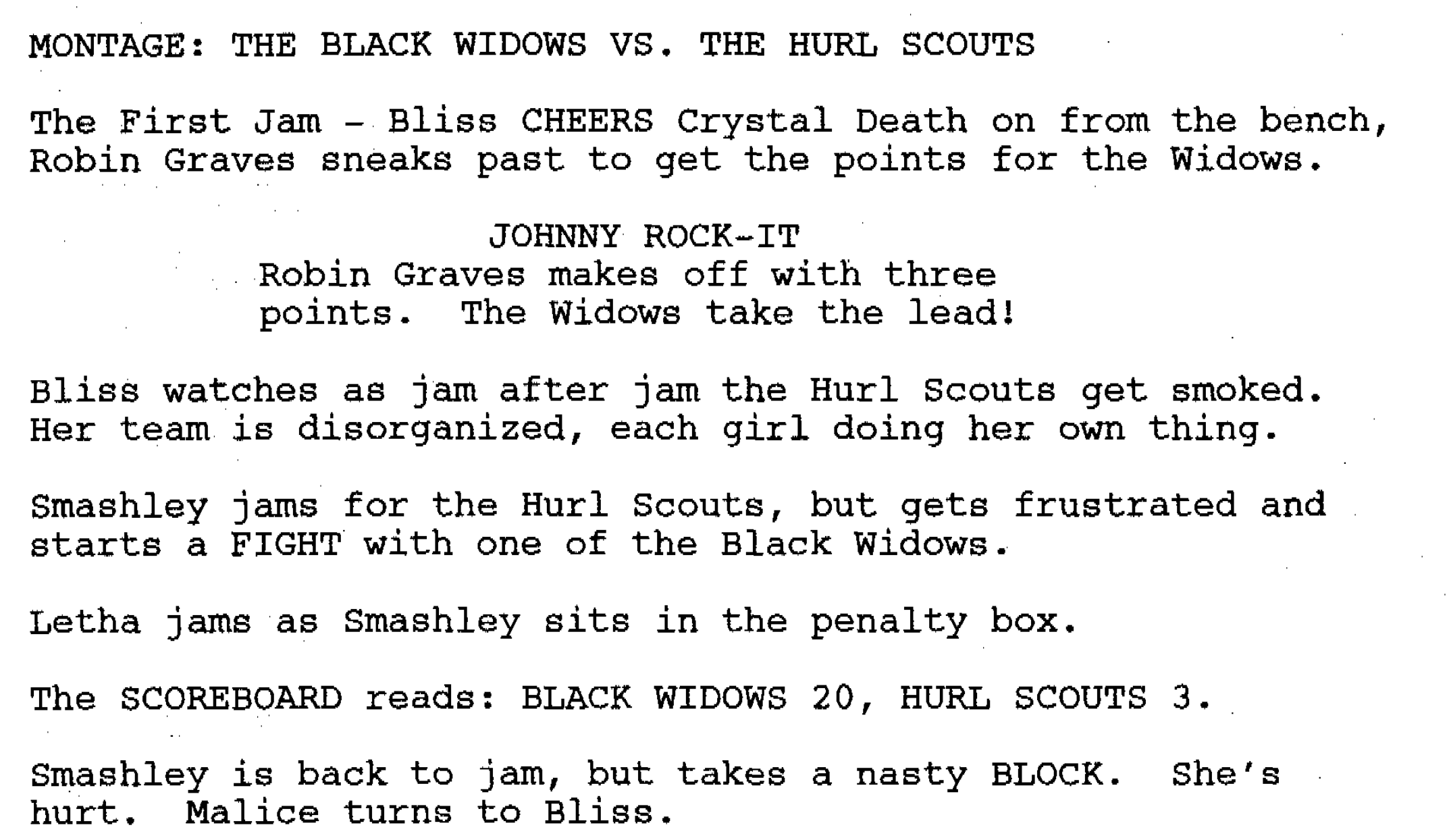
MONTAGE: THE BLACK WIDOWS VS. THE HURL SCOUTS.

The First Jam — Bliss CHEERS Crystal Death on from the bench, Robin Graves sneaks past to get the points for the Widows.

Johnny Rock-It says, “Robin Graves makes off with three points. The Widows take the lead!”

Bliss watches as jam after jam the Hurl Scouts get smoked. Her team is disorganized, each girl doing her own thing.

Smashley jams for the Hurl Scouts, but gets frustrated and starts a FIGHT with one of the Black Widows.

Letha jams as Smashley sits in the penalty box.

The SCOREBOARD reads: BLACK WIDOWS 20, HURL SCOUTS 3.

Smashley is back to jam, but takes a nasty BLOCK. She’s hurt. Malice turns to Bliss.

Craig: Yeah, I mean, it gets the job done.

John: Absolutely.

Craig: Yeah, this is pretty spare, actually. I mean, I’m kind of a little surprised, because I’ve seen the movie which is so much fun, and these things are such high energy. I mean, I guess I am being a little critical. Like I kind of want sound. I want sound. I want crunching. I want like, you know, like starts a fight, like how? Like punches her?

John: Punches her? You know, I feel like I actually got some of that sound and some of the feel just by the use of the verbs she did choose. So, “jam after jam they get smoked.” Picking the fights. Takes a nasty block. I think this scene comes from later on in the movie, so this may be after we’ve had quite a few examples of like what these matches feel like, so this may be one of the shorter matches in the movie overall.

Craig: Right. Okay, well that’s a good point. Because there is a real fatigue that can set in. It’s one thing to do the ballet of the bullet smashing into eyes, and people smashing into each other, but if this is the ninth or tenth of these at some point in the movie, then I guess short-handing makes sense, because one thing that does happen — and everybody knows this as you’re reading a script — is you read faster. It’s like faster, faster, faster because if the script has done its done its job right, you want to see what happens

John: Yup.

Craig: You want to see what happens. So, you start to go faster and faster. You don’t want quite as much really painstaking detail in here. And perhaps, you know, if Smashley has started a fight before, then — and it’s been spelled out really clearly, then starts a fight here, I kind of get how she’s doing it.

So, that makes sense to me.

John: Cool. I hope this was helpful for people. So, you can find all of the examples that we talked about here. There’s little images that you can download on the Internet. Just go to johnaugust.com/Scriptnotes and in the show notes for this week’s show you’ll see all of these images that you can read along with us. Thank you, Craig.

Craig: You know what? That was great. I feel like we’ve got a pretty big show here. Maybe we should push reshoots to next week?

John: I think we’re going to push reshoots to next week. So, in next week’s episode we will talk about what are reshoots, why do movies have them. How do writers get involved with reshoots? What happens if the original writer is not the writer on the reshoots? And we’ll talk through some of our own examples with our films that have gone through reshoots and what has worked well and what has not worked well.

But there is time for One Cool Things if Craig has a One Cool Thing.

Craig: Uh, my One Cool Thing is your One Cool Thing.

John: All right. My One Cool Thing is A World Without Work. It’s an article by Derek Thompson in The Atlantic. And I thought it was just a really good think piece overall about what is the future of America and other western economies going to be like as more and more of our work gets replaced by technology. And so to date we’ve seen like factory jobs being replaced, but as clerk jobs and transportation jobs and other things get replaced, there may just not be a place for some people to have jobs in the classic sense that we’ve had jobs.

And what does the world look like, not just in terms of how does the economy work, but psychologically how do we deal with a society where not everyone is going to be employed or needs to be employed. And so I thought it was interesting for everyone to sort of take a look at.

Also, the kind of work that you and I do, Craig, is sort of kind of weird luxury work. And we’re not kind of crucial or fundamental to any part of the economy. And we could easily, while we’re not going to be replaced by computers tomorrow, it just got me thinking about sort of what my life would be like and what my identity would be like if it weren’t the job that I had.

Craig: You know, artists have never been essential to society the way that people that grow food are, or doctors are, but we’ve always been in demand. I mean, well, not all of them, but a bunch of them.

So, the nice thing is I always feel like what we do at least, there’s always a place for it. People will always want to be entertained. It’s just innate to the human condition. So, yeah, I don’t think we will be replaced by computers.

I think I could be replaced by a computer. [laughs] That’s just me.

John: I think it does, and this article does lay out, is that it does allow for a greater number of people who have artistic ambitions to sort of fulfill those artistic ambitions because there’s no fundamental need for them to be working.

And so I think it may create a class of people who were never kind of looking for a job, or just decided to have sort of the minimal jobs and just become artists in whatever capacity they wanted to be because there’s no pressure to define yourself by making a certain amount of money.

Craig: All right.

John: We’ll see.

Craig: Yup.

John: Craig, thank you so much for another fun podcast. Our show, as always, is produced by Stuart Friedel. It is edited by Matthew Chilelli. I’m not sure who did the outro this week, but if you have an outro for our show, you can write into ask@johnaugust.com. That’s also the place where you can send your questions, long questions are the place for that.

Short questions are great on Twitter. I’m @johnaugust. Craig is @clmazin.

If you would like to subscribe to our show, you should subscribe to it in iTunes. Just go to iTunes and search for Scriptnotes. Also in iTunes you can find the Scriptnotes App which lets you get access to all the back episodes of the show. There’s also one for Android.

If you would like a USB drive, there’s a small chance that there are still some left in the store. So you could go to store.johnaugust.com and get one of those. There’s a 10% discount if you use the code SINGULARITY.

And that’s our show this week. Craig, have a fun week.

Craig: You too, John.

John: Bye.

Craig: Bye.

Links:

  • Scriptnotes 200 Episode USB drives are available in the store while supplies last
  • Paramount, AMC and Cineplex try new revenue-sharing initiative on The Wrap
  • Excerpts from Aliens, Erin Brockovich, Oceans 11, Unforgiven, Wall-E, Wanted and Whip It
  • A World Without Work by Derek Thompson
  • Outro by Stuart Neville (send us yours!)
Scriptnotes, Ep 187: The Coyote Could Stop Any Time — Transcript

March 13, 2015 Scriptnotes Transcript

The original post for this episode can be found [here](http://johnaugust.com/2015/the-coyote-could-stop-any-time).

John August: Hello and welcome. My name is John August.

Craig Mazin: My name is Craig Mazin.

**John:** And this is episode 187 of Scriptnotes, a podcast about screenwriting and things that are interesting to screenwriters.

Today on the podcast we will be talking about Road Runner rules —

**Craig:** “Beep, beep”.

**John:** The WGA Diversity Report, living in your car and we’ll have three new entrants in the Three Page Challenge.

**Craig:** Big show today.

**John:** Big show.

**Craig:** Big show.

**John:** Big show of little things.

**Craig:** We are — I have to say we are on a roll. Again, thanks to the Redditors over there at the screenwriting subreddit who helped us out with all those wonderful bad rules last week. We’ve gotten a lot of really good feedback on the Malcolm Spellman episode and then that episode last week, so we’re on a roll.

**John:** Yeah.

**Craig:** Let’s keep it going.

**John:** Absolutely. That’s the goal of this episode. So let’s dig right into it. This is something that was just randomly in my Facebook feed. I think Howard Robin had posted and this was a bunch of rules for the Road Runner cartoons. So essentially, Chuck Jones in his book Chuck Amuck: The Life and Times of Animated Cartoonist Chuck Jones claimed that he and his artists and writers had a set of rules that they went back to when they were writing the Road Runner cartoons. And having just been through an episode where we talked all about the rules of screenwriting, I thought it was so interesting to look at the rules and limitations that a group of writers put on themselves when creating something as iconic as the Road Runner cartoons.

**Craig:** Yeah. You want to go through some of these?

**John:** Let’s alternate here.

**Craig:** Okay.

**John:** So first rule. The Road Runner cannot harm the Coyote except by going “beep, beep” to scare or surprise him off a cliff.

**Craig:** Yeah, that’s right. He never touches him.

**John:** No.

**Craig:** Yeah. No outside force can harm the Coyote; only his own ineptitude or a failure of Acme products. Trains and trucks were the exception from time to time.

**John:** Absolutely. And trains and trucks are sort of like natural forces that he was, you know, he was always too close to them anyway, so. And generally, they were like a follow-up punch line. And basically, like, everything would have failed and then he gets run over by a truck.

**Craig:** And the trains and trucks in this area of the desert would appear out of nowhere without warning of any kind. [laughs]

**John:** [laughs] The Coyote could stop anytime if he were not a fanatic. To repeat, a fanatic is one who redoubles his effort when he has forgotten his aim as George Santayana said. So there’s no reason why the Coyote has to do it. I mean, I guess, sometimes they motivate it through hunger to some degree but it’s more that he’s driven to pursue the Road Runner. That’s just his function in life is to try to get the Road Runner.

**Craig:** Yeah, he’s a mono-maniac as we say.

**John:** Yeah.

**Craig:** Dialogue is strictly forbidden except “beep, beep” and yowling in pain.

**John:** Yeah, it’s absolutely true. And I don’t think I realized that when I was a kid watching them in the morning. It was like, that was what was so special about them, are these little silent movies. And, you know, even when he’s going to fall off a cliff, he just holds up his little sign that express his dismay.

**Craig:** Yeah, the little sign thing was, you know, they were like silent movies basically, you know, the old style and they forced these guys to be incredibly physical and everything. So I love that. What’s the next one here?

**John:** The Road Runner must stay on the road for no other reason than that he’s a Road Runner.

**Craig:** Which, by the way, you know, okay, so [laughs] I saw a roadrunner once, I wouldn’t have known it except that my wife who is a bird watcher, she said, “Oh, my god, that’s a roadrunner.” And I guess it’s actually kind of rare to spot one. They don’t look anything like the Road Runner and —

**John:** No at all.

**Craig:** Not even. I mean, the Road Runner looks more like an emu or something in the cartoon. But, yeah, they’re actually — I didn’t see it on a road. [laughs] They don’t actually follow the road but man, if you’d asked me that when I was a kid, I would have thought, no, no, it’s what Road Runners do.

**John:** Well, again, we always talk on this podcast about specificity. But like, you know, we’re talking about the specificity of this one unique bird and the one thing he does and it’s not trying to do anything else. It’s just he’s this one bird doing his one thing and all he does is run and he runs on this one road and it seems to be, just like the Coyote is a fanatic about catching him, the Road Runner just wants to run.

**Craig:** He just likes running. All action must be confined to the natural environment of the two characters, the southwest American desert.

**John:** Yeah, and again, very specific and I know that intuitively like, oh, that’s right, they’re always falling off cliffs and stuff like that but it hadn’t occurred to me until I was an adult that like, oh, yeah, it’s always in the exact same place.

**Craig:** Mm-hmm. That’s right.

**John:** It’s the backlot.

**Craig:** I know, yeah. But it was actually quite beautiful, I mean, and they made real use of the rock formations that he would always fall off of. I mean, I always loved the ones where, you know, the Road Runner goes out on that little separated ledge of rock —

**John:** Oh, yeah.

**Craig:** That’s a mile in the air and — but the huge rock falls [laughs] that the Coyote is on, I mean, they’re very smart about that.

**John:** Well, and also, I think, in its time the American Southwest obviously wasn’t new but I think it was the westward sort of migration of America towards, you know, the Southwest but also towards California. So it was like, it was the right kind of imagery for that generation. That was a place where people hadn’t seen and people were going to the Southwest for the first time to explore it.

**Craig:** You know what’s cool about these rules is that David Zucker and Jim Abrahams and Jerry Zucker had a similar set of rules. And rule number 15 is there are no rules. But in comedy, when you can confine yourself like this, what you’re essentially doing is forcing a certain amount of a degree of difficulty. And you get rewarded for it because everybody knows that you’re stuck in this desert and you’re stuck not talking and you’re stuck with these same motivations. Coming up with new variations on a theme becomes a little more impressive when you actually successfully do it.

**John:** You’re also, you’re taking away all those other choices. And so, it allows you to really focus in on who are these characters, what is their predicament because all the rest of the world is stripped away from it. And that’s a lovely thing in most cases.

**Craig:** Yeah, I agree.

**John:** Example here, all or at least almost all tools, weapons or mechanical conveniences must be obtained from the Acme Corporation.

**Craig:** Of course, I mean, that’s just the coolest company in the world. And I know that Warner Bros is always trying to figure out new ways to revive these cartoon characters. And Acme, I mean, it’s just such a great — you have to use Acme, I mean.

**John:** Oh, it’s the best.

**Craig:** It’s the greatest. And they really did make some very dangerous stuff.

**John:** [laughs]

**Craig:** So I’ll just do, I’ll do a couple of here quickly. Whenever possible, make gravity the Coyote’s greatest enemy which we’ve already discussed. And the Coyote is always more humiliated than harmed by his failures, which, you know, frankly, has to do with squash and stretch, I mean, he was terribly, physically harmed but he didn’t seem to feel that much pain. I mean, I would imagine that if we walked through life able to survive being hit by trucks and falling from the sky, we also would feel more humiliation than harm. Just sort of an extension I guess.

**John:** And related to these, the audience’s sympathy must always remain with the Coyote because even though he’s kind of the villain, he is also your hero. You’re the one — you relate to his struggle.

**Craig:** Yes.

**John:** The Coyote is not allowed to catch or eat the Road Runner unless he escapes up the grasp.

**Craig:** So he’s not allowed to catch or eat the Road Runner unless he can catch him and then the Road Runner gets away.

**John:** And really, I’m trying to remember instances where he really got the Road Runner for any more than three seconds. It’s mostly like, he’s held on to him and suddenly the Road Runner is smoke in his hands and the Road Runner is gone.

**Craig:** Yeah, I don’t really remember him actually holding the Road Runner but I will say that the Coyote, Wile E. Coyote, people sometimes struggle with the concept of what is an anti-hero. Wile E. Coyote is an anti-hero. He’s somebody that is doing something that you know is wrong. By the circumstances of the drama, he is the villain and yet we are rooting for him.

**John:** Yes.

**Craig:** Anti-villain. I mean, anti-hero. Sorry.

**John:** Is there such a thing as anti-villain?

**Craig:** No. I don’t believe there is.

**John:** Yeah.

**Craig:** Well, I guess, maybe you could say, like, Gru from Despicable Me —

**John:** Oh, yeah.

**Craig:** Is an anti-villain. Yeah.

**John:** That’s true. Yeah, because he’s identified as a villain but he ultimately is forced into heroic deeds.

**Craig:** Yeah, anti-villain.

**John:** That’s a lovely thing. So the reason why I wanted to bring up these Road Runner rules is that we were talking in the previous podcast about how all these prohibitions that people put on screenwriters saying, like, “Oh, you can’t do this. You can’t do this. You can’t do that.” And most of those cases, there’s a good reason why that thing sort of seems like a rule or like why generally it’s a good idea but it should not be a blanket rule.

And these are examples of rules that you’re placing on yourself that really should be iron-clad rules if you’re going to make a very specific thing. They are how you focus your story, you focus your art into a very unique frame. It’s providing boundaries for yourself that’s really helpful. Unlike the things we talked about in the previous show which were in many cases I thought destructive rules.

**Craig:** Yeah, I mean, the big distinction is rules that you put upon yourself as opposed to rules that you accept from someone else. You can place any rule you want on yourself for any reason whatsoever. If you feel that that’s going to make your work better or more interesting, do it, absolutely do it. And you’ll hear, there are rules that are specific to a piece of work, which is again different than the rules we were discussing last week which are meant to be these blanket bits of orthodoxy that apply to everyone. So every script, somebody sooner or later will say, “Well, what…” you know, if you have a script where somebody is magical, inevitably a studio executive will say, “Well, can we talk with the rules of the magic?” “Okay, sure.”

**John:** Yeah.

**Craig:** So, yeah, big distinction there. You’re allowed to put any rules on your work that you’d like, just don’t necessarily go follow blindly other people’s rules.

**John:** I had a meeting today with an executive and we were talking about sort of the writing process and she works in animation. And she was describing how over the course of the screening process they’ll screen thing multiple times. There inevitably hits a point at which everything just completely falls apart. And you end up sort of fundamentally questioning the assumptions you’ve made about what this project is. In some cases you are taking a character who you thought was a subsidiary character and that now becomes your main character or you’re doing either just these massive overhauls.

When we had Jennifer Lee on the show, we talked about, you know, the massive overhaul of Frozen where you just really reconceived how everything works. But these kind of rules that you’re setting for the Road Runner cartoons are that kind of massive reshaping and you might be well down the road in a feature length project, whether you formally codify these rules or haven’t codified these rules, you may find yourself like, you know what, these are the wrong rules. These are not the rules that are getting us to where we need to be and we need to write some different rules or just restructure our story based on some different underlying assumptions.

**Craig:** Yeah, it’s amazing how animation goes to, I mean, part of the benefit they have is that they can reimagine their movie and look at it.

**John:** Yes.

**Craig:** You know, through storyboards. They also have the time, generally. Because everybody is so frightened of actually animating something they don’t want, and I mean, animating, like full animation of something is super expensive.

**John:** Yeah.

**Craig:** So they give themselves the time. They also don’t have to worry about actor availabilities. That’s the other thing that —

**John:** That’s a lovely thing.

**Craig:** Huge flexibility for them.

**John:** So her question to me this morning was like, “Well, do you think there’s a way to sort of speed through that process or to get to the breaking point sooner?” And I had to say, no.

**Craig:** No, I don’t think —

**John:** I think the process is the process and the process is just, it’s kind of always terrible. And in live-action features, that breaking point is generally when you see the first assembly of your feature and you want to kill yourself.

**Craig:** Yeah.

**John:** You pray that the movie can never be released. And I remind myself every time before I watch it that, okay, that’s going to happen. And every time I forget.

**Craig:** Yeah. No, no question. There is a, you know, I’ve been talking about built-in inefficiencies. There is a built-in inefficiency to the system. It is impossible to achieve something even good, much less great without going through an inefficient process. Sometimes there are inefficiencies we can avoid that it’s just that the business won’t let us avoid them. But a lot of them, they’re just part of being human. And, I mean, you simply can’t see the story in its totality before you can see it in its totality. I don’t know how else to put it, you know.

**John:** Absolutely. And so the kind of thing where you recognize that your subsidiary character is actually your main character, you wouldn’t know that until you’ve written, you know, scenes with her and sort of heard her voice and saw what was possible. That’s just the reality.

The challenge I think in animation often is that the teams are so much larger. Whereas, making a live-action feature, you have your writer. You have your director. You have your producer. You have your studio executives. In some cases, you have a very powerful actor. In the case of animation, you often have a much bigger brain trust to go through and that can be really beneficial because you have more brains to apply to it but is everyone looking at the same movie, you don’t know. So it’s challenging.

**Craig:** Indeed.

**John:** Indeed. Let’s go to a much simpler challenge to solve which is diversity within the ranks of the Writers Guild of America.

**Craig:** Yeah. It’s a breeze.

**John:** It’s a breeze. I mean, honestly, Craig, I’m just so happy that it’s been solved.

**Craig:** We solved it.

**John:** It’s all good and done.

**Craig:** We solved it.

**John:** We’re talking of course about the diversity report that the WGA published this week that details the numbers for employment. And this was TV and features or was this just the TV report?

**Craig:** I think we will eventually get TV and features but for now it’s the TV report since that’s frankly where the majority of writers are employed.

**John:** Absolutely. So we’ve discussed this before in previous episodes and we’ll have a link to the earlier episode and I honestly wonder if we could just clip the audio from —

**Craig:** I know.

**John:** The previous show and talk about it again. The headlines on the story were, you know, numbers are down. Diversity is worse than it was before. If you actually look at the report, you see that it’s largely a flat line and there are cases where numbers have dropped or numbers for white men in their 40s have risen slightly but it’s not — it’s good news for no one.

**Craig:** Yeah, I mean, part of what I struggle with at times is that the Writers Guild, if their argument is that things are bad for racial minorities, for women, for people over a certain age as their argument should be, well, the data supports them. It supports them so sufficiently that they don’t need to exaggerate and yet they do anyway.

**John:** Yeah.

**Craig:** So, for instance, they’ll say things like, “Well, we’re really down from 2000 and they’ll pick a number, like, they’ll pick a low point but then, you know, you don’t realize, well, yeah, but we’re also up from the year before. So, you know, for instance, women writer’s share of TV staff employment is actually up incredibly slightly from 2013 over 2012, but down ever so slightly from 2011. So they’ll pick that 2011 number. Either way, I’m looking at this and I’m just seeing, this is the most dispiriting graph ever because it’s charting female writer’s share of television staff employment from 2001 to 2013 and the line is flat. I mean, yes, it’s true, in 2001, it was only 26.8 and in 2013 it’s 29, whoopty doo.

It was also 29 in ’07. It was down 27.4 in 2004. It’s basically hovered between 26.8 and 29 for 12 years and this is despite all of the talk and all of the reports. It’s just, like, I look at this and I just think, well why are we spending money on this report? Just keep reprinting the number from last year. If you’re not going to do anything different, why even do the report?

**John:** Yeah.

**Craig:** It’s just the same. Anyway, same deal. Minority writer share of TV staff employment here, there’s a slight uptrend, ever so slight. When you look at 2001 and 2013, you’re looking at actually somewhat steady growth from 8.8% in 2001 to 13.7% in 2013.

**John:** But that’s over the course of 12 years to have, you know, minimal. Yeah.

**Craig:** It’s the same old story there.

**John:** Yeah. The chart we’re looking at actually shows the percentage of US minority population, you know, as a sort of midpoint of sort of like, you know, you’d think you would be able to get somewhere near that and of course it’s nowhere near that.

**Craig:** Yeah.

**John:** And for women, you could — I can even just tell you that about half of Americans are women.

**Craig:** Yeah. That’s right. That’s the way biology works. In fact, if you want to feel really bad about the minority writers’ share of TV staff employment, here’s the saddest thing of all. Yes, there has been a slight uptrend. There’s also been a slight uptrend in overall minority population. Basically, the hiring line has sort of risen ever so slightly along with the actual line of racial minorities in the country.

**John:** Yeah.

**Craig:** So just terrible news there in terms of just the incredible stagnation. Now, here’s the one interesting chart. Here’s something that’s changed, like an actual change. And it’s what they call older writers’ share of TV staff employment. Back in 2001, 40 and under was at 58.2% and over 40 was at 41%. This was sort of viewed as an ageism issue. Those lines —

**John:** That’s flipped.

**Craig:** They have diverged and then they have converged. They converged and diverged, so we have an X. So now it’s flipped, exactly. Over 40 writers are now at 57% and under 40 are at 43%. So I guess now we should be concerned about the employment of younger writers frankly. [laughs] I’m not really sure what this means.

**John:** Yeah. It’s always a problem and it’s always a crisis. Do we need to be mindful of older writers? Yes. Is 40 years old a good barrier for us to be thinking about? I’m not sure it is. You know, as a person who is in my 40s, you know what, this is a gainful time to be employed. I am very much mindful though, as I hit my 50s and my 60s and beyond, that employment may not be as possible.

**Craig:** Yeah. I think 50 probably makes more sense. I mean, obviously people are, you know, life expectancy and so on and so forth. But I think there’s something else going on here. And this is entirely conjecture. It’s just a theory.

The business used to do a much better job of cultivating new talent. And so it is not surprising to me that in 2001, there were many more writers under the age of 40 because the business was generating the farm system, taking care of the younger writers to some extent, and encouraging them and there was frankly more business to do. I think over time that started to fade. And so a lot of the people that were in their under 40s in 2001, well, they’re still there working.

**John:** Yup.

**Craig:** But they have not been replaced, there isn’t that churn, which isn’t a bad thing. You know, we talked about this last year, the segment of population that’s been hit the hardest in terms of age are the 20-somethings.

**John:** Yeah.

**Craig:** And to me, that’s a sign of bad news. Moving forward, just as an interesting stat, this is something, a trend that continues that the distribution of minority TV writers is weighing more and more heavily toward hour-longs as opposed to half hours. I don’t know if that’s — what they don’t do is correlate this data with the actual number of hour-longs versus half-hours in script —

**John:** Yeah, because I have a strong suspicion that there are a lot more hour-longs than half-hours these days.

**Craig:** Right. So this is an area where I think the statistics are either leaving stuff out on purpose or just leaving stuff out because they haven’t really thought it through. God, look at this. Women’s share of staff writing positions and other programming in the 2013-14 season, 18%.

**John:** Yeah.

**Craig:** 18%. Embarrassing. Minorities’ share of staff writing positions, 3.5%. So whatever the numbers are overall, it gets much, much worse when you start looking at actual staff writing positions as opposed to, I guess, freelancing coming in or, you know, part-timers.

**John:** Or the showrunners.

**Craig:** Right.

**John:** So it’s that question of sort of like maybe there’s women who are at that sort of higher level but like staff writers are the people you need because they are the ones who become the showrunners of the future.

**Craig:** And they also are a decent indication of new people coming in.

**John:** Yeah. So, are there any things to be hopeful about? Well, when we had Malcolm Spellman on the show, he was convinced that something had broken in a good way and that there will be more black shows than ever. That would hopefully be good news for African-American writers and for minority writers overall. He’s on a show that has, you know, women running the show. That’s good too.

**Craig:** Yes. Yes. I mean, we’ll see.

**John:** We’ll see.

**Craig:** Right now, all I can say from this data is nothing has really changed. Based on this data, it’s the same old same old. Hopefully, because this is essentially an echo report of, you know, so this is a delayed snapshot. So it may have already changed. The number at the next report, hopefully, is better.

I do want to draw your attention to some of these. [laughs] This is what I call the WGA pointless spin. Percent of shows with no women staff writers, which is obviously a bad thing, they do two charts. They showed that in ’11, ’12, it was at 10%. And ’13, ’14 it went all the way up to 11% which is not a significant growth but —

**John:** Yeah. This chart is amazing. So we’ll have a link to this in the show notes. So we’ll have a link to the whole report in the show notes. But this is figure 12 we’re talking about. And so let me just try to describe it to you.

**Craig:** [laughs]

**John:** It’s a bar chart. And so if I’m looking at it, on the left-hand side, it’s 2011-2012 and it’s a very low bar, it says 10%. On the right-hand side, it says 11% and it’s a very tall bar chart. And then you look at the Y-axis and you realize it starts at 9.4% and it goes to 11.2%.

**Craig:** Yeah. So they have broken down these incredibly tiny increments to make the bars —

**John:** Fox News would be so proud.

**Craig:** [laughs] This was very Fox Newsy but that was nothing compared to figure, oh, this is my favorite, yeah, figure 14, percent of shows with no staff writers over 50. [laughs] So obviously you want that number to be lower. Well, in 2011-2012, it was at 31.1%. In 2013, the bar is literally three times taller at 31.5%.

**John:** Yeah.

**Craig:** It’s gone up 0.4% and they now, the Y-axis is divided in increments of 0.1% each.

**John:** Yup.

**Craig:** That’s just silly.

**John:** It is very, very silly.

**Craig:** Don’t do that.

**John:** Yeah.

**Craig:** Why do they do that? I know why they do it, obviously. You know why they do it? Because they think we’re dumb. And frankly, a lot of people are just going to go, “Oh my god, look at the two huge blue blobs here. [laughs] One is so much bigger than the other.”

**John:** I think if I wanted to visualize this though, I kind of want to see — I want a picture of like what a group of people is. And sort of like, you know, in this room, let’s just say that you have a writer room of like 20 people, how many would be, you know, over 50. If you represented it that way and you would actually see like the little people showing there that essentially, you know, whatever number of little people figures out of the whole group would be, you know, white men in their 40s or a woman or something like that.

**Craig:** Right.

**John:** Something that would actually make it feel more what it’s actually like there because this little bar chart doesn’t tell me anything.

**Craig:** I agree. And I would actually say to the Writers Guild that the value — so this report is put together by Darnell Hunt who is the director of the Ralph Bunche Center for African-American Studies at UCLA and he’s a professor of sociology. And he is the guy that they’ve gone to for almost all of these reports, I think.

**John:** Yeah.

**Craig:** Here’s the deal. The collection of the data is the collection of the data. What is I guess proprietary for somebody like Mr. Hunt is — or Professor Hunt I should say — is the analysis of the data and the presentation of the data. I don’t actually think this data has been analyzed and presented particularly well.

I actually think that there are ways to portray what is very bad news in a more impactful manner. And I also think that there’s a way to be a little more honest about the news that isn’t so bad or at least doesn’t become kind of laughable in its overstatement. I don’t love the way this report is done. Now that we’ve had a bunch of years to look at it, I think the Writers Guild should actually think about maybe switching it up here and seeing if somebody else can do a better job because I’ll say this much, if the report is supposed to be influencing anything, it is a failure.

**John:** Yeah.

**Craig:** If the report is just here to say, “Yup, it’s still bad,” well, success.

**John:** Success.

**Craig:** Yeah.

**John:** All right. So that was some familiar dispiriting news. Another thing that came up this week was a blog post by Todd Farmer who is a screenwriter. And that was sort of a new sobering kind of story —

**Craig:** Yeah.

**John:** Which is Todd Farmer describing how he went from writing two movies, big feature movies, Jason X and Drive Angry, to living in his car and being homeless.

**Craig:** Yup.

**John:** And so we’ll link to the blog post and he does a really great job sort of talking through what all happened and he’s sort of come out the other side of that. But I thought it was a really interesting look at — we always talking about breaking in and there’s this sort of myth of breaking in. Just because you’ve broken in and you’ve had two movies produced doesn’t mean everything is going to go remarkably well. You know, Craig and I both know writers who have found themselves struggling in their careers. And it’s a challenging career to be sort of working at if you’re not actually working.

**Craig:** For sure. You know, a lot of people tweeted you and me about this particular article. And so on the one hand, it is a very sober look at how things can go very wrong, that there are no guarantees attached to selling a screenplay or even getting a movie made or even having a hit movie, frankly. There are no guarantees that things will go well for you and we also saw that unfortunately with the very tragic death of Harris Wittels.

But I also think that, you know, in any population, things are going to go wrong for some people in a dramatic way. I don’t know if there’s any larger conclusion to draw from this. This felt like a very individual circumstance but it was a very good reminder to people that there is no breaking-in nor is there a making-it.

**John:** Yeah.

**Craig:** There is no line over which you are safe until you have actually put together a career and enough resources that somebody independent of you can look at and say, “Yes, at this lifestyle, you are now fine.” [laughs]

**John:** Yeah. [laughs]

**Craig:** But until that day, and, you know, we’ve broken this down before on the podcast. It sounds great. You sell a movie, “I’m making $300,000.” No, you’re not, not even close.

**John:** Not at all.

**Craig:** Yeah. Go ahead, give your managers money, give your agent their money, give your lawyer her money. Now, give the government their money, give the Feds, the state, the city. And then in this case, the writer in question had been divorced and now there’s child support and child. When all is said and done, you know.

**John:** Yeah. The thing for people to keep in mind is that unlike other jobs in which you might be unemployed, employment for a screenwriter is very come and go. And so you are working for yourself. And you don’t necessarily know when that next paycheck is coming and that can be really challenging.

So on the blog, I’ve often done first person reports. And going back many years, I’ve done first person blog posts where I have writers talk about their sort of early adventures in the business and sort of how they got their first jobs. And there were people who like just, you know, got off the boat to Los Angeles and are just figuring out how they’re starting their careers and really talking through what it’s like to just start it out here. What you don’t see so often reported is those, what I think Todd did a huge service to us all by writing about it, is what is life when things go wrong.

**Craig:** Yeah.

**John:** And the realities of things don’t always work out so well. And you may have IMDb credits but you may have no place to live, and that’s a reality.

**Craig:** Yeah. It turns out that hard times in this business look a whole like hard times in every business. All the glamour and all that baloney, it’s just an illusion business. In the end, everybody goes home and they’re still — they need a roof over their heads and they need to be able to pay their rent and put gas in their car. And I do worry.

I mean, look, it goes back to the discussion we had with Malcolm a couple of weeks ago, that feeling of heat and how reality-warping it can be and you think that it will last forever and then suddenly it just stops dead, you know. And then the cold wind blows, not good.

**John:** Not good.

**Craig:** Not good. Yeah.

**John:** So let’s go on to our main topic today which are three new entrants to the Three Page Challenge. So I sent Stuart to finding us three things we could talk about today and he read through 60 different Three Page Challenges yesterday.

**Craig:** Oh, yeah, Stuart.

**John:** And so without even my asking, he slacked over his common patterns he noticed in the different things he was reading. So I’m going to read aloud. These are Stuart Friedel’s observations from the 60 scripts he read yesterday getting ready for the segment.

So things he saw very often. Opening on a night sky or space, zooming in on a town or a house.

**Craig:** Yup.

**John:** Opening with pronouns as character names to hide who the characters are. Opening on a speech/presentation/awards ceremony in a large lecture hall. Opening on breakfast, so not the opening on an alarm clock cliché but very close.

**Craig:** Yup.

**John:** War movies, either ancient like Game of Thrones, fantasy style or real stuff or modern. Common errors he spotted. Opening on an event describing the event in general but giving us no indication of what the camera is actually looking at.

**Craig:** Mm-hmm, interesting.

**John:** Bad children dialogue, like these people were born 30 [laughs] and never bothered to listen to what children sound like. So it’s all cliché of what children-haters imagine children must sound like.

**Craig:** I love that.

**John:** Yeah. It’s Stuart editorializing here.

**Craig:** Children-haters.

**John:** Bad uses of we see or we hear. And in parentheses he says, “I have no problem with those, but when they’re unnecessary, interrupt the flow of the writing.”

**Craig:** Sure.

**John:** Unnecessarily flowery age-defining, an example being, “Stephanie who is currently 16 years old” instead of “Stephanie, 16.”

**Craig:** Yeah, [laughs] is she currently 16 years old? I love that.

**John:** And here’s the reason why I think people sometimes do that is that they’re going to age up the character. But you don’t need to tell us if you’re going to age up the character later on, just give us her age.

**Craig:** Yeah. Just do it.

**John:** And Stuart’s last observation, “Multiple spaces between sentences like three or four. I’ve seen this five times today. Maybe it’s a problem with the form used to submit or something but I don’t see why that would mess up a PDF. So I’m going to assume the problem isn’t on our end.”

So the people who are submitting to the Three Page Challenge, and this is a good reason for us to bring it up. People submit to the Three Page Challenge by going to johnaugust.com/threepage, and there’s a form you fill out and you click a button and you attach a PDF. So the answer, no, Stuart, we couldn’t possibly be changing their PDF —

**Craig:** No.

**John:** But for some reason, people are sending in stuff with like crazy returns and things. And while there are no hard and fast rules of screenwriting, random white space, not your friend.

**Craig:** Well it’s just sloppy. Just don’t be sloppy.

**John:** Nope.

**Craig:** Well, what do you say? Should we crack one of these open?

**John:** Go for it. You can decide which one we hit first.

**Craig:** All right. I’m going to go with Theo & Rabbit.

**John:** All right.

**Craig:** Theo & Rabbit was written by Mark Denton. So you guys all have the screenplay at home, but I’ll do a quick summary.

We open on a sun-baked desert. A Baja Bug, which is a kind of off-road vehicle is traversing the landscape. And in the vehicle, we see Theo Meeks, in his 30s, driving. And next to him is Rabbit, a robot, who’s actually a pleasure bot. Imagine the Iron Giant but six feet tall and painted off-white. And Rabbit is reading a porno mag.

The engine seems to be suffering from a problem, which Rabbit knew about but didn’t mention. And the car dies. Theo discovers that the car’s been tampered with, in fact. And then the two of them are attacked by men in the distance with rifles and Gatling guns. Theo and Rabbit both hide behind the car while they’re being shot at. And they have a discussion about who might be doing this, and it turns out it’s probably bandits.

**John:** All right.

**Craig:** Theo & Rabbit.

**John:** Theo & Rabbit. And I should say, if you want to read along at home with us, all of these scripts are available in the show notes. And so there’s PDFs, you click them open. Read along with us because that will really help you out because we’re going to get very specific because there’s a lot of things I specifically liked about this.

The onomatopoeia in the script was really great. And basically, the use of words to describe the sounds that we’re hearing, which is really fun. So page three, “We see flickers of fire from the gun before we hear anything. Then whump-whump-whump-whump-whump.”

We have some “tunks”. We have, you know, the little bits of sound information that are showing us what kind of thing is shooting at us. It’s really cool.

**Craig:** Yes.

**John:** I liked, overall, the environment of this. I like the overall style of it. I was more enjoying the idea of Rabbit as a character than sort of how he manifested quite on the page so far. But I was going to read page four if page four had been there.

**Craig:** Yeah, for sure. I really enjoyed this. I’m going to talk through some of the things that stopped me or things that I wanted to be different, but then I’m going to say what I like. Because in general, there’s much more here that I liked than there was a problem. And the problems were minor.

First, Theo Meeks is described as a ruggedly handsome man. Don’t do that.

**John:** No, no.

**Craig:** That is the sort of Swiss coffee paint of descriptions. It’s just the most bland overused thing. Also, Rabbit is a pleasure bot. Well, we have no idea of that.

**John:** So I thought he was a robot that you have sex with. But then it made me really confused about the relationship between him and —

**Craig:** Right.

**John:** Yeah.

**Craig:** And we may discover that. And I would much rather discover that. I’d rather have Rabbit explain to somebody at some point, “Oh, no, I’m a pleasure bot. Yeah, yeah, I’m here to give pleasure.” And somebody looks at him like, “Well, you don’t look very pleasurable.”

I really love the reveal. He’s reading a porno magazine. I loved it so much the idea of a rabbit, I’m sorry, a robot reading a porno mag that I wanted that to have its own line. There’s nothing wrong with adding a little line break there for that just to give me that kind of vibe.

**John:** Yup.

**Craig:** Rabbit says, “I was trying to be positive.” Next action line, “He tries the ignition, it turns over.” If you’re going to follow a dialogue line from one person with action by another, don’t use the leading pronoun. Use the name. It just makes it easier to read. You don’t get stopped and wonder.

**John:** Yeah. I would also say, look for not repeating the verb. So Rabbit just says, “I was trying to be positive.” Next line, “He tries the ignition.” If you can avoid, you know, saying “try” twice, do it.

Also, I would say Rabbit’s line, “I was trying to be positive…” dot, dot dot, I don’t know if the dots are helping you in any meaningful way.

**Craig:** I agree with that. Further down on the page, “Theo pops the hood to be met with a cloud of steam.” Now, I had to read that a couple of times to get it because there are sentences where a collection of words could lead our minds in one way. “Pops the hood to be met.” “The hood to be met,” that’s not good.

**John:** Yeah. Did the hood hit him? Yeah, it’s like it implies a change or a relationship between his head and everything else that I didn’t like.

**Craig:** Yeah. I mean, you could say, “Theo pops the hood,” comma, “only to be met with a cloud of steam.” You know, just something to not make that. There was I think maybe an error here on page two. Middle of the page, they’re, “Clipping a belt of bullets into a mounted Gatling gun. Two drivers behind wheels,” no punctuation. I think that there was probably something you meant to get rid of.

Larger note here. I don’t like it when things happen in a movie and I immediately know what those things are and the characters don’t, unless they’re in the dark. Clearly someone’s shooting at him. We’ve seen this before where someone’s talking and suddenly there’s a red dot on them or there’s a bullet hole. And we’ll give them a chance to be surprised, but then they got to get it pretty quickly.

Well, Theo sees this hole, “Tunk!” Then he turns. He sees a bunch of guys, he sees them with guns, he sees them with Gatling guns, that’s what the movie’s telling us, I see. But now, he’s shielding his eyes, going, “Huh?” Like he doesn’t see, but we see him see because that’s the way cameras work. And then he figures that after another shot. I think he needs to see that much quicker.

I did like Rabbit being confused. Because, you know, Rabbit , we didn’t have his POV there. And I just like a robot shielding his eyes. That’s hysterical to me. There’s a very clever bit that Mark does on page three. I’m just not sure it’s working exactly the way he wants it to.

The idea is that when Rabbit, the robot, gets scared, his nose which turns, like, along with his processing, freezes the way that like a Mac pinwheel freezes and then restarts again. I’m not sure any of us would quite know what that turning disk was on his nose because we don’t get that. If in fact he had a display on his nose or something that was a more precise copy of the freezy icon, I think maybe then we would get it. But if it’s an actual analog disk turning, I’m not sure we would know that that’s what that is indicating.

**John:** Yeah. So here’s the description that he puts. And he puts it in italics. I might put a similar kind of thing in parenthesis rather than try to italicize it. He writes, “It’s the physical equivalent of the Mac pinwheel or the Microsoft Hourglass, denoting the fact that there’s too much information for his central microprocessor to handle.” There’s a shorter version of that. “He’s locked up like a Mac pin-wheeling.” I mean, it’s something like that just gives you the sense of what it is without stopping us for, you know, three whole lines.

**Craig:** Yeah, yeah. It’s not quite working. I mean, the bigger issue to me is that a physical equivalent of a Mac pinwheel is a new thing for everyone. No one has seen that before. And now you’re adding it on top of this action. So that’s part of the problem with that.

And then finally, at the end of their conversation where they’re being shot at, Theo, you have a rhythm of Rabbit, the robot, being a little sort of deadpan-ish, “That was a gun.” And Theo, angry, you know, “Yeah, why’dya think?” Right?

And then it turns and flips where suddenly Theo says something and then Rabbit flips out. And there was something a little odd about that last line there because he was kind of being weirdly while they were being shot, or at least his comment was. And then at the end, after they’ve stopped being shot at, he starts to get crazy. So there are some issues with that.

But overall, what I really liked about this was, A, I absolutely want to keep reading it. I’m already interested in this very unique pairing. These pages are very confident. They just present a man and his robot hanging out. They’re not worried about making us believe any of it. There’s not a whole bunch of overdone stuff about what the robot looks like.

The robot has a terrific voice, I think, for most of this. It’s very unrobot-like. And we’re immediately into action. And I don’t know what’s going on or why. I know that they kind of know what’s going on, and that’s good enough for me. So good job.

**John:** I agree. Good job. The thing I want to point out at the top of page three, here’s the sentence that I highlighted. “We see flickers of fire from the gun before we hear anything. Then whump-whump-whump… It’s aimed too low,” comma, “and 50 caliber bullets kick up giant spades of dry earth fifty feet in front of the car, heading right towards them!”

Way too much happens in that second sentence. Just like, “whump-whum-whump… It’s aimed too low,” period. “Bullets kick up giant spades of earth heading right towards them.” In attempting to over describe things, and attempting to sort of make all that into one sentence, it was actually more confusing than it needed to be. And it actually took away the action.

And so this is a moment in which, you know, big stuff is happening and it’s meant to happen fast. Short sentences are going to help you a lot when you’re trying to describe bursts of things.

**Craig:** Yes. And in general, the actual caliber number of the bullet will be undetectable to us.

**John:** Yes.

**Craig:** For many readers, they simply won’t know what a 50 caliber bullet means.

**John:** I really don’t, so.

**Craig:** And we’ll get it. It’s a machine gun. It’s dangerous. So, good.

**John:** Cool.

**Craig:** All right, well, which one would you like to proceed to, Mr. August?

**John:** I will read “This is Working” by K.C. Scott.

**Craig:** I love that title.

**John:** Yeah. I do, too.

**Craig:** Such a good title.

**John:** It does feel like an Albert Brooks movie.

**Craig:** Well, I just like it, you know, it’s one of those titles where I looked at it and I went, you know, ambiguous titles seem kind of corny, you know. But yet I get like, I’m looking at them and I’m kind of fascinated by a title like “This is Working” like “This is working.” But really more, “This is Working.” I think there’s something really interesting about it.

**John:** This is working.

**Craig:** Yeah, I liked it.

**John:** Yeah. A Judd Apatow’s movie could be also called “This is Working.”

**Craig:** Right. [laughs] This is 40 Working.

**John:** [laughs] And I think Judd Apatow would do a good job with this movie. I think Judd Apatow would like this movie. That’s my hunch. So we don’t know if K.C. Scott is a man or a woman. So I’m going to say she’s a woman. I’m going to say K.C. Scott is a woman.

**Craig:** Let’s do it.

**John:** All right. We open in an elegant San Francisco apartment where we see Byron and Jane. And it’s breakfast time. Byron is African-American, chubby, in his 30s. He’s drawing a good illustration of a hummingbird. His girlfriend, Jane, who’s Chinese-American, sets down a bowl of berries beside them.

Byron wants a waffle. Jane says, “You had a waffle on Sunday.” And he’s trying to bargain for a waffle. And she says nope, he’s going to get berries. We move to a busy diner where Byron is working on another drawing. This time, it’s the same illustration, but sort of a more graphic version of it.

And the waitress, Carol, and he have a conversation, and he asks for a waffle. And she has a conversation with someone else there and was like, “You know what, we talked about this. You’ve had a waffle before. Let’s get you something healthier like a parfait.” And they’re talking about how African-American men, diabetes is a big factor, and so basically lecturing him on this.

Amanda, who’s sitting in the next booth over, argues she should just give him the waffle. If he wants a waffle, he should have the waffle. They go back and forth. Carol says, the waitress says, “I’m trying to be a friend.” There’s a whole discussion of like would a friend really intercede there, what is the nature of the relationship between a patron and a waitress. And, ultimately, it becomes sort of a heated moment. And then Byron still wants a waffle as we end page three.

**Craig:** Right. So, K.C., really good. I really enjoyed this. Because generally speaking when I like stuff, I like to talk about little problems first and then just say what I liked. So let’s talk about some little problems, then we’ll talk about the good stuff.

Top of the first page, “His girlfriend, Jane, Chinese-American, sets a bowl of berries beside him. After a long sad look at the berries…” Who’s looking at the berries? These are little things that I find come up all the time when I’m writing, too. This is not just you or anyone. We all do this because we see it so clearly in our heads that we elide certain things. But the readers often get confused.
And in fact, I read this as Jane was looking sad. I made that mistake and then I realized, “No, it’s not possible.” It must be him. So anyway, just make that a little clearer.

**John:** So let’s talk about ways you could actually implement that. So —

**Craig:** Sure.

**John:** Honestly, if you’d broken that, “After a long sad look at the berries,” dot dot, and then Byron says a line, I would’ve described that that he was looking at the berries. But it’s because it’s in the same paragraph where you just introduced Jane and she’s the last person we’ve seen, I’m thinking it’s that.

But honestly, just say, “Byron looks at the berries.”

**Craig:** Or “he”.

**John:** Yeah.

**Craig:** Yeah. “He takes a long sad look at the berries.”

**John:** Yeah.

**Craig:** Right? Okay.

**John:** Yeah. And honestly, if there’s any possibility of confusion, just repeat the character’s name.

**Craig:** Yeah. And, you know, we’re not being pedantic about this although it is pedantic. But we’re not being pedantic about it because the truth is, these little stupid confusions really do impact people. And you’d be amazed how often it comes up professionally. You know, you’re making a movie and somebody will say, “I got confused. Who are we talking about here?” It happens all the time. It’s just normal, so, but no worries. It’s little stuff like that.

Here’s something that I think. At the end of this little first conversation where he’s trying to get this and he’s bargaining for it and he says, “What if I make it myself?” Jane, more sternly, “Byron.” And Byron says, “I know. Sorry.” “He goes back to drawing.”

I would argue that in moments like this where people are apologizing, it’s more natural for us to delay apologies. If we give quick apologies, they feel insincere. And it is a little insincere here, but not. I mean, he is sorry. He knows that he’s doing the wrong thing. And in a very simple way, K.C., what I would recommend is just floppiness.

“Byron. He goes back to drawing.” Byron, “I know. Sorry.”

**John:** Yup.

**Craig:** You know, it just feels a little more natural.

**John:** Yeah, you’ve bought yourself a beat and therefore, you know, it changes that last little bit of the scene.

**Craig:** Right.

**John:** Yeah.

**Craig:** All right. Let’s talk about page two. First off, I’d love to know if the waitress is black or white. Only because you’ve pulled out everyone else’s race, but also because the waitress is going to talk about race. And it’s just a different vibe. If she is a black woman who’s saying to a black man, “Hey, this is our problem,” it’s one thing. If she’s a white lady lecturing him about the problems of African-American men, it’s another thing. So I kind of want to know what the vibe is supposed to be here.

**John:** I went back and forth about whether the waitress should be named, should be titled “Waitress” or “Carol” because we’re ultimately going to learn her name.

**Craig:** I would’ve said “Carol”.

**John:** But she’s a waitress —

**Craig:** Yeah.

**John:** Yeah. Here’s the pros and the cons. If you make her Carol, then suddenly three women’s names we’d have to remember in the first two pages of the script, that’s a lot. So “Waitress” just gives her a functional title. But because we’re going to refer to her as Carol throughout, you can think about sort of whether you want to do it again.

Obviously, if this waitress character ever appears again in the script, you should’ve named her.

**Craig:** Absolutely.

**John:** You should always be using by her name. But if she’s a one-scene character, maybe stick with just “Waitress.”

**Craig:** And maybe also not say her name, you know, it may not that be that interesting or maybe just say, put her — we can see her name as Carol from her nametag, you know. People generally speaking don’t announce each other’s names, you know, so already that’s an issue.

**John:** Yeah. So it becomes a plot point. I mean I think it was actually a really well handled plot point here. So we get into page three, midway through page three. Amanda and waitress are having a little showdown here in which she says, “Are we friends, Byron?” And Byron isn’t exactly convincing when put on the spot, “Sure, when you see me and you say, ‘Hey, Byron’ and I say, ‘Hey, Carol’.” See?

**Craig:** Right.

**John:** So that’s the only reason her name sort of gets dragged into the scene. So I go both ways in whether she should be named.

**Craig:** I’m okay with it either way. But I would love to know if she’s black or white because she’s going to talk. And if she’s black, it just changes the tone of what’s going on with that line about diabetes is the number one killer of African-American men which is really funny by the way that she’s — I mean, I love that. This is all very funny.

I don’t understand this parfait thing. To me a parfait is a sundae, it’s not healthy at all.

**John:** Yes, I agree with you. And, you know, it’s meant to be as berries and yogurt. But I didn’t believe that it’s enough better than sort of like, you know, if it was oatmeal then I’d buy that.

**Craig:** Yes. A traditional parfait is actually an ice cream dessert. So I understand that they’ve kind of, you know —

**John:** So if it’s specified like how about the yogurt parfait?

**Craig:** Right, exactly. That would help. So let’s talk about what’s working here which is just about everything. I really enjoyed this.

**John:** I think the characters’ voices are really clear.

**Craig:** Yes.

**John:** Byron is meek but still goes back for what he wants. I think the characters are really well named and Byron is just a terrific name for this guy who’s, you know, African-American, chubby an artist. I like that a lot. Amanda, we don’t know as much about but she feels good. Jane, I can totally believe as the Chinese girlfriend.

**Craig:** Well, you know, this is — these three pages are a great example of lots of different kinds of conflict, you know, going back to our conflict episode. The unfulfilled desires and the arguments and the negotiations. All this is coming through here.

And you can tell that K.C. is a smart — we decided that she’s a woman, so she’s a smart woman. I really thought this was great. This is the kind of stuff frankly folks at home, sorry can’t teach it.

**John:** Yeah.

**Craig:** She says, “Amanda is challenging the waitress on this, challenging the fact that the waitress really isn’t the friend.” And Amanda says, “I’m a stranger and I just undermined her. Now you have to order the parfait out of loyalty, that’s what a friend would do.” What’s great is that this character has excellent insight into the way this scene is working.

And what’s great is the scene didn’t overdo that. It’s just that this one person suddenly pulls the plug on her baloney, on the waitress’ baloney. And what I like is K.C. is very confident to just presume that we’ll get it and we do. So really good job, I like this a lot.

**John:** Yeah. What’s so smart about the exchange that you’re talking about with Amanda because I highlighted it too is that Amanda sort of flips on Byron too. So the first is like a challenge to the waitress and then she’s like challenging Byron again. So like, “Oh, no, we have to order it because, you know, only a friend would do that.” And so poor Byron is just sort of stuck in the middle here and then she challenges him again. So it was just really smartly done.

So if these pages crossed my desk, if the whole script crossed my desk, I would be fascinated to read it. And if this were a sample, I think it would do really well. If this were in a competition, I could see it doing really well. Granted, I have no idea where the actual story is going.

**Craig:** Me neither.

**John:** And so I don’t know that K.C. has the ability to tell a two-hour movie but I know she can write characters and scenes. And lord knows that’s a lot of this job.

**Craig:** Yeah. K.C. can do this, she knows how to write.

**John:** Yeah.

**Craig:** And here’s something else you can’t teach. When the waitress calls him on his waffle thing, “I know I just I have a big morning at work” and then she starts lecturing about diabetes. And then at the end of the scene when Amanda challenges him and says, “Or do you want the one effing thing you came in here for, a waffle.” After a tortured beat, Byron renders his decision. “The thing is Carol I just have a really big morning at work,” [laughs]. That’s perfect, right.

**John:** Yes.

**Craig:** It’s perfect. It’s the worst way to render a decision. It’s passive, it tells us a lot. And it’s funny because there’s just a rhythm to it. K.C. understands rhythm. If you understand scene structure like that, I’m pretty sure you understand story structure.

**John:** Yes. Another little example of rhythm. Top of page two, waitress, “What can I get you?” “Um, a waffle please.”

**Craig:** [laughs]

**John:** And I highlighted the um. The um is exactly right, you know —

**Craig:** [laughs] Because he knows.

**John:** Yes.

**Craig:** He’s trying to pull a fast one but he doesn’t have the skill to pull a fast one. See all this stuff that we’re pulling out of this guy that isn’t on the page is on the page but not on the page. That’s the job, is to just start to pull stuff out from people that isn’t there. It’s all the good stuff in between the words. So very good, very, very good.

**John:** Nicely done.

**Craig:** All right. Here comes Seven Secrets written by Chris French who also maybe a man or a woman. I think this time we’ll say man just because we gave K.C. — we’re just flipping coins here.

**John:** Yeah.

**Craig:** Okay. So it’s called Seven Secrets. We open on a girl’s dark bedroom. Clara who is nine is hiding in bed listening to her parents argue outside of the room. The mother is saying very cryptically that, “It could be over the ridge by sunrise.” The father is saying, “We’re not leaving until I say it’s okay.” And then the mother says, “Let me out. Please. John.” The dad says, “No, you’re staying put until I get back.”

Then Clara, the little girl, leaves her room, waits for the sound of her dad leaving, then finds a key in a potted palm tree in the house, unlocks the bathroom door and finds her mom trapped inside. Her mom makes sort of an excuse about how she locked herself in. Clara uses the bathroom, then tells her mom to get back into the bathroom and locks her back in again.

Then she goes back to her room and looks outside and sees flickers of flame in the distance, a forest fire. Her mom yells for her, “I need you let me out right now. We need to go.” Clara apparently does, off-screen. The mom starts packing stuff, tells Clara to pack up her things. And Clara packs up her favorite childhood items.

Next thing Clara is in her mom’s car, they are driving. There are fire trucks, they’re in a California suburb, there’s a fire nearby, clearly. And she’s on the phone with somebody saying, “I can see the fire from here and you know something it’s — believe it or not it’s beautiful.”

**John:** Yeah.

**Craig:** All right.

**John:** So of all the Three Pages Challenge we’ve done, I can’t think of an example of three pages in which I found the moment so compelling and what was happening was so compelling and yet the writing is so frustrating to me.

**Craig:** [laughs] Couldn’t agree more.

**John:** Because, I mean, let’s just talk about the situation, just the story situation that was being described here is that clearly the dynamic between the husband and the wife, the mom and dad, what is that and like it’s so intriguing. And is he locking her away sort of her own safety because she’s going to do something rash and stupid. Is she dangerous?

**Craig:** Is she a werewolf?

**John:** Is she a werewolf? And I think my gut was like she’s prone to making really bad choices, that he was doing it for a right reason and not for sort of just being an asshole reason. But I don’t know. And to have, you know, it felt very weirdly I want to say Australian to have like this Clara character who was like, who seemed kind of independent and yet was really a little girl and, you know, didn’t want to disobey her father. It was all those dynamics were so fascinating and then to have a fire coming was great. It started off with, you know, just a lot stakes and it was just great.

**Craig:** And mystery, lots of mystery.

**John:** And mystery. There’s so much mystery. And I was actually genuinely really fascinated about what’s going to happen. And yet, I had a lot of problems with the actual writing on the page.

**Craig:** Me too. I mean. So, yeah, because the summary it’s hard to kind of get this across. We have a situation where there is a fire. There’s a large fire near a suburb. For whatever reason this feels like this has happened before, by the way the discussion feels like the same old discussion in a weird way. The father seems to be somebody who either fights fires or goes out and looks at fires for some reason. He is acknowledging that this situation is serious that in fact there’s a 10% chance the house will be gone by morning. But this is what you always do, you get hysterical is what he says to her. And he locks her in a bathroom.

The daughter is quite familiar with this because she knows exactly where the key is and she knows exactly where her mom is. The mom doesn’t get that Clara knows all this, so she lies about the circumstances. Clara makes her mom get back in and locks her in again which is really weird. And then they both leave and Clara’s mom is on the phone with somebody who we don’t know, she’s crying, she’s so excited that she’s leaving. I couldn’t begin to tell you what happens with the story, what’s going on. But it’s obviously it’s like cliffhanger galore.

**John:** Yeah. And honestly that weird stutter stopper where like, she locks the mom back in and then like, you know —

**Craig:** Well, that’s the biggest —

**John:** But then like three lines later you’re like you’re letting out here again. It’s really strange but I kind of love it because it feels like we’re living in sort of like this no time kind of thing where it’s just like, you know, you don’t know what to do. And that felt very real and very true. And yet, I had a hard time getting through these pages. So let’s go down to actual words on the page.

**Craig:** Absolutely. All right.

**John:** So interior girl’s bedroom, night. We will never see the face of the adults, only the kids.

**Craig:** Oh, you already added a word that should’ve been in there. We will never see the faces of the adults, only the kids. Yeah.

**John:** Yeah.

**Craig:** So you added it in because it needed to be there.

**John:** Okay. So that’s the very first line of the script. It shouldn’t be there because we’re not going to see them in the scene anyway.

**Craig:** Correct.

**John:** But I also, I’d forgotten that by page two and I don’t understand how it is supposed to work like through this whole thing, was I never supposed to see the mom’s face?

**Craig:** I think what Chris was going for was the idea that this section where Clara’s mom and dad are talking off-screen, they’re not on-screen, [laughs], right. That’s what OS means.

**John:** Yes. Well, you know what, OS means that.

**Craig:** Right exactly.

**John:** So get rid of that sentence.

**Craig:** Right. Also it says only the kids, there’s only one kid.

**John:** Yes. So, yeah. So don’t say kids.

**Craig:** Right.

**John:** So let’s imagine that line was not there. So our next sentence would be “A door slams, a nine-year-old girl who’s lying in bed, Clara, blinks with a jolt.” Just an awkward sentence. Clara, nine, blinks with a jolt, she rolls over in bed, just move the bed to the next sentence, do something different there because that was a stopper of a sentence for me.

**Craig:** Yes. By the way I’m just, now I’m hung up on this. I mean, do think that Chris does what he means here is that truly through the movie no adults face?

**John:** That we’re in Peanut’s land?

**Craig:** Yeah. Like if that’s the case, Chris you got to make that like — you got to billboard that like crazy like —

**John:** Yes. That’s where you actually put like a whole separate page or before we get to the first scene because —

**Craig:** Yes. Like there’s a page in-between the title page and this that says throughout the movie, “No adults’ face will be seen, all their dialogue will be framed in such a way that we will never see their faces.”

**John:** Yes. If you’re going to do that, you got to pull that out and make that.

**Craig:** Yeah.

**John:** Because it can’t happen within a scene.

**Craig:** That’s not going to happen.

**John:** That’s going to happen for your whole movie.

**Craig:** That’s not a casual thing. We’ve literally never seen a movie like that before.

**John:** Yeah.

**Craig:** So, I mean, it’s interesting but, okay, so.

**John:** It’s interesting. So then we go into the off-screen dialogue. The parentheticals for off-screen dialogue feels really weird. So Clara’s mom on edge but quiet and Clara’s dad reasoned, calm. I would say before you get into that off-screen dialogue, just give us a sense of who those characters are talking with before they start talking. And then you can keep all their dialogue together.

**Craig:** I mean, frankly the stuff in the parentheticals were essentially baked in to the lines anyway.

**John:** Yeah.

**Craig:** I don’t think he needed either of those. I mean there’s, “Let me out, please, John,” was really cool like, okay, I was nice and surprised and happy by that. I like the description of Clara’s face and what she did I was so like I got to the bottom page one and I’m like, great, we’re going to find out something. Really interesting moment I thought between her and the mom in the bathroom and the way that played but —

**John:** But at the start of page two, so, as she opens it up her mom has been trapped inside. And then you go into Clara’s house bathroom that moment, don’t — if you’re already in a scene, don’t give us the slug line for that.

**Craig:** Right. Just move us through, exactly. You don’t have to worry about that so much like what you find is eventually when you get to production and you’re nowhere near it now, somebody will just go ahead and add something to that or literally say, where her mom has been trapped inside, they’ll turn that into a slug line and give it a scene number. It’s totally — you don’t have to kill yourself over that now.

I have a huge problem with this swing around thing that happens. I found it fascinating that Clara, a nine-year-old, pushes open the bathroom door, a silent command for her mother to go back in, after a moment’s hesitation she does and Clara uses the key to relock the door. Okay, that just told me an enormously crazy thing: not only does the father go ahead and lock the mother up in a bathroom, the daughter does too. And has so much authority over the mother that the mother just agrees to do it.

**John:** Yeah.

**Craig:** That is then completely thrown out the window when just moments later the mom says, “You got to let me out.” Well, why didn’t you say that before you walked in voluntarily, [laughs], back into the bathroom, right, it just makes no sense.

**John:** Yeah. So Clara sees the fire coming more closely, if we had a cut away with the mother seeing it’s coming closer or the mother has a dialogue that’s like, “Clara it’s over the hill, we got to go, we got to go.” Then I would believe it. But not enough had changed for me to necessarily understand why —

**Craig:** No.

**John:** Clara simply agreed.

**Craig:** Well, also remember Clara’s mom has been nervous about this fire since the beginning of the scene. So why is she suddenly, and why a girl, why her nine-year-old daughter can order her back into a lockup, why Clara feels that’s a good idea to begin with? Very strange.

**John:** So some confusing language through here too. So Clara gets in the bathroom she’s going to pee. But it says, “As Clara relieves herself, she looks out the bathroom window.” And then relieves herself is like, okay, you’re not saying pee but just say pee because relieves herself like I sense there’s that weird thing of like she’s giving herself relief. I wasn’t entirely clear that she was sitting on the bowl peeing.

**Craig:** Well, yes, also —

**John:** Let’s be literal here.

**Craig:** Where is this bathroom where a little girl is sitting on the potty and there’s a window, [laughs], at that height straight out right next to her. That’s a little —

**John:** That feels weird.

**Craig:** Yes. It feels weird. Normally, windows aren’t staring directly at a toilet for good reason.

**John:** [laughs] A few sentences later, “As she opens the door, her mother’s feet, in trendy sandals, pace the hall.” So, again, we’re seeing mother’s feet, so maybe we really aren’t seeing faces.

**Craig:** Maybe. But what’s this OS stuff then, it’s like sometimes it’s OS, sometimes it’s not.

**John:** I don’t know.

**Craig:** I don’t know.

**John:** I mean, she’s on-screen but you’re not seeing her face. “She sweats through fraying cargo shorts.”

**Craig:** Like that is a sweaty ass.

**John:** That is a sweaty ass.

**Craig:** Like your ass is so sweaty we’re watching it sweat in real-time.

**John:** But again, we’re having problems with pronouns because this paragraph opens with, she opens the door but the she sweats through fraying cargo shorts is the mother, so, you know, again I was unclear whether we’re looking at Clara’s cargo shorts or her mom’s. It’s probably her mom’s and I’m like I’m now 80%, I but I had to think about it, and I should never have to think about that.

**Craig:** Also, I mean nobody sweats through their cargo shorts unless, just like pacing, that’s like a medical problem.

**John:** Yeah.

**Craig:** And we would laugh at that. We would think that she was peeing. I mean that’s a weird choice. You can show that’s she’s sweaty or, you know, her t-shirt is soaked in sweat, that I believe. Then we get to this final page and there’s some very nice writing here, I really liked the choices of, again, by the way Clara sort of, suddenly innocent “Dad said the red powder planes” that sounds like a normal nine-year-old hopeful child, not the kind of child that Twilight Zone style orders their own mother back into a bathroom for a lock-up.

**John:** [laughs]

**Craig:** But Clara goes to her room and chooses all of her favorite stuff to take with her and it was very nice. I like the specificity of all that, I like the specificity of “strips two Barbies of their outfits leaving the dolls.” That shows that, you know, that Chris has thought through this character and I really like this line “years of childhood smooshed into a pink pleather bowling bag” like I could see that, you know?

**John:** Yup.

**Craig:** But then following, we’re in Clara’s mom’s SUV. Clara’s mom’s SUV. I’m already suffering from the fact that mom doesn’t have a name because I hate the blanks, blanks, blank. Clara shudders in the back seat. I do not think that word means what you think it means. Shivers? Trembles?

**John:** Yeah.

**Craig:** Shudders, that’s pretty big time.

**John:** That’s not the right verb.

**Craig:** No, no ,no. Also, this sentence is no bueno. “With flashing lights and sirens, firemen coordinate the evacuation of a California suburb,” so they’re using the lights and the sirens to [laughs] herd people like cattle?

**John:** Yeah. So, if you wanted to keep that sentence structure, you could do amid or a sea of flashing lights and sirens.

**Craig:** Right.

**John:** Firemen coordinate the evacuation.

**Craig:** I mean, also, “Her mom weaves between police cars and fire trucks. Flashing lights. Fireman coordinate, or flashing lights and sirens.” You don’t have to like —

**John:** Yeah.

**Craig:** This is almost like bad poetry, “With flashing lights and sirens, firemen — ” yeah, so anyway that sentence is not doing at all what you want it to do. So I’m with you, I felt like, “Oh, my gosh, here’s three pages full of these really interesting ideas. I don’t know if Chris is entirely in control of his or her script here or her story. There’s multiple confusions going on and character wonkities but hey I mean he gave us a lot to talk about.

**John:** Absolutely. The last thing I want to talk about is just scene headers, so you can call them scene headers or slug lines, but the INTs and the EXTs and so just look at the ones on page three here, “Int. Clara’s House – Parent’s Bedroom – Moments Later” we’re going to assume that were going to be in Clara’s house no matter what. Unless you tell us we’re someplace else, we’re going to assume that we’re going to continue the space, so I don’t think you need to necessarily repeat the Clara’s House. Parent’s would be the apostrophe at the end of parents’ for ownership.

**Craig:** Right.

**John:** Let’s look at that line you said for Clara’s Mom’s SUV.

**Craig:** Yeah.

**John:** So “Int./Ext. Clara’s Mom’s SUV. Int. SUV, you know, we’re going to assume that it belongs to the person who’s driving the car unless you give us some reason not to think it, so just, you know, always think, you know, specific but simple with these headers so we don’t need to read them.

**Craig:** And we don’t need the “Int./Ext.” there because it’s fine. I mean look, on this page you got Int. — like kind of an over specific Int. Clara’s house — parent’s bedroom — moments later, where it should just read “INT. Clara’s parents’ bedroom” or “parents’ bedroom” then you have “Back to Clara’s bedroom” not slug lined.

**John:** Yeah, that’s odd.

**Craig:** So, pick one or the other and then “Int./Ext.” unnecessary, “Clara’s Mom’s” unnecessary, “SUV – Night” and then in brackets “driving”. “Her mom weaves between police cars” I think we’ll get it from that.

**John:** Now, I am a bracket driver. If I do have a car that’s driving versus not driving I will tend to single that out in scene headers, it’s not a must, it’s a style. And I will tend to do that for driving and for raining and that’s just something I do but it certainly is not a must.

**Craig:** Do you do it even if like the action makes it clear right off the top the car is driving?

**John:** I will tend to do it even if it makes it clear, particularly if I have scenes in cars where they are moving and where they aren’t moving. I think sometimes, the script I finished up today I do that very specifically because there’s times where you’re on the road and times where you’re not on the road.

**Craig:** Well, all right. I mean I know what my comment is on your three pages.

**John:** So our general comment on all these pages is thank you so much for sending these in, it’s so amazing that — certainly these three people who sent in their pages for us to look at, but the other 50 to 60 people who Stuart read through, you’re all awesome for sending in your pages. If you would like to send in your own three pages for us to look at, you can go to johnaugust.com/threepage and submit on a little form there and occasionally we will look through there and Stuart will burn his eyes out by looking at all those different submissions.

**Craig:** Good.

**John:** Yeah.

**Craig:** Good, I hope he goes blind. [laughs]

**John:** You’re the worst, Craig.

**Craig:** [laughs] I just, I really like the runner of me being mean to Stuart for no reason whatsoever. I hope he gets sick, I hope he goes blind.

**John:** Yeah. Stuart’s parents listen to the show, by the way.

**Craig:** I know. Well, I love Stuart’s parents. His parents are great.

**John:** Oh, they’re the best.

**Craig:** Oh, my God. Stuart’s dad is the greatest. He’s the greatest. No, we love Stuart of course, it’s just that Stuart’s adorable and he’s like our Muppet so I have to go dark.

**John:** All right. It is time for One Cool Things. My One Cool Thing this week is a video by Joss Fong and Alex Abad-Santos done for Vox and they’re looking at Kevin Spacey’s accent in House of Cards. And so Kevin Spacey’s character in House of Cards is a South Carolina — I guess he starts as a senator but he moves up. If he were to pronounce the name of his show he wouldn’t say, “House of Cards,” he would say, “House of Cahds,” and he would get rid of the R and so the video very specifically talks about Spacey’s character and his choices in trying to portray his specific Southern accent and essentially he has gone non-rhotic and rhotic is whether you’re pronouncing your Rs or you’re not pronouncing your Rs.

The video talks through sort of how that non-rhotic style came to be, that it was really an affectation and it’s really an affectation that’s passed. You don’t see current Southerners doing it, so like you’ll see Jimmy Carter doing it but not a lot of modern day Southerners do it. So from that perspective you’d say, “Well, Kevin Spacey you’re wrong,” yet at the same time he’s making a character choice and for that character choice it may be kind of right and delicious. The Foghorn Leghorn kind of thing that people complain about Kevin Spacey’s.

**Craig:** It is. Yeah, I mean the problem is that in fact Southern dialect in the United States, it’s broken up into many, many, many sub-dialects, but for the most part it’s incredibly rhotic, I mean it’s like they’re super R R R, you know?

**John:** Yeah.

**Craig:** And that whole, “I say I saw a man who was driving a car.”

**John:** Yeah.

**Craig:** That feels like a cartoon character old school plantationy kind of guy, it doesn’t seem like — I’ve literally never heard anyone actually speak that way. No one in my life.

**John:** Yes and when you find actors trying to do a Southern accent, they’ll often go there. And so when we were doing Big Fish which is set in Montgomery, Alabama, both when we were doing the movie and when we were doing the Broadway musical, we brought in dialect coaches to talk through what the sound was supposed to be. And one of the things I was very specific about is like we are rhotic. We do pronounce our Rs and so when Edward he goes off he fights in a war, not a wah.

And what you do find which is consistent, you know, certainly in the Alabama accent but really all Southern accents is a degree of vowel shifting and this video talks about sort of how the vowels shift and sort of why they shift, but, you know, that’s why pens become pins and most vowels have a pretty logical shift, particularly based on whether the consonants that are near are voiced or if they’re not voiced. And, you know, actors can do it, they can get it and they can sort of learn how it all is supposed to be.

From a writer’s perspective, sometimes you do need to point out certain things that need to go a certain way. And so for the show notes for Big Fish with all the other productions we’re doing, I very clearly point out that we are rhotic, that we are pronouncing our Rs and that certain characters have exceptions and so, you know, Sandra is always pronounced Sandra, it’s never Sondra. And Jenny Hill is always Jenny, not Ginny, even though naturally her name should switch to Ginny. We always say Jenny Hill so you can always recognize we’re talking about the same person.

**Craig:** Yeah.

**John:** So a fun video.

**Craig:** Have you ever met anybody that says, “I was in the wah”?

**John:** “I was in the wah”? I’ve seen so many people in movies do it.

**Craig:** I know, but have you ever actually met a human being that talks like that? No.

**John:** No, I don’t think so.

**Craig:** That’s why I don’t get it. Weird.

**John:** Yeah, I find people talk more like Adele than I would ever imagine could be possible.

**Craig:** Adele the singer?

**John:** Adele the singer. I don’t know any other Adele’s, do you?

**Craig:** They — but — what? [laughs]

**John:** The strange — the F shifting, yeah the VF shifting —

**Craig:** Oh, that. Oh, that thing. You know, that actually does happen. That’s a very Englishy thing.

**John:** Yeah.

**Craig:** But it’s also a very Northeastern thing. For instance in Boston or around Boston you’ll hear that sometimes. There’s an area of Boston called Fall River where I believe our friend Nancy Pimentel is from.

**John:** Yeah.

**Craig:** And my wife is from near there and she said a lot of people from Fall River call it Fall Vivah.

**John:** Yeah. That and sort of the TH frontings are the Britishisms that you hear and I think we’re only going to hear more of them as young people, you know, love their British people and try to imitate the way they speak.

**Craig:** Is TH fronting is that the after erf syndrome?

**John:** Yes.

**Craig:** Erf.

**John:** That’s where the TH has become “fa” sound. Or a V sound after certain vowels, so “My brova.”

**Craig:** Brova. My brova. Right. Well, if that wasn’t dorky enough, watch this One Cool Thing folks. I was a contest winner.

**John:** Congratulations.

**Craig:** Yeah.

**John:** Did you win best co-host of a podcast about screenwriting?

**Craig:** They didn’t have that award.

**John:** I’m sorry.

**Craig:** While everybody else was worried about nonsense like the Oscars, I was hard at work attempting to win the Enigma Variations Crossword Puzzle contest. So around the movie The Imitation Game, a lot of puzzles were sponsored by the movie to just drum up some publicity type stuff but they were good puzzles and I actually did one of them with David Kwong which he won and then because we did it together and then he just put his name down because that’s the kind of person he is. But I did one on my own and it was a really cool puzzle and, you know, there were a bunch of people that won but I was one of the grandmaster level winners.

**John:** So this is a puzzle you designed, not a puzzle you solved?

**Craig:** No, it’s a puzzle I solved.

**John:** Okay.

**Craig:** So it was a crossword puzzle that then you had to kind of find a meta-theme from and then from that meta-theme you actually have to figure out how to get one key word as the ultimate answer which turned out to involve using a replacement code like an Enigma code.

**John:** Well, fantastic.

**Craig:** Yeah. So, my prize, I had a choice of prizes and what I chose was what they call a vanity puzzle. It was a custom crossword puzzle that was done for me by a proper crossword puzzle maker named Tom Pepper who has been published in the New York Times before. And what I did was I helped him because I have a little Twitter crew that does the New York Times crossword puzzle.

**John:** I know I see you tweeting each other. I find it annoying.

**Craig:** Yeah, of course you do because you’re not part of it and you’re jealous.

**John:** I am a little bit.

**Craig:** You’re jealous. Hey, start doing the puzzle. So David Kwong, Rian Johnson, Steve Asbell who is an executive VP at Fox, Megan Amram who was a writer for Parks and Rec. And Shannon Woodward who was on Raising Hope and is about to be on Westworld, we’re all like little crossword puzzle buddies. So I had each of their names built in as answers and I helped clue those and made a little private crossword puzzle for our friends, but Tom Pepper helped me with that, so he — Tom Pepper and the Enigma Variations Puzzle are my One Cool Thing of the week, because it was super nice that they did.

**John:** That’s fantastic. Having a puzzle maker make a puzzle for you and your friends is maybe the most sort of bespoke kind of thing you could do, which is like it’s just so — it’s fancy, it’s fun.

**Craig:** It’s artisanal, it’s bespoke, [laughs] it’s all of that stuff. Incredibly dorky in a way that I like, but you know how dorky I am.

**John:** Yeah, I do.

**Craig:** We play D&D together, we both know how dorky we are.

**John:** We do.

**Craig:** Oh, I should tell people that last week we played D&D, John wasn’t there so I piloted his character.

**John:** And how did Bao do?

**Craig:** Great and I really tried to stay in character, so we did encounter some undead and they were —

**John:** And did you kill them all?

**Craig:** Not only did we kill them all and Bao killed a bunch of them but they were in a room. We opened a door and they were in a dark space and everybody was like, “You know, we could lure them out one by one,” and Bao said, “No,” [laughs] and just walked in and started killing them because he doesn’t wait.

**John:** No.

**Craig:** He’s a paladin and he doesn’t wait.

**John:** Yeah. The dead must die.

**Craig:** The dead must die, so I was very John Augusty about it.

**John:** Well, thank you very much.

**Craig:** You’re welcome.

**John:** Cool. And thank you all for listening. So, this was an episode of Scriptnotes but there are many more episodes of Scriptnotes you could find. You look for us on iTunes and you’ll find the most recent 20 episodes. The episodes before that you can find at Scriptnotes.net. It is a subscription service, it’s $1.99 a month. If you subscribe then you get all of those back episodes and bonus episodes, the dirty show, some other interview episodes.

**Craig:** So dirty.

**John:** So dirty. There’s also an app that you can install for your Android phone or your iOS phone or other device. You can find that on the applicable app store. If you’re on iTunes, leave us a rating, leave us a review because that helps some people find the show.

**Craig:** Come on. Just do it.

**John:** It’s so nice. If you go to johnaugust.com, you will find the notes for this episode and including the Three Page Challenges that we talked about today, links to the different articles we talked about and other great information. You’ll also find a transcript for this show and many other shows, basically all the other shows that we’ve ever done. So we’re one of the very few podcasts you will find that has transcripts dating back to episode 1. So I want to thank our producer Stuart Friedel who puts those transcripts together. Our show is edited by Mathew Chilelli and we have an outro this week by somebody awesome but I don’t know who is it going to be this week.

**Craig:** Oh, by somebody awesome.

**John:** Somebody awesome.

**Craig:** Great.

**John:** Craig, I will be talking to you next week from Boston where I will be there for two weeks doing Big Fish, but we’ll keep it going.

**Craig:** Yeah, we’ll keep it going. Good luck out there. I will hold down the fort here and the entire State of California.

**John:** That’s what you basically always do. All right. Thanks.

**Craig:** Bye.

**John:** Bye.

Links:

* [Chuck Jones’ Rules for Writing Road Runner Cartoons](http://mentalfloss.com/article/62035/chuck-jones-rules-writing-road-runner-cartoons)
* [2015 WGAw TV Staffing Diversity Report](http://wga.org/uploadedFiles/who_we_are/tvstaffingbrief2015.pdf)
* [Scriptnotes, 141: Uncomfortable Ambiguity, or Nobody Wants Me at their Orgy](http://johnaugust.com/2014/uncomfortable-ambiguity-or-nobody-wants-me-at-their-orgy)
* [From Hollywood To Homeless](http://badassdigest.com/2015/03/02/from-hollywood-to-homeless-the-writer-of-jason-x-and-drive-angry-on-screenw/), Todd Farmer tells his story
* [Submit your Three Pages here](http://johnaugust.com/threepage)
* Three Pages by [Mark Denton](http://johnaugust.com/Assets/MarkDenton.pdf)
* Three Pages by [K.C. Scott](http://johnaugust.com/Assets/KCScott.pdf)
* Three Pages by [Chris French](http://johnaugust.com/Assets/ChrisFrench.pdf)
* Vox’s video on [Why Kevin Spacey’s accent in House of Cards sounds off](https://www.youtube.com/watch?v=mgCeH3xovDw)
* [Enigma Variations contest](http://www.chem.umn.edu/groups/baranygp/puzzles/enigma/index.html)
* [Outro](http://johnaugust.com/2013/scriptnotes-the-outros) by Scriptnotes listener Rajesh Naroth ([send us yours!](http://johnaugust.com/2014/outros-needed))

Scriptnotes, Ep 183: The Deal with the Gravity Lawsuit — Transcript

February 17, 2015 Scriptnotes Transcript

The original post for this episode can be found [here](http://johnaugust.com/2015/the-deal-with-the-gravity-lawsuit).

**John August:** Hello and welcome. My name is Craig Mazin.

**Craig Mazin:** Uh…I am John August.

**John:** You’re not the only person who can change things up.

**Craig:** My name is John August.

**John:** Yeah, but it’s really not. He’s Craig Mazin, I’m John August, and this is Scriptnotes, Episode 183. Scriptnotes is a podcast about screenwriting and things that are interesting to screenwriters.

**Craig:** Look at this, you’ve shaken me up, you’ve shaken yourself up.

**John:** I know. Everything is upside down and topsy-turvy.

**Craig:** It’s crazy. The world has gone mad.

**John:** Before we get into the world going mad, one mad thing that happened this week is our insurance company was hacked.

**Craig:** Everyone’s insurance company, basically. Yeah, so no doubt you’ve seen the news. Anthem, which is a massive provider of health insurance to millions and millions and millions of Americans was hacked. They have yet to really indicate — they’ve indicated the scope of it. They’ve said about 80 million people, so not that many.

**John:** No, just a few.

**Craig:** Basically everyone. At that point I would say 80 million people, we’re discounting children, so everyone’s information has been hacked, possibly by the Chinese they’re saying. It wasn’t clear if they meant hackers who were Chinese, or the Chinese government. But, regardless, here is the deal — all of the major SAG, AFTRA, DGA, and WGA, our health plans, are funneled through Anthem.

The DGA sent an email — the Writers Guild did as well — and the long and short of it is that they don’t really know much yet beyond what Anthem is saying. Anthem is saying that they’re going to send out letters to people letting them know if their information was compromised, which I think is a fair bet.

**John:** That’s a fair thing to do. So, we’re recording this on Friday, February 6, so by the time you listen to this podcast may information may come out. But the information may include mine and Craig’s Social Security numbers, so who knows?

**Craig:** Yeah, great. I did take with Chris Keyser today who is the president of the Writers Guild of America West and he confirmed that they’re trying to figure this out. The only possible silver lining is that for the DGA and for the WGA, I assume it’s the same for SAG although I don’t know, Anthem actually doesn’t provide the health insurance. Anthem is processing some of it. I guess the deal is that because our plans are fairly small, for instance, the Writers Guild health plan — I don’t know how many people are members, but we’re talking under 10,000 I would imagine. That’s very small.

So, the health plan insures us — our health plan insures us. But they use Anthem’s purchasing power to get better rates and things. So, there is a question as to how much of our information actually gets funneled to them. There is a hope — and I’m basing this just on the fact that it’s possible — that what Anthem has from us are our names, addresses, and our health plan numbers, which aren’t Social Security numbers.

**John:** Okay.

**Craig:** But, I mean, we just don’t know yet.

**John:** It’s going to be a mess.

**Craig:** It is currently a mess and everyone is saying, well, you know, you’ll get free credit protection. You know, these credit protection things, you know they don’t work, right?

**John:** Yeah, it’s basically an alarm. Basically like, oh, something is happening.

**Craig:** It’s not even that good. To me, as far as I can tell looking at what they provide, it’s more like you hired a security guard and when you get home he’s sitting there in a chair, on your lawn, drinking. Going, yeah, someone broke in.

**John:** Ooh.

**Craig:** Yeah, they took some stuff.

**John:** But someone has a job.

**Craig:** Right. [laughs] But somebody has a job. So, anyway, it’s the end.

**John:** It might be the end.

Today on the podcast we are going to be talking about the deal with the Gravity lawsuit which has been one of the most tweeted things that I’ve actually had in the last maybe six months. Like a lot of people asked me about it, and kept asking me about. And we promised that we would speak about it on the show today. So, we are going to spend most of the episode really talking through it because it’s a fascinating way of looking at what are contracts, what’s chain of title, what are books, what are movies. And so we’re going to spend a lot of time on that.

But I want to talk a little bit about writing, because that’s a thing that Craig and I both did a lot of this week. Craig, how was the writing?

**Craig:** Frantic and fast-paced, but so far so good. I’m in one of those production rewrite things where, you know, I finish 15 pages and turn it over to director and a production manager or studio executives, producers. It’s wild and wooly. But so far so good.

**John:** And I am in the opposite situation where I am in a first draft and I’m at a place now where I’ve assembled things together. It’s not all written, but like a lot of stuff is being assembled and there is still stuff to write. And I had to do this thing which comes up occasionally which is not my favorite thing is I had to start cutting stuff, which is normally I would love to write the whole draft and then like cut the stuff that should get cut. But I started to recognize like, oh wow, if I don’t cut this now, I’m going to be writing stuff that’s going to have to payoff — I’m going to try to payoff things that aren’t going to be in the movie.

**Craig:** Right.

**John:** It’s one of those situations where I think most writers who have written a couple of movies, you have encountered this where you’re still in that first draft but you’re recognizing that thing I wrote can no longer fit because it just can’t be there anymore, which is both sad because they’re like lovely little scenes and they’re moments that are no longer going to be part of the movie, but very, very necessary.

**Craig:** Yeah. I am far more of a cutter I think, just inherently, a writer-cutter. As I go I get really parsimonious about stuff at times, maybe too much, so it’s good to have somebody working with me who can read it and say, no, no, no, you’ve hit bone there. You don’t want to do that.

It is true. The process is one — sometimes people will say, “This is not the time to worry about that. Go ahead, explore, right what you need.” And I do, I want to, but there is — I was listening to Lord and Miller, Philip Lord and Chris Miller, were talking at an event last night. And they were talking with Damien Chazelle. They were talking about the theme of Whiplash which was, you know, do you have to suffer for your art. And something Phil said that was really interesting to me, he said on the one hand he’s always appreciated people who are incredibly encouraging of everybody because there is something in there that only survives in the environment of encouragement, even if it’s just you writing.

But that rigor is essential. And that word rigor I think is why at times we need to cut while we’re writing.

**John:** So, some strategies if you find yourself in this situation. And they could be when you’re done with a draft, or as you’re writing, is there are moments that I needed to cut out, including something I talked about on the show this last week which was that police interrogation which I was so proud of. I had written a great police interrogation scene that was different than anything I’d seen before. And I cut it last night.

**Craig:** Ooh.

**John:** I was supposed to be at the same event with you last night and I was writing and I cut the scene. So, if you’re going to do that, make a new file, call it Trim, and then the name of the scene, and paste that stuff in there. So, at least you’ve held onto it. It’s still there if you ever needed to go back to it. It’s existing in its own little universe. You remember that it’s there. But that scene that I was so delighted with, I recognized that it was, while I love it, it wasn’t absolutely essential. And it became time in the script that I needed stuff that was absolutely essential.

**Craig:** I do love that advice, though. I do that all the time. If I’m going to take out any significant chunk of something, I always save it in its own little file because you never know. And at times, that has come in handy.

**John:** What I was looking at in terms of pacing in this project I’m writing right now is a lot of times we talk about we’re not in Kansas anymore, so basically at the end of the first act and you come into your second act, it’s like Dorothy when she reaches Oz. Like, oh, we’re not in Kansas anymore. We’re in a whole new world. And my script got to Kansas really well, but then I recognized that, wow, I’m spending a lot of time with the Munchkins of Lollipop Guilds.

And so I needed the characters to sort of hit the road. I needed the things that needed to happen to happen. And there was just more setup that wasn’t going to be able to be paid off. So, those were the brutal scenes I had to cut last night.

**Craig:** Well, it’s part of the gig.

**John:** It’s part of the gig.

Let’s get to our big topic this week which is the lawsuit over Gravity and sort of what the situation is.

**Craig:** And we got bombarded by everyone on this one.

**John:** Yeah. And it felt like it was a slow trickle, so like a few little hits and then three days later I’d get another nine little bursts of things. And not just from our normal screenwriters. It was actually a bunch of novelists and sort of other fiction writers who were tweeting me saying what’s the deal with this. And even some DMs from like people who were genuinely freaked out. So, let’s give some context here.

We’re all familiar with the movie Gravity, directed by Alfonso Cuarón. It stars Sandra Bullock. It was a giant hit. There is also a novel called Gravity which was written by an author named Tess Gerritsen. And she’s not a random crank. She’s actually written a bunch of books, including a series of books that became the basis of Rizzoli & Isles, a TV series that I never saw. But it’s real.

**Craig:** It’s got —

**John:** Angie Harmon.

**Craig:** Yes, thank you. And also the other one.

**John:** Yeah. And now you have to tell me which character is which character.

**Craig:** From ER. I think it’s Julianna Margulies?

**John:** That’s not her. No, Julianna Margulies is on The Good Wife.

**Craig:** Oh. Oh, geez. Man, who’s on — I’m looking it up right now. [laughs]

**John:** Okay, while you look it up, I’ll continue on with this. So, on April 29, 2014 —

**Craig:** Sasha Alexander. I’m so sorry, Sasha Alexander.

**John:** I don’t know who Sasha Alexander is.

**Craig:** Oh. Oh. Yeah, she’s Medical Examiner, Dr. Maura Isles.

**John:** The other one is Rizzoli.

**Craig:** She does, by the way, looks nothing like Julianna Margulies. And Julianna Margulies is on a bit hit show. [laughs] This is like — it’s just a failure, a remarkable failure.

**John:** But everyone who is a fan of the podcast knows you don’t see any television or movies.

**Craig:** None.

**John:** None. So, the fact that you pulled Julianna Margulies out of the air, it was just kind of remarkable in and of itself.

**Craig:** Because I saw her in NYPD Blue, right?

**John:** I think you get a gold star for just even knowing who Julianna Margulies was.

**Craig:** I really do think that I’ve achieved something. Anyway.

**John:** So, Tess Gerritsen, the author, she filed a lawsuit on April 29, 2014 and she sued Warner Bros claiming that she was owed money for the film Gravity. And then on June 20 Warner Bros filed a motion to dismiss that lawsuit. And then just very recently, on January 30 of this year, the US District Court issued a ruling that seemed to mostly agree with Warner Bros saying that, yes, the suit is going to be dismissed, but there were some caveats in there that we’ll talk about.

**Craig:** Right.

**John:** But most of what people were tweeting at you and me about wasn’t about the lawsuit per se, but really one blog post that Tess Gerritsen had written about the lawsuit, and this is what happened this last week, and the repercussions. And so I read this, I read people’s responses, and I emailed you, Craig, saying like, well, maybe we should have Tess Gerritsen on the podcast.

**Craig:** Right.

**John:** And you said?

**Craig:** Uh, no. Because, and the reason why is not because — it makes sense to have her on the podcast, but it seems to weird to have one side of this argument on the podcast and not the other side. It would start to become a bit lopsided and biased of a discussion. And there is no chance that Warner Bros is going to be sending a lawyer to talk to us about this on our podcast.

I mean, frankly, the actual other party that would be of interest would be Alfonso Cuarón, who I also doubt would be available for the podcast. So, I thought that maybe we should sort of stay in the more neutral zone.

**John:** I think the neutral zone is a perfect place for us to stay. And the reason why I really want to talk about this case is that actually it gives us an opportunity to talk about contract law and what authors do and what adaptations are like. And we can sort of take what she’s written in her blog post and really look at it from that perspective.

If we had her on the air, we’d have to be sort of talking with her. And here we can sort of take the word she’s written and what everyone else is saying and have a discussion about what it actually really means.

So, if this were a blog post we were doing ourselves, it would be one of those things where we do a lot of block quotes, where we like sample from her things and put a block quote and then respond to it. That’s really awkward to do in a podcast. So, what I did is I asked a friend of the show, Christy Miller, if she would record just some snippets from Tess Gerritsen’s blog post so we could play those, you can hear it in not Tess Gerritsen’s words but in Christy’s voice so we could actually respond to what she was saying there and talk through the issues that are being brought up.

**Craig:** Very clever.

**John:** So, let us do the first of these clips. This is from Tess Gerritsen’s blog post about the lawsuit.

**”Tess:”** In 1999, I sold the film rights to my book Gravity to New Line Productions. The contract stipulates that if a movie is made based on my book, I will receive ‘based upon’ credit, a production bonus, and a percentage of net profits.

**John:** Great. So this is talking about she sold the rights to her book and let’s just sort of dig in on what that actually means. And it’s one of the unique things about this court case is all this stuff is public record. This has all been filed, so you can actually read what that document looks like. What does it look like when you sell your book to a studio?

Well, we have a link to it. So, in the show notes we’ll link to the actual contract for her sale of the book to this company called KATJA which was a subsidiary of New Line.

And have you looked at it, Craig? It’s a pretty standard contract. It’s 12 pages long with a lot of additional exhibits and things about music rights and publishing and other stuff. She notarizes it. You see where she signed it. But it’s a straightforward contract.

**Craig:** Yeah, it is. And this is why for those of you listening along who might be wondering well why — what’s in this for me? What in this podcast is of value for me? This suit is going to help us explain quite a bit of how the machinery of this business actually works. So, listen carefully because there’s a lot of good stuff here as we go through.

So, yeah, a novelist has copyright in their novel. Tess Gerritsen owns copyright in her novel. Unlike, for instance, screenwriters who almost exclusively work on a work-for-hire basis for the companies where they commission a work to be created by us, but they retain copyright. So, in the case of somebody who owns the copyright of a novel, they’re not giving their novel to New Line and saying you now own this book, you’re the author of the book. No, no, I am the author of the book. However, I’m licensing through a sale the rights to make a film of this book. And when you license the rights to make a film, almost always they are exclusive rights, of course. Why would anybody buy the rights to make a book that somebody else could also turn into a movie?

And then there is a negotiation of other rights that may be incorporated, how long you get to hold onto the rights, do you have the rights in the United States, over the world, throughout the universe? They literally will say throughout the known universe at times in case they start opening up IMAXs on Mars. And the idea being that you’re going to get money either if they decide to make the movie out of your book, or you may get money, period, the end. In this case, she gets some money, right, right off the bat?

**John:** Yes.

**Craig:** And then there is additional compensation that is provided to you if in fact the company does go ahead and make a movie of your book.

**John:** And we could see right here in this contract she is paid $1 million for the film rights to her book.

**Craig:** Which I’ve got to say, that’s a big sale.

**John:** That’s a huge sale. That would be one of the biggest sales of the year. And I should remind everybody, this is 1999. So, this is 16 years ago that this happened.

**Craig:** Yeah, that’s a big sale.

**John:** That’s a big sale — in any year that’s a big sale. And there’s also a $500,000 production bonus if the movie goes into production. There is backend in there, which I didn’t look through really carefully, but Craig and I will just tell you in general the backend is going to be meaningless. Even on a movie as successful as this, it’s unlikely she would see net profits out of a movie like this.

**Craig:** Yeah. Net profits are sort of the imaginary things that — now, we should also mention that when she sold this to New Line, that New Line was technically part of Warner Bros, but here’s what was going on at the time: New Line existed as its own company and then in 1994 it was bought by Ted Turner, by TBS. So, they were not part of Warner Bros. In 1996, three years before this occurs, TBS, Ted Turner’s company, merges with Time Warner.

Now, interestingly, at that time there were some companies that were part of TBS like Hanna-Barbera and Castle Rock, which became full functioning units of Warner Bros itself. But, New Line was not. New Line, although it was owned by this parent company Warner Bros, was kept as its own entity until quite recently, about four years ago, or five years ago, or something like that.

So, it had its own kind of control within this parent company.

**John:** Yeah. If you look at the contract, the contract is between Tess Gerritsen and KATJA, but it’s care of New Line. So, this KATJA, which you will see referenced a lot, and New Line, I think we’re safe to look at them as being one entity.

**Craig:** Yes.

**John:** What’s going to become an issue later on is whether New Line and Warner Bros is one entity. That becomes a big issue.

**Craig:** Correct.

**John:** Now, let’s talk about, this is an outright sale. So, it’s $1 million for the film rights. They write a check and they own the film rights from that point forward. This isn’t an option. And if this had been an option, they would be paying her some money to hold onto the rights for a period of time, or to hold on to the chance to buy the rights at a certain price for a period of time. That was actually probably much more common for both spec screenplays that are sold and for novels that are sold is that for a period of 18 months, three years, you get to hold onto the rights to this thing and you can’t sell them to somebody else. But we don’t have to write you a giant check right now.

In this case, they wrote her a giant check.

**Craig:** They wrote her a giant check and what that tells me — this is conjecture — is that in 1999 when she went out with this book, that there was a bidding war. It tells me that multiple studios were interested, so the seller, in this case Ms. Gerritsen, had quite a bit of leverage. And that she was saying, look, I don’t have to option it to anybody. Somebody has to actually pay me for this if they want it. And New Line must have thought, yeah, we’re making this movie. Nobody spends $1 million on a book if they’re not going to make the movie.

Granted, in 1999, there was still a very healthy DVD market. An enormously healthy DVD market. And things were a little, well, the money ran a little more fluidly back in that time.

**John:** Definitely. So, let’s also talk about what chain of title means, and this is where the chain of title begins. And chain of title does not refer to the title Gravity, which is not the title of the movie. Chain of title is more like the title to your car. It is ownership of a property. And the chain of title begins with the original copyright holder, which is Tess Gerritsen, and then the chain of title on the film rights to it through this contract has been vested in New Line and KATJA, this production entity.

**Craig:** Yeah. Chain of title, and people get really confused because of the word title, and I don’t blame them. Because a lot of times you can tell what the chain of title is by the title of the project, you know. But in this case to be really clear, because it’s going to start to get confusing, title is really nothing more than your interest in certain rights. And why it’s important in this case is because when you are told something contractually like if we make a movie from your book you’ll get this, then a movie gets made, you need to be able to say that movie was part of the chain of title of this project.

You took my rights to my novel, you then hired somebody to write a screenplay based on my novel, you then hired somebody to rewrite that guy. Then somebody rewrite that guy. Now, you’ve made a movie. I can follow the chain all the way back to your initial interest in the title, meaning the rights to my novel. Therefore, you owe me the money.

**John:** And clearing the chain of title, which is that term you go through for making sure that you actually have the rights you think you have to something, can be incredibly complicated. And sometimes it will hold up — contracts will hold up a production or development because they’re trying to make sure all that stuff is done and done properly. Because when it’s done improperly, it can be a huge disaster.

**Craig:** Yes.

**John:** Quite famously, the Dukes of Hazard movie, it turned out the chain of title was not clear and the Dukes of Hazard, the TV show, was based on some other property and they hadn’t gotten that property properly and it became a very expensive thing for, I think it was Warner Bros.

**Craig:** It was.

**John:** And I can also tell you from personal experience, I wrote an adaptation of Barbarella, and it became clear between the first and second draft that the chain of title was impossible to clear and that different people could claim different things about whether they had the rights to make the movie. And that froze it, because no one wanted to spend any more money because they were pretty sure they would never be able to make that movie.

**Craig:** Right. So, you can’t go out there with something based on something that you don’t control from start to finish. Every link of the chain has been cleared through you. My personal experience was a very odd one. And that was the tattoo in Hangover 2, which turns out that that tattoo apparently was very similar if not exactly similar to a tattoo that Mike Tyson has on his face. And the tattoo artist improbably had specifically retained copyright on that tattoo. And it was not cleared.

So, there’s its own little chain of title of a tattoo. And he got something, as far as I know. They settled with him. Yeah.

**John:** So, in 1999 when this contract is signed, the chain of title is about as clear as you could ever hope for it to be, because Tess Gerritsen wrote the original book and New Line/KATJA bought the film rights for it. Everything is happy and good.

**Craig:** And, I should also say, that when we are hired on a project that has underlying material, that’s our term of art for everything that you are basing a movie on — a book, a song, a play, a picture, whatever the hell it is. We know that the chain of title of sure as we get our contract because it always says that they’re assigning this material to us. So, we know in our screenwriting contract, yes, I’m writing this based on this novel. It’s assigned material to me.

**John:** Yeah. Everybody remember that, because that becomes an issue quite a bit later in this discussion.

**Craig:** Yes.

**John:** All right. So, let’s talk about what Tess Gerritsen’s book actually is. And so here is how she talks about her book in the blog post.

**”Tess:”** The book is about a female medical doctor/astronaut who is stranded aboard the International Space Station after the rest of her crew is killed in a series of accidents. A biological hazard aboard ISS traps her in quarantine, unable to return to earth. While my film was in development, I re-wrote the third act of the film script with scenes of satellite debris destroying ISS and the lone surviving female astronaut adrift in her spacesuit.

**John:** All right. So, there are two things to sort of get into here. First, her description of what the plot of her book is, and then this rewrite she did which is sort of unexpected and certainly makes it seem more like the Alfonso Cuarón movie we saw.

So, let’s get into her description of it, because from that quick summary description it’s like, ooh, I can see how that’s kind of like the Cuarón movie I saw.

**Craig:** Yeah.

**John:** But then as I looked online at other people’s summaries, and these weren’t people who were weighing in on the lawsuit, these are just like summaries that existed on Amazon or on Good Reads, they weren’t quite as similar. So, I want to read you two of the summaries that I found online about her book. And the first one is from Good Reads.

“An experiment on microorganisms conducted in space goes wrong. The cells begin to infect the crew with deadly results. Emma Watson struggles to contain the deadly microbe while her husband and NASA try to retrieve her from space before it’s too late.”

**John:** So, it’s odd that her name is Emma Watson.

**Craig:** I know, isn’t that strange?

**John:** Yeah, like the actress Emma Watson. But, no, that’s just a good name. And this is the summary from Amazon.

“Dr. Emma Watson has been training for the adventure of a lifetime to study living beings in space, but her mission aboard the international space station turns into a nightmare beyond imagining when a culture of single-celled organisms begins to regenerate out of control and infects the space station crew with agonizing and deadly results. Emma struggles to contain the outbreak, while back on earth her estranged husband, Jack McCallum, works frantically with NASA to bring her home. But there will be no rescue. The contagion now threatens Earth’s population, and the astronauts are stranded in orbit, quarantined aboard the station — where they are dying one by one…”

**Craig:** Now, you can see that the summary that she provides in her lawsuit or I guess is it connected to it through her blog post has been somewhat massaged to seem more like the movie Gravity than say what other people have read. And I haven’t read the book, but certainly this from the other summaries, it does sound like this book is more of the contagion in a spaceship kind of model.

**John:** Yeah. It sounds like Outbreak in space.

**Craig:** Right. Outbreak in space.

**John:** And, by the way, Outbreak in space is totally a book that would sell.

**Craig:** It did sell. [laughs]

**John:** It did sell. Exactly. I can completely imagine why someone would buy that. And, you know, there were actually several outbreak movies that were in development at the same time. Outbreak was one.

**Craig:** The Hot Zone.

**John:** Crisis in the Hot Zone. So, I can see what that movie would be, but I think she’s very carefully crafting something that’s not leaning in towards what her book sounds like it really is about, which is much more of a medical thriller in space and less about one person drifting through the whole movie.

**Craig:** But then there’s this interesting thing where she says she rewrote the third act of the film script, so somebody else was writing the script. And then she says, “While my film was in development, I rewrote the third act of the film script.” So, and when she rewrites the third act of the film script it says here from her complaint “to assist in the development of the Gerritsen Gravity project, Gerritsen wrote and delivered additional material that constituted a modified version of a portion of the book. The additional material included scenes of satellite debris colliding with the international space station, the destruction of the space station, and the surviving medical doctor/or astronaut left drifting in her spacesuit alone and un-tethered, seeking the means rather to return to earth.”

Now, what’s interesting is what she’s saying here is that she didn’t rewrite the third act of the film script, she’s saying she rewrote additional material that constituted a modified version of a portion of the book. She’s saying two different things.

**John:** I find it strange. I also find it kind of weird that we’re not ever talking about the development of the actual screenplay. So, I think you and I know who the screenwriter is, or at least one of the screenwriters who worked on this, and his name hasn’t been brought into it, so I don’t want to be the first person to bring his name into it, but there was active development on it.

At some point she claims to have written this material. We don’t see what this material is, but she’s talking about it because it makes it sound more like Cuarón’s movie.

**Craig:** Right.

**John:** And that’s a change.

**Craig:** And this is one area where this is kind of like our version of Serial, I guess, because we’ll never know. But she says two different things. On her blog she’s saying I rewrote the third act of the film script. In her complaint, she’s saying I rewrote the book. And, now, she may have done both. So, one thing that’s interesting that has not been indicated by her complaint, as far as I know, is it doesn’t appear that she had a contract to write screenplay material.

**John:** Yeah. It’s not been introduced by her or by Warner Bros as far as I can see.

**Craig:** And if that’s the case, I mean, look, if she had she would almost certainly introduce that. So, I’m a little puzzled by this. But, let’s just take it face value that what she’s saying is, look, let’s say even if she didn’t write screenplay material, she did write essentially new book stuff. And that per her licensing agreement for the novel, New Line also had access to and the rights to this new book stuff.

**John:** Absolutely. So, I think part of the reason why she’s introducing it in this way is to make it clear that she didn’t just go off and write something else that no one ever saw that was more like the ISS stuff. She wrote it, she sent it in, and it was — to her telling of it — it constituted more of the underlying literary material from which the project was based.

**Craig:** Right.

**John:** All right. So, next, let’s hear her talk about the Cuarón movie Gravity and sort of how that relates.

**”Tess:”** Sometime around 2008 — 2009, Alfonso Cuarón wrote his original screenplay Gravity about a female astronaut who is the sole survivor after her colleagues are killed by satellite debris destroying their spacecraft. She is left adrift in her space suit, and is later stranded aboard the International Space Station. I noted the similarities, but I had no evidence of any connection between Cuarón and my project. Without proof, I could not publicly accuse him of theft, so when asked about the similarities by fans and reporters, I told them it could be coincidental.

**John:** All right. So, here she’s saying that she was aware of the Cuarón movie Gravity and she assumed that it just had to be a completely different thing because she assumed that Cuarón would not have known about her book and that it was just a coincidence.

**Craig:** Yeah. She says, “Without proof, I could not publicly accuse him of theft, so when asked about the similarities by fans and reporters, I told them it could be coincidental.” That’s not quite her saying that she actually believed it was coincidental. That’s her just saying I can’t prove that he’s stolen anything.

Now, again, this is at a point now, sometime around 2008/2008 where, in fact, Warner Bros has now fully absorbed New Line. New Line is now not its own completely independent entity. They’ve now absorbed it and there’s a much closer interaction as Cuarón begins to write his original screenplay, Gravity.

**John:** But we should point out that Cuarón is not writing the original screenplay for Gravity for Warner Bros. This project, I believe, is at Universal at this point.

**Craig:** Yes. You’re absolutely right. It is, in fact, at Universal. Correct.

**John:** And so an interesting thing, so a year ago I actually hosted Alfonso Cuarón, the conversation about Gravity. And I talked to him about the early development and I don’t have any of the audio from our talk. This was for Film Independent. There are other clips of me talking with him, but like this part didn’t make it in, at least to the stuff online.

But, I did find Dave Poland talking with him during the run ups to the award season last year — last year — two years ago? — about Gravity and sort of how this all came. So, I want to play two little short clips from David Poland talking to Alfonso Cuarón about his development of the screenplay for Gravity. So, this is with his son, Jonás Cuarón, and sort of how they wanted to write a story about adversity.

**Alfonso Cuarón:** In this one, so we sat, we started talking about the themes and the set themes and there was space and we immediately recognized the amazing metaphorical possibilities that space would offer. So, we start pretty much mapping the story and it took us like three weeks to finish the script.

**Jonás Cuarón:** The first draft.

**David Poland:** That’s not bad. Do you usually write that quickly, or — ?

**Alfonso Cuarón:** Yeah, look, I believe that screenplays they take three weeks or five years to write. And, you know, usually I prefer to do the ones that take three weeks. I would like to do something about adversities. You know, I was going through a lot of adversities and it was just — I actually was in the midst of the adversities. And in many ways sometimes you do things just trying to make sense of where you are.

And so that we defined that that was going to be the theme. So, when we started coming out with the scenarios, like the debris as a metaphor for these adversities. But then many other elements, you know, was the first image that we had was this thing of an astronaut floating into the void. And so we started discussing the metaphors of that. You know, it’s a character who is drifting towards the void, a victim of her own inertia, getting farther away from human communication. Living in her own bubble. You know, so we started having all these elements. So, there was already kind of like — that was our — our springboard for where to jump.

**John:** Okay, so that’s Cuarón’s description of what Gravity was like when he and — or his project of Gravity was like when he and his son were writing the screenplay for it.

So, right now you could say like, well, you could argue that maybe these are just two completely separate projects and Cuarón would have no idea that her project exists. But, she says, she recently learned that he did know about her project and her book. So, here is her talking about that from her blog post.

**”Tess:”** In February 2014, my literary agent was informed of Cuarón’s attachment to my project back in 2000. Now the similarities between my book and Cuarón’s movie could no longer be dismissed as coincidence. I sought legal help, and we filed a Breach of Contract complaint that April. Please note: this is not a case of copyright infringement. Warner Bros, through its ownership of New Line, also controls the film rights to my book. They had every right to make the movie ó but they claim they have no obligation to honor my contract with New Line.

**John:** So, there’s a lot to unpack here. First she says that Cuarón was attached. Craig, what does attached mean?

**Craig:** Well, in a general understanding, attached means that someone said I am interested in working on this movie. If I’m an actor, I’m interested in starring in it. You can tell people that I want to star in it. If I’m a director I’m saying, yeah, I would like to direct this. But, I haven’t been hired to do it. My interest in it is more like planting a little flag and less like actually showing up and doing a job. From a legal point of view, people attach themselves to stuff all the time and it’s simply not even papered because no services are actually rendered.

**John:** Yeah.

**Craig:** So, when she says “My literary agent was informed of Cuarón’s attachment to my project back in 2000,” what we don’t know is, well, we don’t know, A, who informed her literary agent. We don’t know, B, if that information is correct. But most importantly, C, if we stipulate that all of that is true, we don’t know the nature of his attachment.

**John:** Yeah. So, it could be anything from he read it and said like, oh yeah, that’s interesting. Or, he was like, I’m determined this is going to be my next movie.

So, I think it’s also important to look at, this is in 2000. So, let’s look t who Alfonso Cuarón was in 2000. He had directed A Little Princess and Great Expectations. Great Expectations, which was not a giant hit. This is before Y Tu Mamá También. It’s before Harry Potter. It’s before Children of Men.

So, if I were New Line would I go to Alfonso Cuarón to direct this probably expensive movie in space about a medical disaster? Maybe. Maybe I recognize that he’s so brilliant, that he’s the person who should do this, but I kind of wonder whether you’re going to him with a giant property at this point.

I’m not saying they didn’t, but it would be sort of surprising to me if he was attached in a sense of like scare-off all other directors because he’s our guy.

**Craig:** Well, that’s the problem with this phrase attachment because you never know really what it means. Sometimes people attach themselves to stuff and a studio will go, oh, have they told you that they’re attached to this? Not according to us. All sorts of funky things go on with that. But, I’m willing to extend the benefit of the doubt here and say that he was attached, which is not a — it’s nothing formal. You know, sometimes, and this is where the legal — these legalisms kind of hit the reality of the road. You know, they may say:

Hey Alfonso, what are you interested in doing?

You know what I really want to do, I’ve got this idea and I want to do this movie about a woman drifting in space.

You do? Guess what? We have a book. We have a book. It’s got that.

Really?

Yeah.

All right, let me read it. Oh, yeah, well this isn’t quite what I was thinking. This is more like, you know, Contagion — well, they didn’t have Contagion — it’s more like Outbreak in space. I’m not really thinking that. But, you know, maybe I could figure something out.

Well, you know what? We want to attach you to this and you’ll have some interest —

Yeah…okay.

**John:** To be clear, Craig is just conjecturing. We have no idea what the real situation was.

**Craig:** That’s the point. It’s all conjecture. Yeah.

**John:** And so I think what I would like to stress is that attached means maybe.

**Craig:** Right.

**John:** That’s really what it means. Because one of our mutual friends is a hot director and he’s attached to like seven projects. And so you ask him, what are you going to direct? He’s like, I don’t know. One of them.

**Craig:** Oh yeah. We hear this all the time. Sometimes you have a screenplay and the studio wants to make it and an actor says I want to do that. And then someone says, well wait a second, I hear that they’re attached to this. And then you ask them, well, how are you going to do my movie, you’re attached to that? Oh, no, no, no, that’s nothing. That’s not real.

You hear that every day. So, this idea of the attachment isn’t particularly — it’s not particularly compelling. But, what it does for Gerritsen is it obviously removes that roadblock that she felt was kind of between her and a lawsuit here.

And what she’s saying is that unlike most of the cuckoo nuts out there who say “you stole my life from me, you ripped off my script,” which is always — and 99% of the times bananas — she’s saying, no, no, no, I’m saying that what’s happened here is Warner Bros through its ownership of New Line has violated my contract. They made a movie that I believe is connected by chain of title to my book. They owe me money.

**John:** Yup. So, there’s really two ideas competing here and we don’t want to gloss over them. First off, “could not be dismissed as coincidence.” So, she’s basically saying like, oh, no, no, he saw it, I know he saw it, so you can’t just say that it was completely independent because I know he saw it. That’s not a fact we actually know, but she’s stating it sort of like it’s a fact.

And this third point which is Warner Bros, through their ownership of New Line, also controls the film rights to my book. And that weirdly becomes the whole issue here is whether they do, or don’t control the rights. What she’s I think very smartly saying in this block is, “Please note: this is not a case of copyright infringement.” So she’s trying to really lean into this sense of like I know you think I’m going to be one of those kooks who says that my book was stolen, and it wasn’t. It couldn’t have been stolen because Warner Bros owns it through New Line. And weirdly the case is about, well, maybe they didn’t. Or maybe they didn’t in the way that we sort of think they did.

**Craig:** Well, yes. Now, she’s also doing something — and her lawyers — are also doing something kind of clever here with this as well that’s a little more subtle. When she says this is not a case of copyright infringement, in addition to separating herself from the pack of lunatics, she’s also doing a little bit of a sleight of hand — these are not the droids you’re looking for.

In fact, down the line somewhere that’s exactly what’s going to need to be figured out. And here’s why — what she’s arguing is, hey look, Warner Bros is saying that they don’t have any responsibility for their contract with me because that’s a contract that was made with New Line, it had separate management, not them, they’re not responsible. Which, by the way, the judge has agreed with. They’ve agreed with Warner Bros’ argument there.

And she’s saying, no, no, no, but we’re going to come back and show that, in fact, they do control the film rights. If she is successful in that, that’s not going to be enough. Then, she’s going to have to show, okay, fine, okay, the judge has said we’re responsible for your contract. Great, we’re responsible for it. Still, this is a different project.

**John:** Yeah. So, it’s just the stage one. Let’s talk about what the judge actually did rule in this case. This is judge Margaret Morrow. And this is from her decision. I’ll just read one little quote here. “Even when her allegations are construed in Gerritsen’s favor, it is apparent that she cannot plausibly allege a claim under traditional contract law theories. Gerritsen pleads that she entered into contract with KATJA and New Line that entitled her to payment if KATJA produced a motion picture based on her book. And that Warner Bros, not KATJA, produced a film that is allegedly based on her book.

“No plausible inference arises from these allegations that Warner Bros was a party to the contracts or that KATJA produced the final film. Thus, absent an alternative theory of liability, Gerritsen’s claims must be dismissed.”

**Craig:** Yeah.

**John:** So, Morrow’s decision is about 48 pages long. It’s super long. And in it Gerritsen is now allowed to file an amended complaint within 20 days, so probably ten days from now. And one of the things that Gerritsen is seeking is discovery. Gerritsen is seeking the ability to look for things that sort of bolster her claim that this has happened, that it’s based on this. And Morrow is saying basically, no, like you haven’t shown enough facts to lead to discovery.

And there’s a quote here which is from somebody else, but I thought it was a really interesting quote. “The court will not unlock the doors to discovery for a plaintiff armed with nothing more than conclusions.”

**Craig:** Right.

**John:** So, basically saying like you kind of want to go fishing but I’m not going to let you go fishing because I think you don’t have enough to bolster your claims here.

**Craig:** Yeah. I mean, and just to make it really clear — that quote that you said was not from Judge Morrow.

**John:** That’s not Morrow. She’s quoting some other decision.

**Craig:** Right. But that’s what it comes down to. I mean, look, discovery is a really powerful thing. When you are involved in a civil case, discovery means, yeah, I get to actually look through everything. I can look through all your emails. I can look through all your stuff. You have to show it to me.

It’s not like a criminal case where you can plead the fifth. And, yeah, so Morrow is saying you haven’t actually given me any reason to think that you would discover something. You can’t just come up with a conclusion and then use that as some kind of pry bar to open up Warner Bros’ stuff to look for something that would fit your conclusion.

But, the judge did on some level at least, you know, this is what Gerritsen believes, kind of guide her to sort of say, here, if you sort of change things this way or this way, maybe then I would entertain your case. Well, not quite as sanguine about her prospects as she is there.

But, normally at this point it would be the end of it. And I should mention that Warner Bros has settled things before. For instance, the tattoo case. In this situation, they did not settle. They said, no, no, no, good, court. We like our odds. And they won. Typically it would end here.

But it is not what ended here. In fact, Gerritsen does something that people don’t typically do and she is a unique situation as far as these things are.

She went public.

**John:** She did. So, the snippets that we’re playing are actually from the blog post after she lost this case, or had most of this case dismissed. And she went public and the reason why we’re talking about it right now is because everyone tweeted this link to her blog about sort of what the situation was. And so this is the alarming language that was in there that set everybody off. So, let’s play one more snippet of that.

**”Tess:”** This is why every writer who sells to Hollywood should be alarmed.

It means that any writer who sold film rights to New Line Productions can have those rights freely exploited by its parent company Warner Bros ó and the original contract you signed with New Line will not be honored. Warner Bros can make a movie based on your book but you will get no credit, even though your contract called for it.

**John:** It’s a call to arms. It’s a call to arms to all writers who might sell their books to Hollywood.

**Craig:** Well, first, before I talk about her alarming comments here, I should say that if you’re listening and you’re thinking to yourself, boy, John and Craig seem a little hard on this lady and a little soft on Warner Bros, I want you to understand that every time these things happen I make a real effort to remember and consider that it is never a case of one writer accusing a corporation of ripping them off.

It is one writer accusing a corporation and another writer of ripping them off. And my feeling has always been that in our brother and sisterhood of writers we need to give all of the writing parties’ benefit of the doubt. There is no greater accusation to make than plagiarism. And she is accusing Alfonso Cuarón and his son of plagiarizing her.

So, everyone flipped out. And they flipped out because she said her case means that any writer who sold film rights to New Line Productions can have these rights freely exploited by the parent company, Warner Bros, and the original contract you signed with New Line will not be honored.

In fact, that is not correct at all. That is a ridiculous jump in logic from her situation. What she’s saying, to be clear is, because I failed to convince you that Warner Bros doesn’t have to honor this contract, Warner Bros never has to honor these contracts. That’s actually not true.

**John:** Yeah. It’s a fallacy of over-generalization. So, your one specific incidence of things that happen to you is a universal truth. So, if your Toyota catches fire, all Toyotas catch fire. And this was a really sort of unique circumstance. And I don’t know that she’s consciously doing a sleight of hand, but a sleight of hand has happened where she’s taking the results of this lawsuit and trying to say well this is what’s going to happen to everybody else in the future.

**Craig:** Yeah, I mean, look. Let’s say Gerritsen never sells her film rights to New Line Productions. Okay? She just publishes her book. She goes on her merry way. And then one day Warner Bros makes Gravity. Same situation. The only thing that’s different is that she didn’t sell the film rights to New Line. Would she not be able to sue Warner Bros? Of course she would. And what would the lawsuit be? It would be a copyright case.

Now, when she sells the film rights, she’s not giving up copyright of her book. So, when she says, well hey, it’s not a case of copyright infringement, what I’m hearing is I’m saying it’s not a case of copyright infringement because I know I can’t prove copyright infringement.

That’s what I’m hearing. Now, I don’t know if that’s true. But that’s what I’m hearing. So, what I want to say to you at home is, no, if you sell your film rights to your novel at New Line and then Warner Bros goes and makes a movie of it, if they’re using your unique expression in fixed form, you absolutely have legal recourse. No question.

**John:** Yes, so that legal recourse is complicated to a degree because let’s say it wasn’t New Line. Let’s say, oh, let’s pick Disney. Let’s say she had sold it to Disney and then Warner Bros makes Gravity. And Disney say, uh-uh-uh, that’s really based on this book that we control the rights to. Disney is the one who would go after Warner Bros.

**Craig:** That’s right.

**John:** Probably more likely than Tess Gerritsen. So, in this case, New Line is not going to sue Warner Bros. And so I am sympathetic to — I can very much see how it feels to her, because she’s saying like, uh-uh-uh, I’m not — New Line should be suing you and New Line is not suing you.

New Line is not suing them I really think for one really clear reason that it’s probably not based on the book that they bought, but clearly even if they thought it was based on the book they bought, they would not be suing Warner Bros.

**Craig:** I still feel like in the case that you said, Disney says we’re suing you Warner Bros because we have exclusive rights to make a film based on this book. That’s fine. But if they have, in fact, made a movie based on a book that they don’t have rights to. The author, too, has a copyright case because —

**John:** They absolutely do.

**Craig:** Because the rights to make derivative works is incorporated in copyright. One of the things of copyright is the right to make copies, but it’s also the right to make derivative works, including films of your novel. So, if somebody goes and makes a derivative work of your book and you haven’t given them that right, absolutely you can sue them. What I feel like — and I can’t say this is true — but what I feel like is that she knows she can’t prove that, so she’s trying to basically get them from a chain of title argument. And the judge is saying you can’t.

**John:** Yeah. Let’s listen to the last little clip of this, and this is how she sort of wraps up. And this was the final call to arms, which I think is what got so many people tweeting this at us this week.

**”Tess:”** It means that any parent film company who acquires a studio, and also acquires that studio’s intellectual properties, can exploit those properties without having to acknowledge or compensate the original authors.

This is alarming on many levels, and the principles involved go far beyond my individual lawsuit. Every writer who sells film rights to Hollywood must now contend with the possibility that the studio they signed the contract with could be swallowed up by a larger company ó and that parent company can then make a movie based on your book without compensating you. It means Hollywood contracts are worthless.

**John:** Craig, are Hollywood contracts worthless?

**Craig:** No, of course not. Now, when you — look, I have to be fair and honest here. When you enter into a contractual agreement with a multinational, multi-billion dollar corporation, you know you are in an asynchronous state. You are an individual and they are not. And if they — if you perceive that they have violated your contract, it’s going to be a tough fight. There’s no question. And I’m aware of that. That said, I have never once in 19 years ever had a situation that even approached a company violating a contract. It costs them too much to violate there.

If they clearly violate the contract, they know they’re going to lose. In this case, what she really — here is how I would sort of express her argument. Let’s say you write a novel and you sell it to a studio. And then that studio is bought by another studio that makes a movie that you think is connected to your novel in some way, but doesn’t actually contain stuff that you think is pulled from your novel in terms of intellectual property, then they don’t have to compensate you.

**John:** Yeah.

**Craig:** Yeah, that’s right. [laughs]

**John:** That’s really what it comes down to is that like in many ways what she doesn’t perceive is that her book Gravity is still a New Line property that they could still make into a movie.

**Craig:** Exactly. Exactly.

**John:** And so I think it would actually be really fascinating if just New Line said like, you know what, it still is a really good idea, because you know what, it kind of does sound like a good idea. They could just make it. They probably wouldn’t call it Gravity because that title has already been used, but I mean, she perceives that her book has been turned into a movie, and New Line says it hasn’t.

**Craig:** And let’s talk about what — okay, she’s alarmed by how she perceives reality now. I’m alarmed by the reality that she wishes to impose. And here’s why.

**John:** Oh yeah.

**Craig:** So let’s say that Ms. Gerritsen gets her way and Warner Bros is held responsible for this and now Alfonso Cuarón’s Gravity is no longer considered an original screenplay, but in fact it’s based by a novel by her, a novel that he may or may not have read, and it doesn’t matter. That’s the way it is.

So, now, let’s talk about what that means for screenwriters. You go to a studio and you say I have an original idea and I’m going to sell it to you. Or, I have an original screenplay, I’m going to sell it to you. And they say, great. We love your spec script. We want to buy it. However, because of Gerritsen v. WB, we have had to run through our archives of all material that we own, including material owned by companies that purchased it before we purchased the company, and we have found seven different books that we have contractual obligations to that are similar in topic.

**John:** In that sense that they involve horses.

**Craig:** Yeah. You have a horseracing movie. That’s a perfect example, because there have been about, I don’t know, one every three years. Okay? You have a horseracing movie. We have seven different books that are basically about the horseracing and they all include a character of a girl who falls in love with a horse. They include an alcoholic. They include a horse that nobody had — that was going to go to the glue factory. Basically we have seven books that include a lot of horse movie tropes. So, your original screenplay is now actually based on seven different books. It’s a nightmare.

It’s a nightmare.

**John:** So, let me give you a scenario that I think is actually much more plausible and likely, that you could really see happening. So, let’s say you are Sony and you buy a great book about Harry Truman and it’s like, oh, we’re going to make a movie about Harry Truman. And then two weeks later Aaron Sorkin comes out with a really amazing spec script and it’s like, oh my god, this is amazing, so you buy it. Do you then have to go to Aaron Sorkin and say, oh, Aaron, by the way, I know you wrote this original script but it’s now based on this book? That’s really the scenario that you’re running into now is that like anything that looks like it could be similar that you already own the rights to, well it’s suddenly source material for this project.

That does come up, by the way. There definitely are situations where a spec script — they’ll own a book and they’ll say like, you know what, we’re going to incorporate some of this stuff but I’ve also had it happen just in bizarre ways. I had a friend who was in production on her movie. And this was a pitch she sold and she was so excited and they were in production. And they’re like several weeks in and they said like, oh by the way, this movie is based on a book. And she had no recourse, essentially. This thing that she thought was an original thing is now based on a book.

**Craig:** Right. It happens. What we don’t want is for it to happen sort of post hoc, you know, where you sell something and then a book is thrown on top of it, or you sell something and somebody throws a book sort of in it as we have to, sorry. We mistakenly have the rights to a book that is sort of the same kind of topic. You know, we’ve talked about what is and is not unique expression in intellectual property. We’ve talked about how ideas are not intellectual property.

I’m a little concerned — the thing that concerned me maybe the most about Ms. Gerritsen’s complaint was what was not there. And what was not there was any kind of literary material that I could read, a passage, a paragraph, a sentence, and say, oh, you know what, I saw that in Gravity. Nothing. And what concerns me then is that she is suing, she is casting aspersions on the authorship of Alfonso Cuarón and yet she can’t actually back it up. And I have to say that is not a good feeling there. She may be right. And she may be proven right. And if that’s the case, then I hope she gets every dime she deserves.

But right now, I’ll tell you what, there is a very famous short story called Kaleidoscope by Ray Bradbury. Have you ever read Kaleidoscope?

**John:** I never have.

**Craig:** It’s probably on the web. We could probably throw a link on, well, actually, that’s copyright violation anyway, so we won’t do that. But it’s an amazing story and it’s about a bunch of astronauts on a rocket ship and the rocket ship explodes from something, meteors or something. And all the guys basically are falling through space and as they’re falling through space they can talk to each other. So, they’re basically above the earth, just like Gravity, and they’re falling in freefall towards the earth, just like Gravity, and they can talk to each other.

And the short story is entirely about what they say to each other in these last minutes knowing full well this is it.

**John:** Well, I can’t believe Cuarón ripped him off.

**Craig:** [laughs] Well, that’s the thing. You know, this is where we have to be so careful because, you know, if she got her way here basically everybody would just be locked into the strangest world, you know. It’s not feasible.

**John:** You know what it actually reminds me of? It sort of reminds me of patent trolls. You know how the way that technologies get patented and then people use them as weapons against each other. And I could definitely see if this were to actually come to pass where you could say like, uh-uh, you can’t do anything involving this little subset of intellectual property because I own all of these things. And that would just be a horrific situation.

**Craig:** Yes. I’m really curious if anyone has actually read the book and if they perceive any real specific connection beyond the fact that the hero is a woman and that she’s in space and falling. That’s not enough at all.

**John:** So, I want to address sort of like why I think so many writers are so freaked out about this.

**Craig:** Ah yes.

**John:** And I could totally feel why they were panicked because you look at it, especially look at it from how she is portraying it. And I also would say like I genuinely think and believe she believes what she’s writing. I don’t think there’s anything false about this. I think sometimes she’s optimizing her words that she’s using to describe her own book, but I think she genuinely believes what she’s writing. And I think if I were in her situation, I would kind of genuinely believe it, too.

Because I’ve been in situations where I’ve had to defend my authorship of a movie that goes into production, or arbitration where I say like, well, clearly this is my work. And it’s frustrating when sometimes that’s not acknowledged. But — and so, well, the writers who tweeted us this link, they felt like, oh my god, this is something that could happen? This is awful. And so what I’d love for people to remember though is there is a whole bunch of other writers that aren’t being acknowledged in this conversation.

There is the screenwriter who adapted her book who that movie never actually happened, but there is a script somewhere with this guy’s name on it that’s based on a book that could be a movie at some point. And there are the Cuaróns who wrote this movie. And to hold up on a pedestal this novelist for her book and for her idea, which is sort of a different idea, over the actual creative work and expression of writing a movie and making a movie feels like a — you’re omitting a really crucial part of the discussion.

**Craig:** Yeah. Everybody roots for the underdog. I mean, sure. And, you know, when she comes out and very candidly frames this as writers versus companies, of course every writer is going to go Defend, Defend, yes, circle the wagons. Always, I say, always defend the writer and circle the wagons. Just make sure that you’re not circling the wagons and excluding a writer while you’re doing it, or running over a writer while you’re doing it.

In that case, that’s what’s happening here. And the writers are — the writer of the screenplay that was actually based on her book and by chain of title and also Alfonso Cuarón, unless — by the way — unless in a court of law she proves that Alfonso Cuarón and his son plagiarized her work. And if that’s the case, well then, they ought to get what’s coming to them. I mean, you know, I mean, I’m all for that. But, you know, when we sign contracts, it’s one of my favorite little hypocrisies of the screenwriting contract is on the one hand we say, look, for the purposes of copyright, Warner Bros is the author of the screenplay. However, I also swear to you that I am the author of the screenplay. Nobody else. I am not stealing anything. I wrote this. Me, me, me.

Meaning, you can sue me. If I sell you a screenplay that in fact I’ve ripped off from somebody else. So, it’s not like we — when we get jobs that we are aware that we are warranting college honor code style that this is our work. And we’re not stealing anybody else’s work. The only work that we’re allowed to access is the work that’s assigned to us. The prior screenplays and the underlying material.

**John:** Yeah.

**Craig:** Well, Craig, thank you very much for a discussion, a very thorough discussion through all of this, and we’ll keep an eye on it. We’ll see what happens. There’s supposed to be another ten days or so before she has to file a new thing. So, if she files that and it goes to another round, we may see more about this.

**John:** Yeah, for sure.

It is time for our One Cool Things and keeping with our science-fiction theme, my One Cool Thing is two blog posts by Tim Urban on Wait But Why, his site. And they’re both talking about artificial intelligence and they’re very, very long posts where he just sort of goes through what modern artificial intelligence thinkers think is going to happen with artificial intelligence. And at what point we will achieve artificial intelligence that can sort of do what we do, and then at what point will we create a superior intelligence that can do things we cannot possibly imagine. And what the timeframes are for that and what the outcomes are for that.

And it’s just a really good, thorough deep dive into that whole area of discussion. So, I had read some of the books that he’s referencing, and Kurzweil, and your best friend, Elon Musk, has huge concerns about artificial intelligence.

**Craig:** Yes, I wish he were my best friend.

**John:** Well, yeah. But one day. And Bill Joy, who is famously sort of negative about the future not needing us. So, I think it’s just a great look at sort of where our thinking is for artificial intelligence right now. One interesting little statistic I’ll pull from it is they did a survey of artificial intelligence experts to f figure out — really asking them when do you think artificial intelligence will achieve human intelligence?

And the median answer was 25 years, which is really soon. The question then becomes, at what point after achieving our intelligence would it become super intelligent and those range from about two minutes to 20 years. And there really isn’t that — we cannot know, because it’s potentially an exponential growth that would fundamentally change everything. And so, while you’re there reading those two stories, it ties in well with the Fermi Paradox, which I’ve brought up before, about why we don’t see other civilizations. How it’s entirely possible that they are computers now and that’s why they’re not in our universe.

**Craig:** Yeah. It’s possible that we are also computers.

**John:** This could all be a simulation anyway, so what does it matter?

**Craig:** Right. What does it matter. Well, while we’re here stuck in the matrix, my One Cool Thing — why not — let’s make it Ray Bradbury and his book The Illustrated Man, which was published in 1951, and it contained 18 science fiction short stories, including the aforementioned Kaleidoscope. Did you go through a science fiction short story streak like I did when I was a kid?

**John:** Absolutely. I think it was seventh grade that I read a lot of them.

**Craig:** Yeah, I just went bananas. I mean, I went bananas on Bradbury, Asimov, various collections, Heinlein, and Bradbury was, I thought, the best writer. Some of the writing of that time period isn’t great. A lot of times you feel like the people writing the stories are really good with plot, terrible with character and dialogue. Everybody speaks ridiculously and on the nose.

Bradbury was a very good writer. And loved actually the idea of what he did with Kaleidoscope. I mean, granted, it’s dated. It’s from 1951. But, definitely check it out if you can, literally, from your library. The Illustrated Man by Ray Bradbury, including Kaleidoscope.

**John:** Fantastic. So, you’ll find links to Ray Bradbury’s works and these two posts I just talked about. All of Tess Gerritsen’s stuff we’ll try to have links up to the PDFs from the lawsuits and from the original complaints, so you can see them and look through them and maybe even sort of read through them with us as we take a look at what the Gravity lawsuit means.

If you would like to talk to me or Craig more, you can tweet at him. He is verified —

**Craig:** Oh yeah!

**John:** @clmazin.

**Craig:** Who do we have to thank for this?

**John:** Well, weirdly, so we have to thank Brian Koppelman for it. But we also literally at exactly the same time that that was happening with Brian Koppelman, I was dealing with Twitter about a bunch of impersonators. And thank you to everyone else who helped me with Twitter and those other stupid impersonators.

But I got verified sort of at the same moment, so it was all a glorious blue check moment for us all.

**Craig:** Yeah, Brian Koppelman, he’s — I don’t know how he does it. He’s just like one of those guys that knows every person that you should know or that you would want to know.

**John:** Yeah. You sort of feel like, you know, if you were walking up to a club, Brian Koppelman will get you in.

**Craig:** Oh, no question. That’s like — that’s elementary Brian Koppelman.

**John:** And I saw that Rian Johnson also got verified at the same moment. So, I think it just all happens.

**Craig:** Oh, no, Rian did? Because he was unverified and dangerous.

**John:** Yeah, now he’s verified. I have a hunch that Twitter said like, oh you know what, these screenwriters, let’s just verify them.

**Craig:** [laughs] While we’re at it…

**John:** While we’re at it. Gary Whitta had one a long time ago, but that was because of Star Wars.

**Craig:** I’m looking to see if Rian still says he’s unverified. No, he says, “Dignity. Always Dignity.” He’s changed it. Oh, well, you know, the truth is the blue checkmark doesn’t mean a damn thing, but —

**John:** [laughs] No, I thought there would be like a giant parade or whatever. I thought they would send me a little sweatshirt with a little blue checkmark, but it was a momentary little adrenaline rush.

But, anyway, I am @johnaugust. He is @clmazin. You can tweet at us with your thoughts about this episode or other episodes. If you have longer questions, the place to send them is ask@johnaugust.com.

You can find this episode at johnaugust.com along with the show notes and all these links.

If you would like to listen to the premium feed and all the special episodes, including the dirty episode from last week, you can find that at Scriptnotes.net. That will also be playable through our app which is both on the App Store and the Amazon Android App Store.

We are on iTunes. You should subscribe there and leave us a comment. Just look for Scriptnotes there.

And I think that is it. So, I want to thank Christy Miller again for providing the voice of Tess Gerritsen for this. Our outro is probably by Matthew Chilelli. We’ll see. But he also edited the show.

**Craig:** Yeah!

**John:** And Stuart Friedel produced it.

**Craig:** Oh, yeah! Stuart.

**John:** Oh yeah! Craig, have a great week.

**Craig:** You, too, John.

**John:** Thanks.

Links:

* [SAG, DGA & WGA Members Could Be Victims Of Anthem Hack](http://deadline.com/2015/02/sag-dga-wga-anthem-hack-cyber-attack-1201367324/), on Deadline
* [Alfonso Cuarón’s Gravity](http://www.amazon.com/dp/B00H83EUL2/?tag=johnaugustcom-20) on Amazon
* [Gravity: A Novel of Medical Suspense by Tess Gerritsen](http://www.amazon.com/dp/B003WEA9P2/?tag=johnaugustcom-20) on Amazon
* [Warner Bros. Aims to Shoot Down Author’s Gravity Lawsuit](http://www.hollywoodreporter.com/thr-esq/warner-bros-aims-shoot-down-715806), from The Hollywood Reporter
* [My Gravity lawsuit and how it affects every writer who sells to Hollywood](http://www.tessgerritsen.com/gravity-lawsuit-affects-every-writer-sells-hollywood/), from Tess Gerritsen’s blog
* [DP/30: Gravity, co-writer/director Alfonso Cuarón](https://www.youtube.com/watch?v=1c2EQP5nIAA) on YouTube
* [Judge Morrow’s decision, dated January 30, 2015](https://pmcdeadline2.files.wordpress.com/2015/01/wb-gravity-lawsuit-order-wm.pdf)
* [The AI Revolution: The Road to Superintelligence](http://waitbutwhy.com/2015/01/artificial-intelligence-revolution-1.html) and [The AI Revolution: Our Immortality or Extinction](http://waitbutwhy.com/2015/01/artificial-intelligence-revolution-2.html), from Wait But Why
* [The Illustrated Man by Ray Bradbury](http://www.amazon.com/dp/1451678185/?tag=johnaugustcom-20) on Amazon
* [Outro](http://johnaugust.com/2013/scriptnotes-the-outros) by Scriptnotes editor Matthew Chilelli ([send us yours!](http://johnaugust.com/2014/outros-needed))

Scriptnotes, Ep 159: The Mystery of the Disappearing Articles — Transcript

August 28, 2014 Scriptnotes Transcript

The original post for this episode can be found [here](http://johnaugust.com/2014/the-mystery-of-the-disappearing-articles).

**John August:** Hello and welcome. My name is John August.

**Craig Mazin:** My name is Craig Mazin.

**John:** And this is Episode 159 of Scriptnotes, a podcast about screenwriting and things that are interesting to screenwriters.

Craig, how is the writing going?

**Craig:** It’s going well. I’m on page 30.

**John:** Nice.

**Craig:** Yeah. Yeah.

**John:** And are you achieving your goals? Are you hitting things you wanted to hit in your outline? How is the process?

**Craig:** The process is going well. I’m doing this in a different way than I’ve written anything else in that as I write I give pages to Lindsay and then what we do is — you would hate this because it’s the extreme opposite of what you do. So, you do this kind of one draft all the way through kind of squirreled away in solitude and you don’t go back over the work, you just forward, forward, forward, forward, forward, and then you stop and you take stock of what you have.

In this, I’ll write some pages and I’ll send them to her and we’ll start on page one and go through it. And then I move the ball forward, I send all those pages, we start on page one, and we go forward. But it’s been great. She’s been terrific and the pages are coming out really well so far. I deviated from the outline as I always do, but in ways that make sense.

**John:** Yes?

**Craig:** I find that deviations from the outline are purposeful, though they are deviations, because they are reacting in response to the roadmap as opposed to just guess work.

**John:** Yes. You’re dealing with a situation on the ground. You’re not just the general who is like moving pieces around on the board. Now you’re actually on the ground and you’re seeing what the terrain is and what you need to do on the terrain.

**Craig:** Absolutely. And you begin to feel where you ought to be. You begin to feel that some things need to be compressed into one. Some things need to be expanded into two. There was a phrase that I used the other day; I’d never used it but now that I think about it it’s kind of a useful screenwriting concept. And it was owing a debt.

I felt that on page 25 or so that the script owed a debt to a concept that was going to become important later on. And the debt needed to be paid before it was time, you know. And I accrued this debt and I needed to kind of go back and say, okay, we actually need to pay that debt earlier here on page 15 and now again on page 25 because that’s going to just make everything feel better later on.

**John:** Now, I’ve been in your situation where I’ve been handing pages sort of as they’re written to people, and the wonderful thing about it is — we talked earlier about Good Boy syndrome. It makes you feel like a good boy. Like, look, I’m doing my work. Teacher, look at my work. My work is so good. And Lindsay Doran is the most lovely teacher you could possible give, because she’s so wonderful and yet she’s really smart. And if there are problems she’s going to point out what the problems are.

**Craig:** That’s right. And so you’re putting your finger on something that’s of the essence here. And that is if you’re going to work this way you have to trust this person completely. You have to understand beforehand that their taste is good, that they have an experience doing this kind of work and running this kind of relationship with a writer. And that they are going to have a conversation with you. That’s there is nothing imperious about any of this. And it’s been terrific. I’ve just been having a ball and so far so good.

Here’s the other interesting thing. When you do it this way, in particular with somebody like Lindsay who is a principled person, when you’re done you have a great ally. You have somebody that understands and has thought about every word the way you have. And that’s really powerful, because usually you don’t have that.

**John:** It’s interesting you bring up trust because I did a long blog post this last week about trust because that’s the central thematic issue of my script. And I was wrestling with what trust means. And the concept of trust and really the word trust, because it’s a strange word in English that we don’t have an exact synonym for it. We have words that are kind of cousins to it, like believe or hope or duty. There are words that sort of encapsulate similar ideas, but trust is actually a really fascinating concept because I decided that it’s inner motivation about an external person or something else.

And so I broke it down and my definition of it was trust is confidence in the reliability of someone or something.

**Craig:** That’s right.

**John:** And that’s a really strange thing because we think of trust as being a two-way contract, but really it’s not necessarily that. You can trust somebody who doesn’t necessarily trust you. And you can place your trust in things and yet when that trust is questioned — when they do something that breaks that trust, it’s not necessarily that they can themselves break it. They may not even have sort of known that bond was there. But what’s really shattered is that inner thing that you had about that person.

Like love, it’s a similar kind of thing. You can love somebody who doesn’t love you back. You can trust somebody who doesn’t trust you back.

**Craig:** How true. Unrequited trust is a little less painful than unrequited love. And sometimes unrequited trust is perfectly fine, because you don’t need somebody to trust you. You just need to be able to trust them. My kids don’t need me to trust them. I want to. In fact, one thing that parents are constantly saying to their children is “I’m trusting you now.” And as I recall as s child I thought, why?

**John:** [laughs] I’m not trustworthy at all!

**Craig:** If you want to. But if I break it, eh, what are you going to do? But as a child you must be able to trust your parents, which is where so many childhoods go south is when children can’t trust their parents. And I think your definition is great. It’s a confidence in the reliability of somebody to do something specific, so we don’t trust everybody and everything, but that feeling is the same feeling that I like to impart to people with whom I work, when you talk about working with studio executives or actors or directors, I want to inspire their trust. It doesn’t mean that I’m obedient or non-critical, quite the opposite. What it means is they can rely on me to do the best I can on the movie as opposed to letting other things get in the way.

**John:** That they can place a set of expectations on you and you will fulfill those expectations. And that’s honestly why people get paid above scale is that we think you’re a good writer but we also think you’re going to be able to deliver this thing and we can sleep better at night that you are doing this thing because we trust you.

And in some ways I think even this podcast there’s some degree of like trust contract happening here that we’re not going to suddenly spring horrible bad advice upon people and that we’re not going to sort of betray confidences and do things that are not in the best interest of our listenership.

**Craig:** And that’s where things go wrong. I mean, basically if we started doing that then people would leave.

**John:** Well, if you look at Twitter, I mean, Twitter has had these little flashpoint moments where they’ll change something and everyone is like, well, I can’t trust Twitter anymore. Like I can’t trust that the things in my timeline are the things I want to be in my timeline. And, well, yeah, that’s the nature of that sort of one-sided relationship. And you could go somewhere else, but could you really go somewhere else?

**Craig:** Well, right, and same thing with Facebook. They’ve had those moments. And it’s interesting to watch when people react to companies or corporations and they get really emotional about it, sometimes it strikes one as odd, but then you do realize it is about trust.

**John:** Well, I also think it’s because we take these corporations, like Twitter, like Facebook, like Google, and we are applying — in my post I say like you can’t trust a chair. You can sort of have expectations of that chair, but you can’t really trust a chair. You can only sort of trust things you things you think are capable of making independent decisions. You can’t really trust a baby. That’s sort of crazy to talk about trusting a baby.

**Craig:** I trust babies.

**John:** I trust babies all the time. I trust them to be adorable and I scratch their heads and smell them. They’re so good. But I think when we’re talking about trusting Google or trusting Google Maps, you’re really sort of personifying them. I think you are thinking about them as a person and therefore you’re applying all of your trust principles to that person, which is crazy because you shouldn’t really do that, because they’re not a consistent entity. They are this conglomeration. They’re this swarm of little desires. And they’re not a thing you can really trust, in my opinion.

**Craig:** I totally agree. And this is where I often find myself isolated from my fellow man and woman because I have an instinctive — it’s not a paranoid position towards institutions, but rather just simply a constitutional lack of trust. Not a presence of mistrust or distrust. Just a lack of trust. I don’t trust religions. I don’t trust unions. I don’t trust corporations. I don’t trust groups of people. I don’t trust them. Why should I? I trust individuals.

**John:** Yeah. That seems like a reasonable choice.

**Craig:** Yeah.

**John:** Today on the podcast we are going to hopefully instill some trust in our listeners as we discuss four different Three Page Challenges. These people were —

**Craig:** Four!

**John:** Four! These people were brave enough to send in their three page samples and trust us to read them and provide our honest feedback which won’t always be kind feedback, but will always be hopefully respectful feedback, helpful feedback.

**Craig:** I think helpful is always a good thing.

**John:** Helpful is always a good aim, on their three pages. But before we get to that, I want to do a little bit of follow up. I think I talked about this on the last show. On October 8 Craig and I are doing something in a public way that’s not a live Scriptnotes, but it’s something like a live Scriptnotes. As we’re recording this it’s not actually announced, so I don’t want to risk spoiling it, but just keep October 8 open on your calendar if you’re in Los Angeles.

**Craig:** What time of day?

**John:** I believe it is an evening.

**Craig:** Okay.

**John:** Yes. And evening Los Angeles, October 8, and it should be cool.

Secondly, a bit of follow up, Nick wrote in. We had talked about NRG last week and he says, “NRG is now known as Nielson for maybe the past ten years or so.” And so I always like it when someone writes in to sort of give us a correction or a suggestion. But really I will say that everyone in the industry that I talk to still calls them NRG.

**Craig:** Yeah, I mean, when I saw this in the notes for the show I kind of giggled because I’m like, oh, is that what people have been calling it for the last ten years? No. [laughs] Everyone calls it NRG. Everyone.

**John:** Yeah. And so I would say any filmmaker you talk to, they’ll say like, “Oh, I had an NRG screening.” They’re not going to say I had a Nielson screening, even though it’s technically Nielson/NRG is the company. We call it NRG.

**Craig:** Right. Yeah, I don’t know if this is one of those deals where this guy works at Nielsen, is kind bummed because people keep calling it NRG or what. But, yeah, it’s NRG. That’s what we call it.

**John:** That’s what we call it. [laughs] We call it the right thing this entire time, but that’s just what we call it.

**Craig:** That’s what we call it. I mean, you can say that it’s technically that, but you can’t say, “It’s been known as this for 10 years.” By the people at Nielsen maybe, but not by us

**John:** And I think Nick actually works for another company, like a rival company. I’m not sure.

**Craig:** Oh, well, in that case I’m sure this is far more on his radar than it is on ours. I actually did one test screening with a different company. Once.

**John:** And how was it?

**Craig:** It was fine. It’s weird, I was just like, wait, oh, you have Pepsi? Okay.

**John:** It’s basically the same.

**Craig:** It’s close enough. Yeah. You know. I mean, in the end it’s like, oh, whatever, they’re all adding up numbers.

**John:** Yeah. The last bit of follow up is Less IMDb is this plug-in we made for Safari and for Chrome. We made it four years ago. And, Craig, do you have it installed? Do you even know what I’m talking about?

**Craig:** I do. I think I had it installed once.

**John:** And so what Less IMDb does is if you go to IMDb and you’re looking at a page for a movie, or an actor, or writer or whatever sometimes there’s just a lot of ads and other junk on the page and all you really want to see is the credits. So, what this plug-in does is remove all the stuff that’s not the interesting stuff that you want to see, like the credits, and move stuff around the page. So, it’s been working great for four years, and then less month it broke and we fixed it. So, if you’re interested in Less IMDb, you can go to quoteunquoteapps/LessIMDb, but you can also find it in the show notes. And so it’s all fixed up now.

**Craig:** May ask is it, because I do use Ad Blocker. Is it different than that, or is it — ?

**John:** It’s better than that because it’s really fine tuned for exactly IMDb. So, it knows what the stuff is on the page and rearranges it in way that’s helpful and pretty.

**Craig:** All right. Installing.

**John:** Installing.

**Craig:** Installing. Installing.

**John:** Nice. Let’s get to our work for the day, which are the Three Page Challenges. So, if you are new to the podcast, you may not have encountered Three Page Challenges before. What we do is we invite people to send in their first three pages of their script. It can be a pilot, it can be a feature screenplay, it can be kind of whatever. If you would like to follow along, go to johnaugust.com/scriptnotes and look for this episode and we’ll have the PDFs up there so you can read along with us.

You can also find them in Weekend Read on the iPhone if you have that app. There’s a whole category for Three Page Challenges. And you can find them in there. So, let’s take a look at the four that got sent in this week. The first one is by Joseph Bodner.

**Craig:** Yes.

**John:** And it is called…

**Craig:** Joan.

**John:** Joan. Do you want to set up Joan for us?

**Craig:** Sure. Yeah. So, the show is called Joan and this is a three pages of a pilot. And the title of the pilot episode is Savior. So, we begin on black and we hear whispering. A girl is whispering these numbers six, 15, 46 over and over and over. And then we reveal that she’s in a warehouse. She’s 19 years old. Looks a little bit like a young Liza Minnelli from Cabaret, short black hair, androgynous. She’s naked, her body covered in tattoos, and she just keeps saying a bunch of numbers over and over.

She’s got a Mickey Mouse lunchbox filled with drug paraphernalia and some drugs. A couple of guys are with her and they are freaking out. They think something is wrong with her.

We now are in a hospital. We flat jump over to an emergency room. She is on a gurney. She keeps saying these numbers over and over but oddly enough she seems like, as this says, she seems like a drug overdose, like she should be comatose, but she keeps saying these numbers. Her heart rate is going crazy.

She’s now in the operating room. They are hitting her with a defibrillator because her heart has apparently stopped but she’s still saying these numbers. Then she kind of contorts her body into this crazy backwards arched position and then her body collapses. She stops saying the numbers. She is dead. She is pronounced dead.

We then see that she is in the morgue with a bunch of dead bodies. And she wakes up and pukes. And then realizes that she’s alive, confused, looks down at her abdomen to one tattoo in particular, a series of horizontal and vertical lines. They mean something to her. The lines shift like puzzle pieces rearranging and they turn into the show title, J-O-A-N. Joan. The screen goes white. And those are our first three pages.

**John:** So, on the whole I liked it as a teaser. I could definitely see this as a teaser for a one-hour show. A one-hour show that is about this supernatural person who has been sent back for some reason, who has some special ability. So, this could be the teaser for a Heroes kind of show. There’s something like maybe Darren Aronofsky’s Pi and made that into a show. It feels like that kind of thing. But I think I was more a fan of the kinds of things that were happening then sort of how it was written on the page.

**Craig:** I agree with you that it does everything a teaser is supposed to do. It gives you a very confusing, mysterious set of circumstances that interests you. I’m interested in her and why she’s saying these numbers. I’ll tell you, where I got caught up, there were frankly two things essentially that sort of stopped me here. One was that the hospital sequence felt like it was just, that somebody hit a macro on a keyboard and came up with patient in emergency room having heart problems. “Clear. We’ve lost her. Time of death.” You know, all that stuff that was all done very, very — in a very hackneyed style.

But my bigger hang up was that this is a woman doing something extraordinary. She’s repeating, verbally repeating numbers and yet her heart is stopped. That alone should get some sort of reaction and shock from these doctors. And when her body contorts like that and then collapses, the doctors don’t seem to have any interest in the fact that a dead person with a dead heart was talking, then did this crazy thing. They’re just like, eh, well, I guess that’s it. Lunch time.

**John:** Yeah.

**Craig:** So, those two things really kind of stopped me in my tracks here.

**John:** So, if you look at the beats in this teaser, I think it reads really strongly as like the one sentence version. So, Joan has overdosed, in hospital, she has seizures, keeps speaking numbers, she dies, she wakes up in the morgue and her tattoos have changed. Those are good little three beats in that teaser.

I think what you’re focusing on in the hospital is the key crucial beat that sort of — it’s the signature cinematic moment which is like her arching her back and that stuff could be really cool. Where I thought it kind of worked is in page two we sort of start to shift into her perspective. As the doctors are moving in and around her, “We HEAR the familiar, ‘CLEAR’ — jolt — ‘CLEAR’ — . But our focus remains on — JOAN. Still reciting those numbers. Her small frame convulsing up and down.”

I think it’s interesting to perceive this sort of clichÈd situation of like, you know, the defibrillator cart from the perspective of the person who is actually having it done to them.

**Craig:** Right.

**John:** And to the degree that this show is titularly it’s the Joan show, I think it’s interesting to have it all be about her. And the degree to which the doctors can be kind of walla walla walla, that may be fine because it’s really about the spectacle of what it feels like to be here.

I thought we gave some short shrift to the numbers themselves. If we’re going to have her be talking numbers this whole time, give us a few more numbers. I thought the dialogue glosses were a little bit short and I didn’t have a good sense of whether she was repeating the same numbers or just random numbers each time.

**Craig:** Right.

**John:** It didn’t help me that in her first dialogue block is “Six. Fifteen. Fourty Six,” all spelled out, which is good, except forty is not spelled that way.

**Craig:** Correct.

**John:** And should have hyphens in it.

**Craig:** Hyphen.

**John:** So, again, not urgent, but the first line of action, real line of action says, “TEASER. OVER BLACK. Whispers. Quick. Fast. A GIRL. And she’s whispering — ”

**Craig:** And she’s whispering. [laughs] And then Joan — he should have just added in parentheses (whispering) just in case. You got to triple up on that whisper.

**John:** So, yeah, I think we need to remove that last whispers. But up until we got to that last little bit of that first sentence it’s like, oh, that’s okay. Snappy. Little quick things. But then you don’t need to say “numbers” after it. I sort of get like, oh, they’re numbers. Yeah, those are all numbers, aren’t they?

**Craig:** Right.

**John:** It felt a little first drafty I would say overall. I think it’s the right kinds of beats for a teaser. It definitely sets the hook , which is what the goal of a teaser should be. It makes us interested about sort of what this world is going to be and sort of what is going on. These are wonderful good things.

I don’t know a lot about Joan, but that’s okay.

**Craig:** Yeah, we’ll find out.

**John:** We’ll find out. I could love a little bit more specific interesting bits about her little drug culture life, because the guys she’s with, “SHAW (25, shaved head, shirt off), and RUSS (20, skinny, in his underwear),” they’re just people with names. And so I don’t have any sense of whether I should be invested in them coming back into the form or if they’re just disposable.

**Craig:** Well that’s a tough one in three because, you know, maybe on page six she shows up at her apartment and they’re both there again and then we get to know them, you know?

**John:** Yeah. It’s entirely possible. I’m not sure I would want to have a longer beat before she has the overdose.

**Craig:** Well, their dialogue isn’t doing Joseph any favors here. “What’s she doing? Why is she — ?” “Can you hear us? Joan! Goddamnit!” “Cut it out! Quit messing with us. Joan? What the — ”

That’s not very good. I’m a little concerned here because, all right, so Joseph, some good news. You right action very well. I love the way you spread things out on the page. You give stuff that’s appropriate white space. It’s a compelling style of writing. I’m a little worried because all of the actual spoken dialogue feels clunky. So, this may be an area for you to look at. It all feels a little wooden. But the scenario and the way you’re describing the scenario is pretty good. I like that part.

I think you definitely need to ask this question about what the doctors, how the doctors are reacting to this extraordinary thing that this woman is doing. The only other thing I would say to you is while I know what you mean by Liza Minnelli in Cabaret because, you know, I love musicals, that’s tonally totally off for what you’re going for her.

When you say “think Liza Minnelli in Cabaret” I’m like, [sings] “I used to know this girl named Elsie.” I’m not thinking about this.

**John:** Describe it as like an anime heroine, then I get that.

**Craig:** Or even just short black hair, androgynous look.

**John:** Absolutely.

**Craig:** For now, I think that will work. Yeah.

**John:** Yeah. Another point is on page two we introduce Dr. Osborne. So, this is how we get to know Dr. Osborne. Joan is talking and “She can’t stop, DOCTOR OSBORNE at her side, wheeling her in.” Dr. Osborne has dialogue. “Blood pressure 140 over…” So, Dr. Osborne is given a name, and sort of established, but we don’t know anything about her, him or her. Osborne could be a man, could be a woman. And we keep calling this Dr. Osborne but it doesn’t sort of matter.

So, again, if this is going to be a character we’re going to see again, like maybe as Joan is leaving the hospital that same doctor sees her or something, then it is important to give that person a name. But if you’re going to give that person a name, give us something about who that person is.

**Craig:** Yeah.

**John:** You can’t just throw a character name there without some information about the person.

**Craig:** Yeah. The bare minimum as we all know is gender and age. And we have neither here. This is total cipher to us. Not helped either by the name which is about as generic as it gets.

**John:** I agree.

**Craig:** And just to really think about how sophisticated audiences are now, when a patient is having some kind of, okay, so here she’s got tacky cardio and her heart rate is accelerating, they’re not — they see this 20 times a day. They’re not like, “Heart rate 190. 200! Bah.” No, they’re not.

This is what happens, [laughs], you know. They’re doctors. It’s an emergency room.

**John:** Yes. So, on the whole again I would wrap this up by saying I think it’s a really interesting teaser. I think it’s doing its job in terms of story point wise getting me interested to see what’s going to happen next. I just think the writing itself can be sharper. So there should be no reason to sort of quibble with it and sort of doubt that it’s going to be working well.

**Craig:** I agree.

**John:** Honestly, again, it does sort of come to trust. So this aspect of are you going to make it worth my 45 minutes to read your pilot, well the more typos we see, the more little sort of nagging things the less we are going to be trusting that you are going to get us to a good place. And so cleaning up those mistakes on those first couple pages are really important.

**Craig:** I agree. That’s why I singled out the bit where the doctors weren’t reacting to the fact that this woman who is dying is screaming clearly and shouting numbers because it violates my trust in the tone and the world and what I know about reality. So, those things need to be looked at carefully. Definitely do a dialogue pass here. Let’s be sophisticated. A little less melodramatic and wooden.

But encouraging overall, Joseph. I think you can do this. There’s a certain inviting style here. And good descriptions and it’s an interesting concept. I mean, what little we know about it is interesting to me.

**John:** Yeah. I agree.

**Craig:** All right.

**John:** All right. Our next one is called The End of Things and it’s by Lisa [Mecham] Mek-am, or Mech-am.

**Craig:** I’m going to go with Meach-am.

**John:** Oh, see, there are many choices for her name pronunciation.

**Craig:** Right. All three of those may be wrong.

**John:** It could be Meh-cum.

**Craig:** Meh-cum. [laughs] That’s horrible.

**John:** Let us open on a Midwestern suburban street. And this is the Knoll’s house where Dr. Sarah Knoll, she’s dressed in business slacks and a blouse and she’s on a ten-speed bike. She’s adjusting her helmet as she heads down this suburban street. She passes Laurie Miller on her front lawn who is picking up her newspaper.

We follow Sarah as she pedals past, a series of vignettes going through the business district: the shoulder a four-lane expressway; a blighted industrial area. And when she finally gets to the place where she’s at we are at a vehicle impound office. And she’s talking to the young police officer, he’s 21, and he’s not agreeing to release her car. So, she doesn’t have the right paperwork, so her car has been impounded.

She says she absolutely needs to get her car. She has to get her son to school, “We have no other car.” The officer says that these are the rules, this is procedure. She finally convinces him to maybe let her get the car out with license and registration.

And when he sees the license he says, in a low voice, “You’re the lady who killed her baby.”

Back at the Knoll housemaster bedroom we see Peter Knoll, her husband, he’s 32. Ethan Knoll, their five-year-old son bursts in. He’s wearing dinosaur pajamas and tennis shoes. Wakes up his dad. He plops down, shows that he’s able to tie his shoe, poorly, all by himself. And that is the end of our three pages.

**Craig:** Mm-hmm.

**John:** Mm-hmm.

**Craig:** Where to begin? Well, I suppose I should start with the general and then maybe move to the specific. Although, no, I’ll start with a specific because it was the first thing that struck me. I feel — this is Lisa — I feel like someone told Lisa that you’re not allowed to use the words A or The. Because we have the strangest way of doing things. “The gray dawn light casts pallor on THE KNOLL’S HOUSE. ” That would be casts a pallor.

“Garage door GROANS open on a car-less garage” oddly, and then “she pushes off down driveway, onto street.”

“Next-door neighbor LAURIE MILLER…clutching bathrobe.”

**John:** Yeah.

**Craig:** “Laurie eagerly scanning front page.”

**John:** You know, I didn’t notice that. Something was tracking weird, but I didn’t notice the lack of articles.

**Craig:** Yeah. There’s a lack of articles and it’s so pronounced that I honestly feel like somebody told her screenwriters just don’t use articles. But that’s not true. We do. They’re an essential part of our toolkit.

**John:** Yeah. That’s so interesting. So, as we started the thing, before she gets to the impound lot, it felt like an opening credit sequence. And then we get to END CREDITS near the bottom of page one it’s like, oh, well, let’s START CREDITS. I’m a big fan of like if you’re going to show credits just tell us that we’re starting credits because then the series of vignettes has a point.

**Craig:** Correct.

**John:** As credits begin we start a series of vignettes and then those bullet points are actually nicely done. They do the job. It’s not the most exciting way to start something, but that’s not necessarily a bad thing.

We’re all leading up to this moment on page three, halfway down page three where the young officer says, “You’re the lady who killed her baby.”

**Craig:** Yeah.

**John:** And then it’s like, okay, something very fascinated just happened. Yet, to cut away at that moment felt like maybe not the best choice. What is her reaction to someone saying that? That is overwhelming and yet we’re cutting to a happy suburban moment next. I don’t know that that’s going to best serve the story.

**Craig:** It’s not. It will not best serve the story. I mean, first of all there’s a strange thing here. She’s a doctor. Now, the audience may not know this, but we know it. And she is dressed in her business slacks and blouse, one presumes going to work. She’s riding a ten-speed bicycle which the script tells us is her husband’s, although we probably won’t know that unless we know the difference between male bikes and female bikes, which has something to do with the bar around the —

**John:** But let’s think about what visual cues could we give that would tell us that it’s her husband’s bike?

**Craig:** If you want us to know that it’s definitely not her bike, that she’s borrowing a bike here, yes, we need some sort of clue like it’s just too big for her or something.

**John:** Or let’s start with we see her adjust the seat down a lot.

**Craig:** There you go. Like clearly this isn’t her bike. Perfect. She then does this very long bike ride. Why she’s on the shoulder of expressway on a bike, really, I was like, wait, what? You can’t ride a bike on the expressway. You’re not allowed to do that. So, that stopped me sort of dead in my tracks. But —

**John:** See, I actually bought it because if you look at that whole sentence, “Shoulder of a four-lane expressway. Sarah has pulled over to check directions on a cell phone as cars, trucks roar by. All are blinded by fierce, rising sun.”

**Craig:** By A fierce rising sun.

**John:** That’s true. Where’s the The?

**Craig:** Oh, there’s so many of them. “Dismounts at closed metal gate for…” She does not write A or The, ever.

**John:** It’s fascinating.

**Craig:** It’s amazing.

**John:** But I took it as she is following sort of the driving directions on how to get there and isn’t thinking about like, oh, I’m actually on a bike.

**Craig:** Well, yeah, but she’s a scenting human being who would know that you really don’t drive our bike on a freeway. You’re going to get killed. There’s nowhere to drive. I mean, have you ever in your life seen someone on a bike on the shoulder of a freeway?

**John:** No, but here’s the opportunity. If you’re going to do that, maybe hang a lantern on that and let somebody acknowledge that like, lady, you’re not supposed to be on the freeway.

**Craig:** [laughs] I guess. Although now I’m questioning where she got her medical degree. But regardless, the bigger issue is this: where she ends up is the vehicle impound. And so, okay, she was riding her bike because her car has been impounded. Hey, take a cab? I feel like this whole thing has been rigged. I don’t buy it.

**John:** I get it. Yeah, if they have enough money to have a suburban house —

**Craig:** A house. I mean, you can’t — nobody rides their bike to the vehicle — unless you’re truly dirt poor. But she’s not, so that was puzzling to me.

This conversation with the, so this was a young officer. Now, I’m not sure that vehicle impound offices are manned by actual police officers.

**John:** I would agree.

**Craig:** So this is an area where one must do and talk about like a stickler for research. You can’t slip anything by Lindsay Doran. Like I was on Twitter asking people this question because there’s a character who is the Vicar of the Church of England church.

**John:** Is he naughty.

**Craig:** He’s not a naughty vicar, no. Well, eh, well actually. We’ll see, won’t we?

**John:** I think your movie has sheep in it, that’s the only reason I ask.

**Craig:** He’s done some naughty things. I can’t give away who did the naughtiest thing of all. But do you call him reverend, the reverend. We had a whole research thing on this. Okay, so do your research. I don’t think police officers man these things. Young officer is kind of a tough one to keep looking at over and over. Let’s give him a name if he’s going to be talking for a whole page.

**John:** Yeah.

**Craig:** And she says, “I’m not leaving without the car.” That should be my car. I mean, that just seems natural to me. I’m not leaving without my car.

“My commanding officer will be here around ten.” I mean, unless martial law has been imposed, this seems very odd for a policeman.

**John:** It feels a little forced.

**Craig:** Really forced. But this is my biggest problem, and so this one, Lisa, this is the line I want you to look at and really think about. The young officer says, “Lady, I’m coming off the overnight shift and I’m real tired.” And Sarah says, “I have to get things back on track. My son has to go to school. We have no other car.”

“I have to get things back on track” is the definition of what we call on the nose dialogue.

**John:** Yeah, you’re speaking your subtext.

**Craig:** It is never something that you would share with this guy in this way. You could certainly — what we try and do instead is, “My son has to go to school. We have no other car,” and then just suddenly tears are welling up like the emotions underneath are mismatching the circumstances, you know, something there. But we really want to avoid stuff like that. And I completely agree with you — worst cut ever. “You’re the lady who killed…”

I don’t even know if he’s saying it to her, or murmuring it to himself. You know what I mean?

**John:** I do know what you mean. So, let’s take a look at the top of page two. So, or like we’ve just gotten into the vehicle impound office. So, let’s say we figure out whether that person is an officer or whatever the employee is that she’s dealing with.

What if we cut the first sentence he speaks. He says, “This isn’t the official paperwork we need to release the car.” For the first thing he speaks, “It should look like this yellow copy here.” We get the context, we get the conversation is already — we just jumped ten seconds into this conversation and it’s helped us. Cut down to, “I’m not leaving without the car.” Cut all the dialogue down to, “My son has to go to school. We have no other car.”

Give him a new line. Then get to the police. Just like get to it quicker. And then you’re going to get to the reward of the, “You’re the lady who killed her son,” or killed her kid. And then let that moment — be in that moment. It’s so incredibly awkward and uncomfortable. That’s drama. Just let’s be in that drama.

**Craig:** Correct. Now, there is another possibility here which is, and we don’t know where these pages go. But the other thing to think about, simple question, would this really happen? Constantly ask yourself this? Would this really happen? So, this guy looks in a folder, sees her name, connects it to the news story he just read which we presume is the same one Sarah’s neighbor has read. And then looks back at her, either says it to himself, which is bizarre, or looks at her and says, “You’re the lady who killed her baby.”

No one says that. Because it’s so awkward and weird. You could certainly look at her and go, “You’re…” and then she just walks out and gives up on the car. Or, realizes her name and has a moment and then she recognizes that he recognizes the name, so there’s a mystery there. But it’s so odd for somebody to just turn around and go, “I know who you are. You are the lady who killed her baby.”

**John:** If he were to say something it would be something like, “What you did is unforgivable,” or something like, you know, if he steals the courage to actually say that. The other opportunity is like is there a second clerk, is there someone else he can talk to or like someone else has to come over. Basically if he can’t do it himself but someone else has to come over and it’s that second person who is like, it’s between them, it’s like, “Oh, that’s the lady who killed her baby.” Then that’s a moment that can actually play.

**Craig:** Yes. Yeah, we’ve seen that moment in movies where the guy walks back into the office to get, you know, a waiver on the form and the guy looks at it and then he recognizes something and then he picks up his newspaper and then he shows it to the guy. And they both look up at her and squirrels on out of there.

But this one is tough to just have a guy announce this like this.

**John:** Yeah. The last little thing I’ll point out here is on page three, this is the thing that happens, just people need to look out for it. Ethan’s dialogue, “Look! I did it all by myself.” If you look at the margins on that, it actually fell into parenthetical. So, I’m sure she’s in Final Draft or something like Final Draft and she had it as a parenthetical but without the parentheses and so that’s why the margins are all messed up.

**Craig:** Correct. Also, minor thing. “The air is stagnant.” And this, by the way, this paragraph she went back to using, she introduced The which was nice. “The air is stagnant, the only movement from floating dust mites until…” You don’t want the word dust mites there. Dust mites are microscopic. I think you’re looking for floating dust motes or floating dust would work.

**John:** Wow. I learned something today. Motes and mites.

**Craig:** Yes. Mites are the microscopic bugs that feed off of dust. And they live on us. They don’t float in the air.

**John:** Fantastic.

**Craig:** Yeah.

**John:** All right. Let’s get on to our next script by Patrick McGinley. Do you want to do this one?

**Craig:** Sure. Destination: Earth. That’s Destination: Earth, written by Patrick McGinley.

So, we begin, oh, we’re on black again. Title on black. So, we open with just — I guess it’s a white title.

**John:** I would always bet on black.

**Craig:** Always bet on black. “Aeons from now,” and I’m wondering if Patrick is English because he spelled eons with an A in the front which those of us who do crossword puzzles are always on the lookout for.

**John:** But he didn’t do it with the conjoined AE.

**Craig:** Probably because he didn’t hit the option thing before it. You know, he just spelled it out. But, anyway, I always like to see aeons spelled old school like that. Aeons from now. And now a voice over, over black. The voice over says, “We’re losing this war. Mankind, I mean. We’re not going to last long.”

We then smash cut to a human face, frozen in agony, dead. We reveal that this face belongs to a dead body in space floating away. And we now reveal the aftermath of this huge battle. Three spaceships have been cracked open. We lost some kind of war. The narrator, his name is Spin by the way, is telling us that there’s been this endless war with these creatures that we call the Gray. And we see one of their dead bodies float by, too.

And the Gray have been fighting with humans over possession of the habitable planets. They are ruthless and smart and they’re taking their worlds away. And the scope of the battlefield is there are 40 million inhabitant worlds, but the Gray are slowly taking them all and this guy is saying we’re outnumbered, we’re outgunned, and we’re doomed.

And then says, “Well, I better shut up now. They’re about to find me,” which is interesting. And then we cut to the inside of a space freighter on the bridge. We have two characters, Gears, 30s and overweight, and an officer with red hair who will be known as Red Hair.

And what they see on their — so they’re basically scavenging this battlefield looking for bits of metal to reclaim when they see a blip of a life form. Gears takes a shuttle over, finds this escape pod, gets inside and discovers this little boy. He’s about five year old hiding with a dog tag around his neck. And the dog tag is some name, but the only letters visible of the first name are S-P-I-N, hence Spin. And the boy is very scared.

**John:** Yes. So, before we get into the actual substance here, I want to point out a little thing about form. This is written in Courier Prime. And it just looks a little bit better. So, Courier Prime is the typeface that we make and it’s free to download. So, Courier Prime, I like Courier Prime —

**Craig:** [laughs] I love that you know.

**John:** And it does look — you will admit, Craig, it does look nice on the page.

**Craig:** It does. I use it. And you know me, it’s not like I use every one of your products.

**John:** No, it’s true. But he likes the Courier Prime.

**Craig:** I love Courier Prime.

**John:** So, Courier Prime is quite nice. The pages look really good. I didn’t fully engage with these pages and part of it was the voice over, but part of it was just things just felt very familiar in these pages, which is ultimately we are finding a kid on an abandoned ship and that kid will ultimately become our narrator. We don’t know that in the three pages. The audience wouldn’t know that in three pages. We know it just because we’re seeing the name of the guy who is giving the voice over.

There’s the instinct to have — voice over can be lovely. And I have no general qualms about voice over. If voice over is giving us perspective and tone that is surprising and interesting. So, in this case the voice over from Spin Braddock is described as “world-weary, dry, cynical – yet a sly sense of humor shines through. The owner of this voice would tell a killer campfire story.” Okay, but I didn’t really feel that in the actual dialogue that followed.

I couldn’t hear that voice that is being described saying these words. Instead I got some really confusing information that made me think too much about numbers. So, here’s his first bit of dialogue about numbers, “You’d figure, a galaxy of 400 billion stars is big enough for two sentient races. But these guys don’t think so,” which setting that up.

Later it’s like, “Grays breed like moon roaches and they are equally hard to kill. But unlike moon roaches, they’re smart. Ruthless. One by one, they are taking our worlds.” Well, who is our? Is it human world? Is this earth? Where are we? I just got confused.

And then later on there’s numbers: “That’s the problem when your battlefield is 40 Million inhabited worlds. Even if you’re losing, it’s going to take a helluva long time until you’re finally defeated.” I’m just having a hard time picturing the timeline of this war and where we’re at in it. Where is this voice over happening. I just — I was having a hard time getting seated in the movie.

**Craig:** I’m with you all the way here. Courier Prime is not magic. So, here’s what’s going on. You cannot — John, you and I have said many times we’re not of the school of voice over is terrible. The reason that, I think we talked about this in our last podcast, the reason that you constantly hear this admonition against voice over is because people who read screenplays are often reading bad voice over.

This unfortunately, Patrick, is bad voice over and I’m going to tell you why. It’s not even because it’s expository, although it is aggressively expository. Because if you look at the opening voice over that Cate Blanchett does in the first Lord of the Rings film, it couldn’t be more expository, but it’s beautiful, it’s lyrical, it’s dramatic, it’s creepy. And this is none of that.

So, the mistake here is that you’ve done some very expository VO but you’re doing it in a kind of almost snarky tone. And you’re telling us he had a “sly sense of humor shines through.” Well, now it just sounds like a folksy guy talking about this kooky war. And I don’t care. I do not care.

And if I had any little bit of caring, it was obliterated when you told me, “That’s the problem when your battlefield is 40 Million inhabited worlds. Even if you’re losing, it’s going to take a helluva long time until you’re finally defeated.” You know what else is going to take a helluva long time? Me caring. Because it’s too big. 40 million? Is this movie going to be a thousand hours long? It’s too much.

**John:** You’ve sort of told us not to care. In some ways you have like taken away a ticking clock, you’ve taken away stakes because it’s like, well, okay, so it’s not going to resolve in this. You’ve set expectations kind of so low for the movie that we don’t kind of engage.

**Craig:** Yes. I think we talked about the problem of the endless bigifying of stakes, you know, so it used to be a person, and then it was a family, and then a town, and now it’s full cities. And now we’re at the world. And soon it will be the galaxy. But this guy, he’s like, oh, I’ll show you. [laughs] The stakes are 40 million planets. Well, the stakes are so big that they are simply not stakes anymore. He has over-bigified them.

The description of the villains here, let me say this. And, Patrick, I don’t mean to beat you up, but honestly I have to tell you there is not one original idea in these three pages. The aliens, the Gray, I’ve seen it. The floating dead body in space. I’ve seen it. Humanity fighting a race that is best analogized to insects. Seen it.

Wait a second, there’s a life form. What? I’ve seen it. The cracking into what might be an abandoned lifeless spaceship with a flashlight and it’s all creepy. And then you find a little child in it. I’ve seen it. I’ve seen all of this. I think I’ve seen all of it multiple times. And that is not good.

**John:** No, it’s not going to help you there. It’s not going to get the reader to read page four, and five, and six, because we feel like, well, we’ve kind of seen this movie before and we’re not eager to keep pushing forward.

Some little small things that could be helpful in the rewrite and for other people who are reading through these pages. In general, you should spell out numbers in dialogue. It’s just a good idea to make sure that people are saying what you actually want them to say. So, forty million, four-hundred billion. But honestly, take away those numbers because those aren’t good numbers.

Another example of places where your red pen is going to help your dialogue be better, if we’re keeping this, but there’s a life form. “I’ll take the shuttle and check it out. Maybe it’s a survivor.” “What if it’s theirs?” Gears takes a blaster from the rack on the wall and checks the charge. “I’ll kill it.” Well, you just said that by taking the blaster. So, it’s an example of many times the right answer to a question is an action rather than actually saying something.

**Craig:** Right.

**John:** Many times the right answer to a question is another scene. Because if you can leave a scene with a spin of energy, then hooray, you’re into your next thing. And that’s the right thing. So, someone asks the question, “Where’s Tom?” And you cut to Tom someplace. That’s the answer to your question. Where if you said, “Tom’s in Denver,” and then you cut to Tom in Denver, you’ve lost energy.

**Craig:** Totally agree. I totally agree. Sorry man. Look, you have to do better than this. This in and of itself, I don’t want you to be discouraged by this, because sometimes like I was saying in the beginning it’s what you react against that gets you where you need to go. You don’t want to write stuff that feels like it’s aping things you’ve already seen. Because other people are doing that. And as we mentioned before, by the time you see the movie it’s already been — a lot of quality has been boiled out of it just through process. So, you have to start better to get to that.

**John:** Yeah.

**Craig:** You start at that, you’re going to get to something worse.

**John:** I would agree. Craig, did you end up seeing Guardians of the Galaxy?

**Craig:** I haven’t yet, but we’re going to have Nicole Perlman on the show —

**John:** I’m excited to have her on the show.

**Craig:** And so obviously I will be getting to the theater to see said film before we entertain her.

**John:** That would be great.

All right, our next and final script for this episode is the Legendary Knights of Yore by Todd Bosley. So, I will do the summary here. We fade in on a battlefield at dusk. Corpses of soldiers as far as the eye can see. Various sections of the field smolder. The battle is over.

We’re at a impenetrable fortress of stone. Rows of archers, a drawbridge, a moat of fire. Some charging, “To the last man!” Archers ready their bows. Soldiers are yelling, “Down with the king!” There’s a whole drama with the drawbridge that comes down. They’re trying to jump up onto the drawbridge. They fall, plunge to their fiery death. The main title card: Legendary Knights of Yore.

Next we cut to a dungeon at night where a torch-carrying guard drags a prisoner, a 20-year-old prisoner by a chain. They walk across several grates on the floor. Opens a pitch dark hole and shoves him down into the pit.

In the pit, the prisoner holds his head in pain and we meet Dicky, 50s, a scrappy — sorry, a craggy, filthy, emaciated, bearded man who hobbles towards him. He’s saying, “Lord be praised, I have a roommate! I was afraid I was going to die alone in sorrow and agony down here.” Dicky is a talkative sort. The soldier doesn’t really respond to him very much but gives him his name. His name is John.

Dicky says that John is a really common name. Summons the guard over. The guard’s name is also John. Dicky is talking about the different jobs that the guards have, including like removing the bodies and sort of stuff like this. The guard’s job is just to take the buckets of shit out of the jail.

**Craig:** [laughs] Right.

**John:** And there we’re at the end of our three pages.

**Craig:** End scene.

So, this is, from the very start what I liked about this was that it told me exactly what it was. Right? I mean, there’s a brief moment of misdirection where we see this medieval battlefield with dead bodies and then one soldier — one — who has been left alive apparently is running towards this enormous fortress. And he is all full of confidence that he is going to take this fortress down himself, despite the fact that every other person in his army is dead. And he is so super confident that he jumps to try and reach the right raising drawbridge and ends up plummeting into this fiery moat. And I’m like, okay, so we’re kind of in Life of Brian/Holy Grail territory.

And the Legendary Knights of Yore is a very funny title for something like that. I like the seriousness of it. And this discussion in the pit was funny. Dicky is a funny guy. And the guard is a funny guy. And in general, I mean, who knows where this goes, but it starts well. I kind of felt like I was — at least I felt like Todd knew exactly the kind of story he wanted to tell, the kind of tone he wanted to employ, and he stuck to it.

So, so far so good.

**John:** It’s so fascinating that the tone worked for you, because I actually wrote on page three like, “Tone?” Because I didn’t catch that tone on the first page. And so I had a little hard time getting into it because as we start, “FADE IN: On a desolate — BATTLEFIELD — DUSK. Corpses of soldiers as far as the eye can see. Various sections of the field smolder. This battle is over. Then, in the distance, a SOLDIER runs toward — A massive, seemingly impenetrable FORTRESS of stone. The soldier, still tiny in the distance screams out a rather unthreatening battle cry as he unsheathes his SWORD.”

**Craig:** [laughs] I’m already laughing at that.

**John:** But the challenge is I got, you know, many lines into it before I realized that we were in medieval times at all. So everything that I was reading up to that point is like a soldier. I thought we were in Fallujah. I thought we were in like, I was seeing modern day.

**Craig:** Good point. That’s a good point.

**John:** You could say like Medieval Battlefield. Dusk. Then I know, okay, we’re in swords and horseback territory.

**Craig:** Right.

**John:** So, this soldier, I like it as an idea, but let me know that I’m reading it right. And so give me just a little bit more saying like “Despite the hopeless situation, this one guy just won’t say no.” Give me one of those action lines that let me know how I’m supposed to read it.

**Craig:** I don’t know. I have to disagree with you on that. Because I think part of what makes — if this is going to work it has to work with confidence. It just has to sort of put itself out there like neither the script nor this character are willing to acknowledge that this character is absurd.

**John:** Did you take this soldier as being the same guy, the prisoner that we’re seeing in the — ?

**Craig:** No, he’s dead. That guy is dead. Oh, for sure. No, because the moat is made of fire. [laughs] He jumped into the moat of fire. I just like that he kept saying, “To the last man!” like he wasn’t the last man. There’s just a lot — the only actually joke-wise, Todd, the only thing I would suggest is I wasn’t, in terms of the structure of what you were doing here comedically I didn’t love the archer because the archer was taking him seriously by readying the arrow. And I kind of want just the archer to be looking at this guy like, “Uh, what?”

And he’s got his arrow sort of loosely in the thing and then maybe the archer starts with the tense and then kind of just un-tensions it, because this guy is never going to even get to the bridge, much less get into the castle, much less kill any of them. And then he dies. And then I think where you have the archer stands down his bow, I think the archer can sort of shrug and, you know, just shrug. And then, boom, Legendary Knights of Yore. I like that title.

**John:** Yeah. I like the title a lot, too. So, what you just described in terms of the archer tension can be really funny and I can totally picture that, but I wasn’t picturing it in reading that first page. I was reading that first page serious. And so something needed to change there because it didn’t click for me and I suspect it wouldn’t click for many readers that it’s what that comedic tension is.

**Craig:** I agree. I think you make a great point that we need to definitely establish from the top this is middle ages, middle age battlefield, swords and horses and lances and so forth.

I sense that true to any sword and horse movie that this is in England, so everything is funnier when you say it with an English accent. Dicky is funnier because he’s speaking in English. So, the overeducated, disgusting prisoner is, you know, it’s a funny thing, even if I’ve seen it. But I did like the guard saying, “I hope one day I’ll move up to corpse dumping.” [laughs] That made me laugh.

**John:** So, did you read Dicky’s dialogue as sort of good medieval English, because I didn’t.

**Craig:** Oh, okay.

**John:** Yeah, so it was interesting. Let me try to do it. [English accent] “Lord be praised, I have a roommate! I was afraid I was going to die alone in sorrow and agony down here. It’s a relief to know that now…” Yeah, maybe so.

**Craig:** Yeah, I mean, to me it’s like Eric Idle or Terry Jones. I liked “I was afraid I was going to die alone in sorrow and agony down here. It’s a relief to know that now I’ll die in sorrow and agony and solidarity with a friend. Unless, of course, you die first. In that case I suppose I’ll eat you. I’m Dicky.” [laughs] It just made me laugh. I liked his name, and I don’t know, I thought that this “Shut your mouth, you diseased rat. I’ve got shit buckets to clean out.” That, to me, is very Monty Python. The whole thing feels very Monty Python.

So, it was working for me and it was making me laugh. These are hard movies to write. Very hard movies to write because you don’t — you really struggle to find how to care about people because it’s so absurd. But if this were to sort of go in The Princess Bride direction where it was very arch and absurd, but then there was a romance or a hero story that we could connect to in kind of a serious way, that would be terrific. Or, it’s just got to be insanely hysterical in an almost sketch style in the way Monty Python did it.

**John:** Yeah. Or the Robin Hood: Men in Tights, where you’re throwing all the gags you can at it, but it doesn’t feel like he’s trying to do that.

**Craig:** Yeah. This isn’t a parody. It’s not playing like a Zucker-Abrahams-Zucker or a Mel Brooks parody. This is playing more like a Monty Python comedy of the absurd.

**John:** Yeah. So, any time you’re doing a movie that’s in a genre, so this is both meant to be period and sort of the fantasy comedy kind of genre, you have to deal with all of the expectations that come with that. And so you get a lot of things for free, like you get a lot of stuff about horses and dungeons and all that stuff. The challenge is then you have to use those things in ways that are interesting. And find new ways to sort of show us how to do this stuff that is going to make it rewarding for us to see it.

I would also say the same thing about the space movie. If you’re going to do a space movie where there’s an intergalactic war, you get all this stuff for free about space travel and warp engines, but you have to find some new way to tell us that so it’s not feeling like the same movie again, and again, and again.

**Craig:** Totally. And if there’s one little tip that keeps cropping up as we read these pages, it is this: if you are writing a screenplay that takes place in some simulation of the real world as we know it, not a pushed thing like our medieval till, you have to constantly ask this question of yourself, particularly if you’re a new writer and you’re growing your muscles. Would somebody say this in the situation really? Would somebody do this in the situation really? Would somebody react like this in this situation really? Because if we can sniff fake on the page you can’t imagine what it’s like on screen.

**John:** Yeah. If you look at the challenges we had with Lisa’s script about the baby-killing doctor, we know what the real world feels like. And so therefore we are going to look at it with those critical eyes. But in these other ones that have these more pushed — or actually the same with the doctor — we sort of know how doctors would react in that ER. And so if they’re not acting that way we’re going to call bullshit on that.

In these pushed worlds, you know, you have to ask would this character behave this way in this world that I’m creating? Because if the character reacts in a way that we don’t expect, then we are forced to sort of change our expectations about what the world is and maybe that’s not what you want either. And so the good thing about setting things in the real world is like at least you get the real world kind of for free. If setting it in these pushed worlds, any choice the character makes or anything the character does or says might change that world in ways that you don’t necessarily want it to change.

**Craig:** That’s right. And if you’re creating a world where people are going to behave in ways that you know are intentionally foreign to what we expect, you have to teach us.

**John:** Mm-hmm.

**Craig:** You have to teach us through normal behavior, rather I should say the behavior that is normal to that world before you start showing them behaving extraordinarily. We need to see just average behavior that is strange behavior to us and we will learn.

**John:** My instinct is that in this movie, this sort of pushed Monty Python-ish medieval movie, the straight man’s character is going to be incredibly important. The ordinary guy is going to be incredibly important because the world itself is so askew. And so while Dicky may be incredibly enjoyable, I bet the movie doesn’t hang very much on him.

**Craig:** No.

**John:** Because it has to hang on this other guy. And I feel like we maybe have done some short shrift just in setting up this other guy and at least what’s interesting about him. We don’t even give him a name for awhile. I think we should probably start with that.

**Craig:** I do agree, because I’m with you there’s no way that our twenty-something, that is to say hero-aged prisoner isn’t the hero here. We should have a name for him. I know that there is this bit where we reveal that his name is John, but frankly you can just call him John and have the guy call him John and then have him say, “How do you know my name?” That’s fine.

**John:** Yeah.

**Craig:** There’s no need to hide that from us.

**John:** Yeah, it is interesting because on page two, “The guard drags along a prisoner, 20s, but a chain.” We’re given nothing about the prisoner. So, if that prisoner is important, who I suspect he is important, let’s give a little bit more service to him.

**Craig:** Agreed.

**John:** Agreed. So, if you — we need to thank our four people who sent in these Three Page Challenges. It’s always so brave. And thank you for doing it.

If you have three pages that you want to send through to us, the URL you want for that is johnaugust.com/threepage. It’s all spelled out in three page. And you’ll see there’s a little form and you say, yes, yes, yes, you can talk about it on the air. And then you attach your PDF and it magically goes into a little box that Stuart checks. So, if you are interested in doing that, please send in your pages.

**Craig:** Yes!

**John:** Yes!

**Craig:** Yes!

**John:** It’s time for One Cool Things. Craig, do you have a One Cool Thing?

**Craig:** I do. I have a One Cool Thing and I’d like to thank everybody on Twitter that’s always lobbying potential One Cool Things at me. It’s very nice of you guys to take care of me because as you know I struggle with that. Today, I got a suggestion from Austin Bonang – Bonang — who is @abone114 on Twitter. And he suggested, he just put a link, Sugru.com. Sugru. So, I clicked on it and lo and behold it was awesome and I spent some money today.

So, let me tell you about Sugru. The stuff is amazing. This woman, she is a chemist of some sort, and she invented this stuff and it basically looks like — a little bit like Play-Doh, remember that, what did they call it, Fun Tack?

**John:** Yeah.

**Craig:** You know, when we were kids, or like a Plasticine modeling clay. But it’s not. It’s only that for about 30 minutes. So you can take this stuff and blog it around and stretch it and make it any shape you want for about 30 minutes. At that point it begins to cure and I guess what it’s doing is reacting to moisture in the air. And give it a day, about 24 hours, and it becomes a tough, flexible silicone. So, it is now permanently formed and shaped. It adheres, forms a strong bond to aluminum, steel, ceramics, glass, wood, and other materials like plastics, and ABS, and rubbers.

So, it becomes this incredible, it’s like you basically have your own plastic factory, your own rubber silicone factory in your house and you can pretty much patch stuff and put cool grips on things. You can do anything you want with this. It’s awesome.

So, I bought some.

**John:** And you haven’t gotten it yet, so, is this again a One Cool Thing where you’ve seen the video of it and now you’ve ordered it and eventually you can tell us whether it actually works?

**Craig:** Yes.

**John:** Yes. So, I clicked through the website while you were talking about it and I have seen write-ups of this. There’s a link I’ll put in the show notes for Cool Tools, which Craig you would love. Kevin Kelly who created Wired has this newsfeed called Cool Tools and every day or every week, a couple times a week, they put out Cool Tools. And they had mentioned this stuff because it’s really good for grips on like gardening tools and handles and that kind of stuff. People love it.

**Craig:** Yeah, I mean, it looks awesome. And you get a whole — oh, like my favorite thing that they, because this happens all the time in my house. We have these little ceramic jars where we put our sugar and salt and flour. And inevitably somebody pulls one of the lids off and then drops the lid and that knob at the top of the lid just cracks off. Well, you can mold yourself a new knob, stick it on there, and then it’s awesome. It’s so cool!

**John:** It does look good. My One Cool Thing is a TV show. It’s a show called, you would actually really enjoy this, Craig, called Please Like Me. It’s an Australian show created by Josh Thomas who also stars in it. And most of the write-ups about it have compared it to Girls, which is kind of fair because it’s the same situation as like Lena Dunham created and stars in Girls. Josh created and stars in Please Like Me.

There are six episodes of the first season. They’re running the second season right now. You can find them all on iTunes. It’s also on this TV channel called Pivot which you probably have but you don’t you know that you have it. It’s a really good little comedy. It’s a half hour and it’s Josh, this 20-year-old gay guy and his housemates and his family, his parents, his bipolar mother who is spectacular. And it’s really, really well done. And so I would say it’s probably more of a comedy-comedy than Girls is, but really smartly done and put together. And definitely something that people who are interested in writing should check out.

**Craig:** I will check that out. I find that Australians are very funny people. I tend to be impressed by their output as a nation. They have such an interesting — they find an interesting tone. I mean, Chris Lilley, he just did that incredible work. But even like Baz Luhrmann, sometimes I watch Baz Luhrmann’s stuff and I just think where — how did his mind function here to… — My daughter watched Strictly Ballroom the other day, because she’s really into dancing now, and I hadn’t seen it in a few years. I do love it. And I was just sitting there like how did he — why did he put the camera there? How did he know that that would be awesome? It’s so weird. So cool.

**John:** At lunch we were talking about Australian shows and Canadian shows. And the challenge that Canada has, because Canada has its own homegrown stuff and some of it can be really good, but Canada gets all of the North American stuff sort of in real-time and so culturally they’re always sort of being force fed US programs as well. Whereas Australia, they are isolated, and so they get our stuff but they can really have their own thing.

And so this show is set in Melbourne which is even not in Sydney. So, it really is its own unique little microcosm, but it’s completely recognizable to our experience. They just talk about university in very different ways than we would.

**Craig:** Please Like Me.

**John:** Please Like Me.

**Craig:** Like me. Please like me.

**John:** It’s really the Craig Mazin story. That is our show for this week. So, Scriptnotes is edited by Matthew Chilelli and is produced by Stuart Friedel.

Our outro this week is by Matthew, but if you would like to send your own outro music, we would love to hear it and play it on the show. So, you can send those to our general email address which is ask@johnaugust.com. That’s also a great place to send longer questions.

If you have a short question for me or Craig, or a suggestion for Craig’s One Cool Thing, Craig is @clmazin on Twitter. I am @johnaugust.

If you are on iTunes, click subscribe for Scriptnotes. Or just search for Scriptnotes and click subscribe so we get you as a subscription. Leave a comment if you like. We love those comments. They’re lovely.

**Craig:** Love ’em.

**John:** Also in iTunes you can download the Scriptnotes App which gives you access to all of the back episodes. So, this is 159. There are 158 back episodes that you can listen to. It’s $1.99 a month for the premium subscriptions. A bargain.

**Craig:** Yeah, I mean, honestly, you could buy so much Sugru, but you can’t buy any Sugru for what it costs to just have all those podcasts. You’d get like a tiny little blip of Sugru.

**John:** Yeah. It’s completely a different experience.

**Craig:** It’s a different experience. [laughs] And by the way, our podcast never cures. It’s always malleable.

**John:** It’s always malleable. Interestingly, I’m looking at the Sugru site right now and one of the things they recommend doing with it is actually very smart. You know how sometimes cables will fray at the point where it connects.

**Craig:** Yes! I saw that.

**John:** You wrap it around that and get a little extra insulation. I can see that being very useful for some people.

**Craig:** Yeah, and by the way, it is electrically insulating as well.

**John:** Yeah.

**Craig:** I mean, this lady, honestly lady, it’s funny, I can’t find her name on here. I was looking for it. But madam, you are smart. You’re my hero. You really are.

**John:** Of course, we’re going to find out in like two years it’s actually cancer-causing and it’s made of death.

**Craig:** Good. Good.

**John:** In the meantime your grips will be nice and springy.

**Craig:** I won’t stop using it, even if that — I don’t care.

**John:** Craig is that stubborn.

**Craig:** They’ll take my Sugru from my cold, dead hand.

**John:** All right. Craig, thank you, and I’ll talk to you again next week.

**Craig:** See you next week, John.

**John:** All right, bye.

Links:

* John’s blog post [on trust](http://johnaugust.com/2014/on-trust-drama-and-corporations)
* [Less IMDb](http://quoteunquoteapps.com/less-imdb) is working again
* [Submit your Three Pages](http://johnaugust.com/threepage)
* Read this week’s pages on [Weekend Read](http://quoteunquoteapps.com/weekendread/)
* Three Pages by [Joseph Bodner](http://johnaugust.com/Assets/JosephBodner.pdf)
* Three Pages by [Lisa Mecham](http://johnaugust.com/Assets/LisaMecham.pdf)
* Three Pages by [Patrick McGinley](http://johnaugust.com/Assets/PatrickMcGinley.pdf)
* [Handling numbers in dialogue](http://screenwriting.io/how-should-you-handle-numbers-or-confusing-jargon-in-dialogue/) on screenwriting.io
* Three Pages by [Todd Bosley](http://johnaugust.com/Assets/ToddBosley.pdf)
* [@abone114](https://twitter.com/clmazin/status/502894592862060544) recommends [Sugru](http://sugru.com/) for fixing that thing
* Sugru on [Cool Tools](http://kk.org/cooltools/archives/4671)
* Please Like Me on [ABC](http://www.abc.net.au/tv/pleaselikeme/), [Pivot](http://www.pivot.tv/shows/please-like-me), and [iTunes](https://itunes.apple.com/us/tv-season/please-like-me-season-1/id671267950)
* [Outro](http://johnaugust.com/2013/scriptnotes-the-outros) by Scriptnotes editor Matthew Chilelli ([send us yours!](http://johnaugust.com/2014/outros-needed))

« Previous Page
Next Page »

Primary Sidebar

Newsletter

Inneresting Logo A Quote-Unquote Newsletter about Writing
Read Now

Explore

Projects

  • Aladdin (1)
  • Arlo Finch (27)
  • Big Fish (88)
  • Birdigo (2)
  • Charlie (39)
  • Charlie's Angels (16)
  • Chosen (2)
  • Corpse Bride (9)
  • Dead Projects (18)
  • Frankenweenie (10)
  • Go (29)
  • Karateka (4)
  • Monsterpocalypse (3)
  • One Hit Kill (6)
  • Ops (6)
  • Preacher (2)
  • Prince of Persia (13)
  • Shazam (6)
  • Snake People (6)
  • Tarzan (5)
  • The Nines (118)
  • The Remnants (12)
  • The Variant (22)

Apps

  • Bronson (14)
  • FDX Reader (11)
  • Fountain (32)
  • Highland (74)
  • Less IMDb (4)
  • Weekend Read (64)

Recommended Reading

  • First Person (87)
  • Geek Alert (151)
  • WGA (162)
  • Workspace (19)

Screenwriting Q&A

  • Adaptation (65)
  • Directors (90)
  • Education (49)
  • Film Industry (489)
  • Formatting (128)
  • Genres (89)
  • Glossary (6)
  • Pitches (29)
  • Producers (59)
  • Psych 101 (118)
  • Rights and Copyright (96)
  • So-Called Experts (47)
  • Story and Plot (170)
  • Television (165)
  • Treatments (21)
  • Words on the page (237)
  • Writing Process (177)

More screenwriting Q&A at screenwriting.io

© 2026 John August — All Rights Reserved.