• Skip to primary navigation
  • Skip to main content
  • Skip to primary sidebar

John August

  • Arlo Finch
  • Scriptnotes
  • Library
  • Store
  • About

Search Results for: protagonist

Five quick questions

July 21, 2008 Big Fish, Formatting, Projects, QandA, Words on the page

I have lots of questions, but by all means choose two you’d like to answer.

— Ric
New Zealand

questionmark1) What’s the commercial potential of movies without happy endings? I’m tired of every movie having to end in a good way, even if that’s a main character surviving a slasher flick. Does a movie automatically fail if it ends with the world blowing up? Forrest Gump wouldn’t quite be the same movie if Forrest suddenly went mad and killed everyone, but surely not every single movie has to end on a good note.

Movies can certainly end with everyone dead, ((Consider The Blair Witch Project, or Cloverfield. If either of these are spoilers, you’re officially behind on popular culture.)) and it’s not at all uncommon to kill off key protagonists (e.g. Romeo and Juliet, Titanic). Even a comedy can end on mixed notes — The Graduate being a good example. But your basic assumption is correct: the commercial potential of most movies is going to be stronger if it ends happily, simply because people will walk out of the theater happy. So you need to decide how important a happy ending is to your story, knowing the extra challenges you face with a downbeat ending.

I’d also challenge you to remember that a happy ending doesn’t necessarily mean everyone skipping off into the sunset. From The Godfather to Aliens, many great movies end on a note of uncertainty. The immediate threat may have passed, but the road ahead is dangerous.

questionmark2) What’s the best way to handle an “early life” part of a film, where you need to show the character growing up? How much is too much? How many “stages” are too many? Will it break the movie if my screenplay uses the whole first act to show incidents: at birth, 5 years old, 7 years old, 10 years old, 14 years old (and that’s condensing things, stage-wise) and then further flashbacks later on? And how do I show the character’s “want” or “why” through all of this? Or is it okay if the want or why doesn’t start until later in the film?

Every movie works differently, but trying to include that many stages will almost certainly fail. Here’s why.

In a book, aging a child from five to seven to ten to fourteen costs you nothing. You can skip from age to age, incident to incident, without trouble. Readers don’t have a strong expectation about “when the story is supposed to get started,” so as long as you are holding their interest, you’re okay.

In a movie, aging a child from five to seven to ten to fourteen means casting at least three actors. ((I’m assuming the same child actor is playing 5 and 7, or 7 and 10.)) Each time, you’re forcing the audience to identify with a new kid, with a new face, and new quirks. The replacement cost is very high, so it has to be really worthwhile to consider doing it.

More importantly, movie audiences have strong expectations about when the story is supposed to get started, and we know the story won’t really begin until we reach the grown-up version. Any scenes involving the young versions are going to feel like stalling.

Big Fish follows Edward Bloom’s life from the day he was born until the day he dies, but deliberately structures those moments to tell the bigger story of Edward and Will’s reconciliation. That’s the A-plot, and everything else is in service of that. In fantasy flashbacks, we see Edward very briefly as an infant, then jump ahead to him as ten-year old. After that, he’s either adult (Ewan MacGregor) or elderly (Albert Finney).

Get to the grown-up. We need to know much less of a character’s history than you think.

questionmark3) What is, in your opinion, the best way to write a synopsis?

A good synopsis doesn’t follow the plot beat-by-beat, but gathers together related story threads to explain What It’s About rather than exactly What Happens. Depending on its purpose, a synopsis can be two sentences or two pages, but I find almost any movie can be well described in a paragraph.

questionmark4) How would I show someone “studying really hard all year.” Would that be a montage?

Yes, but it sounds incredibly dull. Please avoid it.

questionmark5) Say the character starts singing a song and then all these different scenes start showing. How would I write that, considering each scene coincides with certain lyrics?

The character begins singing, then as you move through other scenes, you include the next part of the song as voice-over.

BOY’S CHORUS

Oh beautiful, for spacious skies / For amber waves of grain...

SONG CONTINUES as we...

CUT TO:

INT. PRINCIPAL’S OFFICE – DAY

Mrs. Wiggin’s ginormous bare butt bounces up and down. She’s evidently straddling Mr. Garcia.

BOY’S CHORUS (V.O., CONT’D)

For purple mountains majesty, / Above the fruited plain.

Mrs. Wiggins opens her mouth in wide-eyed ecstasy:

BOY’S CHORUS (V.O., CONT’D)

America! America! / God shed his grace on thee.

CUT TO:

FIVE MINUTES LATER

Sweaty and slaked, Mrs. Wiggins lights a cigarette. Mr. Garcia is trying to work a kink out of his back.

BOY’S CHORUS (V.O., CONT’D)

And crown thy good / With brotherhood

BACK TO:

INT. AUDITORIUM – NIGHT

BOY’S CHORUS

From sea to shining sea!

The parents APPLAUD.
Making unnecessary and possibly horrible changes

July 15, 2008 Film Industry, Producers, Psych 101, QandA, Writing Process

questionmarkI’m a struggling screenwriter in Brazil. About one and a half years ago, I had my first screenplay produced, a drama/thriller that had mixed reviews. The large part of the negative reviews pointed to aspects of the screenplay that I was forced to modify in the course of the production. In all, I like the result, but I think it would be better if my fourth draft (not my fifth) would had been the basis for the movie.

Now, I am having similar problems with my new screenplay in pre-production. This time, it is a child adventure that is very close to my heart, a story about ghosts and divided families. I have a very tight screenplay that is focused in the protagonists. It’s a story about a family of ghosts that is trapped in a house, each member enclosed in a separate room. Three young heroes tries to broke the curse that binds them there. Because of this, the plot is mainly focused inside the house, with a little touch of claustrophobia. Now I have the studio which is banking the project demanding the adding of new subplots. But I fear that the added subplots will loosen the narrative.

My question is: What you do when you truly think that your story don’t need to have new plots, but you have to add them anyway? How can I cut to external situations without weakening my main story?

— Sylvio Gonçalves
Brazil

You’re facing exactly the situation Hollywood writers find themselves in on almost every job. You have the draft you think is ready to shoot, but other powerful forces are pushing for more changes. Sometimes the changes come out of necessity — they simply can’t afford to shoot that sequence. But more often, the changes feel arbitrary. “We need more monkey jokes. Everyone loves monkeys.” ((This is true, up to a certain threshold. More than three monkeys, and I start to get nervous. You’re getting into monkey gang territory, and working together, they could probably take down a grown man.))

So what should you do?

Lick you finger and see which way the wind is blowing. If there seems to be a consensus that more monkey jokes are needed, then add them. And don’t add half-assed monkey jokes in the hopes that they’ll fail and get cut later, because screenwriter karma dictates that the worst things you write will always get prominently featured in the trailer. So make them good monkey jokes.

Am I seriously advocating selling out?

Yes, for you Sylvio, because with one produced credit you don’t have a lot of hand to be saying, “Absolutamente não.” If making the changes will completely undermine the movie, your job is to get the other decision-makers (director, producers) to realize this. The best way to do it is to write the changes as well as you can, and present them with your reservations, explaining in advance how hard you tried, what works and what doesn’t.

There is a small but real danger that they will disagree and shoot your revisions. But your version is no doubt better than what the director or another writer would have come up with.

Coincidentally, I’m going through the same thing right now on a project I’m writing. I’ll be spending three days doing revisions I’m pretty sure won’t work, but that’s the best way to demonstrate to everyone why they won’t work. The silver lining is that the process of doing these failed revisions may inadvertently create some good material that will be helpful in other parts of the script.

In your specific case, I’d make sure that whenever you’re cutting to external situations, you’re using the cuts to increase the overall energy. Make sure you’re leaving the house with a question unanswered, and returning to the house with something changed. ((Consider how Lost uses its flashbacks/flashforwards. They’re interrupting the flow, but they’re goosing the overall energy.)) You’re probably using claustrophobia to create tension, but there are many other tools in a writer’s arsenal. (Also, we’ll notice the enclosed spaces more if we’ve had some contrast.)

Good luck.

Rethinking motivation

March 25, 2008 Big Fish, Charlie, Projects, So-Called Experts, Words on the page, Writing Process

I’m in the planning stages of my next project, which is honestly my favorite part of the writing process. There’s no emotional cost to killing unwritten scenes, no niggling logic flaws, no exhaustion at page 72.

Plotting a movie is mostly figuring out who the characters are, and what obstacles they’ll face. In film school, we were taught to look at character motivation as the combination of two questions: ((My recollection is that these ideas are featured in Syd Field, but I’m not inclined to look it up, for fear of sparking of an enraged tangent about how damaging I think most screenwriting books are.))

1. What does the character *want?*
2. What does the character *need?*

The implication is that your characters should be able to articulate what they want (true love, the championship, revenge) at or near the start of the movie, but remain clueless to what they truly need (self-respect, forgiveness, literacy) until quite late in the story.

The screenwriter-creator leaves explicit prayers unanswered, but performs subtle psychological revelation so that the characters exit profoundly changed.

Like most screenwriting hackery, this want-vs-need concept works just often enough to seem useful. You can trot out the familiar examples. Every character in The Wizard of Oz can be addressed this way (the Scarecrow wants a brain, but needs to realize just how smart he is). Ditto for The Sound of Music, though it gets a bit vague amid the younger Von Trapps.

Of my films, Big Fish and Charlie and Chocolate Factory come closest to fitting this template, though it requires a bit of hammering to get there. In Big Fish, Will Bloom begins the movie *wanting* to find the truth in his father’s tales, but he ultimately *needs* to accept that his father is contained within these tales. In Charlie, Willy Wonka *wants* an heir, but *needs* a family. ((Charlie Bucket *wants* a Golden Ticket, but *needs*…well, Charlie doesn’t really need anything, which is another argument for why Wonka is the protagonist, and Charlie the antagonist.))

Bolstered by these two examples, I spent a few hours this week looking at the characters in my project through the want-vs-need lens, before finally concluding it is complete and utter bullshit. Trying to distinguish between characters’ wants and needs is generally frustrating and almost universally pointless. The fact that I can answer the question for Big Fish and Charlie after the fact doesn’t make it a meaningful planning tool.

I’ve written about character motivation a [few](http://johnaugust.com/archives/2007/write-scene) [times](http://johnaugust.com/archives/2007/clarification-on-point-one), but hadn’t thought it necessary to define my objectives. But I think it can be simplified down to a single question:

**Why is the character doing what he’s doing?**

Here’s what I like about this definition:

* **It scales well.** You can ask this question about a character in a specific scene (“Why is he trying to get in the bank vault?”) or the entire movie (“Why is he racing in the Iditarod?”)

* **It implies visible action.** Characters in movies need to do something. That sounds obvious, but you’d be surprised how many scripts slather motivation on like spackle to fill the holes. ( “He has OCD because his father abandoned him.” Umm, okay, so why is he robbing a bank?)

* **It can be both concrete and psychological.** In Go, why is Ronna trying to make the drug deal with Todd Gaines? (A) Because she’s about to be evicted. (B) To prove to her friends (and herself) that she can. Both are true.

When I started asking this question, many of my concerns with the project I’m writing slipped away. The problem wasn’t character motivation, but how I was looking for it.

That said, you need to be careful not to stop at the first easy answer: *Why is he racing in the Iditarod?* “To win the prize money.” The better answer will likely lead to a better story. *Why is he racing in the Iditarod?* “To beat his ex-wife, the five-time champion.” “To catch the man who killed his brother.” “Because the ghost of his childhood dog is haunting him.”

For the record, I’m not writing Snow Dogs 4.

Manhunter = awesome

January 27, 2008 Books, Rave

Stuff tends to stack up in the August household.

We have systems in place to optimize magazine readership and recycling, ((When finished with a magazine your significant other and/or roommate may also wish to read, write **(your name) read** in big letters across the cover with a Sharpie. Then the other person may safely recycle the magazine after reading.)) but printed objects of which I am the sole reader — comic books, scripts, serio-comic novels purchased on an Amazon spree — have a tradition of piling up on the corners of desks and counters.

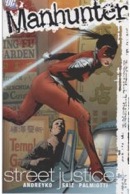
I offer this preamble as partial explanation for my delay in articulating how much I love Marc Andreyko’s Manhunter.

manhunterI’m not the first writer of note to notice that it’s great. It features blurbs from Joss Whedon and others. But I came upon so late, and so randomly, that I feel some obligation to point out its merits so others can appreciate it.

As long-term blog readers will know, I have deep respect and shallow knowledge when it comes to the comic book world. I didn’t grow up reading them. My teenage years were spent around the D&D table, arguing over the relative merits of a vorpal blade vs. a sword of sharpness. ((You can see a summary of the vorpal/sharpness situation [here](http://community.codemasters.com/forum/showpost.php?s=2466046a9f4e0b7ad3b276c18b93d3a4&p=1307195&postcount=55). And no, I didn’t write it.)) That and snow-caving. (Colorado + Boy Scouts = unsafe survivalism.)

So a few months ago, when I was in Golden Apple picking up the latest Black Adam, I had no idea that Manhunter was a DC character, or that Marc Andreyko was doing a new series with a female protagonist: Kate Spencer, a D.A. with no special abilities, a failed marriage and a smoking habit. I would have passed it on the shelf, unopened, except that Marc Andreyko happened to be in Golden Apple at that moment, and recognized me from a screening of The Nines.

After a friendly chat, I asked him what he wrote. He put three trade paperbacks of Manhunter in my hands. Which then landed in one of my to-read piles.

I read all three over Christmas, back-to-back, forgoing sleep and egg nog.

Other than Batman, I never had much use for superheroes who couldn’t fly or punch through walls. If I wanted normal people, I’d read a novel. What Manhunter does so well is create a deeply flawed and funny hero who has to interact with the super-powered every day. As a prosecutor, Spencer has to deal with all the villainous debris left behind after the capes fly off. And one day, frustrated by guilty psychopaths going free, she decides to deliver justice herself.

The series is set in LA, rather than a mythical surrogate city, so having direct references to real places is refreshing. The book manages to weave in a who’s-who of minor DC villains, with some big names showing up in unexpected ways.

There’s no shortage of ambition in the comics world — that’s one of the things I admire most about it, as opposed to features. But the combination of ambition and execution in the Manhunter series is why I’d urge you to give it a shot.

« Previous Page
Next Page »

Primary Sidebar

Newsletter

Inneresting Logo A Quote-Unquote Newsletter about Writing
Read Now

Explore

Projects

  • Aladdin (1)
  • Arlo Finch (27)
  • Big Fish (88)
  • Birdigo (2)
  • Charlie (39)
  • Charlie's Angels (16)
  • Chosen (2)
  • Corpse Bride (9)
  • Dead Projects (18)
  • Frankenweenie (10)
  • Go (29)
  • Karateka (4)
  • Monsterpocalypse (3)
  • One Hit Kill (6)
  • Ops (6)
  • Preacher (2)
  • Prince of Persia (13)
  • Shazam (6)
  • Snake People (6)
  • Tarzan (5)
  • The Nines (118)
  • The Remnants (12)
  • The Variant (22)

Apps

  • Bronson (14)
  • FDX Reader (11)
  • Fountain (32)
  • Highland (75)
  • Less IMDb (4)
  • Weekend Read (64)

Recommended Reading

  • First Person (87)
  • Geek Alert (151)
  • WGA (162)
  • Workspace (19)

Screenwriting Q&A

  • Adaptation (65)
  • Directors (90)
  • Education (49)
  • Film Industry (489)
  • Formatting (128)
  • Genres (89)
  • Glossary (6)
  • Pitches (29)
  • Producers (59)
  • Psych 101 (118)
  • Rights and Copyright (96)
  • So-Called Experts (47)
  • Story and Plot (170)
  • Television (165)
  • Treatments (21)
  • Words on the page (238)
  • Writing Process (177)

More screenwriting Q&A at screenwriting.io

© 2026 John August — All Rights Reserved.