The original post for this episode can be found here.
John August: Hello and welcome. My name is John August.
Craig Mazin: My name is Craig Mazin.
John: And this is Episode 136 of Scriptnotes, a podcast about screenwriting and things that are interesting to screenwriters.
Craig, no funny voice this week?
Craig: Uh, that wasn’t a funny voice?
John: Oh, no, that sounded like your normal voice.
Craig: Oh, you mean, [creepy voice] you mean this voice, John?
John: Yeah, no, that wasn’t the voice I wanted. I was looking for something, I don’t know, something British maybe, I don’t know. I was expecting something different. I don’t know why.
Craig: What are you looking for buddy?
John: Yeah. You’ve got a whole trench coat full of voices and you just pull one out.
Craig: I’ll give you what you want. Sexy Craig is back!
John: Sexy Craig needs to go away forever.
Craig: Sexy Craig! Oh yeah!
John: So, I think it’s because of your voice last week that I had a mild stroke. And when I said the dates for this Writers Guild Foundation event that I’m hosting a little panel on with Kelly Marcel and Linda Woolverton, I said July 12, which is completely wrong. It’s April 12. And I often get dates wrong, but that’s like really, really wrong. So, it’s April 12. It’s a Saturday.
So, if you are interested in coming to see me, and Kelly, and Linda Woolverton, and a bunch of other screenwriters, there’s a link in the show notes to that.
Craig: “Sexy Craig needs to go away forever.”
John: Yeah.
Craig: You don’t mean that.
John: I think sexy Craig might have a better use inside your own home than on this podcast.
Craig: Sexy Craig goes where he wants.
John: Ah, that’s the danger of sexy Craig.
Craig: [laughs] He’s so dangerous. Sexy Craig honestly is nothing but trouble. Nothing but trouble.
John: Yeah. You feel like sexy Craig is probably the younger brother who sort of like started smoking a little too early, started drinking a little too early because the parents had kind of given up on him a little bit.
Craig: Hey man. I don’t need them to tell me what to do.
John: Exactly. The parents I feel are actually kind of old at this point and they just really can’t control him.
Craig: Sexy Craig doesn’t need parents.
John: Sexy Craig was born in the wilderness.
Craig: He was born fully formed. He knows what he wants. He goes out and he gets it. He doesn’t need advice. He doesn’t need guidance. He guides you.
John: That’s right. He’s the master of his own fate and destiny.
Craig: Yeah. Sexy Craig is a real sociopath, by the way.
John: Craig, this week I got to do something kind of amazing. I am going to qualify it down as kind of amazing. I very rarely, and I want to ask you about this, how often do you play the sort of “I work in the industry and I have a certain profile and therefore I’m going to ask permission to do a certain thing.” How often do you sort of play that, like, screenwriter card?
Craig: Oh my god, like zero.
John: I never do it at all. But my daughter’s favorite show in the entire world is Lab Rats on Disney XD, which if you don’t have a young kid you have no reason to know that this show exists at all. But it does exist. It exists on Disney XD and it is a show about these four — well, there are three bionic kids and one unbionic kid.
Craig: Yeah, my daughter watches it.
John: Yeah. And so it’s the kind of show that an eight year old watches. And it’s not my taste in a show, but my daughter absolutely loves it. And so Stuart, Stuart Friedel, who everybody on the podcast knows because Stuart is the producer of our show, he used to work for Disney. So, he said, “You know, I can totally get you in to see a taping of Lab Rats.”
And so I finally said, “You know what? I’m going to do it. I’m going to do it for my daughter.” So, on Monday we went and saw a taping of Lab Rats. It was kind of fascinating.
Craig: That doesn’t count as like pulling rank or throwing your weight around. I mean, you know, that’s no big deal.
John: Maybe not such a big deal. Except that they don’t really have an audience for their tapings.
Craig: Oh, you were observing a taping? I mean, I honestly thought that where this story was going was that you were going to say that I was waiting to get into an event and they weren’t letting me in and I said, “Do you know who I am?” [laughs]
John: [laughs]
Craig: I thought this was going to be a “don’t you know who I am?” moment.
John: Oh, Craig, that’s every day for me. I’m pretty much always throwing my weight around that way.
Craig: Stomping your little foot.
John: Yeah. Here’s the thing. It’s because Stuart knew the people that it was very easy to sort of make those first phone calls. But because it’s not a show that normally tapes in front of a live studio audience, it was a little bit odd to go visit the set. And they weren’t used to having a lot of visitors. But they were actually terrifically nice and wonderful and helpful. The producers are Chris Peterson and Bryan Moore who created the show.
It was also just a fascinating time to sort of see what that whole universe is like because you and I don’t do that at all.
Craig: Right.
John: Like you’ve never written multi-cam, have you?
Craig: The very first stuff I was trying to do were multi-camera sitcoms. But I never actually got a job, you know. So, I watched some tapings. I went to some tapings.
John: Yeah. I’ve been to some tapings, too. And so it’s a show without an audience but it still has a laugh track. And so I was always curious like how do they do that? Do the actors just know to pause because that thing is supposed to be funny and therefore they’re going to fill it in with wild applause even though it doesn’t deserve wild applause?
Craig: Yeah.
John: It turns out the answer is they have this group of like six or seven people who sit in these sort of lawn chairs and watch a monitor and laugh. And these are people who I think are probably paid as extras whose whole job it is is to watch the show and laugh, take after take, and laugh the same at every joke as if it’s as funny the first time. It’s such a bizarre job and it’s such a great — I wish Ricky Gervais were still extras because it’s exactly the kind of thing you would want to see him do.
Craig: I’m honestly stunned. [laughs] I can’t quite absorb what you just told me. To reiterate, if I may, the show is not shot in front of a live studio audience. Obviously a laugh track is put in after. But rather than just leave some spaces and put the laugh track in as they desire, they have commandeered human beings to pretend to laugh over and over and those people do that?
John: I would clarify to say they are actually laughing, whether it’s genuine or not genuine. They provide a full voiced laughter that is apparently helpful for the actors in their timing to sort of know how things are supposed to feel.
Craig: I guess. But the thing is, A, no, it’s not natural because they’re adults. [laughs] I mean, look, I actually really enjoy the fact that there has been this resurgence of multi-cam traditional sitcom format on Disney Channel, and Nickelodeon does some as well because those were the shows you and I grew up with watching.
John: Absolutely.
Craig: Laverne & Shirley, and Happy Days, and so on. And so I like that my daughter can watch them and she really enjoys them. But she’s not laughing out loud at them. Nobody really laughs out loud at them with rare exceptions.
John: Every once and awhile my daughter does laugh out loud at them.
Craig: Okay. Every once and awhile.
John: In some ways it’s a strange thing because I think it teaches kids that certain things are funny that actually aren’t funny. I do wonder about the dangerous quality of that laugh track.
Craig: There is that. But I guess my point is that adults surely wouldn’t be laughing out loud at that. Granted, when you go to a live sitcom taping, because it’s live theater and you’re in the moment, you do tend to laugh. And they do have to remind you to continue to laugh if there’s a retake, which they try and not do over and over. I mean, a lot of a sitcom is just shot, you know, okay, we’ve got it. We’re moving on.
But, there’s just six people. It’s not a big crowd. It’s just six people. They have to laugh. And I’m just a little surprised that the actors wouldn’t be completely creeped out by the fact that there’s this fake laughing going on.
John: Yeah. But they’re three seasons in and they’re all 17 years old and this is their job. Two years ago they were living at the Oakwood auditioning for things. So, it’s not a bad gig that they’re in right now.
I think the reason why they can’t have a normal audience for this is because they’re so — you’ve seen the show probably. There are so many stunts and effects that they can’t shoot like a normal multi-cam can, so they are doing things like four or five times and they’re having to do specific like wiring of stuff, so they couldn’t do a normal audience.
But it is just strange.
Craig: That’s weird. Yeah. Hey, if it works for them, god bless them.
John: Our mutual friend Melissa McCarthy is on a multi-cam right now. She’s on Mike & Molly. And so she’s describing how they do pre-tapes for certain things like car scenes they’ll do a pre-tape. And they’ll anticipate sort of where the laughter would be naturally, but on the day they actually film the show in front of a live studio audience they’ll just sit on apple boxes without like any of the set around them and just do the same scene again so they can get the laughter, get the jokes timed right.
Craig: And they’ll see where humans would naturally laugh.
John: Yeah. But there’s really nothing natural or human about a Disney XD show. And I’m not sort of denigrating them, and bless them for having me come over. I don’t really want to sound like I’m throwing them under the bus.
Craig: Why would that — that’s not denigrating.
John: It’s a strange thing.
Craig: Yeah, for you to say that there is nothing less natural, [laughs], what was it? Nothing less natural than a Disney XD show?
John: I may have said nothing less natural or human than a —
Craig: Or human, yeah. There’s nothing negative about that at all. [laughs] They did you a favor!
John: They did me a huge solid, so I am just being sort of a jerk now. But it was fascinating, this is a show about androids. Sorry, they’re not androids. I’m sorry, they’re bionic.
Craig: Right.
John: There is something actually inherently non-human about them, so maybe that’s what makes it all work.
Craig: Listen. Whatever production tricks they need to do to get through the day, that makes sense. I just find it so odd. I mean, I would have never thought of that.
If somebody were to say to me do this show and you can’t have a live studio audience, but you do need to figure out the timing of the laughs, I suppose I would just say, well, I think since I’m controlling where the laughs go, and there isn’t a live studio audience to cue me where they would naturally go, it’s entirely arbitrary per my decision, so why don’t I just get a thing to playback laughs live on the stage and not have people do it over and over?
John: Yeah. Why don’t you actually just like push a button for where the laughter is, where you think it’s going to go.
Craig: Right. Have you ever seen one of those guys with their machines? Those guys are gone now. Everything is on a computer. But when I started in the business way, way back in the ’90s, there was a guy who would show up with this special patented machine and he would plug it into your mixing board.
John: A sweetener.
Craig: Yeah. And he would select the laughs. And there are stages of laughs. Little — everything from titters to guffaws and awes, and oohs, and all that. And actually the creepiest thing about it was I remember, I was talking to that guy and he goes, “You realize all the people you hear laughing on TV, they’re all dead. They were recorded in the ’50s.” And so a bunch of 50 and 60-year-old men and women in the 1950s were just recorded laughing and doing all these reactions. And they’re all gone now, so it’s like ghosts laughing at jokes that they wouldn’t even understand about iPhones. [laughs] It’s so weird!
John: Yeah.
Craig: I love it. I love it.
John: Today on the show we’re going to do a Three Page Challenge. People love the Three Page Challenge. And we have three new entries for the Three Page Challenge.
Craig: Oh, I wish I had a thing right now so I could go, “Ahhhh.” Yeah, after everything you say I’m going to give little laughs.
John: Maybe Matthew Chilelli will add in a little laugh here or there. But, actually, this is sort of an interesting segue because one of the things I realized as I was watching this, I asked the guy who had written this episode like what are your scripts like, are you writing them like a single cam or like a three-camera, because there is no reason why you should kind of write it like a multi-cam, but they do write it like a multi-cam, so they write it in that format that I find so odd where dialogue can be all caps and parentheticals are in part of the dialogue. They’re not set aside as their own separate line.
But I recognize fully that my thinking it is odd is just because it’s not what I’m dealing with on a daily basis. And so a good transition to us talking about some follow up on what a screenwriting format could look like or should look like and what some of the priorities would be. Because we actually had some people email us and tweet at us this week following up on our last conversation.
Craig: Yeah. There was a little bit of a discussion in our last podcast we talked about how you and I have this instinct to move away from slug lines as the scene dividers and talk about sequences as the primary chunk in which to parse out a screenplay.
And there was a little bit of discussion back and forth, and it’s true that initially when we started talking about this we were saying, “Oh scenes are the thing,” but I think you and I realized fairly quickly that scene is a strange word because it means different things to different people. And I’m going to agree with a lot of people who are like, “Hey, slug line doesn’t define scene.” That’s correct.
It does, I think, in current format to some extent, maybe to the detriment of the screenplay, it does define the scene. When you’re shooting people say, “Well, what’s the scene number?” And they’re referring to something that’s connected to a slug line. Interior or Exterior, location, time of day. And what we’re saying is that’s useful information to have, and that’s important to have, but that’s actually not a great way to split up the work. A better way to split up the work is to think of a sequence and a sequence is a group of scenes that are organized around a certain narrative movement.
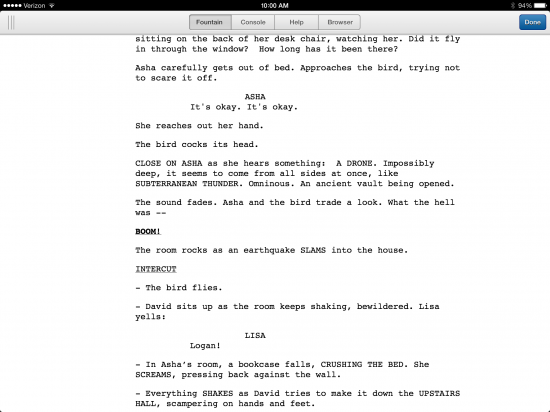
And when I even say a group of scenes, I mean to say bits. You know, bits. And those bits may actually cut across slug lines as well. For instance, in one of our Three Page Challenges today we’ll come to a part where there is a bit, where a kid is upstairs and then he’s downstairs. And there is a missing slug line in there. And I missed it. But that doesn’t mean that the scene isn’t really one scene.
John: Absolutely. I think when we get to that Three Page Challenge you’re going to see what we’re talking about. I agree with you that I really like that our listeners have challenged and pushed back on some of our assumptions, because that’s exactly what you sort of need to do at this early stage of talking about what could be new or better.
Right now when we talk about scenes, ultimately you and I are still in two different worlds. We’re trying to write a movie and we kind of know what a scene is in a movie. It’s this chunk of a movie that it’s about this thing. And usually it’s often characters in a certain place in a certain time. And then that scene — you kind of feel like that scene is over and then you’re onto the next scene. And so location and time is often a useful way of describing the boundaries of it.
But we are always running into situations where you have people on two sides of a phone conversation and that ends up sort of being kind of two scenes, or is it one scene. Or you have people who are moving through a space and you’re trying to decide do I break this out as separate scenes, or is it continuous. And all that stuff is really just weird text baggage being put on something that’s very natural when you see it in a movie, but it’s really weird on a page.
And really what we’re talking about — and I don’t know if we’re going to end up on scene or sequence as being the right sort of defining block for it — but, yeah, we’re talking about what makes sense in a story purpose as a scene, not what necessarily needs to make sense on a budgeting or a strip board kind of thing.
Craig: Right.
John: A lot of what is in the modern screenplay format is there as much for the AD or the line producer as it is for the reader. And so things like INT/EXT as a shorthand for are we inside or are we outside. The location and trying to be really consistent about the name of that location so you’re not calling the same place three different things. Well, it’s not maybe the best experience for the reader, but it’s meant to be sort of consistent for the person who has to figure this stuff out later on.
Craig: That’s right. The slug lines are there to help you figure out how to shoot the movie out of order, because you are going to shoot it out of order. But, of course, we read it in order. So, we have this strange format that straddles out of order and in order. And as you were talking it occurred to me that I guess one of the defining characteristics of this useful bit of parsed out storytelling that we’re trying to describe here is continuous time.
John: Mm-hmm.
Craig: That there is a section of storytelling that occurs in continuous time. So, if somebody is inside and then they walk outside and then they get in their car and then they pull up, and there is not a jump — or even if there is a jump but the jump just exists to compress, it’s about a sense of continuous time.
John: There are cases in screenwriting where it’s discontinuous time, but you’re continuously at a place or you’re continuously on a certain idea. And you really, I mean, yes, sometimes you really call this more sequences where you’re going back and forth between a lot of different things, but it’s really all one idea. You’d really call that one scene.
Craig: I agree. Or one sequence. Exactly.
John: So, yes, in both cases our reliance on that single line of scene header to describe what’s going on and what this feels like as a movie is really hurting us, I think.
Craig: Yeah. I think that’s why sequence is the best word. Because scene is borrowed from stage anyway. And it probably made a lot of sense when they first started shooting movies and everything was on a stage.
John: Yeah.
Craig: And it was just you enter, you talk, you leave. We really do need to switch to this notion of sequence and leave this word scene behind. Scene doesn’t even describe what the slug lines are doing anyway. All the slug line is is just an indication of location and time of day.
John: Absolutely. What people may not be aware of, in the origin of screenwriting the first screenwriters were largely women. And the first screenplays were essentially just a list of shots. And so they were this list of sort of like how you’re going through things and basically shot, by shot, by shot this is what you’re seeing. And it evolved into this format that we have now which is sort of like halfway like a play, halfway like a radio play. It’s its own weird beast, partly because of how it started.
And I think it doesn’t necessarily do a great job of describing what we’re actually making right now. So hopefully if there’s going to be something to replace it it would do a better job of describing that.
One of the things which people who haven’t been through production are probably also not aware of is there’s a stage in production where you take a script and you break it down. And by breaking it down you’re going down to scene by scene. And by scene I’m talking about that sense of this is the location, this is the time, this is how many pages or eighths of a page is occurring in this block of shooting.
And one of the functions that so often an AD or a line producer is doing is writing a synopsis of that scene. It’s basically like a one sentence or two sentence description of what happens in that scene.
Craig: Right.
John: As a screenwriter I often, if I’m heavily involved in production, I will often ask for that and go through and rewrite that quite early on. And I’ll rewrite what the synopsis of those scenes were, because so often I’ve seen the purpose of the scene horribly misrepresented. And so it’s like they’ll describe it as being like “Susan confronts Tom about this” when it’s actually not what happens in that moment, so people can get confused. But that idea of a synopsis for a scene I think is actually a really interesting idea as an element to be part of the screenplay format from the start.
And it’s actually a thing that exists in Fountain. We have a thing where if you start a line with an equal sign that’s called a synopsis line. And it’s just a way of — a shorthand for what happens in that moment. And that can be very useful for writers. So, essentially almost that kind of what you would write on an outline or what you would write on an index card for a scene could be part of the actual document itself.
Craig: I think that that ability is in Fade In and Final Draft and Screenwriter. They have these kind of summary little things that are attached that you can tag onto, but what’s interesting is that none of it is really formalized, you know, because we’ll do all this stuff, but you’re right at some point it just goes through the meat grinder of an AD going, “Okay, how many pages is this? How much time do I need to shoot it? Is it a day or two days? Is it inside? Is it outside? Where is it? What time of day?” And, yeah, some brief often ham-fisted description of the action just so people…
I don’t know if you’ve noticed this. I’m fascinated. I cannot do it. It’s funny, Todd Phillips and I would talk about this all the time. We’d be on set and somebody would walk up to us and say, “Hey, listen, for scene 72 did you guys mean…,” and we both are like, “Don’t — we have no idea what that means. None.”
John: Yeah.
Craig: Zero.
John: I do that all the time in production. Because they’re only looking at numbers.
Craig: And they actually memorize it. And they all do it. It’s incredible. I feel so stupid. I mean, it’s like some guy will come up to me and he’s like, “Hey, are we doing 85 tomorrow?” And I’m like, uh, how did you do that? [laughs] Where? What?
John: What’s fascinating is that once you start production, from production through the end, that actually is a meaningful thing because editors are looking at those scene numbers, too. So, like everyone else can talk about scene numbers, but weirdly the people who wrote the script generally have no idea what those scene numbers are.
Craig: None.
John: Which is crazy. But maybe that’s reasonable, too.
Craig: Well, we’re the ones that put it in. It’s just that we put it in for everybody else. But in our minds we’re, you know, we’re just thinking about the movie.
John: We’re thinking of the movie. We’re thinking of how you get from place to place. How you transition from that moment to the next moment.
Craig: Correct.
John: So, a couple wrote specific tweets that I thought we should address on the air. So, Alyssa Brick wrote, “Is there a danger that people could hide bad writing behind good AD presentation in a new format?” I think absolutely. There is a danger that in some ways you could forget about the writing and sort of like the importance of the writing by having all of these other gimmicks in there. And somebody else had written in with some pages of a script that they were working on that I just, I don’t know what you thought about it, I thought that was a mess and I would not be interested in reading that or seeing that. I wouldn’t want to be handed those pages and say like, okay, here’s the movie.
Did you look at those?
Craig: I did. They were fascinating. The problem was that the writer used every possible thing. It was a bit like, I mean, I like mustard and I like ketchup, but I don’t want mustard and ketchup and salt and pepper and this and that. I mean, they just went kitchen sink.
There were ideas in there that I thought were at least nibbling at the sort of things that could be helpful, but I do agree with the implication here. The last thing we want to do is basically imply, oh, you’ve just got to go and puke a bunch of insanity onto a page to flimflam us.
By the way, I don’t think it’ll ever work.
John: I don’t think it would ever work. And here’s why I thought those pages didn’t work specifically for me is that even if you’re adding more stuff into a script page than would normally be there, the experience of watching a movie is essentially linear. You can’t pause and take everything in. It’s going to keep running forward. And so, you know, a script ultimately has to be very linear because that’s the experience of watching a movie is very linear.
So, if you’re throwing out a bunch of stuff that has like two column charts and then like all these other stills in there and you have — if I’m spending like five minutes looking at this page trying to figure out what’s going on, that’s not the experience of what a movie can actually be. And that’s not going to be a great experience. So, while it’s great that you have all of these resources, I think you actually have to look at sort of what the experience of watching the movie is going to be like and how can you reflect that in a document. Because the experience of watching a movie is nothing like that page, I would hope.
Craig: I agree. And in fact one of the things that I think we should think about as we invent our new format is to use the flexibility of digital format, so that the reader has a choice of when to call up extra information. It’s not imposed upon you. The page isn’t a scattered pastiche of text, and image, and sound, and all the rest, but rather I understand that there’s a small icon next to a description. I can click it, a window will pop up, show it to me, and then I can make it go away.
It’s at my command, as I wish.
John: Yeah. So, Mr. Bowers wrote in saying, “Have you guys seen Scrivener?” Which I have seen Scrivener. “It’s very close to what you describe as your ideal new screenplay format.”
No. And I think you tweeted back saying that Scrivener is an app, it’s not a format, and I think that’s a really crucial distinction and I want to make sure that as we talk about this that that sort of comes out clearly, because I think if there’s any one app that does a bunch of this, that does all this stuff, that’s not the solution. The solution — because we’re not trying to replace Final Draft. We’re really trying to replace what screenplays are like.
Craig: Correct.
John: And that’s a much broader thing and that’s existed before Final Draft and everything else that generates these kind of documents, too. So, it’s really a system for like how you could display this kind of information. And what I think has worked so far about Fountain is it’s not trying to be one company and it’s not trying to be one app and it’s not trying to be one thing.
It’s about there is going to be buy-in by a bunch of different people. So, in many ways I think what you and I are talking about is incredibly utopian and would probably never actually really happen, but it might steer a conversation in an interesting way and some of these ideas could come to pass.
Craig: I think it’s going to happen.
John: All right. That’s great.
Craig: Yeah. I’m a go-getter.
John: The last thing is people tweeted back saying, “Oh, you can’t get rid of one page per minute,” and so I want to have one last little bit of discussion about the one page per minute because there is a step that, again, I don’t think people realize because they haven’t been through production is that before you actually start shooting a script there’s what’s called a script timing. And that’s where a person with experienced production goes through the script literally with a stopwatch, reading through it and sort of feeling out how long each thing is supposed to be taking, often in conjunction with the director, timing it out to really get a sense of like how long the finished product would be.
Because you and I both know that there are scripts that are 140 pages that come out at 100 minutes and scripts that seem incredibly short that come out very, very long, especially in episodic, the different shows will have a completely different style, so a show that is really rapid fire like Gilmore Girls, their scripts were like 80 pages long for a show that was going to be 42 minutes because they spoke a thousand miles per hour.
Craig: Right.
John: And I wouldn’t be surprised if True Detective was kind of the opposite where those scripts weren’t a full — wouldn’t feel like a full hour, but it’s because of the pacing of it that it wouldn’t be that. So, there is a stage called script timing which is actually designed to do exactly what we’re talking about. Even if we’re not doing this one page per minute rule, someone is going to time it out. You’re going to know how long something is.
Craig: No question. I still believe that you get a sense of how long a script is from reading it. And if you were to hide the page numbers from me, or hide pagination entirely and I just read it, I would be able to give you some vague sense of how long I thought the movie would be. And that would be, I think, more accurate frankly than some paginated page number.
Look at The Social Network. I mean, very famously Sorkin wrote massive — I mean, the opening scene, I don’t know how pages that it’s paginated. 15? I mean, it’s wall-to-wall dialogue but it was meant to do at a very rapid pace. And it certainly didn’t take the amount of time that the one page per minute would indicate.
Similarly, when I was doing spoof movies with David Zucker, I understood that they were done at breakneck speed. And that it was really more like 45 seconds a page if anything. The people that are clinging to this one page a minute thing I think are just afraid.
John: Yeah.
Craig: They feel, it’s like we’re taking their woobie away. But the woobie is not real.
John: The woobie is not real.
Craig: No. There is no woobie.
John: Craig, you brought up a topic that I think was great and incredibly apropos, so I would love you to take over this. This is about when it’s okay to work for free.
Craig: Yeah. This has coming up a bit lately and there’s a little bit of a confusion about it. And so I just wanted to lay the groundwork for people in terms of what the rules are, which I think frankly parallel what is best for us as screenwriters. This is not always the case. In this instance it is.
So, per the WGA and our agreement with the companies, so called “spec writing” is forbidden. And you’re like, “Well, wait a second, we write specs all the time.”
Okay, let me explain. The deal is that you can write on your own. You control the material. You own the copyright as you wish. You can write a spec screenplay, you can write a novel, you can write anything you want. And obviously no one is paying you for it because it’s yours.
You can do this even in conjunction with a producer, because remember producers don’t employ us. Producers are employed by the studios just as we are. If you were to sit down with a producer and they say, “Hey, we have an idea and we’d like for you to write it. And you could write it on spec and then we would go out and try and sell it.” You are perfectly free to say yes. And I don’t think there’s any issue with that, because you control it. That’s the most important thing. You have the copyright on it. It’s yours. You wrote it.
You don’t feel like selling it? You don’t feel like selling it for a certain number? It doesn’t happen. It’s entirely under your control.
The kind of free writing that is unacceptable is free writing that occurs as a condition for employment or free writing that occurs as part of employment. So, if somebody says to you, “We would be interested in hiring you to write this. Write me ten pages to prove that you can.” That’s a huge no-no. It’s against the MBA and it’s also something that we just shouldn’t do as writers. It’s unprofessional.
If you are hired on something and the employer says, “We know we’re supposed to pay you now for the script you just turned in, but we don’t want to. We want you to write another draft of it.” That is a no-no.
Now, there is a flexible area where producers are asking for this and this is the whole free rewrite conundrum. We’ve gotten into that before. But the biggest issue to just keep in mind is that you cannot, cannot write to get employment. You can’t accept writing as a condition for employment. They’re not allowed to ask for it. They can’t even ask you for a summary or a lead behind or an outline or a treatment. And, frankly, as writers I would strongly suggest that you not do it, that you not give them that in order to get a job.
They will put that on as a condition and one of the things that we’ve been talking about with the studios is to say to them, “Look, not only is that against the rules, but it’s going to blow up in your face because…” and this has happened now a bunch of times. Somebody is going to write one of these things to get the job. They’re not going to get the job. And now you have somebody out there with material that you don’t own. And you’re going to make a movie and as we know there are similarities and they’re going to come back and they’re going to get you, because they’re going to say you stole it.
So, anyway, that’s the basic dividing line and hopefully that clears it up for people in some way.
John: In some way. I think the take home from this is that there’s nothing wrong with free writing if it’s your writing. If you are writing for yourself a spec work that you are doing for yourself where you’re writing a script for yourself, yes, and that’s one of the most wonderful things about being a screenwriter is no one can stop you from writing, unless they have some exclusivity on you, which is a crazy thing, which we’ll get into at another point. But essentially no one can stop you from writing and that’s the gift you have as a writer.
One of the other gifts is you can say you want to work with somebody on a project, you can do that. And a producer who is not a guild signatory who is not a person who would be hiring you in general, you could agree that you’re going to write this thing and collaborate with this producer on getting this thing to its final best form, but it’s still yours. You’re going to own this. And you can choose whether to sell it or not sell it.
It’s when you are going into a buyer, a person who is going to pay you money to do stuff who chooses not to pay you money to do stuff, but rather is just going to have you write for free and if they like it then maybe they’ll buy it. That’s the problematic situation.
Craig: Absolutely.
John: So, where it gets complicated and where you and I both know people who have run into this situation is that conversation of like, “We would be really interested in something like this,” and so it’s like, uh, so are you telling me that you want me to spec — not telling me but they’re telling the young writer — are you telling me that you want me to spec something that’s in sort of this ballpark? And they can’t really quite say that, but they talk about the kinds of things they’re interested in and it becomes this conversation that is essentially asking you to write something for free.
Craig: Well, yeah, but the difference again is if you really like, yeah, you own it. They don’t want it, go sell it to somebody else, assuming that it’s something that anybody would want.
John: Yeah.
Craig: The trickiest of these for me is when a producer comes to a writer and they control a property. They have an option on a book, for instance. And they say we’d like you to adapt this on spec to see if we can go set it up somewhere. I’m not a big fan of that.
John: Yeah. Because it’s really clear to see how this can go wrong, essentially they decide they don’t like your script, they drop the option on the book, and suddenly you have a script that’s based on material you don’t own or control. And you can’t sell this project.
Craig: Precisely. So, the idea is when you’re writing on spec you need to write in an unencumbered way, so that you own the material completely. The only other thing I would say is if you really loved some underlying property that a producer controlled, it would be fair to say, “Fine, I’m going to write this on spec, but I need us to sign an agreement. And that agreement is that if you’re going to set this project up, you’re setting it up with my script.” And usually they won’t, [laughs], they won’t agree to that. And that’s why I like asking those questions because suddenly they have to show you who they are.
John: Yeah.
Craig: Yeah.
John: The leverage you have as the writer is the ability to say no. And there are times where you’re going to need to say no, or at least ask the questions that will lead you to a no.
Craig: Correct.
John: All right, let’s get to our Three Page Challenges this week. We have three that Stuart picked. So, Stuart, I want to just stand up for Stuart here for a second. Stuart read 70 Three Page Challenges yesterday. They had sort of backed up for awhile. And so when I asked him like, hey, could you grab some for me and Craig, he went through 70.
Craig: I am impressed, Stuart.
John: So, these are the three he picked. And some of these may have been from before this last batch of 70, but if you are new to the Three Page Challenge let me talk you through what happens here. So, we solicit our listeners to send in three pages of their script. It’s almost always the first three pages, but there’s no rule that it has to be the first three pages. But if you’re going to do that, there are rules that you have to follow.
And that is go to johnaugust.com/threepage, all spelled out, and we will ask you to have certain boilerplate on the email. Send only the pages. Don’t send anything else. Just send the pages. We’d love to have your name. We’d love to have a title page is great and helpful. But it’s just these three pages. And we talk about them on the air, a very small fraction of the people who send pages in actually are discussed on the air, but we really thank everyone who sent them in. And we especially thank people who are brave enough to hear us talk about their pages on the air because you guys are heroes.
If you want to read along with these pages, there are PDFs attached to this episode. So, go to the show notes either on your app device or at johnaugust.com and you’ll see the show notes and these Three Page Challenges attached.
So, what should we start with, Craig?
Craig: Well, you know, I just noticed. I was looking at our three submissions today and I feel like Stuart hides little themes.
John: Well I think I picked up a theme, but what are you going to say?
Craig: I think the theme he hit today was single word punchy title.
John: Yeah. All these are — the three scripts this week are Reactor, Bruiser, and Paragon.
Craig: Paragon.
John: They all kind of feel like they could be ABC shows. Like Scandal. Betrayed. Or Revenge.
Craig: [laughs] That’s right. Revenge. Well, we can start with any of them. I’m holding, well, I’ve got all three of them. Do you want me to summarize this first one here?
John: If it’s one that I’m not ready to summarize. Do you have Chris Sandiford?
Craig: I have Chris Sandiford right here. Reactor.
John: Reactor. Yeah, I want to talk about this one, so let’s go for it.
Craig: Okay. So, Reactor. We open up high above the clouds at night in moonlight and then we descend down through the clouds to realize we’re in a violent thunderstorm.
On the ocean below there is this big Maersk E-Class Ship, big cargo ship, and there’s a heavy cable, like a toe cable that fires from the sky and hits one of the containers on the ship.
Inside the ship we can now see that a helicopter is attached to this toe cable and it’s using this toe cable to sort of pull itself into the ship.
And then we go into the helicopter where Colonel Drumm is advising his pilot and some guy using a laptop to essentially take it easy and try and land thing.
We go onto the ship’s bridge where a crewman is watching his radars fizzle out and then he notices that there’s this helicopter that’s coming in. He gets on the radio to the captain who is in the mess hall eating spaghetti and basically says there is an unidentified helicopter and there are three guys with weapons coming out of it.
And we then go to the engine room of the ship where a crew person is alerting Emilia Alvarez, an engineer, that there are hostiles outside, emergency protocol. We think that she’s just working on the engine, and then it is revealed to us but not to the other crew person that in fact she is assembling some very fancy looking grenade launcher.
John: And I took it that she’s actually a hostile.
Craig: It appears that she is a hostile. Yeah, a saboteur.
And so that is Reactor by Chris Sandiford.
John: So, my take on this is this is essentially all action setup. And so this wasn’t like, you know, oh we’re getting to know who these characters are. We’re not getting to know the world. This feels like the start of an action movie. It feels like the start of a Die Hard or some sort of like big set piecey kind of action movie taking place on the seas.
And I actually kind of dug it for what it was doing here. There are some things that didn’t work. I thought some of the dialogue didn’t especially ring true. I don’t like Spaghetti Captain. I don’t like on page three we have, “Then, with respect, Captain, get your ass in gear! These guys have weapons!” That’s how you’re talking to your captain? That feels kind of odd.
But I liked the overall sense of scale and size and drama. I felt like I knew what kind of movie this was after these three pages. And was excited to sort of see well what is this set piece going to be like.
Craig: Well, I agree that there was a good sense of pacing to it. I mean, it was an example of how to introduce elements and reveal things cinematically. These are very cinematic pages. We’re watching everything and that’s great.
In a general sense, tonally this feels out of time. It feels old fashioned to me. This feels a bit like a Steven Seagal movie.
John: I was going to say Steven Seagal. Yeah.
Craig: Yeah. Mid-’90s. I think we’re past this. Even video games, frankly, are past this. This feels like a cut scene from like the first Splinter Cell, not something that you would see now. So, there was a kind of an old fashioned sense to it and it was not helped at all by the characterizations that Chris gave us.
Even the names. We’ve got Colonel Drumm. “Easy, ace.” And in fact, Ace says, “Aye, Colonel. This storm is something else.” All of the dialogue is very cornball, frankly. I really got puzzled, very puzzled by the interaction with the captain.
I’m just going to read this exchange. This crewman, he’s seeing this thing that — I mean, they’re on a ship in the ocean and there’s a helicopter that’s towing itself in that he does not recognize and his radars are gone. And they’re in the middle of a storm. Captain, for some reason he’s eating spaghetti, fine. The guy turns an alarm on and then calls the captain and says, “Bridge.”
And the Captain says, “This had better be good!” Why? Because it’s spaghetti time and everybody knows don’t bother the captain when he’s eating spaghetti? They’re in the middle of a storm. There’s an alarm.
“Sir, we’ve got a chopper more to the bow,” which isn’t true because it was actually more I think to a container, but fine. “You expecting anyone?” It’s already that kind of vaguely, quippy Michael Bay Armageddon-y kind of dialogue.
And the captain says, “Alarms are for emergencies, crewmen!”
I don’t know. I kind of feel like some strange helicopter that’s moored itself to your bow in the middle of a storm is sort of notable. And then, yes, the guy with the assault weapons come out and then the crewmen says, “Then, with respect, Captain, get your ass in gear! These guys have weapons.”
And then the captain slams down the receiver, turns to the other three crewmen in the mess and says, “OK, listen up!” This almost is bordering on spoof. Assuming that there’s a kind of a modernization of the dialogue and a little bit more of a professional veneer to — not professional screenwriting veneer, but professional crew person veneer to how these people behave.
What I did like was the visual of a helicopter towing itself in. I would have loved those people in the helicopter to be more serious. I like the idea of crew members going, “Whoa, what the hell is that?” And I thought it was a good reveal to see that there is this engineer who is listening to headphones and seems to just be oblivious, actually being part of the sabotage crew.
John: Yeah. So, where I thought this could have really benefited from is just a little bit more mystery. And so more sense of like as the audience we’re watching these two sides and we’re not sort of sure who to root for. Because I guess right now I’m not sure who to root for. But honestly if you were to take out all of the dialogue I think you have a much stronger, more compelling scene.
So, if we see this helicopter landing and we see like just quick barked commands behind like what people are doing and mounting this ship, and then if we didn’t really see, if we didn’t know much about sort of what the captain situation was — honestly, just give us less. I think you could take out almost all the dialogue in here.
And then we’re watching this thing, it’s like should we be rooting for the people in the helicopter who are boarding this ship? Should we be rooting for the people on the ship against the helicopter. Is this an invasion? Is the ship evil? Is the helicopter evil? These are all kind of fascinating question and I feel like holding back on this a little bit longer would have been great.
Craig: I agree.
John: I mean, even right now I don’t quite know who I’m rooting for, but I’d like to really have that heightened more.
Craig: I agree. My suspicion is that the helicopter guys are bad guys, but I don’t know, then they’re military. It seems like they’re acting like bad guys? I couldn’t tell.
The other advice I would give on just the plotting, just logic, is you’re a helicopter and you’re going to do this very fancy maneuver to land on this ship. And obviously you’re up to no good. Why would you start landing in a spot where they could see you? I mean, there’s this guy tapping on a computer to shut their radars down. But yet they’re just landing in front of a window. You know, it seems like it would be a good thing to show that these people are a little more competent than that and are revealed only because something goes wrong or the ship gets rolled by a wave or something.
John: Yeah. And if we’re going to have a guy on a laptop there may be a better way than “guy on laptop” honestly. It would be more exciting to see the physical action of what you’re doing to take down that radar thing. A person doing something is almost always more exciting than a computer doing something. So, if it’s a physical person taking something down or breaking something or changing something, that could be great to see as well.
Craig: Yeah. Guy on laptop in helicopter above turning radars off below, again, just feels like a cheesy misunderstanding of how computers work. And you used to be able to get away with that sort of thing, I guess, but less so these days. People do demand a little more technical verisimilitude.
John: Yeah. I mean, if it’s the thing where like you’re tossing something out the radar that makes it look like a lightning strike but it wasn’t a lightning strike, that you’re doing something to physically knock it out feels probably a little bit more rewarding.
A couple other things I noticed, sort of words on the page. Right now we’re starting “EXT. SKY — NIGHT. FROM A GREAT ALTITUDE WE SOAR over a thick blanket of endless CLOUD,” I think it’s clouds, “bathed in enchanting moonlight.”
I don’t think you need the “EXT. SKY — NIGHT.” The first line is telling you that we’re in the sky, so I think you’re just redundant. And I love starting a script without that scene header slug line when we don’t need it. It was a little too written for me.
Craig: A little purple.
John: It was a little too purple. And it’s like, “Thick blanket of endless bathed in enchanting moonlight,” and then we’re going through the fluff and into a violent thunder storm. Let’s just start at the thunder storm. It’s a thunder storm. Let’s be in the middle of this.
Craig: Yeah. You’re going to end up there anyway when they cut the first part.
John: Yeah. You are. You’re totally going to be there.
Craig: You just are. You see the company logo and then, boom, you’re in the middle of a thunderstorm. It’s a cool way to start.
John: So, Chris Sandiford is evidently British because he spelled “storeys,” which is absolutely fine. Nothing wrong with being British. But I will say a general bit of —
Craig: [laughs] I think there’s something a little wrong with being British.
John: Just a little bit wrong.
Craig: I can think of somebody I know who is British who is just a little wrong.
John: Oh, but she’s wrong in just the right ways.
There is a general style note. Let’s talk about numbers in scripts. Because we’ve talked about how you shouldn’t really write numbers in dialogue, you should spell them out. Let’s also spell out numbers that are starting sentences. And numbers less than 10. I mean, I’m sort of talking MLA style here. But here “20 storeys,” spell out the twenty. Don’t give me numbers for that.
Later on another page he does “4 men” with the number four to start things. No, spell those out. Numbers ten and above, I would say probably better to use the numbers for those. But the smaller things, use words because they’re easier to read. It just feels more natural.
Craig: Agreed.
John: Okay.
Craig: Agreed.
John: Chris, I think I’m a bigger fan of these pages than Craig was, because I was — I was honestly sort of skipping over some of the dialogue moments because I was so excited by the skill and scope of which this ship was being setup and sort of what this action was going to be.
Craig: All right. What are you going to do now?
John: I can do Paragon by Aaron Kablack.
Craig: Kablack.
John: Sure. Like Kaboom? Kablack.
Craig: Like Slotboom. Kablack.
John: Yeah. I think you’re right.
Craig: We never heard from Slotboom, did we?
John: I don’t think we did. I can check through the mail. But I don’t think we heard back from Slotboom.
Craig: I don’t think she listens to the show.
John: All right. She just sent in pages randomly.
Craig: Yeah, she’s too cool, man. She’s Slotboom.
John: Yeah, I submitted my pages but I didn’t bother listening. That’s how cool I am.
Craig: Yeah. Exactly. Whatevs.
John: That’s the title of the script. It’s called Paragon. As this story begins we’re in an elementary school hallway. And we start with Ashley Ayers, and she’s being slammed against the lockers by Wanda, who is 10. Ashley is only 7 years old.
Wanda is going to beat her up for narcing on her that basically she was cheating off the test. Ashley ducks the blow, gets on top of Wanda, starts beating her up. And she’s fighting hard.
Cut to principal’s office, where we see Ashley with her mother, Blair. The principal says, “This is the fourth time this year. I’m sorry, but we have no choice but to suspend Ashley. Again.”
We’re in the car. We’re driving home. Ashley says it’s not her fault. Her mom says, “We’re going to deal with this when your father gets home.” A comment about whenever dad does get home. Some setup about how he works for the news station.
And then traffic starts slowing down more and more and more and suddenly people are running past the windows, concerned. A distant wail of sirens. More people sprinting past. And suddenly a whole bunch of people are sprinting past the windows, getting away from something as we reach the end of our first three pages.
Craig, go for it.
Craig: Well, this is the first thing, “INT. ELEMENTARY SCHOOL HALLWAY — DAY. The back of 7-year-old ASHLEY AYERS’S head SLAMS into a locker door. Her barrettes CLACK off the metal.” And here we were off and running with problems.
John: Yeah. There are a lot of problems in that first sentence.
Craig: A lot of problems. I mean, problem number one: I don’t think you know many 7 year olds, because this is not — the whole — all these pages were not appropriate for a 7-year-old character to be behaving the way this little girl was. First of all, the fight between a 10-year-old and a 7-year-old seemed way misaligned. The kind of dialogue, the fact that she calls her a bitch. And they’re back and forth and the severity of the fight just seemed way off for a 7-year-old.
I mean, I know 7 year olds. My daughter is 9, so I can remember all the —
John: Yeah. 7 year olds, they’re second graders.
Craig: They’re second graders.
John: They’re kind of tiny.
Craig: They weigh 40 pounds soaking wet. They’re sentences are all ka-jumbled. [laughs] They’re little girls.
John: Yeah.
Craig: They’re really little girls. I mean, a lot of them are still like learning to read and stuff, you know. So, just the age was nuts.
Her barrettes clack off the metal? I got really just like, huh? How?
John: Because here’s the thing — there’s a physics problem of like if her head is slamming against that, well that slam is going to be louder than the clack. It felt weird. And so I get the instinct behind the barrettes. It’s like it’s trying to make her younger by giving her barrettes in a way, like reminding her that she’s still a little girl. But, it doesn’t make sense.
Craig: I think being 7 would be the tip off. Also, let’s just be realistic. It’s impossible to shoot that. You literally can’t shoot a 7-year-old girl having her head slammed against a locker. How exactly does that work on the day, you know? So, really I guess my first thing is just say to Aaron I think you mean an older girl here. Everything that happens here seems to be asking for an 11 or 12-year-old girl.
John: Yeah. 7 year old girls haven’t been suspended multiple times.
Craig: Absolutely not.
John: It’s actually really hard to get suspended from school in second grade.
Craig: It’s really, really hard. And, frankly, if you’re fighting that much in second grade, you’re just mentally ill. [laughs] Little girls in second grade aren’t doing this.
John: I want to stop for one second and say like assuming that all these girls are older and that this is a fight that actually should happen, which I don’t think probably should happen, the actual beating up and the fighting was handled relatively well. I got that that slugging and stuff was kind of fine. It just didn’t make sense for this little girl at all.
Craig: The fight in and of itself was fine. I’ve seen it before where the girl gets on top of the person and starts punching and then they pull her off. The back and forth discussion I found very mundane. It was sort of just paper thin. Mean girl who’s super mean bullying tiny girl. Frankly, if Ashley has in fact gotten into fights this many times to the point where she was suspended this many times, pretty sure everybody would kind of give her a little bit of a wide berth. I certainly would.
We then get a scene in the principal’s office where we meet the mother. And the principal delivers some exposition. And he says, ” I have no choice but to recommend suspension.” To whom? You’re the principal. Go ahead and suspend her. Suspend her.
John: So, Craig, you’re familiar with stock photos?
Craig: Yes.
John: I feel like they’re stock scenes. I feel like you could actually just go to like iStock Scenes and just buy this little thing that you can just copy and paste into your script. Because I think I’ve seen this exact scene. I mean, I actual can picture the people in the photos that would go with this thing about like this is what it looks like when you get suspended. Your kid being suspended is such a trope. I mean, it’s not even a trope. It’s sort of a super trope.
Craig: [laughs] Yes. Super trope.
John: It sort of demands to have some sort of weird spin put on it, but there’s no weird spin here at all.
Craig: I agree. It’s like Clip Art. These things, we’ve seen — the mean, motivation-less bully, and then she beats the bully up. She gets blamed by the glum, 50s, central casting principal. And then, frankly, we’re going to have another scene that’s Clip Art where the little girl is saying it wasn’t my fault, the mom doesn’t get it. And then the little girl starts making these pointed comments about the absentee father. And then the mom starts making very on-the-nose comments that are defensive, including a reference to his job.
It just felt so out of place.
John: Yeah. So, for people who don’t have the pages in front of them, let’s do the scene together.
Craig: Let’s do it. Would you like to be mom or daughter?
John: You be Ashley, I’ll be Blair.
Craig: Okay.
ASHLEY
It wasn’t my fault.
BLAIR
I don’t want to hear it, Ashley.
ASHLEY
It wasn’t! Why don’t you ever listen to me?
BLAIR
We will deal with this when your father gets home.
ASHLEY
Whenever that is.
BLAIR
Excuse me? What did you say?
ASHLEY
Nothing.
BLAIR
Your dad works hard to make sure that you and I have a good life.
ASHLEY
How good can it be if he’s never around for it?
BLAIR
Your dad’s job isn’t like other jobs, sweetheart. You know the Beacon’s slogan: News...
ASHLEY
...Never sleeps. I know, I know.
Craig: I mean —
John: Yeah.
Craig: Like even the sigh you put in, it was like, because the problem is this isn’t — people don’t talk like this.
John: People don’t talk like this.
So, here is what’s so fascinating though is like these pages would drive me crazy, but then on the very bottom of page three suddenly like there’s a whole stampede of people going past. And clearly this is not the movie you think it is. There’s something strange is happening here and it’s going to be, you know, something remarkable and probably supernatural is happening here.
So, there’s a bigger thing. And so it made me think like well maybe this is all meant to be sort of like, you know, stupid sort of template scene stuff to set up the banality of this kind of movie. And then it’s going to go someplace else. But it’s not played that way at all.
Craig: I don’t think so. Yeah, I don’t think this is intentionally off. And even this bit at the end where the action begins is Clip Art because I’ve just seen — I just saw this in World War Z. I’ve seen it in every zombie movie.
John: Yeah.
Craig: They’re in a car and suddenly there are sirens and people are running and are heroes are confused.
John: Yeah. So, World War Z, I mean, obviously this made me think so much of World War Z in terms of everyone running past, and it made me think back to like that opening scene in World War Z is not awesome. It’s sort of a Clip Art scene. It’s like that pancake scene. And it’s not like the best moment of everything, but there’s something to be said for something that like really lowers your expectations in a certain way. Like you’re just like — it’s just like so kind of common. And then like something supernatural happens. So, there’s nothing wrong with having some really natural, normalistic stuff, but this isn’t normalistic. It’s just —
Craig: Exactly.
John: It’s far too familiar.
Craig: Right. I mean, the opening scene in World War Z is — nothing happens in it. It’s just a family waking up in the morning and they are really happy with each other. They’re just a super self-satisfied American golly gee family. But, it does feel realistic. It feels, like you said, naturalistic. It feels like a happy family.
They didn’t jam any exposition down our throats except for one little tiny bit where we get the sense that he used to work for important people and now he doesn’t anymore. But this feels very after school special. And then zombies are going to show up.
So, I just think that — I am concerned, Aaron, about your grasp of tone and character. And I want you to take some time. Unless this was intentionally meant to be this way, I think you need to do a little remedial work, frankly. And watch some movies that are of your genre and really examine how people are set up and talk to each other.
And above all ask yourself am I — is my job to mimic stuff I’ve seen or is my job to offer something unique?
John: You know, actually fascinating. If this were to be intentional, I mean, even if like after the fact this sort of odd tone was deliberately intentional, wouldn’t it be fascinating to have like Ashley’s voice over, like almost like a Veronica Mars kind of voice over where she’s commenting on it or something. Like where she had this sort of beyond her years sense of who she was in this place? I feel like there’s something you could do with sort of exactly these scenes where if she had a voice over that was playing against it.
Sort of like what I think about for both Clueless and Heathers where there is this sense of like the world is sort of deliberately a little bit fake, but it’s —
Craig: Pushed.
John: It’s pushed. But it’s because these characters are able to talk directly to you that you sort of go with it. I mean, Brick, Rian Johnson’s Brick is also the same kind of way. It’s not a realistic world.
Craig: But we’re made to understand that. In other words, you know, we’ve talked about how the beginning of a movie teaches you how to watch the movie. And so Rian understands how to teach you to watch that movie. The problem when I’m reading this is I just think, this isn’t teaching me how to watch an interesting kind of movie. It’s just copying other movies.
And, frankly, if you’re going to copy movies, copy better movies. Because the other thing is sometimes I think it might be frustrating for people to say, “Well, look, you know, I saw a movie in the theater, maybe even one that you or I wrote. And that wasn’t very original, or that scene felt ripped off.” And I guess my point is for those people to say that’s the end. That’s the end result after maybe somebody else rewrote it, maybe somebody had a different way of shooting, maybe people got involved. Maybe actors got notes. Production problem. God knows what.
The entire process of going from page to film is a degrading process to quality in general. It’s corrosive. It’s very hard for the best to remain at that level, the best of what you can do to remain at that level. So, all the more reason to start as good as you can because it’s going to get worse from there, not better.
John: For sure. Well, it also goes back to that sort of plus one fallacy, which is like if it’s better than the worst thing I’ve ever seen. Well, that’s not anything to aim for at all.
Craig: Nobody is going to — yeah, what they’re doing is they’re actually buying brilliant screenplays and then turning those into crap. [laughs] So, you can’t start with crap.
All right, well, so our last three pager is entitled Bruiser and this is written by Jessica Wiseman.
So, we begin in William P.’s House. William P. That’s abbreviated, P. He’s 13 years old. Comes into his room, good-looking kid, starts tossing his backpack and his book bag and his gym bag aside. He’s on the phone talking to someone named Rajeev and telling him to stop freaking out. He gets on the computer and he’s basically saying to this Rajeev, and we only hear his side of the conversation, something about who cares if it’s cliché, people love that. Can we get a picture of an eagle.
It’s like he’s advising somebody who is designing something for him. And he takes a soccer ball out and starts juggling the soccer ball. He’s apparently very good at it. And then he hears a noise from downstairs. He comes downstairs. We don’t see him. We just hear him, because we’re in a different room. Heads downstairs. And he’s surprised by somebody that he knows but isn’t expecting to see. There’s an off-screen scuffle. And then William enters into a room. His nose has been bloody. He’s trying to calls somebody but he can’t.
Two people in black hoodies run in, pin him down. William is begging. Call my parents. Don’t hurt me. And another person enters the room whose face we cannot see. I assume it’s from behind. And William knows them and is asking them please to stop. This was all just fun. And the person slams his face with their boot. We cut to black.
Next day we’re in Nate’s house mourning. Nate, also 13, preppy kid, reading a book about politics. And his mom is giving him breakfast. And apparently Nate is going to be running for some sort of class office or something. Mom talks about getting together for family time. And he asks her if she has any cash she can lend him.
John: Yup. And so three pages. I was really excited to read page four and five and six. Of all the things we read this week, this was the thing that I was sort of most excited about. I thought it was hardly perfect, and there are some things — there’s a lot of stuff to talk through with this. But I was excited to see it.
Let’s start with what we talked about earlier in the show which was that sense of when you’re moving between two places but it’s really unclear on the page where you are. And so this happens for us on page two.
Craig: Yeah.
John: He leaves the room, but it’s not really clear that he leaves the room. And it’s not clear that we have stayed behind in the room. You have to be clear about this people. So, that’s one of those cases where it’s appropriate to say we stay behind as he leaves and we hear him off-screen, because right now the only indication that he’d left was that he’s O.S.
Craig: O.S. Right.
John: Yeah. So right on page two. He hangs up the phone and immediately walks out of the bedroom door to check on the noise. We hear him start to descend the steps to the living room. Well, tell us that we’ve stayed behind, because otherwise we’re going to think we’re going to move with him. He’s the only character we’ve seen.
We’re not used to, as readers or as an audience, staying behind empty rooms unless you’re telling us that specifically we’re going to do that because it’s just not a thing we do in movies without a good reason.
Craig: That’s right. I mean, we need some kind of indication of geography here. And, frankly, I’m not a big fan of even staying in the room anyway and then coming back to the room. It’s an odd move, but I guess it could work.
John: I liked it. Actually I liked it a lot because it sets up tension. Because it’s an unusual thing to do. So, we know that there is something wrong but we’re not quite sure what’s wrong. And then he comes back in and he’s been bloodied and apparently it’s probably a continuous shot, so that’s going to feel great.
Craig: That’s my problem with it in a way is that I have an angle — I’m just imagining I’ve got to shoot this. I have an angle on this kid in his room and then he leaves and I’m stuck with that angle. So, when he runs back in I’m stuck with him just running back in. It almost feels like my camera has become a webcam or a point-of-view camera like a security monitor, because I’m locked into that angle. And in my mind, what I kind of wanted was for him to leave the room and then I’m downstairs in a living room. And I hear something off-screen and then he runs into this new room, just so I could reorient myself.
But, regardless, listen, that’s a choice, but geography is a choice and you need to get it across very clearly.
John: So, I think she made an interesting choice. It just wasn’t clear. It was confusing to the reader and therefore she lost a lot of the power of her interesting choice by not making it clear to the reader.
Craig: That’s right.
John: But I actually really liked the sequence that happened here. I liked —
Craig: Yes.
John: — William P. I liked that he was clearly focused on something. And you see him like — he pulls a soccer jersey out, smells it, but puts it on anyway. He’s talking to some guy on the phone. We’re not sure even what he’s talking about, but he sits — he’s working on stuff beyond his years. He senses that there already could be trouble before he hears the first sound off-screen.
I thought all of that was really well done. And I like a 13-year-old getting the shit kicked out of him. That’s surprising. And so that happens on page two and you’ve got me for another ten pages based on what happens there.
There were some surprising formatting errors and so while we were talking I actually looked to see what app made this PDF, because there are things which felt really like strange mistakes.
Craig: Yeah. And consistently done incorrectly.
John: Yeah. So, this was made in Final Draft, so this person was using a normal app but maybe hadn’t read a lot of other screenplays, because there were things that were sort of odd.
When you have a parenthetical under a name, the convention is that that parenthetical is lower case. And so all of these got upper cased for sort of no good reason.
At the bottom of page two, for whatever reason, “You gotta stop this. This…this was all just…fun. You know?” It’s centered rather than being dialogue.
Craig: Right dialogue is always left justified.
John: Yeah. Always left justified. So, just some odd things. Then, when we get into page three, she makes a choice to have the mom character be I guess almost like a Peanuts character with like a wah-wah-wah, so it says —
Craig: Peanuts or penis?
John: Peanuts.
Craig: Oh.
John: Sorry.
Craig: [creepy voice] I thought he said Penis character, John.
John: Have you seen the trailer for Peanuts?
Craig: Yeah. I did see the trailer for Peanuts.
John: You know, it wasn’t awful. I just don’t know what that — I know what it is. I guess it’s like the specials in a way, but just like a better version of the specials.
Craig: Yeah. I mean, it’s been a long time since we’ve seen Peanuts moving around. I mean, I love that they used the Vince Guaraldi, yes.
John: [hums]
Craig: Yeah. I mean, I’m positive. I mean, you know, hopefully it’ll come out nicely. I mean, I did like that they didn’t — it wasn’t like uncanny valley. It was a very subtle 3D-ification of the artwork.
John: So, on page three, back to the script, the unseen mom, so it’s referenced a plate of bacon, scrambled eggs, and a glass of orange is set in front of him by his unseen mom. So, by using the passive voice and saying unseen mom, you’re establishing like that you’re never really going to see her and that it’s all from this character’s perspective. I guess. It just feels like I got a little bit nervous about sort of how locked focus we’re going to be on not having adults be in this world. But it felt a little bit strange to me and it felt a little arch on page three.
Craig: Yeah. Well, I agree — I think where I was happy was on page one most of all. There’s a big chunk of action at the top and I liked it. It was good description. And it was the sort of description that I felt didn’t cheat. I just liked it. Even the part that was kind of cheaty was more hypothetically cheaty. He probably has older women cooing at him all the time.
John: She actually wrote “older woman cooing at him all the time.”
Craig: Yeah. That is true. There are a bunch of those in here. And I like what he was saying — what I liked is that William P. is really cocky. And he’s talking like an actual kid talks, which was great.
I wasn’t thrilled about him suddenly doing soccer ball tricks while on the phone and doing this because that felt very — that was an indicating movie, like he knows how to do soccer. And then the ball ends up on his head, which first of all is just annoying to shoot, but also more importantly it just felt forced.
Then we already discussed the moment where he gets attacked. Wasn’t thrilled with his dialogue once he got caught. Less is more in that circumstance. And I feel like this comment comes up all the time when we do these Three Page Challenges. Think about how many words you would be able to form and speak when your heart is racing and you’re physically hurt and you’re afraid for your life.
John: Yeah. I thought her scene description on him was really nice there. So, “William’s face is soaked with tears. Snot mixed with blood streams out from his nostrils.” That feels really appropriate.
I agree that less is more, and so don’t have a giant block of dialogue ahead of that. I wanted to get to that moment. And so break up your stuff. Just do something different.
Craig: I think that when people are hurt and they’re not action heroes of a kind of archetypal sort, archetypical sort, that they tend to regress. I think that, “I’m sorry, it was just fun,” is all he could probably be able to get out. And that’s the only part that matters anyway.
John: Yeah.
Craig: So, I think less is more there. I did not really love this next scene. Again, felt a little like, okay, so it’s a kid reading a book on politics and he’s running for class office. And everything he says is sort of, I mean, “Chris Matthews doesn’t say anything about eating bacon as a key election strategy,” feels very, very contrived and not true. It’s like it’s too much.
John: Yeah. I agree.
Craig: It’s too much. The mom off-screen I actually think can be a cool choice. What I would say to you, Jessica, is that if you want to have somebody off-screen that’s unseen, what you’re telling us is that our focus should be on this kid. And if our focus is on the kid, give me more from the kid. Let me know what’s happening. Show me more than just quippy comebacks and a discussion of breakfast which is irrelevant. And show them either studiously not listening to her, not paying attention, or show me what he’s reading. Show me him, because you’re making a choice that he’s lost in something and I want to understand why.
Because right now he’s lost in something but he’s not, because he’s responding to everything she says. He’s eating. He’s talking about Gus, about bacon, and then about cash. And that last line indicates that he’s up to something.
John: Yeah. And I like that he’s up to something.
Getting back to the mom being off-screen, I’m counting up lines here and she has a lot more dialogue in the scene than he does and it just feels weird that — here’s one of her blocks of dialogue: “Well, I guess he would know better than me. Your dad is getting off work early tonight and he wants to know if you’re up for some family togetherness time, maybe bowling?”
That’s a lot to be sticking on an off-screen character while we’re just sitting here watching this kid with a book.
Craig: Right. I mean, to me, there’s an interesting choice here. If you have this kid and he’s reading this book and food gets put down in front of him while this mother is talking, and I wouldn’t have her talk about what he’s doing. I wouldn’t have her talk about the campaign or anything. She could be talking about other things. “Remember, I’m going to be gone from this to that.” We don’t see her. We just see him looking at the book. And he’s looking at a passage in the book or something about it that matters that we’re hip to. And she’s just rambling, rambling, rambling, rambling. And he’s not eating. He’s not drinking. He’s just focused.
And then at the end he sees something and then he goes, “I’m going to need some money.”
John: Yeah.
Craig: He wasn’t listening to her at all. He’s on his own track. So, if you’re going to make this choice, Jessica, you have to match the storytelling to the choice.
John: Absolutely. Jump back over to the first page. I like so much of it, I just felt like there was a little bit too much scene description overall. So, you were talking about getting rid of some of the soccer moments of it all. I honestly felt that the first paragraph just went on too long. So, that whole thing about older women cooing over him all the time, you need to cut off that line shorter, but it just got to be too much there. And it took me too long to sort of get to his action.
Craig: Well, yeah, either that or maybe just paragraph break it, because everybody — I mean, I liked the content, but six lines in a row right off the bat is a little bit of a ugh…
John: And it shouldn’t be, but it is. And it’s just the reality is whenever we’re faced with a paragraph that is six, or seven, eight lines long, you’re just going to go, [sighs], and I’m going to dive in and read that paragraph. Versus a two or three line paragraph, just churn right through it.
Craig: Yup.
John: Cool. Well, thank you again to these three people who sent in their Three Page Challenges which are great. And I think Jessica, I would love — I have a suspicion that the rest of your script is probably really, really cool. And I think she can really write. I think these other guys also had some really promising stuff in their scripts to. So, thank you again for sending them in.
Craig: Yes. Thank you. and thanks for facing the firing squad as it were.
John: Yeah. Craig, my One Cool Thing this week combines two things that I suspect you love and that many of our listeners love which is technology and fire.
Craig: I love technology and I love fire. How did you know?
John: Because you are an…
Craig: I’m an open book.
John: Yeah. Because you’re Craig Mazin.
Craig: Yeah.
John: As you recall this last week, or two weeks now when the podcast comes out, we had a little earthquake. Not a big earthquake at all. But weirdly we had just actually done all of our — every six months we do our sort of earthquake shopping and we sort of go through our food supplies and throw out the stuff that’s about to expire.
We have like a whole set aside stuff for food supplies. But one thing that I’ve been thinking about is like I really want to get a little camp stove so in case we lose power here at the house we can actually just boil water and cook food and do the normal kind of stuff.
And so I was in the market for a camp stove and I found this little thing called the BioLite Stove. Have you seen this at all?
Craig: No.
John: So, it’s a wood burning stove. And it’s kind of nice it’s a wood burning stove because you can fill it with anything that burns, basically stick it inside, but really wood, cardboard —
Craig: Flesh.
John: Pine cones, anything you want to stick in there is great.
Craig: Human hair.
John: Yeah. It’s about the size of like a Folgers coffee can. It’s about that size.
Craig: All right.
John: What’s clever about it is that it actually has attached to it is a battery pack that has a fan. And so what the fan does is it blows extra air into it. You know sort of how you blow on a campfire to get it started, it burns much hotter, and it really gets going. Well, this fan is blowing on it all the time. And it blows much hotter. And because of that it’s much hotter than sort of trying to boil water over a campfire. It’s a good hot flame.
And so we were able to boil water in ten minutes, like a big pot of water in ten minutes, and it was really impressive. What’s clever about this battery pack is that it has a heat exchanger in it so as the fire is burning it’s actually recharging the battery.
Craig: Ooh. It’s a perpetual motion machine.
John: Well, it’s not perpetual motion because you’re having to burn fuel, but it’s burning sticks and twigs.
Craig: Of course.
John: And you can also charge USB devices off of it.
Craig: That…now you’re talking.
John: See, that’s the technology thing that I thought you would really appreciate.
Craig: When shit goes down, and I’m dismembering people in my front yard, I want to be able to take a human hand, the hand that tried to strangle me and that I severed, [laughs], I want to take that man’s hand, put it in a tin can, light it up, and get on Twitter.
John: Yeah. I mean, when civilization falls apart Twitter may not really work so well, but you could at least play some Threes.
Craig: Right. Exactly.
John: You can pass some time.
Craig: I will tell you that even when everything goes down there will still be porn out there.
John: Oh, there has to be.
Craig: Has to be. Porn never goes away.
John: So, I’ll have a link to this in the show notes because I was really impressed by it. So, the downsides of it is it’s still essentially a fire, so we were testing it out at lunch yesterday and so I wanted to make sure it worked really well, and it did work really, really well. But your clothes smell like smoke because you’ve built a little hot campfire.
Craig: Right.
John: So, it has that drawback. But, the fact that it can burn anything is kind of amazing.
Craig: That is amazing.
Well, I’ll tell you my One Cool Thing is something that I could theoretically attach to your flesh burning tin can. I’m obsessed with the idea of just putting human parts into this thing. It is — did you play Infocom games when you were a young man?
John: I did. Zork.
Craig: Zork. So, for those of you who are annoyingly young, or too cool, Infocom was an early videogame company and video is really stretching it because they created text based games. There was no artwork whatsoever except for the game boxes which were totally misleading.
So, an Infocom game was basically a text adventure. They would describe where you were and then you had choices to make — move east, west, north, south. Pick this up. Show this. Hand this to this person. Buy a thing. Limited text commands. And you had to move through an adventure. And in these adventures you could die and have to start over, which was super annoying.
And some of them were notoriously hard, verging on impossible. Hitchhiker’s Guide to the Galaxy probably the most notable example. So, when I was a kid you’d have to scrimp and save to buy an Infocom game. Well, there’s no an app called the Lost Treasures of Infocom.
John: Ah-ha!
Craig: And it has not all of them, but most of the games. It’s got all of the Zorks, which was like essentially Dungeons & Dragons. It’s got Ballyhoo and Border Zone and Cutthroats. And it’s got Trinity, which is a great one. And Infidels and Planet Fall and Leather Goddesses of Phobos. All of these games that I remember.
And you buy the app, but I think they give you Zork for free. But for $10 you get them all.
John: That’s great.
Craig: You get all of them. And the nice thing about text based games is that it plays so well on your iPad or your iPhone. I mean, it’s such a goof. Because I really don’t like — when they try and duplicate analog controls on the iPad or the iPhone, I don’t like it. So, anyway, if you remember those Infocom games and you love them, $10 you can have them all. And they come with hint systems and, you know, I don’t know.
John: And also now we have the internet, so when you really get stuck you can just go to the Wikipedia article and figure out what you’re supposed to do.
Craig: That’s exactly right. And I kind of like these apps more than anything because I feel like I’m literally laughing — not literally — figuratively laughing in the face of my younger self. Like, ha-ha, stupid. I have all the things you wanted. All of them, for $10.
John: Yeah.
Craig: On this futuristic thing.
John: Yeah. If you’d only waited you could have had them this whole time.
Craig: Right. All of your whining, I have them all!
John: I do remember a couple of years ago, do you remember they sold, what was — like the old Atari joystick, but it actually had all of the games built into the joystick. Itself.
Craig: I bought it.
John: Yeah. And I played it for awhile. And then at a certain point I realized like, you know what, the other games I have are much better.
Craig: Yeah, they’re terrible. But that — to me that’s a great example of I’m just buying this to insult my past.
John: Oh yes.
Craig: Like look at what I can have.
John: A giant middle finger towards nostalgia.
Craig: Yeah, look what I can have that’s cheaper, smaller, and I don’t even want it.
John: Yeah.
Craig: God.
John: I put it in recycle.
Craig: What will the future bring?
John: Who knows?
That’s our show for this week. So, you can find links to the things we talked about in the show notes at johnaugust.com/scriptnotes. It’s also where you can find transcripts for our previous episodes.
You can listen to all of the back episodes, both on the site and through the Scriptnotes app for iPhone and Android. Check there. And, if you want to listen to all of the first 100 episodes, we still have a few of the USB drives left where it has all 100 of them on. So, you can just buy the USB drive and we will mail it to you and you will have them all.
You can find that store.johnaugust.com. We also have a few random weird sizes of t-shirts left. If you have a question for me or Craig you can find us on Twitter. I’m @johnaugust. He is @clmazin.
Scriptnotes is produces by Stuart Friedel who picked those Three Page Challenges. It is edited by Matthew Chilelli.
And longer questions go to ask@johnaugust.com. And our outro this week is provided by Jeff Harms. So, thank you to everybody who sent in the outros because they’re amazing. So, we have a big stack of great outros now that will last us many weeks.
Craig: I love those. I just love those. I just think people are so creative.
John: Awesome. So, if you want to hear all of the outros, in the show notes there is a link to all of the outros that have ever been used in Scriptnotes and it’s just a good sort of fall into a hole and listen to them for 45 minutes because there have been some great variations.
Craig: Word.
John: Word. Thanks Craig.
Craig: Word! Thank you, John. Bye.
Links:
- Get tickets now for John’s WGF panel, From First Draft to Feature
- Lab Rats on Disney XD
- Screenwriting.io on multicamera script formatting
- Three Pages by Chris Sandiford
- Three Pages by Aaron Kablack
- Three Pages by Jessica Wiseman
- How to submit your Three Pages, and Stuart’s post on lessons learned from the early batches
- BioLite Woodburning Camp Stove
- BioLite KettlePot
- Lost Treasures of Infocom for iOS
- Outro by Scriptnotes listener Jeff Harms