• Skip to primary navigation
  • Skip to main content
  • Skip to primary sidebar

John August

  • Arlo Finch
  • Scriptnotes
  • Library
  • Store
  • About

Search Results for: outline

Adobe Story, an early look

September 22, 2009 Screenwriting Software

Reader Andrew [pointed me](http://twitter.com/abeeken/status/4170234549) to the preview version of [Adobe Story](https://www.adobe.com/products/creativesuite/cslive/story/), the new screenwriting application that’s designed to work with Adobe’s Creative Suite.

It’s Flash-based and runs in the browser (or via Air), but does a credible job duplicating most of what you’d expect from a traditional desktop application.
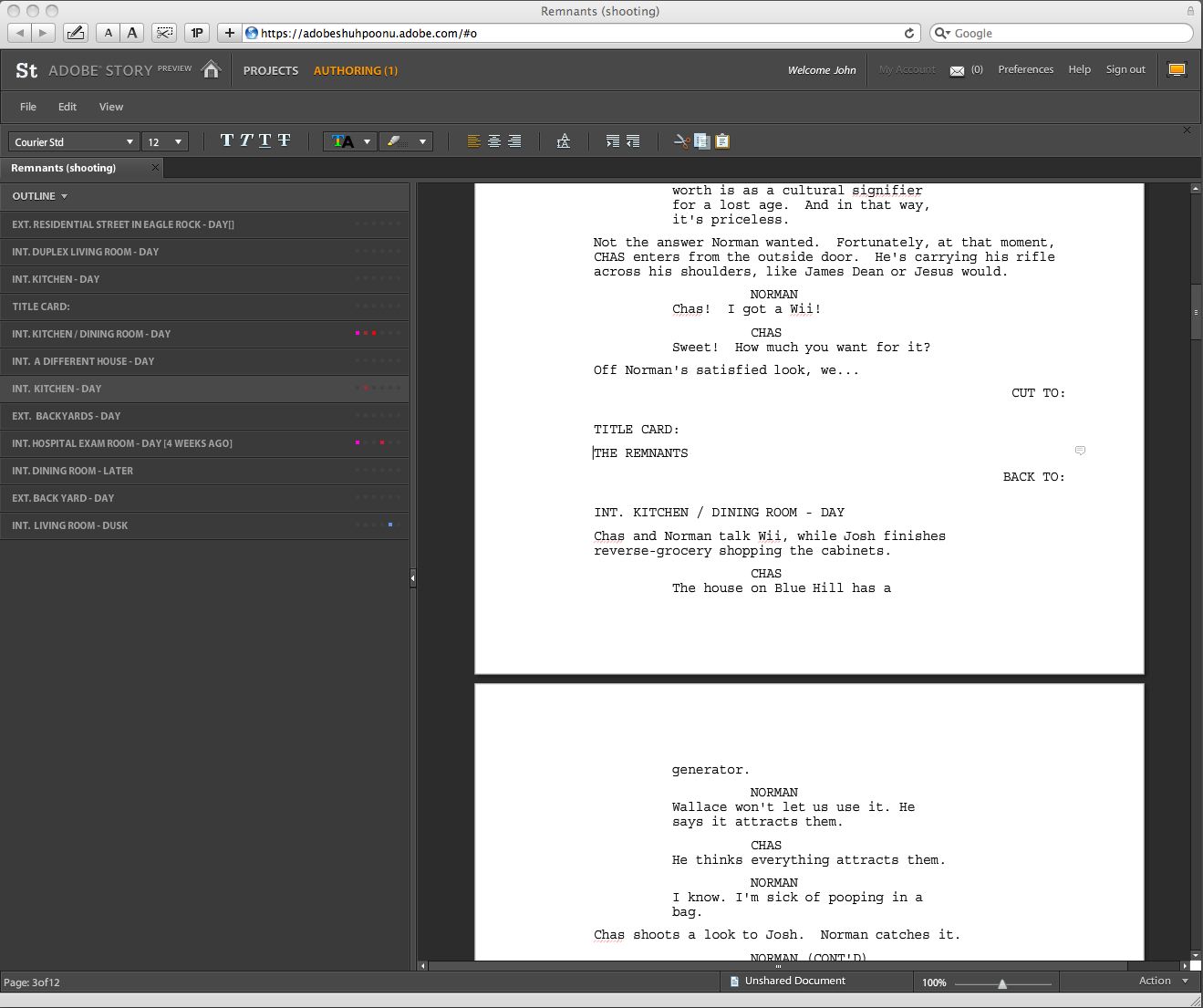
screenshot

Story is definitely a work-in-progress, so it’s not fair to compare it to the dominant players in the field. In its current form, it flubs some fundamentals like drag-and-drop and keeping blocks of dialogue together.

But while you wouldn’t use it for Actual Work yet, Story does some clever things that are worth calling out.

* Story tries to identify which characters are in a scene, and uses colored-coded dots to mark them in the outline.

* The highlighter is really a highlighter, changing the background of text.

* Full-screen looks good, with everything but the page itself nice and dark.

* Find and Replace is simply a toolbar in the same window.

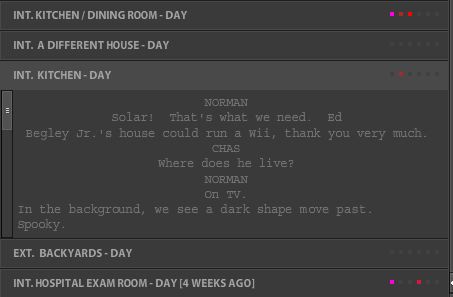
* Single-clicking a scene header in the outline expands it to a compressed, scrollable version of the scene, so you can check something without losing your place in the script. (Double-clicking a scene header jumps you to that scene.)
screenshot

I wish Story well. Competition is good, and a company like Adobe has the resources and experience to keep plugging at it. Yet I have a hard time envisioning it capturing a lot of ground.

Its text handling is strange, probably a result of its Flash origin. No doubt a lot of that can be remedied, but one of the consequences of platform-independence is that a web application is never going to act quite like a Windows one or a Mac one. With something as basic as text, I don’t want to have to consciously anticipate what’s going to happen if I try to select a word. Just work.

My other concerns are more philosophical. When the public preview of a screenwriting application lets dialogue spill across page breaks, I get nervous that its developers really don’t understand the format. Properly handling dialogue isn’t a feature; it’s a fundamental.

The preview version of Story does a good job importing and exporting. I didn’t test out the sharing and version-tracking features, but web-based software has a definite advantage here, and if Story is to make real inroads, it will probably be in this area. For writing teams, this can be very helpful.

I’ll be looking forward to seeing what Adobe does next with Story.

ADDED: Whenever I write about screenwriting software, the first questions are about what application I use. I alternate between Final Draft 8 and Screenwriter 6, with no strong preference between the two. I have also tried Celtx, Scrivener and Montage, but haven’t found them adequate for my work.

On the WGA elections

September 1, 2009 WGA

I was traveling last week when the WGA ballots were mailed out. Now that I’m back, I’ve had a chance to look through the candidates’ statements and endorsements. I want to explain my priorities for this election.

The future is important. The present is essential.
—–
The guild has focused so much of its energy on new frontiers — organizing reality television, political action committees, new media residuals — that we’re doing a lackluster job of providing basic services to our members: the boring but essential stuff like collecting residuals and enforcing contracts.

We’re running a deficit. We’re laying off staff members. We rail against “management,” but the fact is that our guild does not feel particularly well-managed. I want a president, secretary/treasurer and board of directors who will focus first on getting our own house in order. When I call the guild with a question, I want an answer. I want follow-up.

This may mean hiring more people, and firing some under-performers. This is a business. The guild needs to operate like one.

Groupthink is nothink
—–
I want a diversity of opinion and experience throughout the board. I’m leery of slates. I’ve endorsed several candidates who disagree with each other.

Rebuilding burnt bridges
—–
During a strike, it’s natural to demonize any person or organization that seems to be standing in the way of our goals. But the strike is over. DGA, SAG, AFTRA and IATSE aren’t stumbling blocks; they’re peers. We have reasons to be frustrated with these groups and their leaders, but the fact is that most of our goals overlap. We need to be meeting with them regularly and cordially.

The same can be said for the studios themselves. Their objectives are transparent — get as much as they can for as little as possible. But, like us, they also want to keep working. They want to figure out how to make money as technologies change and prices fall towards zero. They want to shoot movies and TV shows locally for a fair price.

Just as in international diplomacy, we’re often both partners and adversaries. I want officers and board members who understand this and don’t let heated rhetoric ruin any chance of cooperation.

My choices
—-
In all my conversations with **Howard Michael Gould**, I’ve been impressed with his ability to see multiple sides of an issue. His candidate statement for Vice President outlines exactly the points I think are most important.

I don’t know **Chris Keyser**, but his candidate statement for Secretary/Treasurer emphasizes enforcement and better fiscal discipline. These are my priorities. **Steven Schwartz** makes other important points about getting writers the money they’re owed.

**John Wells** is controversial because he’s perceived as being more of a producer than a writer. That’s naive, of course: in television, successful writers become producers, and mega-successful producers become John Wells. His experience and connections are an asset. His intercession during the strike wouldn’t have been necessary if guild leadership had engaged the DGA earlier.

**Howard Rodman** is a good friend, and an important advocate for indie writers, who are often overlooked. As a guild, we need to make sure we’re representing all screenwriters before trying to broaden our reach.

I got to know **Ian Deitchman** through United Hollywood and Strike.TV. Reading his candidate statement, I like that he’s pragmatic about the realities of new media, and the importance of enforcing the current contract.

Writer/directors like **Billy Ray** can help bridge the gap with the DGA. **Jeff Lowell** makes that a priority as well.

These are my opinions on the candidates and the issues. I’ll be keeping comments closed, because I don’t really want this to become another forum for accusations and potshots. It’s already become a frustratingly ugly election. My hope is that we can move beyond personalities to the crucial issues.

If you’re a WGA member, please vote. The deadline for ballots is September 17th — but mail them in early to be safe.

Jerome Schwartz, first person

May 13, 2009 First Person

I met Jerome Schwartz during the WGA strike. He recognized me from the blog, and told me that he’d applied for his job at the guild specifically because of one of my posts. After the strike, I asked him to keep me apprised of how his career was going. I had a hunch he would find a path.

———

first personI can remember, in the years before moving to Los Angeles, being constantly frustrated with Hollywood “breaking in” stories. I would devour those tales in search of details, steps to follow, at least an outline. But people seemed remarkably cagey about their first step. They gloss over, they skip the details. And now, after eighteen months in L.A., I realize why that is: The stories are useless.

Maybe useless is too strong a word. What I mean is, these stories are not replicable. There is no outline to follow. Hollywood careers all have their own weird combination of factors — luck, skill, circumstance, the flow of the industry, the flapping of a butterfly’s wings. The ingredients may be similar. But the meal is never the same.

So, disclaimers aside, here is my own little story.

I moved to Los Angeles in October of 2007. It was a move I had contemplated for a while, but resisted. At the time, I was living in Portland. And I loved Portland. It had friends, mountains, good coffee and better beer. I wrote a lot. I made a few films. But I finally concluded that script writing outside of L.A. was really just a hobby. If I wanted a career, I needed to wave goodbye to the evergreens and head to the land of sunshine and smog.

jerome schwartzOn Day One in Los Angeles, I picked up a copy of the LA Weekly. I saw mention of a little thing called the “Writers’ Strike.” And I thought, great. Of all the ill-timed ventures, I just made my big L.A. move two weeks before every writing job in the city was about to disappear. Nice move, Schwartz. Real nice.

Fortunately, I read John’s blog. And he pointed out that the strike was a blessing in disguise for young writers. Under normal circumstances, you arrive in Hollywood, and can’t find a single working writer to talk to, much less reveal the arcane secrets of the industry. Because they are all working. But now they were all standing in a pack, in front of the studios, holding signs. Looking for a little conversation to kill the time.

A week later, I found a temp agency hiring out to the Writers Guild, and pressed them for a job. This sounded like the perfect opportunity. To be around writers every day, networking, supporting my future guild, and getting paid for it? Dreamy.

On my resume, I was a “Volunteer Coordinator.” But to the writers, I was “That Van Loading Guy.” Put simply, the guild operated strike lines at all the major studios. Those striking writers needed signs. A lot of signs. And water. And food. And sunscreen. And chairs, and tables, and flyers, and so on. Every night, vans returned from the strike line in need of fresh supplies. Writers arrived to volunteer, and I put them to work loading those vans.

It was a funny reversal of the Hollywood story. I had just arrived. I was supposed to be getting these people coffee. Instead, I was ordering them to haul water jugs and clean dried orange juice out of vans. One time, a volunteer came up and said, “That was gutsy. Asking Cameron Crowe to haul your garbage.” I thought, “That’s Cameron Crowe?” I didn’t know what he looked like. To me he was just another easy-going volunteer, someone who wouldn’t mind taking out the trash if his guild depended on it.

The work was simple. The kind of work that is only made bearable with chit-chat. So there was a lot of it going on in the basement of the guild. And in Hollywood, I have often found chit-chatting to be synonymous with networking. I had always thought of networking as a particularly vile form of communication, reserved for slick, soulless Hollywood types. But in practice, it’s really just a habit of making friends. And eventually, friends may be in a position to help you.

100 days later
——-

The strike ended after 100 days. Unemployment loomed. So I emailed all my writer friends, and started hunting for that elusive first job. And finally, a job came through. One of the van-loaders was a writer on “The Office,” and he got me a job in the post production department. As a P.A. I loved the show and was excited to work there. I learned a lot in a short span of time. Problem was, I wanted to write. And I wasn’t learning about writing.

About two months later, a second opportunity arrived. Another writer from the guild (okay, full disclosure, this writer happens to be my girlfriend) passed my resume along at “Cold Case,” where they were looking for a writers’ P.A. This was much closer to what I wanted. I jumped at the chance.

Let me explain the job, at least as it plays out on “Cold Case.”

As a writers’ P.A., you are the lowest person in the writing department. Meaning coffee, lunch runs, and photocopies. But, at the same time, you are right where it’s all happening. Your work is all for the writers, and you will inevitably get to know them. You’ll see how they shape a script from concept to production draft. You learn the language, the techniques, and the pace of TV writing.

Now, I don’t know about other staffs, but the writers at “Cold Case” were also amazingly supportive of my own fledgling career. They gave me great critiques, which helped sharpen my material. A few of them passed me along to their agents, which was huge. As someone who has cold-called every agency in town (just before my L.A. move), I assure you it goes nowhere. You need a personal connection. And the writers at “Cold Case” were willing to recommend me, for which I am extremely grateful.

While working this job, I wrote a “Mad Men” spec that was well received. One very generous writer (from my guild days) thought the script was good enough to pass on to showrunners. Thanks to her belief in me, and a strong script, I landed two showrunner meetings in my first year in Hollywood. Neither worked out; one show wasn’t picked up, the other said close, but no thanks.

But getting those interviews was huge. It put me exactly one step away from that elusive dream of writing for a TV staff. Also, it impresses people. I was suddenly getting read by more agents and managers, because they heard about these meetings.

At this point, I had a little buzz, but nothing tangible. My spec was good, but not enough on its own. I met with agents, and was told repeatedly that I also needed a great original piece. So I buckled down, did my research, and wrote a one-hour dramatic pilot. In the process, I gained new respect for the art of the pilot episode. Setting up a unique world, a great cast of characters, a full season of conflict, and a satisfying story arc in 59 pages is no small task.

The here and now
———

As I write this, I have just completed that pilot. I have been getting notes from writer friends. I passed it on to agents in hopes of representation. And last week, I finally secured a manager. He agreed to manage me only because I had a personal recommendation, a good spec, showrunner meetings, and a good pilot. All these factors finally made me an attractive client. And I couldn’t have gotten good management without them.

Eighteen months ago, I had no idea what a Hollywood move would do for me. Now, after a lot of legwork, I at least have a toe wedged in that ornate mahogany door. I ain’t there yet, but the path looks a lot clearer than it once did. And for that, I feel pretty good.

Based on an idea by…

March 11, 2009 Producers, QandA, Treatments, WGA

questionmarkSo, I’m watching “Gosford Park” and I notice that the film is “based upon an idea by Robert Altman and Bob Balaban.”

My question is: How does one get that credit? Do you have to do some actual writing for it or is it some sort of a vanity credit? (I assume it isn’t, because otherwise every producer or executive type would have a whole stack of those on their record.)

— Steffen
Nuremberg, Germany

[Craig Mazin](http://artfulwriter.com) is on the screen credits committee, so he can likely answer this more thoroughly. But I can at least give you my take on it.

For feature films, the official WGA credits are “Story by” and “Screenplay by,” which can be combined to make “Written by.” ((There is also a very rare “Adaptation by” credit, which is only given in specific, complicated situations.)) When something is based on preexisting source material, like a book or a play, that original writer gets a “based on a novel/play by Original Writer.” ((Where it gets weird is when a movie is based on an earlier movie’s screenplay, such as a remake of a foreign film. There is ongoing discussion in the Guild about how to best handle this.))

Your instincts are right: Producers often have ideas for movies, but rarely do they get a specific, additional credit for it. However, if they wrote those ideas down, even in prose form, they could very likely get “story” or “source material” credit.

Per the [Screen Credits Manual](http://www.wga.org/content/subpage_writersresources.aspx?id=171), the requirements for these two credits are as follows:

> 3) Source Material

> Source material is all material, other than story as hereinafter defined, upon which the story and/or screenplay is based.

> This means that source material is material assigned to the writer which was previously published or exploited and upon which the writer’s work is to be based (e.g., a novel, a produced play or series of published articles), or any other material written outside of the Guild’s jurisdiction (e.g., literary material purchased from a non-professional writer). Illustrative examples of source material credits are: “From a Play by”, “From a Novel by”, “Based upon a Story by”, “From a series of articles by”, “Based upon a Screenplay by” or other appropriate wording indicating the form in which such source material is acquired. Research material is not considered source material.

> 4) Story

> The term “story” means all writing covered by the provisions of the Minimum Basic Agreement representing a contribution “distinct from screenplay and consisting of basic narrative, idea, theme or outline indicating character development and action.”

> It is appropriate to award a “Story by” credit when: 1) the story was written under employment under Guild jurisdiction; 2) the story was purchased by a signatory company from a professional writer, as defined in the Minimum Basic Agreement; or 3) when the screenplay is based upon a sequel story written under the Guild’s jurisdiction. If the story is based upon source material of a story nature, see “screen story” below.

When you see a credit like “based on an idea by,” that’s clearly a “source material” type of credit. In the case of Gosford Park, it may have been the strange way Robert Altman shoots. Apparently, rather than a complete screenplay, they had a framework upon which his actors improvised, with screenwriter Julian Fellowes on set to help shape the scenes.

Regardless of the specific situation, I’m not a fan of the “based on an idea by” credit, and would like to see it stay rare. It over-emphasizes the vague conception of a movie, at the expense of the distinctions provided by characters, narrative, theme and action (that is, story).

For example, “a movie about the Civil War” is an idea. Gone With The Wind is a story. For them to have rough equivalence is absurd.

« Previous Page
Next Page »

Primary Sidebar

Newsletter

Inneresting Logo A Quote-Unquote Newsletter about Writing
Read Now

Explore

Projects

  • Aladdin (1)
  • Arlo Finch (27)
  • Big Fish (88)
  • Birdigo (2)
  • Charlie (39)
  • Charlie's Angels (16)
  • Chosen (2)
  • Corpse Bride (9)
  • Dead Projects (18)
  • Frankenweenie (10)
  • Go (29)
  • Karateka (4)
  • Monsterpocalypse (3)
  • One Hit Kill (6)
  • Ops (6)
  • Preacher (2)
  • Prince of Persia (13)
  • Shazam (6)
  • Snake People (6)
  • Tarzan (5)
  • The Nines (118)
  • The Remnants (12)
  • The Variant (22)

Apps

  • Bronson (14)
  • FDX Reader (11)
  • Fountain (32)
  • Highland (75)
  • Less IMDb (4)
  • Weekend Read (64)

Recommended Reading

  • First Person (87)
  • Geek Alert (151)
  • WGA (162)
  • Workspace (19)

Screenwriting Q&A

  • Adaptation (65)
  • Directors (90)
  • Education (49)
  • Film Industry (489)
  • Formatting (128)
  • Genres (89)
  • Glossary (6)
  • Pitches (29)
  • Producers (59)
  • Psych 101 (118)
  • Rights and Copyright (96)
  • So-Called Experts (47)
  • Story and Plot (170)
  • Television (165)
  • Treatments (21)
  • Words on the page (237)
  • Writing Process (177)

More screenwriting Q&A at screenwriting.io

© 2026 John August — All Rights Reserved.