• Skip to primary navigation
  • Skip to main content
  • Skip to primary sidebar

John August

  • Arlo Finch
  • Scriptnotes
  • Library
  • Store
  • About

Search Results for: outline

Workspace: Phil Hay

November 23, 2011 Workspace

phil hayWho are you and what do you write?
—-

I’m Phil Hay, a screenwriter. I write (always have) with a partner, [Matt Manfredi](http://www.imdb.com/name/nm0542062/).

At the moment, our film [R.I.P.D.](http://www.imdb.com/title/tt0790736/) is in production in Boston, and we are back and forth from here to there. We wrote, with Adam McKay, an adaptation of the great Ennis/Robertson comic The Boys. McKay is putting that together right now. We’re also working on a quasi-secret movie for Fox and an adaptation of a Japanese movie called Big Man Japan for Sony and Neal Moritz (who is, indisputably, our main man.)

Before all this, we wrote [crazy/beautiful](http://www.imdb.com/title/tt0250224/), [Aeon Flux](http://www.imdb.com/title/tt0402022/), and co-wrote the [Clash of the Titans](http://www.imdb.com/title/tt0800320/) remake, and directed a movie, [Bug](http://www.imdb.com/name/nm0006534/) (2001).

Where and when do you write?
—–

workspaceFrom the beginning, Matt and I have tried to keep to a very regular schedule. We go Monday-Friday, 10-5:30 or 6 in normal times. Obviously, if in production, or when we’re close to a deadline, we can scramble into any hours.

For many years, we worked out of an office lovingly hewn from my garage. Recently, we moved to a place called “The Lot,” in West Hollywood. It looks pretty much exactly as you’d imagine a 1930s studio lot would. It’s mellow, and several of our writer and director friends are here, too, or come here when they are cutting or shooting.

We have one bigger room with two desks and a couch, and one smaller room with the corkboard and a table with chairs around it. We have a mini-fridge with beer in it, acquisition of which was a personal and professional high water mark.

My desk is piled with stuff — scripts, notes, books, scrawls. Matt’s is completely, eerily, annoyingly clean. The desks face the same direction but are angled slightly toward each other so we can talk. We used to sit directly across from each other, but I think we can all agree that that’s a bit much, right?

We’ve both realized that the immediate surroundings don’t affect us all that much. Our HQ used to be the kitchen table in an apartment we shared. At times it’s been a hotel room, a veritable broom closet at Warner Brothers, a spotless, oddly narrow room at Studio Babelsberg in Potsdam, a shivery, cavernous room with dangling electrical wires at Longcross (a tank-proving-ground- turned-studio in England,) a glass fishbowl in Boston that actually, and truly, and deeply, smells of fish.

(An interesting bit about production: during the last couple weeks of preproduction, the editorial department always comes sniffing around your office, measuring, assessing… craving. They will inevitably annex your space and kick you down the hall. 3-for-3 so far.)

But at home, going to our own office every day is a ritual that is very helpful. We always outline together, then we divide scenes and write — sometimes still in the same office, sometimes at home, sending files to each other at the end of the day. When we have the raw scenes down we manufacture a Frankenstein’s monster version, stitch it together, then come back together and work (battle) it through.

What hardware do you use?
—-

I use a previous-generation MacBook Pro, because I always, always pull the trigger on a new computer moments before the new model debuts. Matt uses a MacBook Pro of the current generation, bought two weeks later. I love all office products. I buy a lot of them, but I rarely I end up using them. Little cardboard folders, aluminum boxes (the greatest), envelopes, binders… going to Staples is like going to Toys ‘R Us. But as I said, I can’t figure out what to use them for. I guess what I’m realizing is that I love to store office products. That my true passion is for warehousing.

I truly love pens. I’ve only met one person who loves them more, and that’s [Robert Schwentke](http://www.imdb.com/name/nm0777881/), our friend and the director of R.I.P.D., who turned me on to the greatest pen in the world. Pilot G-TEC-C4. Do yourself a favor.

**Drawing pens.** I scribble and doodle a lot, maybe even obsessively, over all surfaces.

**Notebooks.** I also love notebooks. I’ve had some great composition books from Japan that have weirdly translated slogans on the front: “It must Perfection try to it” or “Information: here fell the NewHand”. I used to use those great hardcover lab books when I was in grad school. Now, I like those orange Rhodia deals that are the size of a pack of cigarettes and can fit in your back pocket.

**Freitag bag.** I got my first in Berlin, where they are very popular. They’re made of old truck tarps and seatbelts. For me, it’s the greatest computer bag in the world.

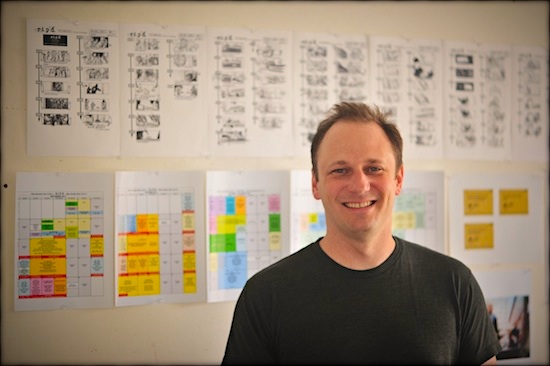
**A corkboard.** We aren’t big on notecards, but we post a 10-12 page outline sequentially on a corkboard, and kind of check it down as we are writing. We often write out of sequence — our belief is that we should write the stuff that most excites us on any given day, both because it’s more productive for us and it eventually exposes any scene that feels obligatory or dutiful — so this is really helpful. We also put storyboards up here, diagrams of action sequences, things like that.

What software do you use?
—-

[Final Draft](http://www.finaldraft.com). Never occurred to me to use anything else.

Sometimes, [iAnnotate](http://itunes.apple.com/us/app/iannotate-pdf/id363998953?mt=8), which allows you to write on PDF’s on the iPad. It’s the first thing that has come around in a while that feels like a leap forward and has made a dent in my totally locked-down habits. Still, I generally need to print a script out and make notes by hand.

What would you change?
—–

Here’s what I definitely wouldn’t change: having an extremely talented and excellent partner. He’s truly great.

What I would change: I’d write more.

I’d be less snowed under all the time by an avalanche of thoughts and fragments and 100 movies or stories I’d like to write. I’d be more methodical and I’d move on faster. No matter how much we write — and I think objectively we write pretty much — it never feels like enough. That definitely haunts me.

But I bet I have a lot of company in this feeling out there (don’t I?!). So maybe what I’d change is accepting that more. I never stop thinking about stories. Even though I feel I do 90 percent of my own work while walking around doing something else, there’s something very important about having the dedicated physical space and an ironclad ritual about attending to it every day.

Someone once told me that as a writer you’re like the proverbial Newton under the apple tree. Your job is to be there when the apple finally falls. Sometimes that is the job, just being there, putting in the hours, as many as you can. You have to be sitting there so you don’t miss it.
Workspace: Heather Hach

November 18, 2011 Workspace

heather hach

Who are you and what do you write?
—-

I’m Heather Hach, and I’m lucky enough to call myself a mostly-employed screenwriter. My best-known credit is Freaky Friday — the recent one, not the 1970s version. I’ve also written for Broadway (Legally Blonde the Musical), TV (an ABC pilot last season that didn’t get picked up), and a book you may have seen in the Bargain Bin pile (Freaky Monday), but I still consider myself first and foremost a screenwriter.

I tend to write comedies and more female-driven material. I’ll share credit on the upcoming [What To Expect When You’re Expecting](http://www.imdb.com/title/tt1586265/), which comes out Mother’s Day 2012. (Please go opening weekend. Please.)

I probably identify myself primarily as a screenwriter because I simply love movies all out of proportion. When movies are good, I’m the woman randomly clapping and guffawing with loud delight in the back of the theater. (Actually, not the back — the middle, and always on an aisle. Always. Small bladder.)

When I went through the ego boost of having my husband walk out on me 15 years ago, I told myself, “Good god, seriously? This is my life? Okay, what do I REALLY wanna do now then? Because my personal life is in the toilet but maybe my professional life could kick ass.”

And I realized while watching Good Will Hunting, I love movies most. (And while watching Star Wars. And while watching Jaws. And while watching Crimes and Misdemeanors. You get the idea…) And I love comedy. (I used to perform with an improv troupe in Denver.) And writing. (Which is what I did professionally.)

So I combined those passions, and realized that’s called being a screenwriter. I started writing scripts, and I knew this was ‘it.’ I moved to LA in 1998. In 1999, I won the Walt Disney Fellowship, and my first assignment was Freaky Friday. I had no idea then this is generally not how Hollywood works.

Where and when do you write?
—–

workspaceI try — operative word being ‘try’ — to write from 9 to 5-ish at my home office, with varying degrees of success. I have a 21-month old boy at home who wants to wander into my office, and he is damned irresistible, so that’s challenging.

I also can be easily distracted and spend an inordinate amount of time looking up flash sales to places in the Bahamas I’ve never heard of and for ridiculously high heels I’ll never wear and why Kim Kardashian is the worst person on the planet.

Oh, and interactive maps predicting whether Indiana will go blue or red in 2012. I love those.

What hardware do you use?
—-

I use a Macintosh OS X (I had to go to the “About This Computer” icon to find out that information, if that gives you a clue) and have a painfully out-of-touch Mac laptop. It’s so old I’m not even going to look it up and embarrass myself.

What software do you use?
—-

[Final Draft](http://www.finaldraft.com/), of course, and I think I have version 8 but I could be wrong. I use [Word](http://office.microsoft.com/en-us/word/) a lot for my outlines. Frankly, I’m like a fawn whose mother has been shot in the woods when it comes to technology.

What would you change about how you write?
—-

I think writing would be a lot easier if I could somehow magically be Aaron Sorkin for 23 minutes a day — or Beyonce, even. Both, ideally.

That’s not going to happen. So I have to maximize my own skills and do the heavy lifting and painful work of breaking a story (the part that inevitably makes me want to lay down). I wish I knew how to make that process more digestible. I still don’t. I wish I could tune out the world better and not be so ADD all too often.

I strive for five pages a day when I’m in delivery mode — whether that takes me an hour or ten. If I’m ambitious, I’ll do more.

Workspace: Chris Nee

November 1, 2011 Workspace

chris nee

Who are you and what do you write?
—-

Despite the name Chris Nee, I am not an Asian man — although I did get a staff writer job on a show because the studio was looking for an Asian male perspective. When they met me, a chick and Irish, I’d already been hired and they couldn’t exactly say anything.

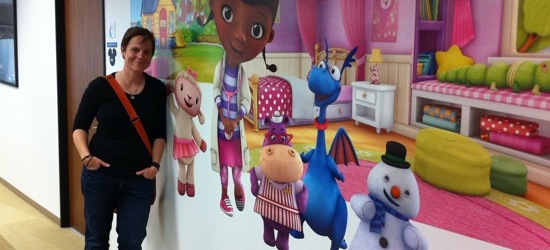
I’m currently the Executive Producer, showrunner and head writer of an animated series I created for Disney Junior. The show is called Doc McStuffins. We’re in post on 26 half hour episodes (52 11-minute stories) that will premier on Disney Junior in March of 2012.

I’ve had a pretty eclectic career. I started at Sesame International and spent time in Mexico, Finland, Israel and Jordan working on local versions of Sesame Street. Somewhere I have tapes of the Arabic Bert and Ernie taking long drags on their cigarettes after every take.

For many years I juggled writing for kids TV — both animated and live action, teens to tots — and producing documentary/reality TV series. I wrote the first Wonder Pets Christmas Special from a converted WWII barracks-turned-hotel on an island halfway between Alaska and Russia while producing season one of The Deadliest Catch.

I won an Emmy for writing Little Bill on Nick Jr. while I was Supervising Producer on Roseanne Barr’s first reality show. All in all, weird and wonderful.

Where and when do you write?
—

workspaceI write in one of three places. While we’re in the nine months of writing the series, I have an office/loft space, which I share with two staff writers and our writing coordinator. Or I’m in Ireland sharing an office with the director of our series; the show’s being produced in Dublin. Or I’m working in my home office. It’s a separate room in the front of the house. I watch everything that happens on our street. You can’t believe how often people drive the wrong way up a one-way street.

I have no explicit rule that my five year-old can’t come into my office, but he’s pretty good about it. Sometimes it’s a huge distraction, but mostly he’s dying to see what I’m working on, and that’s pretty validating. I think I once had a rule about my partner not coming into my office, but she pretty much just ignores that, so I gave up.

I can’t do music. Or talking. Other than that, I’m very good at blocking out the outside world. With next-door neighbors in their fourth year of construction, this is a good thing.

I do a round of emails right when I wake up, since I’m in LA while my production team is in Ireland. Conference calls are also early. I try to run four times a week. Then, I write from 10 to 6-ish. I’m almost always home for dinner.

If I’m up against a tight deadline, or at the height of the writing schedule, I sit back down for a few more hours after my son is in bed.

What hardware do you use?
—-

I have a 27-inch iMac at home. The screen is ridiculously big, but I love seeing a complete top-to-bottom page on the screen. Even more, I love having an outline or notes open on the left of the screen, and a full page of a script on the right.

I’d worked exclusively on a laptop for years, but it was catching up with me. I don’t have carpel tunnel, but I get numbness in my fingertips from the track pad. So I knew it was time to set things up right in my home office. That meant a desktop computer. An Aeron chair. And a foot stool, as I’m short. [Beth Schacter short](http://johnaugust.com/2011/workspace-beth-schacter).

I use the standard Mac wireless keyboard. I’m very sensitive to the weight of keys on different keyboards, and this one feels incredibly light and easy on my fingertips. When I go to a bigger keyboard that requires more punch to get the keys down, I tend to start having finger pain.

My current laptop is a 15-inch, almost 5-year-old MacBook Pro. I take it back and forth to my writing office, the voice records, the mixes and Ireland.

I usually update computers every three years. I figure I spend most of my life on my computer so I should let myself be on one I love, but I started feeling bad about the environmental impact, and am now trying to get an extra year or two out of my laptops. About two years ago I stripped my MacBook Pro, had the memory doubled, and started clean with the machine. It’s been great for this extra time, and I feel better traveling with an older computer, but I’m itching to upgrade and am sure I will when my series gets picked up for season two.

I review all 52 episodes of my show at all of the follow stages: EMR, rough animatic, animatic, rough animation, offline animation, score pass, revised score pass, pre-mix and final. Plus I get huge amounts of artwork, voice auditions and animation tests every week. All of which is to say, my computer is overwhelmed by huge files. I stopped keeping everything on my internal hard drives. I have a 500 GB LaCie external hard drive that lives on my desk for backup. And I carry a portable 500 GB LaCie drive with me everywhere I go. My show lives on that drive, and is backed up to the other one.

I use small-sized [Moleskin notebooks](http://www.amazon.com/dp/8883701003/?tag=johnaugustcom-20) to keep lists in. I write the lists, but can’t read my own handwriting and rarely look at them. Still, it’s good to know they’re there.

I have a wall with 3×5 cards of all of our episodes — 52 of them — color coded for the stage of production they’re in. I live for it. I stare at it. I need it. Almost weekly I panic on record days and ask my assistant to take a picture of the wall and send it to me so I can visually see where I am.

I have a white board for breaking stories with the staff writers or freelancers. We take a picture of the board when we’re done and erase it.

I have a separate white board by my desk. It has three lists:

1. Everything that’s been assigned to writers.
2. Everything I need to talk to Disney about. That way when my exec calls, I can tick through the things on my agenda without fumbling or having to call back.
3. My to-do list. I love this list. I often finish something, turn to the board anticipating the satisfaction of the check mark, realize I never wrote it down in the first place, run over and write it down, wait a beat, then change to the correctly colored pen and check it. Still satisfying.

I have an HP 3-in-1 jet printer, and a laser printer. As someone who is a terrible speller and was always a bad proofreader, I’ve had to teach myself to hand in pages that are professional and error-free. I live by the printed proof pass. It’s been proven that you see more on the printed page than you do on a screen. If you’re not naturally good at proofing, always print. Put your finger on the page. Mouth the words. It is a skill you can learn and improve on. And yes, it matters. People do notice.

What software do you use?
—-

I use [Final Draft](http://finaldraft.com). In the world of TV animation, it’s the only format I’ve encountered. To change would be a royal pain in the ass. I try to ignore talk of greener grass.

I also use Microsoft Word. I use [Skype](http://skype.com) quite a bit when communicating with the Europeans. I envy John August and his technical relevance.

What would you change about how you write?
—-

I’d always write as if it were crunch time in production. When there’s more than is humanly possible to do, I’m a machine, and I do it. Well. And without angst. When my schedule lightens up, I can’t seem to get half the work done in twice the time.

For me, having a child was the greatest productivity booster of all time. A) I want him to be proud of me. B) I can’t fuck around anymore. I just sit down and get the shit done. When I think of all the times when I was single and not a parent that I said I didn’t have time to do/work on this, that or the other… I could just shoot myself. I had all the time in the world.

Scriptnotes Ep. 9: Five figure advice — Transcript

October 27, 2011 Scriptnotes Transcript

The original post for this episode can be found [here](http://johnaugust.com/2011/five-figure-advice).

**John August:** Hello and welcome. My name is John August.

**Craig Mazin:** My name is Craig Mazin.

**John:** This is Scriptnotes, a podcast about screenwriting and things that are interesting to screenwriters.

Craig, you are doing our first live from the field reporting.

**Craig:** That’s right. I’m at the Austin Film Festival here in Texas. It’s a big deal. I mean, it’s not a big deal that I’m here but the film festival is a big deal.

**John:** The Austin Film Festival is one of the few festivals that is really setup for screenwriters. Screenwriting is the focus of the festival I would say.

**Craig:** That’s exactly right. There’s the National Screenwriting Conference but that really isn’t a film festival. That’s specifically just about screenwriting. The Austin Film Festival does have actual films.

It has a pitch competition, a screenplay competition, a ton of panels and seminars and big, big names here. Larry Kasdan’s here and John Lasseter from Pixar and I believe Johnny Depp is in town, your buddy.

**John:** Good stuff.

By the time this podcast is actually up on the site it’ll probably be past and no one can come see you at your speaking engagements, but what panels are you going to be on? What are you going to be talking about?

**Craig:** I already did two today. Today I did a how to pitch seminar and then they do these round tables where you sit down and just meet people and talk to them and then after 20 minutes you go to the next table, a little bit of a speed dating thing. Then tomorrow I’m doing — I’m flipping through the book to see what I’m doing tomorrow.

I think I’m doing a thing on comedy. Yeah. It’s called Comedy: The Hardest Genre, and it’s at nine in the morning, so yeah — at nine in the morning it is the hardest genre. Then something else. Then there’s some creative — I don’t know John. [laughs] Honestly I should know and I keep checking this booklet and I keep forgetting what I’m talking about, but hopefully I’ll be fascinating when I say it.

**John:** Last year I was at the Austin Film Festival and I gave a special master class seminar on Big Fish which was scheduled super early in the morning. It was like a 7 AM session on Big Fish.

I enjoyed doing it. The challenge was that I had to talk about Big Fish as if it was some project I had worked on many, many years ago, because at that point we hadn’t announced that we were doing the Broadway musical.

So there were several moments during the presentation on the choices of the adaptation that has to say like, “Now, if you were going to do this, for example, as a Broadway musical, you might make some different choices about these kinds of things,” but it couldn’t be too specific.

Of course I was literally hopping on a place to fly from there to work on the Broadway musical so it was a strange thing. People said, “Wow, you seem to remember that story very, very distinctly and clearly. Did you bone up for it for the session?” No, it was all there. It was all live.

**Craig:** No one bones up for anything.

**John:** No. We pretty much show up and talk about the kinds of things we know to talk about which is screenwriting and answering questions about screenwriting, which is why I thought today we might take one of our listener questions that came in. This came in today from a young woman. I assume it’s a woman. I assume she’s young.

These are just random assumptions. A person named Alana. She writes:

“I’m a pretty new working writer. Last year was the first year I did real work for a studio, and now that I’m done with that project and back on the merry-go-round of meeting some producers, I don’t really know how to plan my career or, indeed, if that’s even a thing people do. When your agent and manager bring you possible projects or people who would like to meet you, should you just say yes to everything, pitch on everything, develop ideas with every producer who wants to, or should you pick things that you think will lead you in the overall direction you would like to do? Basically, should you have rough goals for the next few months, the next year, should you have a five year plan?”

This is a very broad question I thought could be a good… Let’s talk about your first couple years as a screenwriter jumping off place both in career advice but also overall life advice.

**Craig:** That’s a great question. It’s a great question. I feel like I’m still wrestling with that one to some extent. Almost all those things I could answer yes to all those oppositional questions. Should you plan? Yes. Should you say yes to everything? Should you be picky? Yes. I feel like I’m always vacillating back and forth between those poles. I don’t know about you.

**John:** Definitely. So I think it’s going to be best if we break this into smaller, manageable chunks that we can address. So let’s talk about career advice in terms of Alana as a screenwriter. Let’s talk about meetings. Should she take every meeting that she’s offered at this point?

**Craig:** Yeah. I would say so.

**John:** I would agree. Your agent and your manager are going to send you out to meet with a bunch of people, and a lot of those are people who they have other clients working with, people they know socially. They’re basically going to throw you against a lot of walls and see what sticks.

The reason behind this is people will have read your stuff but nobody’s going to feel comfortable hiring you to do any project unless they’ve sat with you in a room and seen, “Oh, she’s this kind of person, this kind of writer. I can see calling her on the phone and talking about a specific project.”

So you’re very unlikely to get hired for any of these early jobs unless you’ve actually sat in a room and talked with these people.

**Craig:** It’s true. Sometimes there’s a magical little thing that happens. Inevitably, these meetings have some context. They say general meetings, but there’s no such thing, because everyone that’s having a meeting with you has something they need and they’re going to mention it.

“We would love to have somebody write a movie like this.” Every now and then you have one. You have that thing that they’re looking for, even if it’s just the germ of an idea, and you might just start talking about it and they might just get excited and suddenly you’re generating a possible job.

I always think of general meetings as specific meetings that just don’t know what they’re specific about yet.

**John:** I’ve talked about this in sessions like the Austin Fall Festival but I don’t know if we talked about it on the podcast is that every one of these meetings has the same kind of template, which is that you will show up at the office, you will be a few minutes early, the assistant will offer you for something to drink.

You should ask for a glass of water or a Diet Coke or something that they will have, so they can get you something and bring you something and feel like they’ve done some part of their job.

The meeting will start a little bit late. You’ll go into that person’s office, you’ll sit in whatever chair is appropriate to sit in, and you’ll spend the first five minutes talking about nothing important at all.

It’s just really general chitchat about the most recent movies, about random stuff, where you grew up, where you went to school. At some point it’ll segue to “This is what we’re working on. Tell us what you’re working on. Is there something together that we should be working on?” A lot of times this is the same template as going in for a pitch, where there’s the general stuff before you get to the meat of it.

In a general meeting it’s just, “I’ll show you some of what we’re doing if you show me some of what you’re doing.”

**Craig:** Exactly, and usually there’s some pretext for the meeting, even if it’s just, “I love your agent, he insisted that I meet you and then I read your thing and I really liked it.” There’s always some pretext. Nobody really has a meeting with somebody that is a complete blank with them. There will always be a little something to talk about.

**John:** At the same token, you should be able to have a conversation about the kinds of things you want to write and the kinds of things you want to work on. So you don’t have to be able to pitch specifically what it is you’re trying to do.

If you’re the kind of writer who is working on thrillers you might say, “I’m working on a thriller set in the Boston financial market,” which I’m not even sure makes sense.

It’s a general enough pitch that describes the kind of idea that you’re working on without giving up all the details of what specifically you’re trying to do. If you just sit there and respond, “Oh, that sounds good,” or “That sounds interesting,” they’re not going to have any more specific idea of what to pitch to you when something comes three months down the road.

**Craig:** Yeah. It’s an opportunity also for you to start showing them what you can do. They might say, “Well you know we’ve had this idea that we’ve been working on for a while that’s the kind of thing we love and it’s this,” and they briefly describe it.

There’s nothing wrong with saying, “I really like that. When you pitched it to me where I was thinking it was going was this or this.”

The truth is that’s what they’re hiring you to do. They’re certainly not looking for people to go, “Oh, Okay. Thank you for spoon feeding me something.” They want people with an opinion, as long as it’s a smart opinion. So it’s a chance for you to begin to show off the quality of your mind. So I would say take every meeting you can when it’s early on in your career.

**John:** The more challenging decision is whether to pursue every project that comes up, every project that enters your universe of maybe-you-could-be-hired-to-do-this. When you and I were both starting, projects would come up.

The first idea I ever pitched on was How To Eat Fried Worms, which is an adaptation of a great kid’s book that Ron Howard’s company was doing.

It was presented to me as this is something you might be considered for. This was before I’d written Go. I’d just written a romantic tragedy and the novelization of Natural Born Killers, so it wasn’t a great choice on paper to be doing this.

But it was a book I knew and a book I liked so I pursued it hard and tried to get it, and I was able to get it.

There were a lot of those kinds of opportunities, and you had to be careful about which ones you were going after, because you could spend all your time chasing these projects that either aren’t real or were that they’re meeting with 15 writers and your odds of actually landing the job are pretty small.

**Craig:** That’s gotten worse, I would say, with the contraction of the release schedule. They just make fewer movies now, so there are fewer things to go in on, which means that the group of people that you were going up against — that cohort — has increased dramatically.

Early on in my career, most of the stuff I was working on was self-generated with my partner. So we would come up with ideas and pitch them and just try and get our own stuff going, which is always a great way to keep these meetings going because it’s a relief for them. They don’t feel like they have to do all the work and that they somehow are convincing you to let them pay you for something.

But when it’s early on you have to ask the fundamental questions: “Okay, do I need money?” “Am I starving?” “Am I making my rent?”

If you need money and a job comes in, take it. If you’re doing okay and there’s not going to be massive opportunity costs and a job comes along that just seems like a bad idea, you have to push the plate away.

That’s a lesson that it took me a while to learn, and I think I suffered, frankly, because I wouldn’t push the plate away. I grew up with… My parents are public school teachers and it was a very firmly middle class life where somebody offers you money you do the work.

I had to shake myself out of that a little bit, because eventually you start to become connected and associated with those jobs whether you like it or not.

**John:** The second scenario, though, that you’re talking about, where somebody comes to you with a job and you say, “No, no, I don’t want to do that job,” that’s a luxury problem, and I feel like this early on in her career that’s probably not going to happen very often.

It’s unlikely that someone’s going to come to her and say, “Hey, do you want to do this movie for us? You don’t have to pitch against nine other people. This job is yours if you want it.” That’s going to be unlikely where she’s at right now.

**Craig:** So the question is whether or not she should be pursuing the chance to write something?

**John:** Exactly. My instinct is if it’s a job she really wants then she should pursue it, but she should also be asking her agents and her managers how many other people are going out for this, which is information which I think contractually the studio has to say how many people are going out for it.

Producers will sometimes fudge and not really say how many people they’re bringing in or how many people they’re talking to about a project. If you find out that fifteen writers are going in for this adaptation of this book they just bought, that may not be the best use of your time.

**Craig:** If you love it then I think there is a case to be made that it’s good practice. Again, if you’re early on in your career it’s good practice. God knows how many stories I broke early on in the pursuit of chasing down work. It’s a way of honing your craft and getting better at it while exposing your potential value to people who hire writers.

But if you’re marginal on it or if your agent is excited about it for you but you’re not then, yeah, you might be better off working on your own thing.

**John:** What might be important to talk about is how many days to spend prepping that first coming in with your idea. Don’t spend two weeks on it.

I think it’s a great thing to be spending a couple days figuring out your take on it, being able to pitch what your idea is, but if you are writing a ten page outline even for yourself on that project you’re probably spending too much time pursuing something that’s not a real job for you.

Being able to go in and pitch a good version of a movie, especially if you’re one of the youngest writers, the most junior writers, going in on the project, that may at least impress them and get them thinking about you for the next job, certainly.

**Craig:** Yeah. And these things have levels in that you want to go in and pitch a take on it. You don’t need to give them your scene by scene description of the movie you would write; give them your take, your vibe, your approach. If they get really excited by that that is a green light for you to continue on it because there is a real possibility. If they’re lukewarm or negative you just saved yourself a bunch of time.

**John:** Absolutely.

Now let’s talk about the types of projects she should be pursuing, because in her question she didn’t say what kind of project it was that she got hired on, but my instinct is whatever it was she got hired on was probably based on other stuff she’d written before.

So if she’s a comedy writer she had written some comedy specs, she wrote a comedy for these people, the first studio job, and that’s what people are seeing her as.

This is not the time for her to say, “I’m going to write a political thriller.” I think if she’s being perceived as a comedy writer she would do herself best by continuing to write comedy and continuing to go out and pitch comedy.

**Craig:** Certainly from the point of view of building a continuing career, no question. Everybody’s a little concerned about being pigeon holed, but the truth is that is a rich writer’s problem.

You can write yourself out of your pigeon hole. You can’t write yourself into a career if you’re all over the place. People want to know what list they should put you on, and they do have list. Your agent, too — by the way, your agent will get very confused.

**John:** Yeah. If your agent doesn’t know which jobs to put you up for, that’s going to be a real problem, so you need to be honest about that. To a degree, to broaden your perception of how people see you as a writer, that’s why you need to be continuing to write specs even while you’re going out after these assignments.

You need to be working on your own stuff that is not beholden on anyone else hiring you to do stuff so that you can have new stuff to show.

**Craig:** I would say that the nice thing about specs is if you do want to branch off and show another side, I feel like you’re always allowed to do that in a spec, because the proof’s in the pudding. If you are getting comedy work but then you go turn around and sell this amazing horror spec, now you’re a double threat and that’s great.

In terms of pitching and going after jobs, don’t really think that anyone’s going to take you seriously if they don’t have evidence that you can deliver.

**John:** My first two jobs were How To Eat Fried Worms and A Wrinkle In Time, so at that point I was perceived — and pigeon holed — as being a guy who adapts kids’ books. So I was getting sent everything that involved gnomes, elves, dwarves, and Christmas. I liked those movies, but it wasn’t the only thing I wanted to write.

The luxury of having Go as a spec is that people could read Go and say, “Oh, this is a guy who writes comedy or writes action movies or writes drama or whatever.”

People could read Go and see whatever they wanted to see in it, and even before we made the movie it was very helpful for me getting considered for lots of different kinds of projects.

I would only be able to have a writing career at all because I had written these other movies that were so safely pigeon holed.

**Craig:** I don’t get really fussy or embarrassed about whatever it takes to break your way into the business. There are very glamorous, apparently creatively honorable ways to get in, but I’m not obsessive over purity.

It sounds great to say, “I wrote an incredibly heartfelt spec that was shatteringly brilliant and that’s why I am the biggest writer in the business,” which I’m not, but you don’t have to be that.

That’s an unnecessary burden to place on yourself, particularly when it’s early on.

**John:** While she didn’t ask the question I will append the question: She should also be considering TV. If you’re a future writer who likes television you should also consider TV, especially at this early stage in your career. You don’t know that you’re going to get another feature job for a year or two years or ever.

There’s more jobs in TV overall, so if TV is something that you like and something that you feel like you can write, I think you’re doing yourself a service in 2011 also writing television and trying to get television shows set up, trying to get staffed, trying to make good television shows, because that’s where the best writing and the most writing is happening.

**Craig:** Makes sense.

**John:** Let’s talk more life stuff for her in terms of a five-year plan. In terms of a five-year plan I think you have to ask yourself, “€œWhat kind of writer I perceive myself as being?€ Do I want to be a feature writer who is known as a brand of a writer?” If so, then probably picking a genre and being very true to that genre will serve you very well.

If you want to be a writer/director you need to start thinking about, when are you going to direct a movie? If you perceive yourself as being a writer/producer, like Kurtzman/Orci or Simon Kinberg, you need to start thinking about writing the kinds of movies that require such care-tending.

— Care-tending? Care-taking?€

**Craig:** I like care-tending€ Own it.

**John:** — Care-tending that requires such oversight and such producorial function that people start perceiving you as the guy that can keep the ship from sinking. You look at the writer/producers who do that and they are responsible people who are good writers but are also able to deal with all the politics and all the personalities of getting a movie made and can deliver a movie for a studio.

Kurtzman/Orci do it for Dreamworks; Simon Kinberg does it for Fox. There’s a lot of value.

**Craig:** The thing is, you have to know what your goals are and lay out perfect what the options are. Plan implies that you can chart a course that is followable, and I have to say I don’t think there is such a thing. What we’re dealing with is a highly chaotic business, and at its best there is still this enormous questionable outcome.

Even if you get your movie made, who knows how it’s going to hit the audience, how it will perform, how it will be received within the business, how the perception of you as a writer or writer/producer or director changes?

The important thing is to keep your goal in mind. Try and nudge this thing towards the goal, keep moving forward as best you can, but prepare to adapt, because you will get thrown curveballs. You may say, “I want to be a writer/director,” and you may turn out to be a writer/producer or just a writer, and there’s nothing wrong with that.

Hard to plan, I have to say.

**John:** I think it’s hard to have a plan. It’s easier to have templates. I remember as I was first getting started, Go’s production offices or pre-production offices were actually shared with Kevin Williamson’s space. I would see Kevin Williamson writing Dawson’s Creek.

I’m like, “Oh, that seems really, really hard but I see that he’s working really, really hard and I can work really, really hard so I could probably have a show on the WB as well,” and I did. It was good to see that.

I always kept Kevin Williamson as an aspirational figure in those early years. Here’s a guy that’s making movies and doing TV shows at the same time and it’s all good and happy.

I think now with the rise of the show runners — or at least the publicity we now have for show runners — you have a better sense of whether it’s JJ Abrams from the Alias days or Joss Whedon, people who are running these major shows.

You see what it’s like and you can say, “I want to get to the stage where I can create a show and become a show runner and that’s not going to be easy,” but that’s a template.

You can see how those specific people did it.

**Craig:** Right. You define a goal, you look at how other people achieved the goal, and then you move towards it the best you can, but be open to things that you didn’t think would be there.

I never thought of myself as producing movies until I started producing movies. Keep your knees bent and stay loose because it’s going to turn out differently than you think. Over planning is just going to choke the life out of you. You need to be able to be prepared when serendipity strikes.

**John:** On the topic of being prepared, let’s segue to the life advice, particularly money, because you talked about, “Should I pursue this job? I need the money.”

Money was a huge concern for my first four or five years as a screenwriter in that what’s so different about screenwriting versus other jobs is we don’t get paid regularly. We get paid in these chunks and then that money dissipates.

So what I would do is as I would get paid to start a new draft…

Actually, I should explain how screenwriters sort of get paid in case people aren’t familiar with it. When we are hired to work on a project, we are given a certain amount of money to start the first draft. And then when we deliver the first draft, we’re paid the other half of that money.

So usually, the biggest chunk of money comes from that first draft, and we’re paid half upfront and half when we deliver. If we’re brought on for the rewrite, we get half upfront and half on delivery for that rewrite.

Once you’re hired onto a job, you have some sense that money is going to be coming in and you have some control over when that money should be coming in — hopefully they’ll pay on time, based on how long you know it’s going to take to write stuff.

Being an organizer and a planner, I would make a spreadsheet that would list all the months ahead. I would mark when I was expecting money to come in and I kept really careful track of all of my expenses.

I would say like, “Okay. This is how much it’s costing me to live each month in Los Angeles. This is my rent. This is how much I’m paying on food. This is how much I’m paying for my car. This is how the money disappears.”

And I could track that. Like, “I would be okay for six months at this point and hopefully, I will have another job before then to keep paying. And hopefully, I will overlap some of these checks so it’s not just, ‘Watch all of John’s money disappear.'”

But that’s very much the experience of being a screenwriter. You’re not getting a weekly paycheck, and without getting that weekly paycheck, you have to really be looking quite a few months down the road.

**Craig:** Certainly the best financial advice I could give to a screenwriter who is working and is early in their career is: live beneath your means.

Think of yourself like a professional athlete. You’ve managed to make it all the way past all the barriers to achieve this incredible goal of playing professional sports. All it takes is one torn ACL and you’re out. You’re done.

And things can happen in the movie business and suddenly the work goes away. It happens all the time, often terribly, terribly unfairly. Live beneath your means.

It’s funny listening to your heuristic of how you analyze what you should spend and all the rest of it. I made it really easy myself. I just said, “I’m going to spend as little as I can, just in general, so I don’t have to do much math. Just spend as little as I can. Keep socking it away. Keep socking it away.” And then at some point, adjusting that floor upwards as money would come in.

It is a difficult thing for anyone to master, the kind of financial planning with intermittent, unpredictable income levels. It is that much more difficult for people who aren’t naturally inclined to these things. The venn diagram of writing doesn’t overlap quite neatly with the venn diagram of financial planning.

And look, I know writers that have run into real trouble. And when you run into trouble, then the problem is this business is very high school. No one wants to date the guy that needs a date. When that pressure starts kicking in and suddenly you need a job and you need the money, they can smell it. It’s not good news.

**John:** You were talking about living beneath your means. The first four or five years I lived in Los Angeles, I didn’t have a bed. Instead, I had the two of those egg crate foam mattress pad covers and that was my bed and that was absolutely fine. I ate a lot of ramen.

**Craig:** Dude, so much ramen. I had a futon mattress, not the frame. I had the mattress on the floor. My first apartment I shared with a college buddy. The rent was $705 a month. Now granted, it was 1992. But the point being, it was like a game. “How little can I spend?”

I’ll tell you, there’s really nothing better for you, frankly, than to be in your twenties and live right on the edge of what you can get away with because then, man, you appreciate it so much more when you’ve earned it, and you have it, and you get it.

**John:** I think it’s important for people to understand here and dangerous if you were to miss it is that we’re not talking strictly about the people who are aspiring to become screenwriters, who are living cheap with like that dream, “One day I’m going to get paid to write.” We’re talking about like when you are actually getting paid to write.

People are paying you money. The problem is you just don’t know how long that money is going to keep coming, so living beneath your means is so crucial at this point. And basically pretending you don’t have some of the money you do have so it can last a lot longer is crucial.

**Craig:** And it’s crucial for people to know that sometimes the numbers seem like a lot more money than it is. I’ll give a real life numbers example. The first script I ever sold with my partner in 1996 I believe. I believe we got paid — we were guaranteed a payment of $110,000.

**John:** Oh, my god. That’s so much money, Craig. You could live forever on $110,000!

**Craig:** Let’s do the math. Shall we, John?

First of all I had a writing partner, so let’s whack that in half. It’s actually $55,000. Now let’s remove 10% for the agent. So now we’re down to roughly $50,000. Let’s remove another 10% for the manager I had at the time and most young writers do have a manager. Now we’re down to $45,000.

Let’s remove 5% for the lawyer, so now we’re down to about $42,500. Now let’s take out federal income tax. Let’s take out state income tax.

**John:** It’s not fun if you take out the taxes, Craig.

**Craig:** Yeah, I know. But you have to because it turns out you go to jail like Wesley Snipes if you don’t.

And so, your big deal for $110,000 is actually putting maybe $30,000 in your pocket. Now interestingly when this deal happened, they said, “Okay, we’re going to pay you guys $110,000. Commence writing.”

Then they send over this contract that says, “We don’t actually pay you until this contract is signed,” which seemed totally reasonable to me until it occurred to all of us that the studio was taking a very, very long time to actually amend the contract to a place that was reasonable for our attorney.

So we had already finished the script by the time that contract finally got done. They withheld payment the entire time. So now we’re two months in and finally at the end of that rainbow, you get your commencement.

Now the commencement, that $110,000, that covered two steps of writing. The first step is always — you get a little extra in the first one. So I think it was something like 70/40. So okay, $70,000. But the commencement is half of that, 35. But remember, I split it with my writing partner. So that’s actually 17.5 and then the manager, the agent, the lawyer, the taxes.

Suddenly after all that time, maybe I had four or five grand in my pocket. And that’s what people need to get. Even if you write on your own, even if you make $500,000 and it’s just you, it’s less than it sounds like.

Oh! And I forgot. The Writer’s Guild takes a percent and a half plus an initiation fee of $2,500. I think I netted zero by the time the commencement was complete.

**John:** But you got paid $110,000, so the big party you threw because you got paid money to be a screenwriter was probably a little premature.

**Craig:** It was lavish.

In practice, I changed nothing. I took it all in stride. I did the math. I said, “Uh-huh. I get it. This is going to be awhile.” And it is going to be awhile.

People need to understand that there is no fast rise to the million dollar level, and these numbers seem bigger than they often in practice are. You have to, have to, have to save. You have to. No way around it.

**John:** So in general, my advice to Alana who’s at this early stage — and I guess this would be five figure advice. It’s not quite six figure advice, but she’s getting paid money to write projects with is awesome — I don’t know that she needs to keep a day job. I don’t know if it would be conceivable for her to really keep a day job and still take all the meetings she needs to take.

It would be great if she had a significant other who is also working to help even out the peaks and valleys of this monetary income. But in many ways, the degree to which she can pretend that she’s had no success at all will probably help her financially at this point.

**Craig:** And creatively by the way. I mean, stay humble in all regards.

**John:** Good. I think this is a good, sobering look at that first couple of projects for a working screenwriter.

**Craig:** I think we saved a lot day. [laughs]

**John:** We might have.

Down the road, I do want to have the more challenging but also more fun discussion of the six figure advice, which is for those writers who actually are working relatively regularly who have to start thinking about things like becoming a loan out corporation, and health insurance, and disability insurance.

You talked about the professional athlete who tears an ACL. At a certain point, I had to get disability insurance because quite rightly my business manager pointed out that if I got hit by a bus, it would be really, really bad and traditional insurance wasn’t actually going to help me out there.

**Craig:** We’ll call that “Rich Guy Podcast.” But there’s a lot of stuff that does need to be sorted through. We’re all in isolation, so I think that’s a great idea to talk about that stuff because a lot of it is boring procedural stuff. And yet, you can really, really screw yourself up if you do it wrong.

**John:** And I suspect you probably know how to do it right, so that’s why you’re a good person for this discussion.

**Craig:** I bet you do, too.

**John:** Craig, enjoy the rest of your Austin Film Festival.

**Craig:** Thank you, sir.

**John:** Are you going to have some barbecue tonight?

**Craig:** Tonight I think it’s Mexican food, which the only place in America that I think outdoes LA is Texas. So a little Mexican tonight, but there will be some barbecue in there somewhere for sure.

**John:** Sounds good. Thanks so much.

**Craig:** Thank you, John.

« Previous Page
Next Page »

Primary Sidebar

Newsletter

Inneresting Logo A Quote-Unquote Newsletter about Writing
Read Now

Explore

Projects

  • Aladdin (1)
  • Arlo Finch (27)
  • Big Fish (88)
  • Birdigo (2)
  • Charlie (39)
  • Charlie's Angels (16)
  • Chosen (2)
  • Corpse Bride (9)
  • Dead Projects (18)
  • Frankenweenie (10)
  • Go (29)
  • Karateka (4)
  • Monsterpocalypse (3)
  • One Hit Kill (6)
  • Ops (6)
  • Preacher (2)
  • Prince of Persia (13)
  • Shazam (6)
  • Snake People (6)
  • Tarzan (5)
  • The Nines (118)
  • The Remnants (12)
  • The Variant (22)

Apps

  • Bronson (14)
  • FDX Reader (11)
  • Fountain (32)
  • Highland (75)
  • Less IMDb (4)
  • Weekend Read (64)

Recommended Reading

  • First Person (87)
  • Geek Alert (151)
  • WGA (162)
  • Workspace (19)

Screenwriting Q&A

  • Adaptation (65)
  • Directors (90)
  • Education (49)
  • Film Industry (489)
  • Formatting (128)
  • Genres (89)
  • Glossary (6)
  • Pitches (29)
  • Producers (59)
  • Psych 101 (118)
  • Rights and Copyright (96)
  • So-Called Experts (47)
  • Story and Plot (170)
  • Television (165)
  • Treatments (21)
  • Words on the page (237)
  • Writing Process (177)

More screenwriting Q&A at screenwriting.io

© 2026 John August — All Rights Reserved.