• Skip to primary navigation
  • Skip to main content
  • Skip to primary sidebar

John August

  • Arlo Finch
  • Scriptnotes
  • Library
  • Store
  • About

Search Results for: outline

Spending a year on Ringer

May 8, 2012 First Person, Follow Up, Television

Last year, Jay Faerber wrote a First Person post on [his experience in the Warner Bros TV Writers Workshop](http://johnaugust.com/2011/transitioning-from-comics-to-tv). At that time, he was just finishing up the workshop and staffing season was underway. I asked him for an update.

—

first personThe great thing about the Warner Bros workshop (in addition to what I learned in the program itself) is that it creates a strong incentive for any Warner Bros show that wants to hire a workshopper: the workshop will pay your salary for about the first 13 episodes. So it really gives workshop people a leg up when going out on meetings and competing against other lower-level writers.

Despite that, as any writer will tell you, staffing season is enormously stressful.

While I had that great Warner Bros backing, I was still competing with the seven other drama writers from my workshop. I ended up going on meetings for two bubble shows, plus another pilot. Then upfronts happened, and the two bubble shows were cancelled and the pilot didn’t get picked up.

At this point, I think most of my workshop colleagues had already been staffed, so I was starting to sweat a little. Then Ringer, which had been developed for CBS, got picked up by The CW, which made it a Warner Bros show and therefore a viable option for workshop graduates. I got a meeting on Ringer and was able to get a meeting on another Warner Bros pilot that had been picked up, and if I remember correctly, I got an offer to join the Ringer staff the evening after I had my meeting.

I accepted the offer and started work the Wednesday after Memorial Day.

Getting down to work
—-
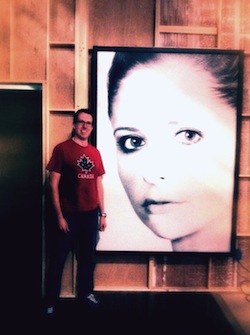
jay faerber ringerThat first day at Ringer had a kind of first-day-of-school feeling, as all the writers got to know each other. It became apparent pretty quickly that I had lucked out — everyone on the writing staff was really cool.

One of the things that really stuck with me from the workshop was the importance of determining what’s expected of the staff writer. Some writers’ rooms adhere to a strict hierarchy and the staff writer is expected to only speak when spoken to (if that!). Others take an all-writers-are-created-equal approach, and everyone’s encouraged to chime in.

But it can get even more complicated than that.

I heard a story of a staff writer who’d been told by a higher level writer to keep his mouth shut and sit back and learn, but then the showrunner declined to pick up the staff writer’s option (after the 13th episode) because the staff writer never contributed. Whether this was a misunderstanding or deliberate sabotage by the higher level writer is up for debate. But I made it a point on that first day to simply ask our showrunner what she expected of me. She made it clear that all of us were expected to contribute.

On Ringer, all the stories were broken collectively by the writers in the room. Once we had the story fully boarded (all of the beats up on the white board), the writer of that episode would go off to write the story arena (or story area — different shows call them different things), then the outline, and then the script.

I’ve been a comic book writer for a long time, so this collaborative way of breaking stories was new to me, but I think I took to it pretty well. And my background helped in other ways. Serialized shows like Ringer have a lot of plot threads to keep track of, as do comics, so my brain was automatically wired for that.

Learning to love the white board
—-

Our writers’ room was lined on three walls with white boards. On the fourth wall was a TV. There were no windows. As the season progressed, two whole walls were taken up with charting the plot developments for each of the main characters in each episode. This helped us keep track of the various plot threads. The remaining third wall was what we used to break the story for each episode.

We’d start out by breaking each character’s story in a linear fashion. Bridget was usually the “A” story, then maybe a Machado or Andrew or Juliet “B” story, then a Siobhan “C” story, then sometimes a Flashback story. Once we had all these stories broken to our satisfaction, we’d start “blending” them — weaving the various stories together and figuring out where they fit into each act.

I quickly became the go-to guy to write on the white board throughout this process. I have good handwriting, and I didn’t mind doing it. It gave me a clear role in the room, and let me feel like I was contributing something even when I wasn’t pitching ideas.

I was also the only writer on staff with an active Twitter account (you can follow me [@JayFaerber](http://twitter.com/JayFaerber)), so I would sometimes Tweet about the show. It was an interesting experience. I wasn’t the “official” spokesman for the show by any means, but I tried to be accessible to fans. Most of my answers were probably vague and unsatisfying, since so many of them were of the “You’ll find out…” or “That’s not my department” variety. And because I was just a staff writer, I didn’t have the authority to be as forthcoming as Shawn Ryan or Jeff Eastin when they’re tweeting about their shows. But it was still fun (for the most part) to interact with the fans.

As is standard in TV, all the writers had initial contracts for the first thirteen episodes, and after that the showrunner could chose to pick up our option…or not. I was kept on, and over the course of the first season I got three scripts: one solo, and two that I co-wrote.

We shot Ringer in LA, and the writers were on set for the entire production of their episodes, which means I got a chair with my name on it and everything.

Someone once said that being a writer on set is like being a fireman — you sit around for long periods of time, and occasionally someone needs you. And that’s a pretty apt description. Most television directors are basically hired guns — they come in, direct an episode, and move on to the next gig on another show. As talented as these directors can be, they don’t always know the show, so it’s important for one of the writers to be there to make sure what’s being shot captures what we intended.

Not every show sends their writers to set. I have friends who wrote on shows that shot out of town, and they never got to be involved in production. And while these friends have been TV writers longer than I have, I feel like I have a leg up on them when it comes to production.

Back on the market
—

Ratings on Ringer haven’t been great and as we ended the season we were very much a “bubble show.” We might get renewed, we might not. The powers-that-be at The CW are probably waiting to see how their pilots turn out before they make any decisions.

This means that I’m going out for staffing season again. It’s a different experience now, since I’m not fresh out of the workshop. I’m competing with every other staff writer and story editor out there — not to mention this year’s new workshop graduates. But I’ve also got a year of experience under my belt, including three produced scripts.

I’m discovering staffing season requires you to be in a weird emotional space.

I want Ringer to come back because I love working with the writers and I really enjoy the world we spent the past year building. It’s a good job, and I’d like it to continue.

But in order to go out and meet with the showrunners of other shows, I have to sort of emotionally disconnect from Ringer so that I can allow myself to get excited about the idea of working on something else.

This isn’t a unique situation I’m in — a lot of shows end their season not knowing if they’re going to renewed. This type of emotional disconnect seems to be something worth developing if you’re going to have a career in TV.

I’ve spent the past couple months reading pilots and going on meetings for new shows, but I’m also still in touch with all the writers from Ringer. Hopefully we’ll be back in our writers’ room next season, and if not, I can only hope my next job is as great as my first one.

Scriptnotes, Ep. 31: All Apologies — Transcript

April 5, 2012 Scriptnotes Transcript

The original post for this episode can be found [here](http://johnaugust.com/2012/all-apologies).

**John August:** Hello and welcome. My name is John August.

**Craig Mazin:** My name is Craig Mazin.

**John:** And this is the 3rd intro that I just did for Scriptnotes, a podcast about screenwriting, and things that are interesting to screenwriters. How are you, Craig?

**Craig:** Uh, I’m exhausted. I’m so tired right now. Anything could happen. I could say anything.

**John:** Well, today we are going to mostly answer questions, so it should be kind of easy.

**Craig:** Yeah.

**John:** This won’t be a particularly taxing one is what I am trying to say.

**Craig:** Thank God. Because normally, normally, I need to be on my A-game for this sort of thing.

**John:** Yeah. But your C-game, we will let it slide.

**Craig:** Yeah. Oh, by the way, my C-game may end up being my A-game. We will find out.

**John:** You never know.

**Craig:** Yeah.

**John:** We wanted to start off with an update because in a previous podcast we had talked about Toph Eggers who had written a criticism of Steve Koren, who is a fellow screenwriter, that we thought was poorly done. It was a bad choice of something to write about, and it was not the correct thing to do. And we sort of went at length on our feelings about that.

**Craig:** Yeah.

**John:** But he wrote a follow up piece that was actually pretty nice.

**Craig:** Yeah. It was a pretty well thought out apology. I mean, I guess that is the headline, really, is that he apologized for it, and seems to own completely that he behaved poorly and boorishly. And not only did he apologize in a very convincing and thorough manner, but he also touched on why what he did was wrong, and why in fact Steve Koren doesn’t deserve harassment at all.

It was an A+ apology. And so I offer Toph Eggers my A+ acceptance.

**John:** He wasn’t really apologizing to you specifically, but acknowledgement.

**Craig:** I think he was apologizing to me, because I see everything as about me. [laughs]

**John:** Oh, I forgot the solipsism and narcissism that draws everything out.

**Craig:** Yes. Like he performed the role of “guy apologizing to me” extraordinarily well. [laughs]

**John:** [laughs] But I would say, I like apologies, and I like apologizing. It’s weird that people aren’t better at it. I hate the modern form of apology which is, “I’m sorry you were offended.”

**Craig:** Right.

**John:** This weird way of sort of redirecting it back at somebody, saying, “Oh, it is your fault that you were offended, but I don’t want you to feel bad about it in a strange way.”

**Craig:** Yeah. Liked I’m not apologizing for what I did; I’m apologizing for the weird interaction between what I did and your thin skin.

**John:** Yeah. Really apologizing and genuinely apologizing feels so good.

**Craig:** Right.

**John:** It’s like coming out, but of a blame thing.

**Craig:** That’s exactly right. In fact, I remember during the strike when my blog was hoppin’, and there was an enormous amount of attention, I made a mistake. And the mistake that I made was I gave an interview to the LA Times, and in that interview I was very clear about the way I felt, but perhaps I was not as specific about insisting that they include a certain amount of context in what I said.

And when I read the article the next day, they had basically left out half of what I said and made me sound in a way, frankly, that was unflattering and counterproductive to what I wanted, which was an effective resolution to all of this. I wanted something good for the union and I didn’t like the way they made it sound. And people attacked me.

Now, the people attacking me, that was sort of par for the course; I would get that every day. But on that one, they were right, and the mistake that I made was, frankly, not taking my — not being as careful with the responsibility I had that came with the, I guess, my public presence. And I didn’t manage it well enough. And I apologized. And interestingly, I would say half of the people who follow the blog accepted the apology and took it for what it was, which was my mea culpa, and the other half viewed it as an opportunity to kick even more dirt in my face.

And I find people who do that particularly off, you know. [laughs] If somebody makes an apology, why not accept it? I mean, they are apologizing. If you won’t accept the apology all you are really doing is eliminating future apologies from people like that.

**John:** Yeah.

Wait, okay, I just did that thing where I say, “Yes,” and you say something long, and I just said, “Yeah.” It’s part of the drinking game apparently.

**Craig:** You did the “Yup” thing, yeah. You did the “Yup” thing.

**John:** I’m so sorry I just “Yupped” you.

**Craig:** Yup.

**John:** [laughs] I was reading the transcript of our podcast. One of the unusual things about our podcast is we do actually provide a transcript of all our podcasts a few days later, and it is on at johnaugust.com, you can look for it there. And I was reading through it, which I don’t usually read through it, but I was reading though it and this new person who is transcribing it will put in all of the yeahs that we have, and we say “Yeah” a lot.

**Craig:** We do.

**John:** And I tend to say “Yeah” after you have said something long and profound. And I will just follow it up with a “Yeah.”

**Craig:** I know. It takes all of the wind out of my sails. I feel so good. There is like a brief moment after I finish saying something profound and important where I feel so good. And it usually lasts about a second. And then you say, “Yup,” and then it is all gone.

**John:** Would you prefer in the future that I just leave a long, awkward silence, and then come back?

**Craig:** No. I think instead of saying, “Yeah,” because obviously there is nothing wrong with saying “Yeah” but I think a better word would be, “Wow.” [laughs]

**John:** How about a slow clap. [claps]

**Craig:** [laughs] I would also like a slow clap! I mean, I’m working my butt of here, man.

**John:** Maybe we could provide some sound effects that would sort of show the “Ooohh…”

**Craig:** You know what? We should sweeten this with laugh track and the Full House, “Ooohh!” I love it. Stuart, get that.

**John:** Stuart is on it. One of the most enjoyable things you can watch if you have about a minute to kill is Big Bang Theory without the laugh track. Have you seen this?

**Craig:** No.

**John:** So they take like two minutes of the Big Bang Theory, of an episode, and they just take out all of the laughter, and your realize it is just such a creepy, strange show if you take out the laughter. Because they will say these weird things, and then there will just be awkward silence [laughs]. It looks like a show about serial killers.

**Craig:** That is why I always feel the jump from — and there are people who do it successfully — but jumping from sitcoms to movies is an enormous gulf because there is absolutely no help. And when you whiff, it is brutal. Brutal. Nothing is worse than silence. And, also, impacts every joke after it.

The more you don’t hear laughing, the less you want to laugh.

**John:** My friend Melissa is on a show now that is shot 3-camera with a live studio audience. And so I was talking with her, and they do pre-tape certain things, or they will stuff, like if they are driving a car and it is a green screen thing, so they may pre-record it, or they will do it just to sort of — they will do it for the live, studio audience with them just sitting on boxes on the stage and do it, and then they will actually go back and film the real thing. And they will patch it up with the laughter after the fact.

But she says it is just so odd when you have the audience there and they are anticipating the laugh, and you are waiting for the laugh, and then you have to try to match it in a context when you don’t have that. It has to be frustrating.

**Craig:** Very strange. Are you talking about your friend, Melissa McCarthy?

**John:** I am talking about my friend, Melissa McCarthy.

**Craig:** That’s my friend, Melissa McCarthy, now.

**John:** Oh, you get to work with her now.

**Craig:** Yeah. She’s mine. I took her from you.

**John:** She’s moving on up.

**Craig:** Yeah. That’s right. She graduated. [laughs]

**John:** Let’s get to some questions here.

**Craig:** Let’s do it.

**John:** Because questions are easy and I don’t say “Yup” at the end of them.

**Craig:** Yup.

**John:** Scott asks, “Recently my partner and I sold our first spec to a major studio. It had been a long process that entailed attaching two major movie stars, and Oscar-winning producer, before it went to the market. When it did finally go out, it ended up in a minor bidding war that ended up with a truly modest deal. My question is, what do we do now? After we finish the two rewrites promised in our deal, where should we be putting out time and energy? What should we be asking our agents and managers to do for us? Should we be trying to pitch for existing assignments? Should we be trying to pitch original ideas? Should we be specking something? Should we try to get on staff for a series? What should we do?”

**Craig:** Okay, that last one threw me for a bit, because it sounded like they are feature writers.

**John:** They are feature writers I would say that a lot of feature writers sort of entering right now are really feature and TV people.

**Craig:** Yeah.

**John:** And I think it is maybe smart. We can talk about that, too.

**Craig:** Yeah. No, I get that.

**John:** Don’t limit yourself to one thing.

**Craig:** No, I get that. I think it depends on how this particular project has gone for them. Assuming, I’m going to assume the best and it has gone well. If it has gone well then you have material and relationships that prove that you can do the job of professional screenwriting. So, if it were me, I would be asking my agents to get me general meetings and specific meetings about open assignments. Even if none of those meetings turn into work, they turn into relationships, which turn into work. Maybe not immediately, but done the road.

And simultaneously, I would be developing a pitch as soon as possible.

**John:** Yeah. You are going to have to focus your attention in a couple different areas and figure out what is most likely to work for you. But you are going to be going out on generals, which is basically the, “Hey, hello, how are you?” It is the bottled water tour of Los Angeles, where you sit down with all of the junior execs at different places and you see who you like and who you get along with.

Most of those meetings won’t really amount to anything, but they put a face with a name, and talk about stuff you like to write.

**Craig:** Right.

**John:** Some of those things will be going in for open assignments. And open assignments means that there is a movie that they want to make, or they have an idea, or some piece of property that they are talking to writers about doing. You want to go in and pitch on some of those, because some of those will become jobs. They will actually pay you to do them.

They are also incredibly good practice to figure out how to pitch a movie and how to take a nebulous idea and shape it as a movie and be able to present it to somebody. So, you are going to want to do some of that.

The danger, and what I have seen happen a lot, is you end up pitching on so many of these things that you are not writing anything new. So at the end of a year, all you have was that thing that you sold and a bunch of sort of pitches for movies you can’t make because you don’t have the underlying property.

**Craig:** Right.

**John:** So I would say, I don’t know, if it is you and your writing partner, maybe you just break it down by day, or you break it down by sort of overall percentage of your time. But maybe on Mondays you are only going to work on your own stuff, which is you are writing that new spec, or figuring out your own pitches for something you can go out with. And Tuesday and Wednesday and Thursday, maybe you are going out on meetings and doing other people’s stuff.

But, you are going to have to plan for both things being possible. And if TV is a real possibility, you are going to have to have an honest conversation with your agents about what is the series, what is the season that they need you to be available to do stuff to go out on those meetings. What do they need from you to be able to show people so they can get you staffed on the show?

**Craig:** Right.

**John:** You are going to probably need to write something new. So it is not just a matter of, “Oh, I will do TV and someone will hire me.” It’s a tremendous amount of work to try to get hired on a TV show.

**Craig:** That’s the key. It is a tremendous amount of work. I think no matter what you are endeavoring, and this is the time when you must be extraordinarily aggressive with your time. You have to really work hard right now, because the door has been opened slightly. And I know that everybody has a romantic point of view on this, that when you finally get there and you have your break, the door is kicked open. And then you get to trip through the field of daisies and pick the jobs you want.

And, in fact, all they have really done is cracked the door slightly. You are going to have to work, and work, to get to that next thing. You want to be a professional writer, you need not one job, not two jobs, not three jobs. I think five jobs. Now you are one of the workforce. Now you are a known quantity.

And so you actually do need, unfortunately, to do a lot of work. And I totally echo your concern about over pitching on open assignments because here is the reality of those: they are a little bit of fool’s gold because nine times out of ten they end up going to whomever a director or actor wants, or a big writer, and you will exhaust yourself and your creative tools by cracking and solving problems for nothing, over and over and over.

So, be careful with those, which is why I suggest — there is nothing wrong with it. You are right; going on those is great practice. And it also helps show your problem solving side to these people. But general meetings are also great. And, pitch. Find something new and get out there and pitch it, because they are always looking for new stuff. And you guys get to walk into the room as people who have done it before, which is a big deal.

So, work hard right now.

**John:** Yes. And whatever you are taking out for your pitch should be something in the same ballpark as the thing that you sold. Because people read that script and they said, “Oh, we like this thing,” you know, minor bidding war. They were like, “Oh, there is something here that is promising.” So, if you sold a sci-fi/action movie, don’t try to go out with a comedy pitch next. That shouldn’t be your next spec because people aren’t going to know what to do with that. And they put you on some list, and they want to work with you, but they are not sure what to do with you on what list.

If you are going out to pitch on an open assignment, maybe that is a chance where you are going to stretch yourself to a genre that isn’t necessarily just like your spec. And they can see you do that because it is lower stakes.

**Craig:** Yeah. I mean, I guess the only thing I would say is if you have a terrific pitch that is of a different kind of thing, but you believe in it, and you think it is sellable, then you just have to make sure that the expectations are managed before you walk in the room. That they here, “Listen, the guys who wrote this great science fiction/action-adventure have actually come up with this, amazingly have come up with this, incredible romantic comedy, which sounds like they wouldn’t be able to do it, but they have. So if you are looking for that, they would love to come in and talk to you about it.”

But, frankly, this is rarely a problem. Usually people have a natural genre. And early on in your career you should be going for depth rather than breadth, if that makes sense.

**John:** Yeah. You want to be like the guy who they want to do this next project that is sort of like that other project. That can be helpful. A little bit of pigeonholing is helpful very early on in your career.

**Craig:** Yeah.

**John:** I got pigeonholed as the guy who was adapting kids’ books. I didn’t only want to adapt kids’ books, which is why I wrote Go. The useful thing with Go, just even as a script, is I could go out for comedies with it, I could go out for action movies with it. I could go out for a lot of different kinds of movies with that script.

**Craig:** Yeah. That’s right.

**John:** Our next question is from a guy named Ruckus.

**Craig:** Ooh.

**John:** “When handing in a rewrite, do either of you preface the draft in correspondence? My writing partner and I just submitted a pretty substantial rewrite, and I found myself struggling with the email. There were a few suggestions made by the producer that we didn’t think worked, but we found an alternate and hopefully more elegant solution in the writing. Is it better to let the producer know how you might have veered from the notes going into the reading, or should you let the script stand on its own?”

That’s a really good question.

**Craig:** Yeah, it’s a great question. First, I must of course say, “Can you describe the ruckus?” John, can you identify that quote?

**John:** No.

**Craig:** “Can you describe the ruckus?” I believe it is The Breakfast Club. “I heard a ruckus.” “Can you describe the ruckus?”

**John:** Oh, I don’t know The Breakfast Club that well.

**Craig:** My attitude about it is this: if you feel that you have addressed a problem in a creative and interesting way, that is good, go with it. It is a gamble, but it is a gamble that pays off huge if it works because all I think everyone that doesn’t write, but who advises writers on how to improve their writing, is secretly hoping that you are going to come back and just make them happy. They don’t really want to move your hand for you and type the words for you.

If they could do that, they would be writing. So, if you have a great solution that is off the beaten path of the notes, there is nothing wrong with saying, “Listen. We have in our back pocket the solution we all talked about, but we really wanted to try this.”

And if they don’t like it, just say, “Listen. You know what? It was something we believed in, and we thought about it. We always have the make good back here if we need to kind of go in that direction.” But, there is nothing wrong with showing, in my mind at least, nothing wrong with showing some creativity and some proactiveness, as it were.

**John:** I agree with you. I think if you have the better solution, let the better solution speak for itself. The only case where I would say to think twice is if you have promised that you are going to do a certain kind of thing, and then you don’t do that. Like let’s say you are working with a director and a studio, and you need to turn in this draft. If you promise a director you are going to do something, and you couldn’t do that thing, and you did this other thing instead, you have got to at least tell him or her that that that is there.

Because if it is going to everybody at once, and then they are surprised, and there is cross-talk that is not involving you, that is going to be a real problem.

**Craig:** I agree.

**John:** So there are cases where you want to either have that phone call or have that email ahead of time and everyone knows what is going on.

**Craig:** Yeah. You know, it is really important to ask yourself, “How surprising will this be? And what if they don’t like it? Is this surprise going to compound the negative reaction?”

If you are going to really surprise them with something big, you have got to let them know ahead of time. Frankly, it has less to do with courtesy and more to do with being effective as a screenwriter. Because when people are shocked and surprised, they start to have an emotional reaction that is going to absolutely get in the way of their experience reading the script. That is just something you have to start to feel out, like what are kind of landmine type changes that you need to let them know about ahead of time to protect yourself and the work, and what are things that you can kind of just sort of go about because you are the writer of the script, and you are not a reactor.

**John:** Yeah. The more going into this rewrite process, you were talking about the areas that you were going to work on, but not the specific solutions, then you have a lot more freedom to do whatever you needed to do in order to get that thing to work right.

It is when… — A lot of times when you get very close to production and you had to sort of pitch the exact thing that you were going to do, not down to the word, but it is going to be this, and it is going to fit in this little place, and it is going to be this scene here, that is where it becomes tough where if you are doing something that is just very different it is going to ripple through other changes.

**Craig:** Right.

**John:** And then maybe you need to really warn people about that.

**Craig:** Yeah. And then there is sort of like, “What is the deal with these people? They are just not reliable. I don’t want to hire this guy again because we all discussed something in the room, he agreed, he went off. He came back and suddenly the guy that was supposed to be a little bit more of a mature dad instead of a bumbling dad has become an uncle from out of town who has no kids at all. What the hell is going on here?”

So be respectful of the fact that there is somebody else on the other end of this conversation.

**John:** Yes. Our next question. Max asks, “I have been writing specs for a while now, and working with producers. I have tons of drafts of several scripts — notes in every draft, brainstorming, what have you. I am just wondering how you, someone who has had infinitely more notes and files to deal with, keeps everything accessible and in place?” So just organization strategy for drafts and files.

**Craig:** That is a question for you. You are the Sort Master.

**John:** I am the Sort Master. But I don’t deeply sort. Most things that I am working on actively, I have in Dropbox so that I can reach them through whatever computer that I am in. Or, I can pull them up on my iPad if I need to. So, in Dropbox I have folders for each of the basic projects. So I have one for Preacher, for Frankenweenie, for whatever, and all of the drafts and everything related to it goes in there.

If something is like an email and is attached to an email, I don’t always drag it out of there and stick it into Dropbox. I kind of feel like mail is another way to get to some of that stuff. And a lot of times if I am looking for a specific PDF that I sent through to somebody else, I will just pull it out of mail rather than pulling it out of Dropbox, because at least then I can see the context of what this last thing was that I sent.

But I am just using Dropbox for basically everything. And I am being very lazy, and sort of hoping that Dropbox doesn’t mess it up for me, for my active stuff.

For older backup stuff, I have it on just a “Projects” hard drive. I have a big tower, and I have four hard drive slots in there. I have one that I use for projects, and I just keep everything related to those projects in those folders in there. And that one I back up once a week.

**Craig:** I don’t really think that there is anything lazy about it, I mean, the way you just described it. Frankly, it is not like our job of archiving is that intense. I do a very similar arrangement to you. I have a folder that is essentially a writing archive. Everything that is done, that sort of sits on a folder, and all of that stuff is mirrored to Dropbox as well. I like Dropbox, just mostly because of the backup factor.

I mean, I take my laptop with me wherever I go, though it is nice to always have mobile access. And the projects that are scripts in progress, that is its own folder. And in that, each of those things, there will be — for instance, in my Identity Theft folder I organize things by sort of treatment. So anything in the treatment folder is all the stuff that led to up to the first draft. Then there is first draft folder. There is the second draft folder. And then once the movie gets green lit, then I create a production drafts folder. And in that folder there is a white folder, a blue folder, a pink folder, a salmon folder, and yada, yada.

**John:** That is actually much more organized than what I do. I just keep it in one big folder and I sort it by date. And the most recent stuff is at the top, and I can usually find everything I need.

**Craig:** Who would have thought that I would be the neat one? [laughs] No one!

**John:** The tidy one.

So now what are you doing with just like little bits of scraps that aren’t quite movies or projects yet? Do you have any sort of dump file for that? I use Evernote for it. Are you using anything like that for storing the bits and pieces of things?

**Craig:** If I have an idea, or a little bit of something, it is almost always attached to a project. And what I will do is I will just make a folder for that project. So, even if I don’t quite know what it is, if it is like, “Okay, I have this idea for a historical drama,” I will just write a folder that says, “Historical Drama Idea,” and then I will put that stuff in there.

But, I don’t have a folder that is, like, “Ideas” or “Whims.” Everything gets kind of a spot.

**John:** I started using Evernote because I did have a folder for like bits and pieces, and I would never really check that folder because there were just drips and drabs and stuff. Or, if I made a new folder for something, a year later I would go back and see a folder that had exactly one file in it. And it was like, “Well, that was weird.”

**Craig:** Yeah.

**John:** It’s like that idea sort of never came to anything more than that. So, the stuff that I feel is kind of interesting, that could be a movie somewhere, I’m throwing that into Evernote right now. It’s not perfect.

I use for my day-to-day keeping track of stuff I need to do, I am using OmniFocus, and I will sometimes — I am debating between the “someday maybe” kind of tag you can put on stuff. And so there will be a little idea, and I will put a “someday maybe” on it, and that way it just kicks up for review every couple of weeks. And so it is like, “Oh, that little thing I was thinking about, is that still something I am thinking about? Or should that just go away?”

**Craig:** Yeah. I’m okay with the notion that there are… — I mean I have a couple of folders in my Scripts in Progress master folder that I haven’t touched in three years. And I am okay with that. They are there mocking me, and I like it. I like that one day I will have to address either their mortality or breathe some life back into them.

**John:** Cool. Our next question comes from Salvi from Los Angeles. He asks, “I read about spec scripts or screen rights ‘going to auction.’ Although I am familiar with the concept of an auction, I am wondering if you can explain what exactly this means in a Hollywood setting. What is the process, the formalities? Who manages the auction? How are offers submitted — fax, email, phone call? Where, to whom? How does it work? What is a script auction or a rights auction?”

**Craig:** Uh…I’m guessing that this is… — A script auction, I believe, has to do with the purchasing of a library of material from a company. In other words, a company is going out of business and being sold.

**John:** Yeah. In this case he is talking about spec scripts.

**Craig:** Oh…

**John:** I think what he is talking about is there is the situation where something becomes a bidding more on a spec. So, let’s say you wrote a spec script that suddenly everybody wants. And it gets to the point where you are getting offers from different people. I used to hear about this more. Maybe it still does happen where at some point the agents will say, “Okay, we are going to start at 5pm and say to just start bidding. And people can call in and say how high they will go.” And they will set a time limit on it.

**Craig:** Yeah. To that, there is no rocket science. Basically if it is a hot property, and everybody knows about it, then you just say, “We start fielding calls at this hour, and we will let you know what the highest offer is. And if you want to match it or exceed it, go for it.”

Sometimes the companies, in an effort to short circuit a kind of endlessly spiraling competition will say, “I’m going to offer you $1 million for this. You have to take it or leave it right now, or I am out.” They do all sorts of things.

There are script auctions and rights auctions that occur when companies are being bought and sold. For instance, famously The Terminator rights were auctioned off. And those occur the way assets are auctioned off for any business, when they have to disperse assets. But, probably he is talking about what you are talking about.

**John:** In the case of those big bundle of rights assets, there you would need to know, you have to pre-qualify as a bidder. They have to know that you actually could buy at the price that you are talking about. There would be all sorts of terms and things. But if you just wrote a normal spec script, that is not going to go out as auction in a meaningful way. It is not like Christie’s. It’s not like they say, “We have a new spec script from this writer you have never heard about,” that people can read. That doesn’t happen.

**Craig:** Nope.

**John:** You are just desperate for anyone to read that script if it is somebody you have never heard of before.

**Craig:** That’s right.

**John:** This I am going to read just because this came in with the whole bundle of questions. This is a guy named Josh. He wrote in, “Cool blog. Went there to wash sneaks. CAngel Full Throttle was excellent!!”

**Craig:** Hmm.

**John:** And God bless him. He kept it all in the subject line. There was no text that went with it.

**Craig:** Oh, no, no. Why would there be text? The subject line is there for you to write your entire thing. Yeah.

**John:** But there was punctuation, Craig, I should point out. There were two exclamation points at the very, very end.

**Craig:** Oh. Well, do me a favor. Read that again, because I got C. Angels 2, I think, or C. Angels, but say it again one more time.

**John:** Because when I first read it, I read it as “Cangel.” I’m like, what is “Cangel?”

**Craig:** Oh, it could be Cangel which was a very good movie. But start from the beginning.

**John:** “Cool blog. Went there to wash sneaks. CAngel Full Throttle was excellent!!”

**Craig:** I’m sorry, watch or wash sneaks?

**John:** Wash sneaks. So, this is something, it is esoteric information that as the person who wrote the blog I can tell you, is I have a random blog post on there that says, “You can wash sneakers.” Because no one every washes their sneakers, but you totally can wash sneakers and they look so much better. And things that you would normally throw out are actually quite wearable again after washing them in the washing machine.

So he probably had Googled “washing sneakers,” ended up on my blog. Saw that I wrote Charlie’s Angels Full Throttle, and that was the movie that he wanted to comment how much he loved.

**Craig:** Cangels.

**John:** Cangel Full Throttle.

**Craig:** Cangel Full Throttle.

**John:** Cangel Full Throttle is due for a remake, I think.

**Craig:** Um…thanks, Josh.

**John:** Yeah.

**Craig:** Cool blog!

**John:** So this is a segue for me internally, not to hold it against him, which is a phrase… — Or, actually here is the phrase: let’s not hold that against him. Sometimes in blog posts my name will come up, and they will say, “John August, who wrote Charlie’s Angels Full Throttle, but let’s not hold that against him.”

**Craig:** [laughs] Right.

**John:** It’s the weirdest, most backhanded thing. First off, if you are going to cherry pick one credit just to put for me, you are going to put the sequel to Charlie’s Angels as my credit?

**Craig:** But let’s not hold that against him. And the reason we have to advise you not to hold that against him is because it was a terrible crime.

**John:** It was a crime against cinema.

**Craig:** What a bad thing you did, John. Boo!

**John:** What a terrible, awful thing I did.

**Craig:** But let’s show our humanity and our magnanimity by advising everyone to not hold it against you.

**John:** Yeah.

**Craig:** Because holding it against you would be an understandable action. Let’s hold that movie against you.

**John:** Yeah, it’s like a genocide, but it is a film that someone could choose to watch, or not watch, at their time. And there is actually a better movie that stars the same movie, called Charlie’s Angels, that is also available for watching. If you like Charlie’s Angels, and don’t like the sequel, that’s okay. You can just watch the first one.

**Craig:** I don’t even think we need to go to genocide. Let’s just start with the most mild crime we can think of. Shoplifting.

**John:** Yeah. Okay.

**Craig:** What’s worse — Cangel or shoplifting? I’m going to say shoplifting. I’m going to say there literally isn’t one single thing for which there is some kind of statute that is worse than writing the worst movie in the world.

People need to shut up.

**John:** Oh, you know where people also need to shut up? They need to shut up in freaking movie theaters.

**Craig:** Yeah.

**John:** So, I went to go see Hunger Games here in Times Square, and yeah, I’m sort of asking for it, going to see a movie in Times Square, but that’s where I was. And so I saw the movie.

So I saw it opening day. Or I saw it the Friday that it opened. And it was a packed house. And I really, really enjoyed the movie. I did not enjoy, first off, the two women who got into a fist fight before the movie began.

**Craig:** Awesome.

**John:** Which is not great.

**Craig:** Maybe they were hungry.

**John:** They were hungry. They were hungry for some…

**Craig:** Games.

**John:** Movies. But the guy next to me, the stranger who was sitting next to me decided that he had to sort of provide commentary on what he was seeing the whole time through. And I originally thought, “Oh, he must be with somebody and he is talking to that person.”

But, no. he was just sort of talking to me, or sort of anyone who could hear, and providing his sort of like, “Well that’s a dumb choice.” “Oh, come on, fire the cinematographer,” because it was all shaky cams.

**Craig:** Are you kidding? Really? He was doing that?

**John:** He was doing that.

**Craig:** I mean, because I understand the whole, “Bitch, don’t go in there!” But, I mean, now you have a film student mocking the movie next to you? Shut up!

**John:** Yeah.

**Craig:** I mean, come on! What a jerk.

**John:** Yeah. So anyway, that guy — you are a jerk. But, I’m in the middle of the theater, and this is two-thirds of the way through, so I am not going to actually… — It did tamper my enjoyment. Tamper? It muted my enjoyment somewhat of The Hunger Games. But I did quite like it, except for that person next to me.

And as the lights came up, he kind of turned to me to get agreement from me. I’m like, “No, I want to stab you. That is actually how I am feeling now.”

**Craig:** I always say to those people… — I will just say to them, “Hey, come on man, please.”

**John:** My husband will speak up, but then it becomes extra awkward.

**Craig:** I love the awkwardness. It actually makes the movie better for me. And it is hard on a movie like that, because I would imagine it was a packed house. But I will get up and change seats. Anything to get away from idiots.

**John:** Oh, yeah. In a normal situation I would do that.

**Craig:** Idiots, yeah. I remember my wife… — I didn’t see The Sixth Sense with my wife. For some reason we saw it separately. And she said the moment came in the movie where he is…

**John:** Say spoiler…

**Craig:** He remembers. Oh, spoiler alert, in case you haven’t seen that movie. [laughs] The moment comes where he is sort of flashing back and he sees the ring, and he realizes that he has been dead the whole time, and in the middle of that interesting montage where the filmmaker has cleverly designed a cinematic way to slowly shine the light on you, this older woman behind her, who was with her older female friend says in a loud whisper, “He doesn’t know he’s dead.”

**John:** Yeah.

**Craig:** Got to love that. Just, way to kill it.

**John:** Yeah.

**Craig:** “He doesn’t know he’s dead.”

**John:** They make television who need to talk back to the screen.

**Craig:** They also make guns for people who need to talk back to the screen.

**John:** [laughs]

**Craig:** Yeah, one of the great spoof moments in spoof history is in the first Scary Movie, the Keenen Ivory Wayans’ Scary Movie where Regina Hall, a terrific actor, is playing the stereotypical black girl who must yell at the screen, at everything. And the audience all participates in stabbing her to death. [laughs]

**John:** I remember that.

**Craig:** Yeah. It was great. It was really great.

**John:** All right, the next question. Austin, who turns out we actually know people in common; we know some very tall women who are dancers in common. He writes in to say, “My partner and I were taken on at a management company,” whose name I will redact, “after they read our glorious first outing. It was a good script, but they didn’t want to make it, nor did their partners at Alcon. What they did want was for us to go off and write Bridesmaids Part 2, or the Hangover Again, or Bad Teacher Even Worse, or some other been-there/done-that thing.”

**Craig:** God forbid you write a sequel to a movie like that. [laughs]

**John:** As I read more about it, it is sort of a dense paragraph here. I think it was that they wanted him to write that same kind of movie. They weren’t literally saying, “Write the sequel to that movie.” They were saying, “Write exactly that kind of movie.”

**Craig:** Got it. And they don’t want to.

**John:** They basically didn’t want to. “They turned in outline after outline, high concept for high concept for high concept, piled like cord wood in the WGA Registry. And ultimately this producer/management company dropped us. Here we are six months later with our brilliant original first outing, plus additional treasurer’s trove of stories to be told. We have no connections in this world, other than the producers that just cut the cord.

I read that poorly, but you got the idea of what it is. So, you know what? That’s going to happen a lot. I would say 75% of working screenwriters had exactly that situation, where there was initial spark of interest from somebody who seemed real, who liked your stuff, and you worked your ass off to try to make them happy. They couldn’t be made happy, you weren’t made happy, and you parted ways.

**Craig:** Yeah. It’s far from a rare circumstance. Although, there is a lesson here: don’t chase. And producers — particularly producers — are notorious for chasing. The Hangover happened in spite of quite a bit of resistance. Bridesmaids, I imagine, happened in the face of some amount of resistance. Almost every surprise hit comedy, particularly in comedy, seems to happen counter to what everyone is chasing. And you can see these kinds of cycles that come and go in comedy.

Right now we are in this kind of Rated R comedy for grownups phase. And we will at some point return to — because these things are cyclical, the kind of character-driven, broader PG-13 comedies that ruled the world in the ’90s. But producers chase because, just a little primer on the economics of producing. Producers don’t get paid to develop. They get paid some sort of insultingly small amount of money. It doesn’t support them. It doesn’t keep them going. All they get paid really is to produce an actual money. It needs to get green lit. It needs to be made.

So they are desperate to give the studios what the studios want to make. However, what that often leads producers to do is chase. Therefore, they then put that on you, especially newer writers who they feel they can absolutely tell anything to, and who will… — Finally here are writers that won’t look at me and go, “No, dummy, I’m going to do what I want.”

So then they force those writers to join the hunt in chasing. If you feel yourself chasing, you are never going to win. You have to write something you actually like, that you actually believe in, that you have actual passion for. And that doesn’t mean that it must be artistic or dramatic. It could also mean the dumbest comedy in the world. But you have to love the dumb comedies. And you have to love that style of movie.

Write what you love. If you, and this is a tough one because we are constantly put in our place as the peons, and yet we really are the leaders. We must lead everyone to something new and good.

**John:** You have to remember that screenwriting is essentially the research and development of the film industry. And there is a lag time. So by the time that the Hangovers, and all the R-rated comedies have become incredibly successful, well you could back up like three years before that that they actually started to go through the process.

**Craig:** Right.

**John:** So if you write a brand new one right now, it is going to be another three years, and that cycle will have passed. It feels very much like all the people, the other companies are trying to make an iPad competitor. Well, they are racing to try to catch up with where the iPad is right now, but the iPad is going to be, again, better by the time they are done with this thing.

So they end up releasing a tablet that would have been, “Oh, that would have been okay a year ago.”

**Craig:** Right. And meanwhile Apple, the iPad to them, that’s a small department where that makes minor iterations. The thing that they are going to come out within a year or two, everyone is going to go, “Wait, wait, wait, what?!” And then they are going to go chase that.

And that is what you kind of have to do. And all of the work that I have done that I sort of look at and go, “Huh, I don’t know if that was a good idea,” which is quite a bit of it, was me being involved in a chase. And getting enlisted in a chase. But it took me a long time, and many, many mistakes, and iffy to bad choices to arrive at a place where I understood that that wasn’t going to do anybody any good. And that — just write what you really want to.

And, look, we don’t have to be precious about it. There are a lot of things that get us excited to write. And we can choose to write something that excites us that we also know other people might be excited by. There’s nothing wrong with that. But when you sit down with these guys, and I am really speaking to the newer writers now, and these producers tell you in no uncertain terms that they are not making this kind of movie, and they are not making that kind of movie, they are only making this kind — just understand: they don’t know what they are talking about. None of them do.

Robert Towne, or was it William Goldman? Robert Towne? “No one knows anything.” Robert Towne? I think it was Robert Towne.

**John:** I think it was William Goldman.

**Craig:** William Goldman. We will give it to William Goldman. “No one knows anything” is absolutely true.

**John:** But, we do know the answer to this question, or at least we have two good answers to this next question. Stephen asks about formatting Shakespeare. “When adapting something like Shakespeare to a screenplay, does the original dialogue of the play get formatted like just normal dialogue, or do you do something different with it to show the verses?”

**Craig:** Oh…

**John:** You have written a lot of Shakespeare-based screenplays.

**Craig:** Uh… [laughs]

**John:** So, I will tell you my answer. If a bulk of your screenplay is going to be in verse, you treat it like as if it was going to be sung. And you are going to have to do something with it so that the lines of text make sense with the… — The end of a line makes sense.

**Craig:** Right.

**John:** And so you may end up doing that thing which I do on some lyrics is I sort of cheat the margins out a little bit, and I put things in. Like Verdana or something. 11-point Verdana. Something a little bit smaller so that the lines can actually line up right.

**Craig:** But this is a whole script, right?

**John:** Yeah. Or you can do this thing which is what a stage play does which is when you get to that kind of stuff, you just really block over it like a lot more left, so you can get the whole line in. And you do the true line breaks the way they would be.

**Craig:** Yeah.

**John:** If you are just doing sort of like Shakespearean-like dialogue, and it doesn’t actually have to — the meter or the rhyme doesn’t matter so much, just make it dialogue.

**Craig:** Yeah. I guess if I were to sit down and do it, I would probably keep the margins basically the same. I’m talking about adapting directly from Shakespeare. So I am pulling the dialogue from the play. Shift-return would be my friend. So, when you shift-return in screenwriting software, it doesn’t advance to the next element; it just does a character return within the element. But I would probably do little combinations. If there were short lines, “To be or not to be, that is the question.” I would probably… — Well, even that one I would probably shift-return. It’s a pretty big one.

But, you know, you need to be able to break it up a little bit so people can get a sense of the meter and rhyme as you just described.

**John:** And you have to remember that even if you are using a chunk of Shakespearean dialogue, you still are writing a screenplay, and so you are going to probably break it up in a different way than how Shakespeare would break it up. You are not going to put huge chunks there, because you will probably be interceding it with action and other stuff so that it really is a screenplay.

**Craig:** It’s an interesting question. You know, I think the smart thing to do would be to see if you can hunt down a copy of one of Branagh’s adaptations. Or…

**John:** John Logan just did Coriolanus.

**Craig:** Yeah, exactly. There you go. See if you can track down Logan’s script and see how one of the professionals did it. It’s a really good question. I don’t know.

And nor will I ever have to know. [laughs]

**John:** I’m going to end with a really easy one today.

**Craig:** Yay!

**John:** Tea asks, “Do you have any advice for writing a scene with numerous characters? It is getting confusing who is saying what to whom, and who they are. Is there a limit to labeling people stereotypically just for clarity sake? This scene is in a holding cell with about 23 people and I cannot omit anybody.” [laughs]

**Craig:** [laughs] Wait, do they all speak?

**John:** I guess so. So, here’s the thing, the first half of the question is completely reasonable.

**Craig:** [laughs]

**John:** And so sometimes there is a… — Don’t say Guard Number 2, Guard Number 3 very much, especially if they are talking to each other. It’s good to have a little shorthand for who that person is. And sometimes you will even see this in the movie scroll. You will see like, you know, Old Lady with Bag, or a character who has a weird name which is really kind of their action.

**Craig:** Or like Sleepy Guard, or Short Guard.

**John:** Sleepy Guard, yes. And that is fine, and fair, and good, because it helps keep things more clear. But, yes, there is a limit. And there is a limit to how many people can be in a scene and actually talk. Because an audience can’t keep track of that many people. So if people are just piping out one line, it is okay to not even introduce them. And just give them the line. And, so, “SHARECROPPER: He’s a monster.” That’s fine.

**Craig:** Right.

**John:** And you don’t have to sort of keep track. You don’t have to introduce them. You don’t have to say anything about them.

**Craig:** I mean, look, there is so much… — That question took such a hard left into crazy town.

**John:** You can’t have 23 people in a scene…

**Craig:** No! Let’s just start there. Let’s just start with the creative thing.

**John:** …and have any sense of how you are keeping track of people.

**Craig:** No. There is no scene with 23 people talking. That doesn’t exist. In movie history there has never been a scene where 23 individual people spoke in the scene.

There is something terribly wrong with your scene. Nobody is interested in hearing from 23 different people. Frankly, that means there is 23 lines of dialogue at a minimum if they only say one thing. That is a really, really long scene already. So I am bored and confused, and I don’t understand why the screenwriter isn’t focusing my attention on what matters.

So, there is sort of a failure of authorial intent there. But, let me also say this: putting aside whether there are 23 people, or 10 people, or 8, when you become a screenwriter that writes for production, the first time you go through it you will become attune to the concept of the day player. When they make movies, there are actors, and the actors that we think of as stars. But then there are what they call day players — people who show up to do that one or two lines.

A typical scene is your star walks into a 7-11, asks for a cup of coffee, and the clerk says, “I’m sorry, sir, we are out.” And the star storms out upset. Well, that guy is a day player. He has got one line. “I’m sorry, sir, we are out.” Day players, by and large, aren’t the best. It is hard to rely on them to be interesting. So you really need to limit what they say.

If you have a scene where 23 people are talking, and we are not going to see them again, obviously. They are all day players, or half of them are day players, not only do you have a scene that is populated by actors that don’t really command the screen normally, but you are also paying each one of those people a lot of money. And productions hate day players. They try and minimize day players as much as possible. They will go through the script and they will say, “Do we need this guy to actually say this line? Or can he just walk up, try and get a cup of coffee, and there is a sign that says ‘No Coffee Today?'”

So, no. No with the 23. What?! [laughs] No. If you are having trouble sorting it through, trust me, the audience will have an even bigger trouble sorting it through.

**John:** So I am trying to think of situations where you could have 23 characters in a scene. And there is a possibility. Like late in a story, like let say you have met a bunch of different people and they all, it’s like a Cannonball Run kind of movie, where you met a bunch of different people. Or Airplane, where there is a bunch of people in Airplane, and they are all in a similar space. And so they could conceivably, in a scene, everyone could…

**Craig:** There is no way. There’s no way. Think about it. 23 lines of dialogue. That is the minimum.

**John:** He’s not promising that all 23 people are going to speak all at the same time.

**Craig:** In the scene — they all have a line, right?

**John:** I will reread the question. “It is confusing who is saying what to who, and who they are. Is there…” I guess, yeah.

What I was going to say is there are going to be cases where you have introduced people separately, and they are coming into a bigger group. And there is a concept of keeping people alive in a scene. And sometimes you will notice, and this is important — this is actually one of the reasons why a table read is really good. You realize that a character is in a scene, but hasn’t said anything for a page and a half. And that’s bad.

**Craig:** Yeah.

**John:** Because in real life, people do say something. And so, “Okay, I need to give that person a line here, or get them out of the scene because it is just weird to have a person standing around there.”

**Craig:** Yeah.

**John:** I can envision some scenarios in which a bunch of people have come together at sort of the end of a thing, or as like a big rally, and people have come together. And so we know all of those people are there, but not everyone is going to get a line. You are still going to end up treating those people like blocks of people.

**Craig:** Yeah.

**John:** So it is going to be that the Mad Mothers are there. And it is going to be the Drunk Fraternity Brothers over there. And it is going to be the Kickboxing Team over there. And one person from each of those things is going to be talking in the scene.

**Craig:** Correct. You will never get to 23. I don’t care if it is the end of It’s a Mad, Mad, Mad, Mad World. You are never going to get there. It is never going to happen. It is bad filmmaking. I don’t even know how you direct that, frankly. [laughs] It’s just impossible.

**John:** Yeah. Every person you add to a scene — this is a useful thing to talk about. Like let’s say you have two people at a dinner table, and they are having a conversation. That is fairly straight-forward. You are going to have to cover — you will get masters, you will get each side, you will get some establishing. A minimum of three shots, probably more.

**Craig:** You have got your master, mini-master, over the shoulders, close-ups, extreme close-ups. I mean, you could make a meal out of it. But even if you are… — If you are doing 23 people, the problem is either they are all standing in a freaking clump, like in an audience, at which point why are 23 people in an audience?

You just won’t know where to focus your attention. Just think about it from the audience’s point of view. Who am I listening to? Who am I following? Who do I care about? The audience has the capacity for five or six voices, maybe seven, I don’t know. At some point it gets a little crazy.

**John:** So, wrapping up, maybe we will start doing this every week. I want to talk about one thing this week that I loved. Do you have anything this week that you loved?

**Craig:** Um, you say your thing.

**John:** I will say my thing, and then you can talk.

**Craig:** Is your thing me?

**John:** [laughs] It’s you, Craig.

**Craig:** Thank you.

**John:** I love you. I don’t say that often enough.

**Craig:** You really don’t. Or ever. Yeah.

**John:** I love to apologize. I love to tell people I love them.

The thing I loved this week — I saw Once, the Broadway musical version of Once. So, Once is the Irish film that had Falling Slowly in it, and got Oscar nominations, and I think won some good awards. And I loved the movie. I really loved the show.

So the Broadway show of it is the story of the movie, which means it is very small and slight. And you would think it would just disappear at any moment. But what really struck me about it is how literal — it’s not literal… — Theater can be presentational or representational. Representational means that you recognize what space — it can be acting style, too — but you recognize what space you are in. So, if you are in a post office, it will sort of look like a post office. And then you are someplace else and it is going to look to look like a bedroom.

So in Once, you go in there and as you enter the theater it is this Irish bar setup. And it looks like it fills the whole stage. And you are actually able to go up onto the stage and order a drink. And there are people that they are playing music. And then eventually the show kind of starts, but the lights are still on, and you start to realize, “Oh, the people that are playing music are actually the actors.”

And they never leave the stage. And that set is actually the only set. And they never… — So if characters are going someplace else, they are still in that same set, and everyone is still in the thing, and you are just creating the reality of this moment. Like, this piano comes in, and we are in a music store. And it’s fascinating.

Coming from a screenwriting perspective, where things tend be very…

**Craig:** Literal.

**John:** …literal, it’s nice to experience things where you just have to — you are asking your audience to use their imagination and trust that these people are in their own space. And that they will do the set dressing themselves in whichever way, and they will ignore the people who are sitting at the edges of the stage until they start playing, or singing, and that’s okay that they can do that at any given moment.

Sometimes, like Lars von Trier made Dogville, I guess, which sort of did that same thing, where everyone was around the whole time. But in a movie it is just really, really strange. And in theater you can get away with it. I recommend the show, but I also recommend just thinking about the difference between literality and representing something, versus sort of presenting what something is. It is very hard in a movie to have a space where like I am not sure where I am.

**Craig:** Right.

**John:** Even if you are filming in Toronto for Washington, DC, you know that you are supposed to be in Washington, DC. And if you don’t have a sense of what this place is supposed to be, you are really uncomfortable as an audience member.

**Craig:** That’s right. You are not sure where the ground is beneath your feet. Correct. But I do like when films adapt musicals or plays, sometimes they borrow that. For instance, when Rob Marshall did Chicago, I’m thinking of the He Had it Coming sequence. Clearly he went for that sort of representational.

He shot a scene that could have been on stage.

**John:** Yes.

**Craig:** And yet it was in the movie, and you were okay because he moved in and out, and it was actually a very smart way of transitioning from the non-musical portions of the movie into the musical portions. You would leave the literal representation and enter this kind of interesting representational space.

**John:** If you were watching Smash you would know that they use that conventional as well.

**Craig:** Huge if. The big if. [laughs]

**John:** Big if. If you are watching Smash you would know that what tends to happen is they are starting to rehearse a musical number, and then it will go into one of the actor’s perspectives, and it will come out as the full production as they sort of see it. And then it will go back to the little version.

**Craig:** Yeah. Actually, now that I am thinking about it, it is kind of a time-tested cinematic device, when the director wants you to divorce yourself from the reality. For instance, if you watch the old Danny Kaye movie, The Secret Life of Walter Mitty, when he goes into his Mitty daydreams, it becomes a set. It is quite clearly a set. And it is representational. It is not meant to be real or literal. And then he comes back to his life, and it is real and literal.

**John:** Anything that you loved that you want to share?

**Craig:** You know, I think a lot of people love this, but last night for the 4 billionth time I watched Casino, the Martin Scorsese movie. And I feel like sometimes Casino gets a little overlooked in the shadow of Goodfellas, which I truly love, because.. — And I remember even when I saw Casino in theaters, I thought, “Oh, this is cool. It is sort of like Goodfellas Part 2. And everybody is kind of doing the same thing.”

You know, De Niro is kind of the crafty one, and Pesci is the loose cannon, and it is mobsters and it is ’70s classic rock soundtracks, and corruption, and grifting, and money, and they all come to a bad end. But, there is something wonderful about Casino that is separate and apart from Goodfellas. There is almost, in a strange way, a little more tragedy to it. And I have to say that, what’s her name? [laughs]

**John:** Sharon Stone.

**Craig:** Sharon Stone. Sharon Stone is spectacular in that movie.

**John:** Yeah.

**Craig:** Really, really, really good. And there are wonderful moments in that film. Really great stuff. And there is a sequence… — The other thing is, everybody is very familiar with the sequence in Goodfellas when De Niro’s character, Jimmy Conway, I believe, is starting to kill all of the people that assisted him in the Lufthansa heist.

And the soundtrack that plays over it is that great coda to Layla, by Eric Clapton. But in Casino, there is this amazing sequence where they show — where Scorsese shows Pesci and his guys just kind of going nuts, and robbing everybody, and forgetting all the rules about what it means to kind of stay — keep their heads down in this new Wild West of Vegas. And he uses Can’t You Hear Me Knocking by the Stones.

And I think he plays the whole song. It’s a really long song. And it is really great. So, Casino, I think, probably gets its due from a lot of people, but maybe not as many. I love that movie.

**John:** I haven’t seen it in years. I remember loving it when it came out. And I just remember the sunshine of it. I just remember it being light and sunny in a way that you don’t expect a movie that is going to have the things that it has in it.

**Craig:** Yeah. Well, and it’s a great choice. And you can see that choice echoed in The Hangover, because I remember when I was talking with Todd about The Hangover, he said it was actually a very important thing to him to show Vegas in the sun, because most movies about Vegas show it at night. It’s so much more glamorous, and interesting, and lit up at night.

**John:** With Go we shot at night. It’s exactly what you want to see.

**Craig:** Yeah. But if you are kind of shooting a little bit of a tragedy, a Vegas tragedy, in the daylight Vegas is pretty grim. It is sort of the opposite of most cities where at night they seem grim. Vegas in the daylight is dirty and dusty and a bit absurd, frankly.

**John:** It’s the woman who is kind of hot when the lights are dim, but then you turn on lights and it is, “Oh my God!”

**Craig:** Yeah. And the Vegas sun is…[police sirens] Oh, there they go. The Vegas sun is truly bad light. And all the artifice of Vegas is exposed for what it is, which is just cheap.

But at night, I have got to say, at night the Venetian looks quite beautiful.

**John:** It does.

**Craig:** In the daytime it just looks dumb. And for a movie about how Vegas is entirely about a kind of false presentation, and what the reality is behind it, it was great that so much of it was during the day. Not much at night. Good call.

**John:** Nice. Great. So, Once and Casino. And one of them is a Broadway musical, and Casino probably wouldn’t be a very good Broadway musical.

**Craig:** No. No. No.

**John:** We will wrap up here, but I was talking with someone else today. It’s odd that there isn’t a Goodfellas or a Godfather of Broadway musicals. And his theory was that the violence just doesn’t work on stage in the way that you would want it to work.

**Craig:** That’s true.

**John:** It’s strange that that mafia stuff hasn’t become a central uniting principal of a Broadway show.

**Craig:** Well, and I must say that breaking into song is sort of a natural… [laughs]. Naturally undercuts the immediacy and the visceral reaction you want to get from violence.

**John:** Because the Sharks and the Jets, while terrific dancers, are not as threatening…

**Craig:** No. Even Sondheim could not craft lyrics that made those guys actually sound dangerous.

**John:** [singsong] Da-da, da-da-da. Dada.

**Craig:** Yeah. It just comes off, I don’t want to say “gay.”

**John:** No. You need to not say that. It comes off as less threatening. It’s hard to feel like you are in that much danger when people are singing.

**Craig:** Yeah, you know what it is? It’s silly. It’s a silly combination. If you are a killer, you don’t dance and sing, frankly. I feel like killers never performed in their productions in school. And they don’t sing. They are just killers. So, yeah, that’s a tough one.

**John:** Cool. Craig, thank you for another fun podcast.

**Craig:** That was a good one.

**John:** We went into this with absolutely nothing to talk about, and we ended up talking about a lot of things.

**Craig:** We always do. Yeah. And I sang for Stuart while you took a break in the middle there.

**John:** That was very nice for him. I’m sure he appreciated it. Craig, actually, people should know, has a lovely voice. I have heard him sing a nice Broadway song.

**Craig:** Thank you. I was not doing particularly well when I was singing to Stuart. [laughs] But one day I will sing for everybody on the podcast. It will be lovely.

**John:** Lovely. Maybe when we do our live episode. We can do our stuff.

**Craig:** Yeah! There you go. Excellent. Oh, wait, before you go, one last thing. One last thing. As you know, and I suppose many of our listeners know, I am an avid fan of SiriusXM on Broadway, the satellite radio show tunes channel. And you are working on Broadway, and somehow or another I really want you to get on Seth Rudetsky’s show. I feel this is important to me.

By the way, is Big Fish, it’s a musical so there is no reason you shouldn’t be on Seth Rudetsky’s show. Seth Rudetsky is sort of like 80% of the DJing of that channel. And for whatever reason I am just so taken with this guy. He just cracks me up. And I learn a lot from him, and I am a big fan of his. But I don’t do musicals, so I am not going to be with him. But you have got to get on his show. For me.

**John:** I will work on it. I feel like we need to be closer to actually being a show-show. Closer down to being a show that people can buy tickets for, and then I will work on that.

**Craig:** Yeah. But when you get there, you have to do it. For me.

**John:** Come on, I will.

**Craig:** For me.

**John:** It’s a promise.

**Craig:** Thank you.

**John:** Craig, thank you again.

**Craig:** Thank you. We’ll see you next time. Bye.

**John:** Bye.

What does a reality producer do?

February 29, 2012 First Person, Television

According to Google Analytics, one of the most popular articles on this site is one I was hardly qualified to write: [Formatting a reality show proposal](http://johnaugust.com/2004/formatting-a-reality-show-proposal). There appears an underserved need for good information about how reality shows are pitched and produced.

And with reality TV having become one of the stepping stone jobs in the film/TV industry, I’ve made it a goal to write more about it this year.

I asked my friend Matthew Watts to write up an overview of what a reality producer does. A Columbia film school grad, he served as a producer on both The First 48 and Swamp People.

—

first personFirst, a word about reality television. I like to think of reality television as an adaptation of reality. Essentially these shows take real events and manipulate them, often to extremes, so they fit into three or five acts of thirty or sixty minutes of thrilling dramatic television.

And here’s a fair warning: this post is laced with spoiler alerts about reality shows.

The first little-known secret about reality TV? Not much of it is really real. Okay, maybe that’s not a big secret, but it never ceases to amaze me how many people, even the critically savvy, believe everything they see on reality TV.

In truth, these shows are all “produced.”

matthew wattsTake [Swamp People](http://www.history.com/shows/swamp-people) on History Channel. Due to the treachery that is quite skillfully built into each episode, viewers are led to believe that alligator hunting is a dangerous, even deadly occupation. The truth is that in the history of alligator hunting there have been very few human deaths. (I haven’t found an account of a single serious injury — if you do, let me know.)

Alligator hunting is not a dangerous occupation. It’s a sport, like fishing. And alligators are very easy to catch. In fact, if the tightly regulated hunting season didn’t protect the prehistoric beasts to the extent it does, alligators would be extinct within a few years.

Don’t get me wrong. Alligators are dangerous and potentially deadly. If you scare one and it’s cornered or if you shoot it with a paintball gun or something, it can attack and do incredible damage to a human. An alligator can be deadly, but the fidelity between the reality of a random isolated incident every year or two and the adaptation of reality where these hunters can literally be eaten alive at any second, is incredibly low.

Of course, each show has a subtly different approach to how far the limit of adaptation can go.

If you’ve ever seen the opening credits to [Ice Road Truckers](http://www.history.com/shows/ice-road-truckers), you might be concerned that at any given moment an 18-wheeler will crash through one of the ice-covered lakes it is carrying vital supplies over. But in the history of ice road trucking, it’s never happened (again, if you can find an incident please share). Yet it’s the genius of the opening credit sequence — an impressive computer animated graphic shows an 18-wheeler sinking through ice and into the oblivion — that sets the stage for a gut wrenching hour-long trek through the most harrowing frozen paths on Earth.

It’s tricks like these and the ability of the producers to utilize storytelling to its maximum capacity that eke every bit of drama from reality. While these men are certainly doing extraordinary things, the events are not always as death defying as they may seem.

The facts that fit
—-

On crime shows where the subjects are homicide investigations, like [The First 48](http://www.aetv.com/the_first_48/) on A&E or [The Shift](http://investigation.discovery.com/tv/the-shift/the-shift.html) on Investigative Discovery, the producers do not change facts. It would be unethical, as these cases are literally about people’s lives and deaths. It could also lead to a lawsuit that could take down a show.

So the producing part comes with figuring out the best way to tell the story, and in exploring and highlighting compelling character traits in the homicide detectives and the other characters involved.

The goal in these types of programs is to hone down the actual events into their clearest, most concise and compelling form. It is a process and a skill to whittle down what can sometimes amount to hundreds of hours of footage into a straightforward 44 minutes of storytelling.

A friend of mine — a Series Producer — explains it like this: the goal of reality television is to “simplify and delay.” Tell the stories clearly and hold off on the resolutions for as long as possible. ((Maybe that’s the goal of storytelling in general? Please discuss and submit your answers.))

So, what does a reality producer do? There are a few types of reality producers, and of course quite a few genres as well. I’ll stick with Field Producers, Post Producers and Story Producers. And my experience is mainly in “docu-drama” or “reality/doc.” Depending on which coast one is on, job titles can vary, but the functions are fairly straightforward.

A **Field Producer** (aka Shooter/Producer or Director/Producer) is out in the field, either shooting or overseeing the shooting of the material.

With the less intrusive, vérité-style, fly-on-the-wall approach, the field producer is often a one-man-band, armed with a camera affixed with a shotgun microphone, and a wireless microphone affixed to the subject.

The field producer’s main job is to cover all the action on camera while identifying scenes and storylines as they’re occurring. It can get intense and takes a solid set of time management skills. These folks need to know when to shoot on-the-fly interviews (OTF’s), when to break away and roll on establishing shots of locations and B-roll, and when to get signed appearance releases from every person who may potentially wind up in the program — all while not disrupting the routine of the main characters.

Field producers often have discretion regarding what is suitable for a potential scene.

There’s a saying in the field: “If it didn’t happen on camera, it didn’t happen,” meaning if you missed something, it’s not worth regretting what you don’t have and will never be able to go back and get.

For a field producer, it’s exhilarating to be shooting a scene knowing without a doubt that what’s happening in your viewfinder is definitely going to be in the show (90% of shot material usually winds up on the cutting room floor). So it’s all about getting the coverage that the editors will need to eventually build out scenes in the most compelling ways.

A lot of repetition happens in normal everyday conversations, so a field producer needs to pay attention and be aware when to utilize these moments to get reaction shots. It’s as important to cover the person listening as it is to cover the person talking. Reality shows, you’ll start to notice, are built as much on reaction shots as they are on shots of people speaking. Reactions shots cue the watcher to what they should understand about the information they have just been given.

Concerned face on the detective? Must be some trouble. Excited face? The dude confessed.

On a crime show, a field producer must set up the investigative chronology on camera — that is, the beginning, middle and end of the case, which is the seed of the structure.

Who are the most interesting characters? Why do I care about what is happening here? At this point, the field producer should focus interview questions around those details and ask the detectives (in opportune times only) to clarify what is going on: “Tell me about such and such detail…” “What can you tell from this piece of evidence?” “What does that rap sheet tell us?”

More importantly for narrative purposes is considering these real people as characters in the story being told — setting up and tracking Hope vs Fear. “What’s the best thing that can happen right now?” “What’s worst case scenario?” “Tell me why it’s so important for you to…”

What makes reality shows work is getting answers to these questions on camera in the words of the characters in the moment. It’s the insider’s edge.

Creating stories out of events
—-

After the tapes are shot, field producers summarize their footage on paper. In some cases, these summaries are nothing more than tape logs, simply describing the factual elements of what’s occurred. A phone call with a Story Producer, Series Producer or Executive Producer back in the office can determine potential interesting story angles and plot points to follow up on.

The footage is sent to the post-production office where the **Story Producer** ((I’m using the east coast definition of Story Producer: the person who oversees the field and determines which stories are worthy of post-production.)) will read the summaries, screen various pieces of footage to see how well the outlines match the coverage.

Remember: “If it didn’t happen on camera, it didn’t happen” — so don’t include it in the summary.

They will then organize the stories into what’s suitable for potential episodes. When a storyline is deemed worthy of an episode, the Story Producer will construct a broad outline of how that storyline might potentially play out.

Outlines vary a lot from show to show, but on ours, the broad outline is usually written in Word as two to three pages of prose. We keep it fairly vague, and often base it more on conversations with field producers than actually watching all the footage. Transcription and time code are rare in these. Tape numbers are more common.

The Story Producer then hands the footage and the broad outline to a Post Producer, who will work directly with an Editor in producing the episode.

The **Post Producer** screens every piece of footage and writes a detailed outline of the episode. For our shows, detailed outlines can be five to seven pages with dialogue (sound bites with timecode) and act breaks (including cliffhangers).

These are signed off on by the exec producers, and if it’s the first season of a show sometimes the network needs to sign off on these outlines as well.

Scripts are often done as Excel sheets, with one column for audio (narration, vérité sound bites) and the other for video/text (subtitles, chyrons). We also use index cards to break down stories — on the grander series sense, and on each episode so post producers and editors can track characters and scenes.

Getting it on the page
—

The script writing process is where the different styles of reality shows become evident.

In shows where the goal is to stick closer to reality, narration is used sparingly, to either clarify events, state pure facts or bridge scenes. Generally, the more narration there is in a show, the more liberty the producers are taking with the footage. (The post producer generally writes the narration.)

For example, Swamp People contains quite a bit of narration. If the show were a hunk of Swiss cheese, the narration would be the cheese and the vérité sound bites (dialogue the characters actually uttered, unprompted, in the moment) would be the holes.

For example, a post producer locates a nice bit of vérité footage of one character yelling to another, “Look out…!” A piece of narration can be written that leads into the line like, “TROY NOTICES AN 800 POUND GATOR HEADING TOWARD THE BOAT.”

The editor can find a shot of a gator, cut it into the sequence and voila! Danger.

In actuality, Troy may have been referring to his son’s lunch pail falling into a puddle. The rest of that vérité line may have been, “Look out…your lunch is about to get wet!” But it plays so well regarding a gator. So why not adapt the line into a more dramatic fashion?

My example may be a bit extreme, but it’s not far off. Conversely, in a show that sticks closer to reality, you could say that the hunk of Swiss cheese is the vérité footage and the narration is the holes filling in the blanks. Either way, stories are being told. It’s just a matter of how much adaptation.

One of the more clever devices for hiding narration in reality shows is the video testimonial style in MTV’s godfather of reality television series, The Real World.

In a soundproof room somewhere near set, characters speak to the camera as if it’s a close friend or therapist. Most of the frothier shows use this format (Rachel Ray, Kardashians, etc). What is elegantly kept from viewers is that these testimonials are actually serving as narration. We’re hearing answers to written questions (and sometimes written answers) that the post producers have created to tell these stories in a clear and compelling way. We are not, as it may seem, hearing spontaneous reactions from the character’s deepest pools of forethought.

Sometimes the field producers do these interviews as they see a story developing. Other times, the interviews are filmed during post production when a story develops and needs to be filled in with the characters’ commentary. The genius of the reality testimonial is that they play to the idea that these events are all just happening, and the cameras are lucky to be there at the right time.

Ever notice how on The Real World, when one of the characters with a boyfriend or girlfriend back home starts sleeping with one his/her cast-mates, the boyfriend or girlfriend from back home flies in for a weekend visit? Drama inevitably ensues. Who do you think bought the ticket?

Humans love to be told stories. And Reality TV is a great medium for the storyteller. For all the “producing” and highlighting and editorializing, at the core these shows are just telling tales — tales with narrative arcs and heroes and journeys that scare us and thrill us and make us feel something. Which is why I think so many people are eager to believe what they are seeing.

Do people care that Troy may have been warning his son about his lunch getting wet and not an 800-lb gator? Probably not. People want to be told a story. They want to be entertained, to identify, to live vicariously.

It’s also why, despite the constructiveness of the tales, there is always something interesting to be found, something curious and/or beautiful about the people who have agreed to let us travel with them.

—

*Matthew Watts is now in post on the indie feature [Mutual Friends](http://www.imdb.com/title/tt2112209/), his feature directorial debut. Photo from the set by Michael Seto.*

Scriptnotes Ep. 20: How credit arbitration works — Transcript

January 18, 2012 Scriptnotes Transcript

The original post for this episode can be found [here](http://johnaugust.com/2012/how-credit-arbitration-works).

**John August:** Hello. My name is John August.

**Craig Mazin:** Oh, and I’m Craig Mazin.

**John:** And this is episode 20 of Scriptnotes, a podcast about screenwriting and things that are interesting to screenwriters. How are you Craig?

**Craig:** I’m good. Big 20 episode mark. This is where we don’t…we get renewed or go into syndication at this point?

**John:** Yeah, I guess we would have known by this point if we were going to be picked up for a second season. We would have already gotten our back 9 order theoretically.

**Craig:** Right. When can we renegotiate? [laughs] I’m tired of this salary that we get.

**John:** Yeah. It would really depend on our ratings. And I don’t really have a good way of gauging what our ratings are based on our competitors. Not that we really have competitors — it is a tough thing that we are doing right now.

**Craig:** I feel like, frankly, we have driven all of the competitors out. Why would anybody do a podcast like this when we are doing one? Stupid.

**John:** Well also how much should we be paid? It’s hard to say. Right now I feel like our salaries are probably commensurate with our audience.

**Craig:** That’s pretty rough dude. [laughs] That’s pretty rough. I want money. We should start doing what Zach does on Between Two Ferns. We should get a sponsor, like a weird sponsor, I think he does Mennen or something like that, Speed Stick. We should get something like Speed Stick.

**John:** Great. I listen to the 5by5 podcast and they have sponsors and every once in awhile Dan Benjamin breaks the conversation and talks about the sponsor and segues right back into the topics and is very good at it.

**Craig:** Given our tendency to always end on something about women’s reproductive health, maybe we can get some sort of sanitary product.

**John:** I think Vagisil.

**Craig:** Oh, good idea. Okay, well we will get — Stuart, get on that. [laughs]

**John:** So Craig, this week I went to CES for the first time.

**Craig:** Nerd!

**John:** Oh, so CES is the Consumer Electronics Show. It is in Las Vegas every year and I have always wanted to go. And so the Writers Guild wrote me last month and said, “Hey would you go and be on this panel that they are asking for a writer to be on,” and I said, “Sure, I’ve always wanted to go.” It’s a good excuse — they are going to fly me out there.

And it is not as much fun as I thought it was going to be.

**Craig:** Hmm. Tell me what went wrong.

**John:** Nothing actually went wrong. There weren’t great disasters. It is just when you see coverage of it you think like, “Oh my gosh, it is going to be a wonderland of new products. The future will be in front of me.” And instead it is a lot of the cruddy versions of the present in front of you, or the competitor’s version of this thing that you have already seen. At least that was my vibe — that is what I got out of it this year.

There were some things that were cool and new but most stuff was just…there was just a lot. There is just too much. It was like going to Lollapalooza but instead of great bands there were just a bunch of Chinese companies that made printers.

**Craig:** Right, so you are seeing miles of iPad knockoffs and printers.

**John:** Yeah. The thing that is actually really cool to see there are the TVs that will probably never come to the market, or won’t come to market for like five years, but they are ridiculously thin. They are as thin as your iPad, but they are like 50 inches wide. That’s amazing.

**Craig:** Yeah, I saw they had that OLED display from somebody that was super thin, but isn’t everybody sort of secretly waiting for this hypothetical Apple television thing to come out.

**John:** Yeah, if it comes out that would be great.

**Craig:** That would be great.

**John:** And some of the 3D stuff looked better than I have ever seen before. And a lot of it had glasses, but they also had little small things that didn’t have glasses, that you could hold your hand sort of like the way that the Nintendo 3D stuff works. Because it is so close to you it doesn’t have to require glasses. And that was okay.

But by about four hours into it my eyes hurt. And I don’t want to give that to the 3D. I think my eyes were just overwhelmed by so many things to look at and stare at and I don’t like crowds in general so it was tough for that thing.

I ended up sort of retreating into this one little room to eat lunch just to be away from people and to stare at a padded gray wall.

**Craig:** Well I also feel like sometimes, like for instance Comic-Con, any sort of gathering where you would expect a lot of nerds and geeks who are my brothers and sisters.

**John:** Of course.

**Craig:** Sometimes those are the worst crowds because there is something about the nerd/geek DNA that doesn’t seem to mind crowds very much. So everybody really…I have a feeling if it is people that do mind crowds at a normal level of tolerance, they will, like diffusion, they will seek places of less crowdedness and it will even out, but not so much nerds and geeks. If they find something they really like they will just jam in.

**John:** I guess I was expecting more ordinary geeks and nerds. Most of the people that you see at CES are really people who are selling these kinds of products, so they are not necessarily nerds and geeks. They are not necessarily big on tech; they are just selling their product. And so there are a lot of people who are at booths who I suspect work at some office in Omaha, or were hired specifically to be a pretty model holding something at this show. And they are not there for the joy of technology.

**Craig:** Not so many fans in other words.

**John:** Not so many fans. It’s not like a car show where you feel like it is everyone crowding in to see the latest cars. It is a lot more like, “We are businessmen from various locations.” And the saddest thing that I didn’t really expect is that so much of the activity takes place in these three giant halls in Vegas, they are all next to Las Vegas Hilton. But a lot of stuff actually spills into the hotel rooms at the Las Vegas Hilton.

And so you would wander through the hallways and there would be little signs on the door for “This company, come in and let us demonstrate our thing for you.” And it just felt like maybe that was even worse than being in the massive show floor was to be stuck in a little hotel room for four days waiting for someone to wander in.

**Craig:** Come into your room and use your bathroom.

**John:** Yeah.

**Craig:** Weird. I didn’t realize that. Did you at least have some Vegas fun?

**John:** I don’t gamble, so I didn’t have that kind of Vegas fun.

**Craig:** What?!

**John:** Yeah. I know. But I got to have dinner with Gary Whitta who is a screenwriter colleague of both of ours and it was great to catch up with him.

**Craig:** Does he live in Vegas? Oh, no, he went for the nerd fest?

**John:** He went for the nerd fest.

**Craig:** Got it. I can’t believe you don’t gamble. I want to change that.

**John:** Yeah. I don’t derive joy from gambling. When I do gamble, the few times I have been gambling, I would just say, “Well this is the $100 that I will lose,” and that is the $100 I will lose. But I don’t get the pleasure out of it that I am supposed to get out of it.

**Craig:** Mm, you are doing it wrong.

**John:** I’m doing it wrong. I’m clearly doing it wrong.

**Craig:** Yeah. We’ll fix that.

**John:** Yeah. But so let’s offer practical advice on something that hopefully more of our audience will benefit from which is getting credited on a movie, or a TV show, but really a movie.

**Craig:** Now that’s gambling. [laughs] Now we are talking about gambling.

**John:** [laughs] There is a little bit gambling. So our topic today is arbitration, but really in a general sense it is figuring out who gets credit for a motion picture or for a TV show. As we have talked about before on the podcast there are different credits that you get for screenwriting. There is “written by” which is both story and screenplay, and then the story and screenplay credits can also be parceled out separately if that is more appropriate for what a specific writer did on a project.

If you are not the only person who wrote on a given project there is a very high likelihood that you will have to somehow figure out who deserves the writing credits. And you have several ways of doing that. You and the other writers can all mutually agree on what you think those credits should be. And in most cases that decision will be respected and that will be the final credit on the movie.

**Craig:** Yeah. If in fact the writers, if there isn’t an automatic arbitration — we will talk about what triggers that — if the writers agree on what the credit is, that is the credit. There is a clause that allows writers to self-determine credits.

But, if there is an automatic arbitration, then there is no opportunity for that. And those cases arise when one or more of the participating writers is also what is known as a production executive which is a particularly bad, misleading legal term. What that really means is any writer that is also receiving credit as a producer or a director.

**John:** We launched into this and I didn’t sort of explain a big enough framework behind this. We are talking about movies that are written for Hollywood that are under the Writers Guild contract. The Writers Guild is ultimately the body that decides who gets credit for writing a movie or for a TV show.

And it hasn’t always been this way and there are problems with how credits are sometimes determined. But, given the choices you would probably rather have the Writers Guild figure out the credits on a movie than say a studio.

**Craig:** Yeah. And the idea was when this system was put in place way back shortly after WWII, so the company in the United States, these movies are exclusively, I think, works for hire. That means that the studios own the copyright. They are the legal authors of the movie. But who receives credit for authorship? Who is the author in fact of the movie?

And in order to determine that you have to look at all the people that contributed to it and make a decision. Prior to the Writers Guild making these determinations it was up to the studio. And the studio, frankly, can do whatever they want. They can give writing credit to the people who deserve it or writing credit to the people they like the most, or writing credit to their girlfriend. It doesn’t matter.

And to this day that, in fact, is the system that applies to feature animation. The studio has sole discretion over the determination of those credits. But for Writers Guild-coverage movies, live action movies, the Writers Guild determines it and what that comes down to ultimately, if there is a dispute among the participating writers, it comes down to an arbitration in which three of your peers get all of the scripts written by all of the participating writers, they read them — they don’t know who wrote what, they don’t know any names.

And then after reading all of them they make a determination about what the credit should be.

**John:** Exactly. So, let’s define some of these terms. So three of your peers, these are other screenwriters who are active members of the Writers Guild. I have been an arbiter. You have been an arbiter. They are recruited from the ranks of the Writers Guild. You don’t know who are the arbitrators on your project.

**Craig:** That’s correct. And there are some minor qualifications. You do need to be a member for a certain amount of time — I think it is five years — or have three credits. So, you can’t be a brand spanking new writer and expect to be an arbiter.

**John:** You don’t get paid to be an arbiter. It is actually quite a fair amount of work. So you do it out of a sense of responsibility, out of your writer’s citizenship. It is like voting: you feel like you need to do it because you want to make… you are going to do the best job you can as an arbiter with the belief that somewhere down the road you want those arbiters on your project being just as diligent.

**Craig:** Yeah. It is essentially jury duty for screenwriters and unfortunately, just as the case is with jury duty, it is very difficult frankly to get writers to participate as arbiters. It is work. Frankly, screenwriters hate reading screenplays, so the thought of having to read 12 drafts of a particular movie in order to make a determination is daunting.

And then on top of that you have to write a statement explaining your reasoning for the decision you make. It can be a little bit of a drag, but like you said, the system is only as good as the people who participate in it.

**John:** Let’s talk people through the process of how stuff goes into arbitration. You have written a movie. Let’s pick a name for this movie. Let’s say it is Batman vs. The Smurfs.

**Craig:** Okay.

**John:** Alright. So, you were the first writer on Batman vs. The Smurfs and another writer was hired subsequently on Batman vs. The Smurfs.

Once the movie has finished production and there is no more writing happening on the movie the studio will send out what is called a Notice of Tentative Writing Credit. It is a very standardized form kind of memo that says, “We believe these are the writers who participated on this movie. We believe the proper WGA credit is ‘written by'” — or actually, it would have to be probably “screenplay by,” depending on sort what these underlying rights are.

It would say “written by Writer A and Writer B,” so the people’s actual names. And they send that out to everybody who worked on the movie, everybody who was a writer on that movie.

**Craig:** Yes. Everybody. That means even if they do a roundtable where they ask six or seven writers to sit in a room for eight hours just to do some punch-up on a comedy, for instance, which is fairly common. Even those writers will get the statement. Anybody that was employed under the auspices of this project gets this Notice of Tentative Writing Credits.

And all that is, is the studio’s suggestion. That is the beginning and end of the studio’s participation in the credit determination process.

**John:** Almost always. They may also get involved if there is a question of when material was submitted to the studio.

**Craig:** Yeah.

**John:** Over the course of arbitration the WGA may be asking the studio to provide certain drafts.

**Craig:** Yeah. It is the end, I suppose, of their opinion. [laughs] That is a better way of putting it.

**John:** So all of the writers who work on that movie, so this first writer, the second writer, and all of the people who were on that one comedy punch-up for Batman vs. The Smurfs, they all get this memo, this Notice of Tentative Writing Credits.

Usually it goes to your agent or your lawyer or both, but you get this notice. Actually one friend of mine who wrote on a movie somehow didn’t get the Notice of Tentative Writing Credit and it became a whole issue because she missed her window for when she could…

**Craig:** Protest.

**John:** …protest. And it became a challenge.

**Craig:** Yeah.

**John:** Ultimately she was able to get her protest in there because some other things had happened. But, anyway, your agent and your manager/lawyer should be given this notice. And you will read this and you will say, “Well I think that is the appropriate credit,” or, “I don’t think that is the appropriate credit.”

**Craig:** Right.

**John:** Now, that doesn’t automatically mean that it goes to arbitration. As long as Writer A and Writer B or any of the other writers involved were production executives you have the opportunity to determine among yourselves what you think the credit should be.

So Writer A could call Writer B and say, “Hey look, I read through the Notice of Tentative Writing Credit. I think I deserve sole story credit and then we should share screenplay credit.”

Writer B might say, “Yes, I think that is actually a really good solution. I agree with this. We will both write up a letter to this effect and submit it,” and that will be the final credit as long as the other writers who worked on the project aren’t appealing that. That can sometimes happen.

It happens, I would say, a fair amount of the time.

**Craig:** It happens. Yeah. The simplest outcome to these things is that all of the participating writers get this Notice of Tentative Writing Credit and nobody has a problem with it. Everybody actually agrees with the studio’s opinion in which case the window for protest lapses and those credits become final.

**John:** Exactly. So we should list that as the simplest case. You get the Notice of Tentative Writing Credits, you agree with it, everybody agrees with it, Those are the credits. Done.

**Craig:** Done.

**John:** Second simplest case. You get the Notice of Tentative Writing Credits, the participating writers confirm among themselves, agree what the credits should be. They both write letters to that effect. Everything is done.

**Craig:** Right.

**John:** I ran into a case on a project a while back that we couldn’t actually do that because of weird things that were in our contracts that I think I actually spoke with you about. Certain studio contracts, this boilerplate, that can have the studio…can prevent writers from just reaching that decision.

**Craig:** Well, yeah, and in fact as far as I can tell it is every studio. Here’s the thing. I’m not sure this is enforced.

The deal is: writers get bonuses when they negotiate the terms of their employment. There is the money you get paid to write. And then there is a bonus that you get if you receive sole screenplay credit. It is never attached to story credit.

And there is a slightly diminished bonus you get if you share screenplay credit. And obviously the idea of the bonus is to reward you for authoring a movie that actually got made, which doesn’t…most of these movies don’t get made at all.

There is boilerplate language in just about every contract as far as I can tell that says if credits are determined by the writers agreeing amongst themselves to a credit that is different than the one the studio proposed they don’t have to pay you your bonus. And the reason why is because they don’t want writers to essentially collude to maximize the amount of bonus money the studios pay out.

On the other hand, it seems ridiculous because writers don’t care how much the studio pays out to other people. They just care about what they get. So, the truth is I don’t know if that is every enforced.

**John:** Yeah. The scenario in which I could see it happening is let’s say Writer A is a very low level writer and his bonus was $50,000 for the movie getting made. Let’s say Writer B was a huge writer and had a $1 million credit bonus. You can imagine a scenario in which Writer B would come to Writer A and say, “Hey look, if we just agree on this I will cut you a check for $200,000 so we can avoid all the arbitration and everything else.”

And I think that is the situation that that boilerplate language is trying to avoid. I don’t know that it really happens.

**Craig:** Maybe. Yeah.

**John:** But it did come up with one project that I wrote a while back where we realized that we couldn’t just simply come to an agreement.

**Craig:** Right. And that is a bummer.

**John:** That’s a bummer. So these are the two simple scenarios. First is Notice of Tentative Writing Credit. We agree. Everybody agrees. That is the final credit.

**Craig:** Right.

**John:** Second simplest solution is all of the participating writers decide their own credit, everyone agrees to that, and that becomes the final credit. If those two steps don’t work right then you file a Notice for Arbitration. So you are submitting a letter to the WGA. I think you can actually just call the WGA credits representative and say that you intend to seek arbitration on the credits for this move.

**Craig:** That’s right.

**John:** That starts the whole process.

**Craig:** Yes.

**John:** So that process involves a couple steps. First off you have to determine which drafts are going to be read, which drafts were written under the terms of the WGA contract. That can be contentious sometimes, especially in terms of what literary material really is literary material. Are you throwing in every outline? That can be complicated.

**Craig:** Yeah. And there are rules governing this stuff and there is also a process called a pre-arbitration in which a separate group of writers will make a determination about whether or not something is, in fact, literary material and also what order things came in because chronology is very important. The arbitration process is based on a fundamental principle that all writers have access to all of the WGA-covered writing on the project that occurred before them.

It doesn’t matter if you read the script or not. It doesn’t matter if the studio gave you that first script or not. The truth is if it was assigned to you in your contract, and it always is, we have to assume you saw it. Therefore, if something occurs in a script that was written in June and something similar occurs in a script that was written in December, they will give the writer of the June draft credit for it.

So, a lot of times what happens is suddenly you think you are Writer B and then suddenly somebody waves their hands and says, “No, no, actually I turned something in before that. I’m Writer B. You are Writer C.” And then it becomes a whole thing about trying to figure out who came first.

**John:** Yeah. So, a pre-arbitration hearing may happen to figure out what order stuff happened in. I had a weird situation once where the pre-arbitration hearing was really to determine whether one of the participating writers was actually a writer at that point or was he a producer, like a studio executive on the movie at that point. Were those studio notes or was it really literary material?

So, there can sometimes be a pre-arbitration hearing. I wouldn’t say it is most of the time but it does happen.

**Craig:** Yup.

**John:** Once you agree on which drafts are applicable, your name gets taken off of everything. And they start labeling things Writer A, Writer B, Writer C. If you are a writing team they will still call you Writer A. They don’t try to make it more complicated than it should be.

**Craig:** Yeah. You are treated as one writer by the rules.

**John:** And, of course, it can sometimes get complicated where you have a writing team and then they split up and one person wrote separately and then it just…yeah.

**Craig:** Yeah. I have been in arbitrations where I have been part of a team that was called Writer B and on my own I was Writer C. And unfortunately your contributions as Writer C are viewed as separate from your contributions as Writer B as part of a team. It is just the way it goes.

**John:** Once you figure out which drafts and what you are going to label the different writers, the WGA has to figure out who are going to be the arbiters. Arbiters are assigned numbers rather than letters so you will have Arbiter 1, Arbiter 2, and Arbiter 3.

They will get a giant FedEx envelope or box with all the applicable scripts in it, any background material. They will also get a statement written by each of the participating writers. The participating writers don’t have to submit a statement but they generally do which outlines their case for why they believe they deserve the credit that they are seeking on the movie.

**Craig:** Yeah.

**John:** Now Craig has a really good post on his blog about how to write a good arbitration statement. And so I am going to link to that in the show notes, but we can sort of summarize them here. I think this is back from 2005, but nothing has changed.

**Craig:** No. And unfortunately this is one of those areas where the psychology of the participating writer is in direct competition with their own best interests. Because it is a difficult process to go through; it is a very emotional process. The thought that you will either not be credited for the work you have done or that somebody else will be credited for the work you have done is horrifying properly to anybody who writes for a living.

It is a very difficult thing to go through and it is fraught with anxiety. You add to that mix the fact that you are entering into what people often refer to as the Star Chamber, where you are being judged by three people you will not see, whose names you will not know, and who will not be accountable to you.

And the only communication you can have with these people is this statement. Suddenly the importance of this statement grows into this massive thing. This is your make or break statement. And, add to the fact that we are writers and that this make or break thing is based on writing, and you can imagine how people obsess over the statement.

Unfortunately, on the other side of this thing where the arbiters are, here is the truth: as arbiters, we are judging the scripts. We grant credit based on the writing that we read in the scripts. And that’s it. Or in the treatments. Whatever literary material has been supplied to us.

The statements are nice, but frankly every statement basically makes an incredibly biased argument about why that writer should get this or that. They often include irrelevant comments about how long it took them to write it or that they got the green light or that they never read the other stuff. All that stuff in the end doesn’t really matter.

And tragically there are writers out there paying people, so-called experts, up to $10,000 to write so-called expert participation statements that will get them their credit. And the worst thing you can get as an arbiter is one of these over-written, clinical, legal treatises on why a writer should get credit. All you care about are the scripts.

So, how do you write a good statement? Well… [laughs]

**John:** Here are the bullet points you gave. So let me read them to you.

Keep the statement short. Absolutely. I think the first time I did this it was like a 15-page thing. I don’t do those 15-page things anymore. They have gotten a lot shorter.

**Craig:** Yeah.

**John:** Do not bad-mouth the other participating writers.

**Craig:** Yeah.

**John:** Obviously. Nothing, I mean, remember: it is other screenwriters who are going to be reading this thing. You don’t want to seem like a dick.

**Craig:** Yeah. Don’t be a jerk.

**John:** Talk about what you contributed to the final screenplay and nothing else which is very key because they are going to read those early drafts which were great but the only thing that matters is that final script. You have to show what of your stuff is in that final script.

**Craig:** Correct. And it ultimately doesn’t really… It is not your job to tell the arbiters, “By the way, notice that all of this guy’s first act isn’t even in the script.” They will get it, trust me. They don’t need you to tell them that. And it just seems petty. Talk about what you did.

**John:** Yeah. Avoid the percentage trap. And probably at this point we need to explain why you are talking about percentages at all, or shouldn’t, but why you are thinking about percentages.

In order to be credited as the writer on a project there are different thresholds you have to hit. I’m going to let you talk because I’m going to mess it up and then we will have to edit this back. So, for story credit, story credit can be split between two writers?

**Craig:** That’s right. A maximum of two writers.

**John:** So, in order to… If you are Writer B on a project you have to be able to show that you have contributed 50% or more to the story.

**Craig:** Actually, no.

**John:** See, that is why I am going to let you talk.

**Craig:** Yeah. Story credit doesn’t have percentages.

**John:** That’s right.

**Craig:** Story credit just says that you have to make a…I think it is significant or meaningful contribution to story. And they leave it up to arbiters to determine what that means.

The only limitation on story credit is you can’t give it to more than two writers, and again, teams count as one writer. So there is no threshold so to speak.

The thresholds come into play for screenplay credit. We have two thresholds essentially. The standard threshold is 33%. You have to show that you contributed at least one-third of the final elements that contribute to screenplay in order to receive screenplay credit if the project is a non-original screenplay. That includes adaptations and the like.

If it is an original project, typically something that began life as a spec or a pitch, then the first writer has to show that 33%. But all subsequent writers have to get a 50% threshold. They have to show that they have contributed in excess of half of the elements that contribute to screenplay.

Now, go ahead and ask me how an arbiter makes that mathematical calculation. [laughs] You can’t. It is nonsense. We typically refer to those percentages as guidelines. They are weird kind of — I don’t know how you… — metaphoric simulations of thresholds.

In my mind 50% is whatever half means. And 33% is a good amount. But no one, I dare anyone to tell me that they can figure out that somebody contributed 40% or 45% or 28%. It just doesn’t work that way.

But the upshot is that no more than three writers can share a screenplay credit. And that these percentages are guidelines. So, don’t talk about… That is the point, the reason you brought this up: the worst thing you can do, and I did it on a very early project because I was a dope, is to sit there and try and do math for the arbiters and say, “Look, I added it up and I got 59%.”

**John:** Yeah.

**Craig:** No.

**John:** Don’t try to invent your own math to it.

**Craig:** Exactly.

**John:** It won’t help you.

**Craig:** No. It is just going to make you look like a dummy.

**John:** Your next bullet point: thank them for their service. Absolutely, because it is a hell of a lot of work. And I am always appreciative when I read a writer’s statement that thanks me for my service that doesn’t influence my choices. But I do get that small little endorphin burst that helps me then crack open the next script.

So, thank them, because you would want to be thanked. Golden rule.

**Craig:** Absolutely. Yeah. I have read some statements that were soaking in a strange sense of entitlement as if I had been employed by the writers to render this decision and it was… The statement was sort of a mix of griping, grousing, complaining about the process, suspicions that I wouldn’t understand, or complaints about how they had been burnt before by arbiters.

You know, I’m volunteering my time. And I don’t like it anymore than they do, so dispense with all the negatively. It’s just not going to help.

**John:** Yup. Next bullet point: cite the rules. This is really crucial because what the arbiter is ultimately going to do, he or she will read through all of the scripts, but the only way he can reach a decision is to go to the screenwriters credits manual and look at the rules and look at how to apply those rules.

So, if you are going to make a point, make your point using the same language as the rules that are going to be in the manual.

**Craig:** Yeah. If there is anything that approaches a trick, and it is not really a trick, but anything that approaches an effective way for your statement to have an impact on the arbiters it is this. The reason why is the arbiters have to write their own statement. When they are done with their decision they call the Guild and they say, “This is the decision I reached.” And then once the Guild has determined that there isn’t a deadlock among the jury members, then they ask each arbiter to write a statement explaining their reasoning.

And they do that because as participating writers we have the right to request those statements when the arbitration is concluded to review them and make sure that the arbiters didn’t violate any procedures, misapply rules, et cetera.

What you can’t do as an arbiter is write a statement like this: “I read all of the scripts and I just feel like Writer B just, they really wrote the script. I didn’t really get a sense from Writer A that they did much. But I do think Writer C should get story just because he worked a lot.”

**John:** “It seems fair.”

**Craig:** “It seems fair.” The staff will call you and say, “No.” You have to, please, use the language in the manual to clearly justify your remark that Writer B really wrote the script. Because we have to use the manual, it is helpful if the statements give us hints of how we could use the manual when it is time for us to make our decision.

I don’t think it is necessarily going to be determinative but it shows that you are serious and thinking about the problem the way the arbiter has to think about the problem. It can’t hurt. And it could help.

**John:** Yup. So the arbiter is given all of these scripts. He has received a big FedEx box with all the scripts in them and a timeline and really a deadline. This is how much time we have to figure out the credits. Sometimes there really is a ticking clock because there is a movie coming out, something big has happened. TV has more pressing deadlines a lot of times than features do.

Often I have had two weeks to read through the scripts and come up with answers. Sometimes it has been less than that.

**Craig:** Yeah.

**John:** When you are finished — that deadline is clearly spelled out at the start — when you are finished you call into the WGA. You give them your decision.

If the decision is not unanimous they may ask you to do a teleconference. And, in fact, this last one I participated in they already had the teleconference time scheduled from the start, so they blocked out a period of time for when they would do a teleconference, if they needed a teleconference.

So this last one I went on we had a teleconference which was actually really cool. If there is not unanimity you call into a number, you identify yourself only as Arbiter 1, 2, or 3. You explain how you reached the decision. The other arbiters explain how they reached their decision. If that discussion causes a unanimous opinion to form, that’s great. If it doesn’t cause a unanimous opinion to form, that is still okay.

You don’t have to have unanimity but you would like unanimity if you can find it.

**Craig:** Yeah. This is a rule change that our committee instituted a couple of years ago and it was kind of a revolutionary shift because the legal basis that the Guild has used to defend itself against many, many lawsuits over the years has been that this process is anonymous.

And they have always been very careful to preserve the wall of anonymity between both the arbiters and the participants and intra-arbiter as well so that I don’t know that you and I are both arbitrating on the same movie so I can’t call you up and say, “Hey John, shouldn’t it be this? Don’t you think it should be that? Should we give this guy credit?”

But we had another problem. The way that the rules work, if a decision is unanimous you are done. If a decision is two to one the majority prevails. Only in the case of three different decisions do you get deadlocked and then they have to impanel three new arbiters.

What we found was that —

**John:** Let me stop you for one sec.

**Craig:** Sure.

**John:** What you are saying is unanimity, great. Two to one, majority rules.

**Craig:** Correct.

**John:** Two to one meaning you agree on the exact same breakdown of credits. Sometimes what will happen is one person will say, “I think Writer A should get sole credit.” Arbiter 2 says, “I think it should be split equal between the two.” And Writer C [*sic.*] says, “I think story goes to this guy and the other two share screenplay.”

So it is possible to reach three different decisions out of an arbitration.

**Craig:** Absolutely. Absolutely. And it happens frequently. But what we were finding statistically was that almost two-thirds of decisions were two to one. Only one-third of decisions on features roughly were unanimous. And the problem that we were having for our membership was if you lose an arbitration two to one you are sitting there going, “I shouldn’t have lost that arbitration. I mean, you give me another three people I might win that one two to one.”

It is a difference of one vote. If you lose unanimously, well, you lost. You may not like it, but three people all agreed that it should be this. And what we found often was that the differences between the two people and the one were fairly minor and they weren’t very substantive.

But the writers on the other end didn’t know that. So, what we required was in any case where it wasn’t unanimous from the start the arbiters had to get on this anonymous — this is a constant unanimous/anonymous shift — they had to get on this anonymous teleconference and defend their decision and talk about why they thought it should be a certain thing. And then see if maybe there was room for slight adjustments — if they didn’t feel very strongly, if they were on the fence about a minor aspect of it — maybe you could go to a unanimous decision.

The staff monitors the teleconference to make sure that no one writer is badgering, one arbiter is badgering another, or that no one arbiter is misunderstanding the rules when they make their argument. And two great things have come out of this.

One, we have far more unanimous decisions. And, two, the staff gets a chance to listen to the arbiters and learn who is actually on the ball and who is kind of a dope. And that is a big deal because, frankly, of all the problems that we have with arbitrations I maintain — this is my opinion — that the weak link is the arbiters, not the participating writers, not the staff, not the procedures, not even the guidelines, which are problematic, but the arbiters.

And if the arbiters are bringing bias or slip-shot methodology or just, frankly, a lack of mental acuity, we need to know and not have them arbitrate.

**John:** Yeah. So, this teleconference may or may not have happened, so coming out of arbitration this first step of arbitration, you may have reached an unanimous decision, you may have reached a majority decision. You may have reached a split decision, a deadlock, in which case you are doing the whole process again. But hopefully you have come out of this with a decision.

It is the Writers Guild’s responsibility then to call or email or contact the participating writers and let them know what the decision has been.

There is a possibility of appeal. The possibility of appeal can only be based on the application of the rules. It can’t be based on “I didn’t like that decision.” You have to be able to show that the rules were not applied.

**Craig:** Yeah. More specifically that the procedures weren’t followed correctly because it is… I will tell you that the staff is quite good at not letting out statements. Well, the Writers Guild West staff, not to beat up the East, but we are far more particular about this in the West — the Writers Guild West staff is excellent about not letting statements out that violate our rules.

You will not see a statement from a Writers Guild West arbiter saying, “This guy should get screenplay credit because he hit the 33% benchmark. And that writer really had to hit a 50% benchmark.” We don’t let that happen.

**John:** No.

**Craig:** You are not going to see anything like that. Where you can protest is if you feel the procedures weren’t followed correctly. For instance, you have evidence that one of the writers looked up your name and knew who you were. Or you believed that you didn’t have a proper amount of time to write your statement. Or, you can tell from one of the statements that the writer actually read the wrong draft, something like that.

So, when you get the judgment you have the opportunity to protest. And if you do protest you will receive the written statements of the arbiters which you can review. You will then be given an opportunity to go through with your protest or not. And if you do, you then go to what is called a Policy Review Board where three new writers hear your case with the proviso that they can’t read any of the literary material.

So they are not there to rejudge who wrote what. They are just there to monitor your experience with the procedures. And you can imagine that it is extraordinarily rare that one of these protests is effective.

**John:** Yeah. Basically in order for the protest to be effective you would have to be able to prove something that is very difficult to prove. Because the only things that the Policy Review Board is looking at are these three statements and do the writers get to make a separate statement to the Policy Review Board explaining their beef?

**Craig:** Yup.

**John:** Is it just in the statement or do they also call in?

**Craig:** They actually can show up in person. Because the Policy Review Board, you can see those people face-to-face because they are not reading your material. And you can give them your entire experience. And you can say, “Listen, I was misled by this person who told me this.” Or, “I heard during this process, somebody called me up and said, ‘Did you know that so-and-so is doing arbitration and that they told me that it was you?'” Stuff like that.

Then you can make your argument. But, again, the Policy Review Board is a… It is cold comfort for somebody who has lost an arbitration because their ability to overturn an arbitration is extraordinarily narrow.

And I get why, I mean, because honestly everybody would appeal everything and make everybody read the scripts over again.

**John:** Yeah.

**Craig:** Every time.

**John:** So the outcome of a Policy Review Board, if they find that something was not followed properly, it just gets thrown out and the whole thing starts again.

**Craig:** With new arbiters, correct.

**John:** Yeah. Another chance to roll the dice.

**Craig:** That’s right.

**John:** One thing a Policy Review Board can do, I know from experience, is they can call arbiters. So if they have a question about an arbiter’s statement they can call him or her and ask specific questions about things if there are questions that are not answered just on the paper.

**Craig:** That’s right. I did an arbitration once and I was called by the Policy Review Board. And they asked me to explain. There was one statement that I wrote; it was a very complicated arbitration that involved a project where things had started as… Sometimes, unfortunately, the real world operates in a way that is inconsistent with the cleanliness of our rules.

So, sometimes someone sells a spec and then a studio turns it into a sequel. This happens all the time.

**John:** Mm-hmm.

**Craig:** Well is it original, is it not original? It turns out it is not, usually; sometimes it is. It’s a mess. Anyway, it was a complicated arbitration; those are the types I usually get. And there was a sentence I wrote in my statement that was very specific and appropriate to the rules. And I guess one of the writers, the participating writers, had questioned whether it meant this or that.

And so the Policy Review Board called me, not in front of that writer, and asked me to clarify my statement and I did to their satisfaction and that was that.

**John:** Yeah. One thing that the process of being an arbiter has reminded me of is just the same way that you are writing your statement to arbiters knowing that those are other screenwriters, I have been very mindful of the statement I write as an arbiter being straight-forward and clear but also respectful and kind. Because you realize that in many cases the participating writers are going to read this and so you want it to be clear…

**Craig:** Yes.

**John:** — but you don’t want it to cruel.

**Craig:** That’s right. There is no place for that. You should be…you are acting like a judge so you should talk like a judge and be dispassionate and impersonal and just be about the facts and also be aware that arbiters are not allowed… The statements that you write as a participating writer are considered private to you. It is private communication between you and the arbiters and the Guild.

What the Guild doesn’t want is for — if you and I are in an arbitration, I’m Writer A and you are Writer B, and I write in my statement, “Look, Writer B came in and worked for two weeks on this and then got fired and then they brought me back and it’s crazy,” I should be allowed to write that in my statement. It is not really relevant.

But I don’t want you reading that. So, arbiters are not allowed to quote or refer to anything that is in the participating writer statements because in the case of a protest you will get all of our statements and as Writer A I don’t want you reading in Arbiter 1’s statement how I said something about you.

It’s a very complicated business.

**John:** It is. Before we wrap this up, we have sort of jumped past a couple different times: production executive.

Production executive is a special term of art for determining screenwriting credits. And it doesn’t mean a person who works at Sony, although it can be a person who works at Sony. Production executive in terms of screenwriting credit is somebody who is employed on a movie in a non-writing capacity in addition to being a writer. Is that a fair description?

**Craig:** Uh, maybe, I don’t think that would work if you were both a writer and craft services. I think it comes down to —

**John:** It really means director or producer.

**Craig:** That’s right. It is a hyphenate. Writer-producer, writer-director. Because you can be a writer-actor and you are not a production executive.

**John:** Okay.

**Craig:** Yeah.

**John:** Because oftentimes actors are —

**Craig:** That’s right.

**John:** — re-writing.

**Craig:** It is something that we have talked about.

**John:** Yeah. So, if you are a hyphenate like that, so let’s say Writer A creates a script, writes a spec script. A director comes on board and significantly rewrites it. That director may be considered Writer B.

**Craig:** Mm-hmm.

**John:** And the fact that he is also a director triggers automatic arbitration.

**Craig:** That’s right.

**John:** So, that movie will always go to arbitration. There is no way to not do that. They can’t even come to their own agreement, can they? They have to go to arbitration.

**Craig:** That’s right. Because the presumption is that a director or producer is in a position to pressure the non-hyphenate writer either with their status on the project going forward for press and premieres and so forth, or for future work. So, they take that out of the equation and it is going to be arbitrated no matter what.

**John:** Craig, is the system perfect?

**Craig:** No, no, no. Far from it. It is a deeply flawed system, frankly. The procedures, I think, are pretty good in terms of the way that they have built the firewalls around anonymity and so forth.

Of course, they do the best they can considering that we live in a world with IMDb. If an arbiter really wants to know who the participating writers are, they may not be able to match names to drafts, but they can always go on the internet and find out who wrote on this thing. And then using information from the writers’ statements they may be able to even piece together which writer wrote which draft.

But the procedures in that regard are about as good as they can be. Where we fall down is in the guidelines which we have been steadily improving but which are odd and occasionally impenetrable.

And in the pool of arbiters themselves who, I think, are not well trained and not well guided, not by the staff but just by the… — We just sort of get thrown into the pool and we have to swim. And it is unfortunate because the system is a legal procedure being adjudicated by non-legal people.

**John:** All the same, the people who are adjudicating it actually understand what they are reading better than anyone else would.

**Craig:** Sometimes.

**John:** They are the people who — well, a lawyer wouldn’t be able to read through a screenplay and know whether that change on page 56 was really significant to the rest of the movie or was it just an arbitrary change on page 56.

**Craig:** I agree.

**John:** That’s the advantage of having actual screenwriters doing this work.

**Craig:** Yes. Although I will say that there is a third option which is in, for instance, if you were to allege copyright infringement in the court — you write a novel and then somebody else writes a novel and there is a dispute. The courts rely on expert readers who are not only trained in terms of the dramaturgical and literary analysis of material but in the law itself to kind of combine those skills of legal analysis and literary and dramatic analysis.

We don’t have that training. And I think… Look, I have read — because I am one of the chairs of the Rules Committee, people will come to me when disaster strikes. And they will show me the arbiters’ statements. And I have read some unbelievably atrocious arbitration statements, that is to say, statements by the arbiters themselves. Statements that I thought revealed a very poor, un-analytical mind — a mind, perhaps, staring at the wrong things, thrown by bias, or just poorly argued and thought out.

And that is the part that concerns me the most. That is why I am always asking screenwriters that I know who are experienced and who are fairly left-brained to please, please call and volunteer and serve as an arbiter.

**John:** Great. Well let’s leave it at that as a final plea to our screenwriting brethren, the ones who actually are eligible — and I think a fair number of our colleagues are listening to the podcast now — to take the time out to actually do those arbitrations because lord knows you want smart people doing it when it is your time to submit for credit.

**Craig:** Yeah, you know what, take a day and read the scripts and they usually send you M&Ms with it which is nice.

**John:** Yeah. A little calorie boost. This last time it was a Snickers bar. So you never know what you are going to get.

**Craig:** That’s right.

**John:** And, Craig, thank you very much for a very thorough discussion of arbitration.

**Craig:** Thank you. Hopefully everyone is sound asleep now. [laughs]. This is one of those podcasts that people will go scrambling back to four years from now when they are suddenly sweating in an arbitration, but, if you are riding in your car, it may be not the most applicable thing.

Next week let’s talk about sex.

**John:** Let’s do it.

**Craig:** Yeah, okay.

**John:** Thanks. All right. Bye.

**Craig:** Bye.

« Previous Page
Next Page »

Primary Sidebar

Newsletter

Inneresting Logo A Quote-Unquote Newsletter about Writing
Read Now

Explore

Projects

  • Aladdin (1)
  • Arlo Finch (27)
  • Big Fish (88)
  • Birdigo (2)
  • Charlie (39)
  • Charlie's Angels (16)
  • Chosen (2)
  • Corpse Bride (9)
  • Dead Projects (18)
  • Frankenweenie (10)
  • Go (29)
  • Karateka (4)
  • Monsterpocalypse (3)
  • One Hit Kill (6)
  • Ops (6)
  • Preacher (2)
  • Prince of Persia (13)
  • Shazam (6)
  • Snake People (6)
  • Tarzan (5)
  • The Nines (118)
  • The Remnants (12)
  • The Variant (22)

Apps

  • Bronson (14)
  • FDX Reader (11)
  • Fountain (32)
  • Highland (75)
  • Less IMDb (4)
  • Weekend Read (64)

Recommended Reading

  • First Person (87)
  • Geek Alert (151)
  • WGA (162)
  • Workspace (19)

Screenwriting Q&A

  • Adaptation (65)
  • Directors (90)
  • Education (49)
  • Film Industry (489)
  • Formatting (128)
  • Genres (89)
  • Glossary (6)
  • Pitches (29)
  • Producers (59)
  • Psych 101 (118)
  • Rights and Copyright (96)
  • So-Called Experts (47)
  • Story and Plot (170)
  • Television (165)
  • Treatments (21)
  • Words on the page (237)
  • Writing Process (177)

More screenwriting Q&A at screenwriting.io

© 2026 John August — All Rights Reserved.