• Skip to primary navigation
  • Skip to main content
  • Skip to primary sidebar

John August

  • Arlo Finch
  • Scriptnotes
  • Library
  • Store
  • About

Search Results for: characters

When characters say the name of the movie

November 6, 2009 Video

This [handy montage](http://videogum.com/archives/supercuts/i_love_your_mr_star_wars_and_o_099461.html) might make you think twice about letting your characters use the title of the movie in dialogue.

(via [fourfour](http://fourfour.typepad.com/fourfour/2009/11/two-videos-that-i-didnt-make-but-love-as-if-they-were-my-own.html))

Should I include a list of characters?

September 23, 2009 QandA, Words on the page

questionmarkFrom what I gather, it seems to be almost “bad form” to include a list of characters with your screenplay or at the beginning of it. At least it’s something. However, in dense scripts, wouldn’t such a list be helpful?
Seeing a movie on screen has the advantage of visual recognition in a sea of faces ( “Oh, that’s the Joe Pesci character,” “There’s the guy with the red hat again”, etc.), which obviously the written word can’t always convey, except if you go into background or descriptions every time the character shows up.

So is it okay to include a brief list of characters for a particularly complex and character-rich script?

— Liam
Paris, France

No. Never do this.

The Godfather screenplay doesn’t include a list of characters. Ditto for Lord of the Rings.

If your script is so convoluted that readers won’t be able to remember which characters are which, you need to fundamentally rethink it. A list of character names won’t help.

Yes, in some screenplays it can be tough to recall who’s who. Be nice to your readers. If you have a character who hasn’t shown up for fifty pages, it’s okay to throw a line in the scene description to remind us who he is:

The elevator doors open to reveal Marcel -- Tiff’s obnoxious boyfriend from the race track -- lighting two cigarettes. He hands one to the blonde gamine beside him, who we’ll call FAKE EDIE SEDGWICK.

When I’m reading a script that I’ll need to discuss later, one trick I’ve learned is to write down the major character names on the title page as I’m reading it, like this:

Todd – stockbroker
Brett – meth addict brother
Wallengate – Todd’s boss, narcoleptic

It’s a cheat sheet for myself, based on my reading, and helps me remember the geography of the plot when I meet with the writer. A prebaked character list wouldn’t help the same way.

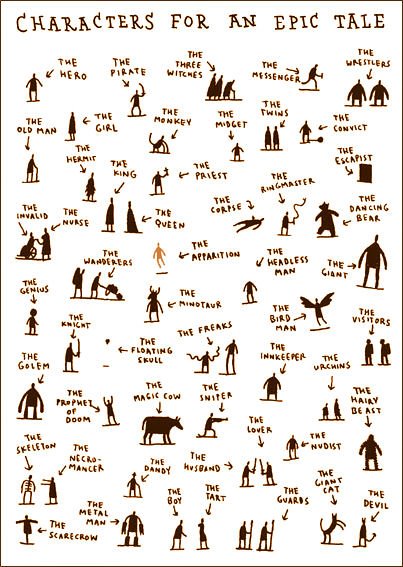
Characters for an epic tale

June 27, 2008 Story and Plot

epic taleUseful reference for all writers. (via [Team Forty](http://teamforty.com/post/40103753/characters-for-an-epic-tale)).

UPDATE: Thanks to Chris for the [link](http://www.cabanonpress.com/index.htm) to the artist, Tom Gauld.

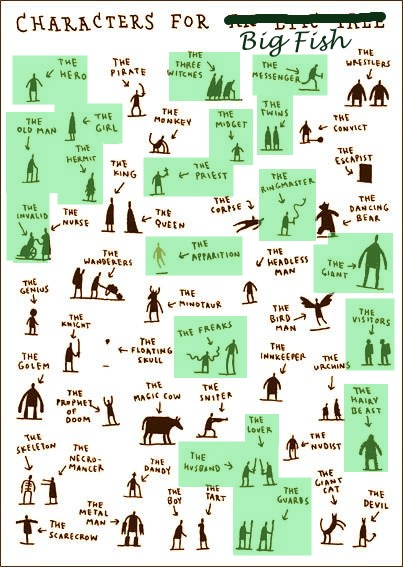
SECOND UPDATE: Because I was curious…

big fish tale


Characters who are not yet important

December 22, 2007 QandA, Words on the page

questionmarkIf the first time a character appears in a screenplay, it is in a scene in which he does nothing — he is just a peripheral presence — should he be introduced at that point?

The specific scene I’m writing is a funeral. There are four characters in that scene that we haven’t met yet. In that scene they don’t really do or say anything notable; they are peripheral mourners. They will all become significant characters later on in the screenplay. Does convention dictate that I introduce them to the reader at that point? (When we meet them later on, we’re supposed to recognize them as having been present at the funeral.)

— Ed
New York City

Yes. If a character needs to be in a scene, you need to put him there. If you don’t, there’s every possibility he’ll get dropped out of the schedule when it comes time to shoot that scene. Screenplays are literary works, but they’re also instructions. Recipes of a sort. While it might be tempting to leave something out — “Of course they’ll remember that Balthazar is at the funeral!” — assumptions like this invite mistakes.

Ideally, the very first time we meet a character, his introduction should be meaningful, giving us some reason to remember who he is and keep us curious what he’ll do. But there are valid reasons why this might not happen, and crowded moments like funerals and weddings are one example.

So if you need to include a character in this way, remember that you’ll need to make your proper introduction later. For example, in the funeral scene, you might simply write…

  • Among the mourners are JOHN BALTHAZAR (50) and his wispy daughter FIONA (21), who hover near the edge of the crowd. Closer to the action are two imposing men in sunglasses — ELAN and MAX, both 25. We’ll meet them all later, but for now, they’re merely paying their respects.

Later in the script, when we really need to meet one of them, we can do the proper setup…

  • Glenn sits across the table from John Balthazar, who we saw briefly at the funeral. With broad shoulders and a piercing gaze, he has the look of a Viking forced to wear to a suit. He keeps his knife and fork clutched like weapons throughout the meal.

You don’t capitalize his name in this second introduction. Since it will be the first time he’s spoken, the dialogue should be enough to help the reader notice that someone new has joined the story.

« Previous Page
Next Page »

Primary Sidebar

Newsletter

Inneresting Logo A Quote-Unquote Newsletter about Writing
Read Now

Explore

Projects

  • Aladdin (1)
  • Arlo Finch (27)
  • Big Fish (88)
  • Birdigo (2)
  • Charlie (39)
  • Charlie's Angels (16)
  • Chosen (2)
  • Corpse Bride (9)
  • Dead Projects (18)
  • Frankenweenie (10)
  • Go (29)
  • Karateka (4)
  • Monsterpocalypse (3)
  • One Hit Kill (6)
  • Ops (6)
  • Preacher (2)
  • Prince of Persia (13)
  • Shazam (6)
  • Snake People (6)
  • Tarzan (5)
  • The Nines (118)
  • The Remnants (12)
  • The Variant (22)

Apps

  • Bronson (14)
  • FDX Reader (11)
  • Fountain (32)
  • Highland (74)
  • Less IMDb (4)
  • Weekend Read (64)

Recommended Reading

  • First Person (87)
  • Geek Alert (151)
  • WGA (162)
  • Workspace (19)

Screenwriting Q&A

  • Adaptation (65)
  • Directors (90)
  • Education (49)
  • Film Industry (489)
  • Formatting (128)
  • Genres (89)
  • Glossary (6)
  • Pitches (29)
  • Producers (59)
  • Psych 101 (118)
  • Rights and Copyright (96)
  • So-Called Experts (47)
  • Story and Plot (170)
  • Television (165)
  • Treatments (21)
  • Words on the page (237)
  • Writing Process (177)

More screenwriting Q&A at screenwriting.io

© 2026 John August — All Rights Reserved.