• Skip to primary navigation
  • Skip to main content
  • Skip to primary sidebar

John August

  • Arlo Finch
  • Scriptnotes
  • Library
  • Store
  • About

Search Results for: Save the cat

Scriptnotes, Ep 304: Location Is Where It’s At — Transcript

June 25, 2017 Scriptnotes Transcript

John August: Hello and welcome. My name is John August.

Craig Mazin: My name is Craig Mazin.

John: And this is Episode 304 of Scriptnotes, a podcast about screenwriting and things that are interesting to screenwriters. Today on the show, we’ll be looking at how screenwriters describe locations and how those choices impact production and the final product. Plus, we’ll be talking a look at how podcasts have become a new source of IP for adaptations. Also, how to deal with that note to make your characters “more likeable.”

Craig: Argh.

John: Yeah. Craig, for the first time in 11 months, we are in the same time zone.

Craig: It’s so nice. So I am here with my family in Amsterdam and having a lovely time. And we are on the exact same time you are. Central European Standard time, which in France is nice because it’s – c’est – it is.

John: It’s really, really nice.

Craig: So yeah, we’re here at the same time. The place where I’m staying, it’s a very large room. You know, the Dutch people are the tallest people in the world. You knew that, right?

John: I did not know that. That’s scientifically proven that they are?

Craig: It is a fact. And so the ceilings here are very high. They’re so much higher than any human being would ever be. For instance, the average height in America, it’s shorter than you think. Because it’s an average. So, some people are very, very small. In the Netherlands, the average height of a Dutch man is 6 foot. That’s average.

John: That’s tall.

Craig: Yeah. In the United States, I think the average height for a man is like 5’8” or something, or 5’9” maybe.

John: Yeah.

Craig: They’re very tall people. So, anyway, it’s very boomy and echoey in here. But, hey, you know what? We’re on the same time, so there’s that for us. Nobody else will appreciate it, but we can.

John: I was going to say, it’s going to be one of those rare cases where neither one of us is tired, is except that you’re probably a little bit jet-lagged. So, we will get through this together.

Craig: Yeah, no, I’m actually not jet-lagged now. Today is the first day of non-jetlag. And you know, that’s usually two days before you leave. And in fact it is. So, it’s just beautiful how you get perfectly attuned and then you get on a plane and do it again.

John: Because you’re no longer jet-lagged, you probably have the energy in you for these first two things. So our listeners, again, the best listeners in the entire world, they sent us two pieces of chum this week, just like bait to get us going. And this first one was really targeted towards you. It’s from a place called Screenwriters University. Craig, get us started.

Craig: Well, someone sent this thing. First of all, Screenwriters University, which is not a university, of course, and I assume they mean it’s a university for screenwriters, but then wouldn’t it have an apostrophe? They don’t have an apostrophe. So it’s just Screenwriters University. Those two words. They sent a list of what those people think are 20 common sense script rules. Now, you know, John, you and I are big fans of rules here, right?

John: 100%. We’re completely rules followers. If you give us a template, if you can give us some sort of like dogma to follow, it really helps us out a lot.

Craig: Well, normally when people put these things out, we don’t necessarily know if they mean them as dogma or not, but the people at Screenwriters University did us an enormous favor because they just went ahead and said right there at the top, “Note: These rules will not make you a better writer. They will simply keep you from annoying your average reader or crew member.” What? But here’s the best part. Per Screenwriters University, “You must learn these simple rules or consider another line of work.” [laughs]

John: That’s a fairly strong statement. Like basically you have to do this or else you’re not even a screenwriter.

Craig: Yeah. You don’t have a chance. There’s no world in which you cannot learn – learn – the rules according to ScreenwritersUniversity.com. There’s no chance for you. If you don’t, you’ll never work.

So, let’s go through a few of these. You know, some of them, sure. So, for instance, Fade In at the beginning of your film. Fade Out at the end.

John: Well, see, I’m already jammed here. Yeah, I’m already in a horrible position here because I’ve written many scripts that don’t start with Fade In and don’t end with Fade Out. So…

Craig: Well, John, I’m going to have to ask you to consider another line of work. [laughs]

John: Fortunately today we are actually at the Musée des arts et métiers which is the arts and trades museum. And I saw all sorts of other professions I could get into, such as like plumping or weaving. So that could be my next step if I can’t master Fade in and Fade out. At least I have those.

Craig: I’ll direct you to Weavers University for their 20 cents common sense rules. All right, so then we have things like, for instance, slug lines have no times of day. No afternoon, morning, mid-afternoon, evening. No.

I do it all the time. I write afternoon, morning, mid-afternoon, evening constantly. Now, by the way, when I got to this – that was number four – when I got to number four I stated to think, “Oh dear, I’m only a fifth of the way in. I hate these people so much I want to fire them into space. How will I ever make it to the end?” And I forced myself, John. I forced myself.

John: Well, the way you got through it, you probably didn’t use a Cut to, because that’s line number 14. Don’t use Cut to. Specifically, “I don’t care if people still use it, or scripts you’ve read have it in spades. I’m telling you the reader will throw out your script for such a small and petty offense. Learn the proper way to do it, and when you’re world famous you can bring the Cut to back into everyone’s good graces. And then we’ll wonder what we ever did without it.”

So, again, just this last week I used a Cut to and, man, it’s a problem.

Craig: Well, you never learned the proper way to do it because you didn’t go to ScreenwritersUniversity.com. Of course, we get to number 15, your favorite, my favorite, the eternally favorite and wonderful Don’t Use We See. And this is what they say, “Seriously, one ‘we see’ per script is plenty. And that’s only when you absolutely must, because you’ve exhausted every other possibility of explaining what we see without actually saying we see.”

Now this is where I put my hands around the virtual neck of Screenwriters University, squeezed and rotated in opposite directions until I heard the snap.

John: My theory is that someone is deliberately doing this just to anger you. That you’ve made an enemy somewhere in your life and this enemy wants to sort of rile you up and distract you from other things. And so therefore they’ve created this whole website just to antagonize you. Because that’s the only reason I could see wording these things in this way. Because I look through all of these rules and at each one I could say like, OK, there’s a general case to be made for like pay attention to this thing, but absolute prohibitions are never actually valid.

So this list of 20 things, they are probably 20 things that are useful to look at here, but they are all phrased in ways that I find maddening.

Craig: Maddening. And inaccurate. And misleading. And then in certain cases just wrong. For instance, their “we see” thing is wrong for a hundred reasons. But what fascinates me is they don’t even understand what it’s for. They literally don’t get it. They think the “we see” is somehow a substitute for explaining something. It’s not. Rather, it’s indicating to the reader who is seeing something. Us. We are. As opposed to say the character. It is mindboggling to me.

Now, I’m going to say the following as diplomatically as I can. And this is where it’s good that I know, you’ve changed me, you’ve made me a better man, John. You have.

John: All right.

Craig: Because I think three years ago I would not have been this diplomatic.

John: I think in some ways you could draw a parallel between our relationship and the key relationship in Wicked. Because if those two protagonists had not met each other at that point in time, who knows the arcs that their lives might have traveled in. But because I knew you – because I knew you, I have been changed for good.

Craig: [laughs] That’s right. Well, I don’t know if you’ve been changed for good. I think I’ve changed you for evil. But you’ve changed me for good. So, I don’t say this diplomatically just to cover my tracks. I feel what I’m about to say. This is honest. I naturally was interested in who wrote this. They did not put a name on it.

So then I looked to see who actually teaches at Screenwriters University. Now, any one of these individuals may be a fine writer. That is absolutely possible. There is nothing that says that a lack of shiny credits means a lack of talent, nor is there anything that says a presence of shiny credits means a presence of talent. However, there is a general lack of experience here and what I would say relevant experience.

This is not a collection of individuals that inspires a tremendous amount of confidence in me that they are in tune and have good grasp of the way feature films are currently written and sold today. And I don’t see any other reason for anybody to be going to Screenwriters University and spending money – quite a bit of money – at Screenwriters University, because I do not believe their instructors are necessarily in a position that is any more informed in any substantive way than most of the people who are paying the money.

That’s the diplomatic version. How did I do?

John: Very good diplomatic version. Craig, I was incredibly impressed. You really withheld some of your umbrage and your fire. I think there’s some really good choices you made there.

What I will say is like some people go to college for the social experience. And so maybe you’re going to Screenwriters University for the social experience. Maybe you’re going there for the parties, for the fraternity life.

Craig: No.

John: Maybe you really want to play Division III football. So, I mean, those are all reasons why you might want to go to Screenwriters University. But I don’t think you are going there for the quality of the education.

Craig: Yeah. They don’t have any of those things. They don’t have a building or anything. So…yeah. No.

John: Then maybe you could save your money.

Craig: I think maybe you could save your money.

John: This was sent I think to anger me, but this is the second bit of umbrage bait. So Sony Pictures Home Entertainment announced that it’s going to start releasing clean versions of some of its movies. There’s a list of 20 movies that they have picked which “allows viewers to screen the broadcast or airline versions of select Sony films free from certain mature content.” So basically in renting the film you can rent the original filthy version or you can rent the clean sanitized version.

I think some people have sent this to me, but I also saw Seth Rogan sort of pleading with Sony like please don’t release the clean versions of R movies. So this was sent to me I think to make me feel like well that’s horrific and Sony should not ever do this. And I had a hard time working up a proper amount of umbrage over this. Because it looked like what Sony was going to be doing is essentially when you download a film you have a choice of the original version or the clean version, or basically they send you both of them. You get to choose which one you’re going to do. I’m kind of surprisingly fine with it. But, Craig, I want to see how you feel about it.

Craig: Well, I’m not outraged. It’s not like they’re eliminating the proper version. And we have children and we understand what it means. I guess I’m a little confused. I’ll just come at it as a parent now. I’m going to take myself out of the movie industry and I’m going to put aside any impulse I might have for artistic fury here and just talk as a parent. I can’t imagine that there is a movie that I want to show my child but I just want certain things taken out of it. At that point, I just don’t want them to see the movie. Either they’re ready for a movie or they’re not. The “clean” version thing is something that never really is very satisfying. You know, when I say to my child, “Hey, you should watch this,” I’ve thought about it and I thought they’re ready for this, if it’s something that requires that sort of thought. Obviously a Pixar movie doesn’t.

And so it’s OK. I don’t really think I would ever use this service. I don’t want my child to see Goodfellas but with the cursing and blood taken out of it, because they’re not going to like it. It’s going to stink. I’m not sure what this is good for.

John: I pulled up the site and it’s talking through the movies that they’re originally going to release with the clean versions available. And some of them I think actually do make some sense. And so like Crouching Tiger, Hidden Dragon is a movie that I can see kids enjoying because it’s just beautiful, but there probably is some stuff in there that you might want to have a younger kid see. I can kind of imagine that.

The three Spider Man movies, the original – actually all five Spider Man movies – they’d release a clean version of that. I guess. I can’t even imagine what’s so dirty about them. But I think they were PG-13, so it may move a PG-13 down to sort of more of a PG level.

But White House Down? I don’t want a kid seeing White House Down because of the language. I just don’t want them seeing White House Down.

Craig: Yeah. Exactly.

John: Captain Phillips?

Craig: Captain Phillips? What’s the point of watching a cleaned up version of Captain Phillips? What child is sitting there going, “I really want to watch Captain Phillips, daddy.” Well, I don’t know, there’s some cursing and there’s some blood. “Well, if we got rid of that, could I then watch the escapades of Navy snipers and shipping captains facing off against Somali pirates?”

What the F? See, I just did it myself. I cleaned myself up. So weird. Captain Phillips?

John: Yeah. So here’s the thing. There have been services out there that have been trying to do this sort of not officially sanctioned by the studios for years. And so to have essentially the airline version of this be available for people to choose, I don’t see a huge crisis there. Now, I do know that there are filmmakers who will take their names off of the airline versions because it’s not their original version. I think that makes sense as well.

And I guess I like that all the edited versions are just as a bonus feature. So essentially you’re downloading the real movie, but under the Extras feature you can choose to have the cleaned up version. I guess I’m just not that outraged by it. If it lets that 10-year-old kid who really wants to see The Amazing Spider Man, it makes his or her parents feel more comfortable watching that movie, I guess that’s not so bad.

Craig: Yeah. Like I said, I can’t. I’m not lit up on fire over it. I’m just more confused by it. As far as the airline thing goes, isn’t the airline cut kind of going by the wayside anyway? Because that was always – you know, in the old days they would have a screen that came down and your five rows were all watching the same movie together because there was one movie. But now everybody gets their own movie on the back of a seat, right?

John: Yeah.

Craig: So I don’t think they clean those up anymore, do they?

John: Yeah. They do clean them up sometimes. I’ve definitely been on some flights where you’ll see a bit of nudity got blurred in the thing. I think it’s because they’re figuring there might be a kid sitting next to you who could be seeing the same screen. So sometimes you will see a little bit of cleaning up in those. But, yeah, I just can’t be that outraged by that.

I think a fairer question to ask is what does cleaned up really mean and what kind of content are they taking out? Because if they’re taking out that tiny bit of gay content in Beauty and the Beast, then I just get a little bit annoyed that that’s the filthy content that you have to protect young children from seeing. But I still can’t be all that outraged by it.

Craig: Yeah. Yeah. You know, I’ve been kind of, I don’t know, marveling at the general liberalism and progressivity of the Netherlands here. I took my daughter to the science museum and they had half of a floor dedicated basically to sex. And this is one of those museums where, you know, elementary school classes are coming through. And there were young children there. They’re like, yeah, it’s sex. You’re here. Go look at the sex now. Let’s talk about how the sex works. They have no problem with it.

So, I can’t imagine what the Dutch would make of this whole thing where we’re snipping out pieces of a movie. I think that they would just find that absurd. So, I’m with you. I can’t get too upset about this. But, seems kind of weird and vaguely useless. I’m probably mostly just umbrage hungover from Screenwriters University. Which, by the way, just to bring it back to them for a second. You realize they’re charging people like $500? I’m going to lose my mind.

John: Yeah. It’s a lot. All right, so let’s give some free education here. Let’s dive in on a topic–

Craig: Segue Man.

John: That we’ve talked about in previous episodes, but a new thing came up this week which made me think about it again, which is location. Which is how we are describing the locations we’re using in the movie, how we’re picking those locations, and how the locations we’re using really can impact the story that we’re trying to tell. So, obviously Screenwriters University can tell you that locations are preceded by an INT or an EXT. But there’s an important level of specificity here. So I want to quickly go through some of the choices you’re making as a screenwriter when you’re picking a location for a scene. And then really look at how those locations you’re picking are going to influence what characters are doing in that scene. Because that’s the new piece that really occurred to me this week. So, let’s look through some questions that a screenwriter asks when picking a location for a scene.

The first one is always what is the most likely location for this scene. And so this scene is a police interrogation, well, that police interrogation headquarters room feels like the natural place for that. It’s the most obvious place for that. But the second question should be what is the most interesting place for this scene to have happen. And I think you always owe it to yourself to go through and like brainstorm five more interesting places for that scene to take place. Before you commit to that first location, really think through like where are the other interesting places I could set this. And what opportunities would occur if I set this at a different place.

Craig: Yeah. You know, you’re right that sometimes your best move is to present the expected location. If you do have, you know, you’ve given the example of an interrogation scene. We know where those take place. And for good and legal reasons it’s rare that you can do them on the rooftop or in a basement. They’re generally going to take place in that room.

But then your job as a screenwriter, I think, when designing that location is to say is there something about that location that is slightly off, a little bit of a twist. Is the paint peeling? Is there a leak in the ceiling because it’s raining outside and that’s this annoying drip-drip into a coffee cup while they’re having this.

You have to do something. Because otherwise it just feels, well, this is not to disparage television, because television is wonderful and they’re putting out better and better television every day, but when I think of the traditional style TV where they got to shoot really fast and they’ve got to shoot a lot and they just don’t have time sometimes to deal with stuff. So you’d end up with these stock locations. Especially if you’re writing a movie, you really want to either not be in a stock location or turn your stock location into something that’s interesting and memorable.

When Clarice goes to visit Hannibal Lecter, that’s the mental institution. That’s a hallway. That’s bars. That’s people inside. But look what they did with it, you know?

John: One advantage to using the stock location, the expected location, is you get a lot of stuff for free. And so going back to the example of an interrogation room or a doctor’s office, we know how those work. We’ve been there ourselves. We’ve seen them in movies before. So there’s no process of like getting the audience used to the location or having to figure out where this place is. We just get it immediately. We see it. We know exactly what it is. And in some ways it’s helpful because the location doesn’t demand a lot of our attention. And so that can be a very useful thing about picking a stock location.

But, I would just say like don’t default to the stock location unless you have to.

Craig: Agreed.

John: Another question I ask myself is are the characters moving or are they standing still? And if they’re moving, you need to give them a space to move through. And so in a location where they’re going to feel hemmed in, it’s not going to be a good choice for a scene that should be on its feet and should be up and moving.

Conversely, I get frustrated sometimes where I see in movies where they have this incredibly active and vibrant location and then they just have the characters standing there. It’s a real mismatch between the production designer picked this great location or the director picked this great location, but the action of the scene doesn’t demand them to be moving at all. And so therefore there’s just a bunch of business happening around them.

So, really ask yourself do the characters want to be moving through a space? Or are they standing there, sitting there, just talking through some idea?

Craig: Yeah. You know, there’s the question which is do the characters want to be moving. And then there’s also a question does this location want them to be moving. Because there are locations that entice you to move. If you’re at a fair, and there are people moving through and around. And there’s rides and things turning all around you, it’s really hard – like if you go to Disney World and you just get into the middle of Main Street and stand there, it’s going to get annoying really fast for both you and all the people around you. So, there is a natural need to keep moving, which is good. Obviously, there are scenes where the motion is the whole point. A chase, for instance, and then that’s a whole different idea.

But if you’re in a situation where you’re thinking, oh, it would be great if my characters were actually moving. They weren’t just standing on their two feet, find something in the environment that naturally gets them to move. Because what I don’t like is the unmotivated walk and talk. It’s just a dreadful thing. And you see it all the time. It’s just two people walking and talking and there’s no reason for them to be walking, because they’re not going anywhere. And they’re just doing it because the camera guy thought it would be nice. And it’s odd.

John: Yeah. They’re doing it because another static scene would just be a killer. Everyone would get bored if they were just standing there, but like there’s no reason for them to be moving. That’s the real frustration.

A question I ask myself is what color do I want to see on screen. And this seems like a weird thing, but we always talk about like hair and makeup and wardrobe and sort of what are we seeing. And hopefully you’re seeing something. But what color are you seeing? And I try in my movies and other things I write to really have a progression of color throughout the story. And so that we’re in a period where we’re in greens and we’re outside a lot, or we have periods where we’re in reds. We have a period where it’s white, because it’s a lot of snow. And so think about what color we might have seen in the scene before. What color would make sense for this scene? Do we want to be consistent? Do we want to mix it up? Just think about sort of what colors you want and that can help point you to a good choice for location.

Now, sometimes based on the nature of the story you’re telling, you may pick a look just to differentiate between two different things. For instance, you may have an A plot and a B plot. And when we cut between those two locations they have a very different color palette just by their very nature. If people watch The Americans, this last season we were in Russia for a lot. And they just slap this massive blue filter on every scene in Russia. And so I feel so bad for the people in Russia because they clearly don’t have enough lights and it’s always blue. But that’s just the nature of the show, the world they’ve chosen to describe. And so it’s always going to blue when we’re in Russia. So, I try to make some of those choices in my head while I’m writing and that can help inform people down the road as you’re actually moving into production.

Craig: Yeah. I put color in all the time. I’ll talk about the color of the walls sometimes, or the color of the floor. I don’t describe the color of everything, but there’s always one thing that I think will catch your eye. And that’s interesting. An old grimy yellow. I can see it now. And I know that it’s grimy because it’s neglected and that’s a thing. I also know that whoever painted it probably didn’t paint it in the last two years.

So, you learn these things from little bits and pieces. I do tend to think about them in contrasting ways. I don’t have an overall color palette for the whole thing. I think of it more the way I think of, you know, when we talked about transition, size changes, you know, like when you go over here suddenly it’s sort of very bleak and gray and cold. And then you go over here and you’re inside with different people and it’s warm and reddish and brown. But those notions of cold and warm, you know, temperature to me is part of location. And temperature informs color. I just think of cold as being bluish and grayish and I think of warm comforting places as those oranges and reds.

And it helps paint the movie for people. You know, this is I guess the opposite of Screenwriters University tells you to do, so forgive us. Because they’re really good. But we’re making a movie. I don’t know how else to put it. You’re making a movie. All these people that tell you, “Don’t step on blankety-blank’s toes,” there’s no toe I don’t step on. Just to be clear. When I’m writing a screenplay, I step on every toe. I am directing the movie, I am casting the movie, I am production designing movie. I’m putting props in the movie. I’m costuming the movie. I’m doing it all on the page as best I can in a way that is evocative so that all those people that come after have something to go on.

But more importantly somebody somewhere read it and said, oh yeah, I’ll spend the money to make that. That’s the point. So, I think it’s great. Color. Yes, use it.

John: You’re making choices that describe the feeling, and that’s sort of my next question I always ask is if this location were a character in the movie, what would its personality be? So if this location could speak, if this character could take an action, what kind of character would it be? And a lot of the adjectives you use to describe in this previous section really apply here. It’s warm. It’s cold. It’s inviting. It’s foreboding. Think about what that location would feel like if it’s a character and then try to figure out what location could embody those ideas. And that’s incredibly helpful to really think about is it sleek and cold and fastidious or is it a jumbled mess? And putting the same kind of scene in those two different locations will greatly impact the scene.

Craig: Yeah. It’s a chance for you also to impart some authenticity to your story, especially if the point is that it’s set in a recognizable place, a specific place. This is where doing research is really, really helpful. And it’s important when you present your version of this real place that you’re not just relying on things like, you know, we’re in Chicago. There’s Wrigley Field. There’s Sears Tower. But you also, you know, you get the vibe of the contradictions of the place, the magic, the ugly, the beautiful.

We spent – Todd Phillips and I spent a lot to time just studying Bangkok. Studying Bangkok online. Then going there and walking around into every kind of neighborhood. And offering people a glimpse of all of it, because there is squalor and there is wealth and there’s beauty and there’s ugliness and there’s crime and there’s peace. It’s got everything. And we kind of wanted to really hand that over. So, that’s kind of how you start to make the place the character is by knowing it as best you can. You know, obviously if you’re not there, start with Google, I guess.

John: That sense of like which Chicago you want to show is so crucial. Because I get really frustrated when I see the establishing shot of Wrigley Field and now we’re at that Fountain. That kind of stuff is just so cheap and tourist brochure that it doesn’t help me at all knowing what kind of movie it is that I’m seeing. And so, yes, ideally you should go travel to the place where you’re setting your story and figure out what parts you want to actually describe and what it actually feels like.

It also means giving yourself the space in your script to describe some of those things especially early on the script to give us a feel for the texture of where we’re at. And hopefully you’re not just flying by some of these places before you get to a real scene. Hopefully you’re setting some of your early scenes really in those places. So your main characters are moving through these locations and giving us a feel for what kind of Chicago we are seeing in this.

I get so frustrated when I read in scripts, you know, it just says, “Chicago,” but I have no idea of what just Chicago means.

Craig: What does that mean?

John: It could be anything. And you just don’t know. And also keep in mind that people are doing to judge the look and feel of your movie very much based on those early scenes. And so if your initial Chicago scenes are in these glamourous hotels and suites and skyscrapers, it’s going to feel like that kind of movie. So if that’s not what most of your movie is, or if we’re starting there and we’re going to someplace else, you’re going to have to spend some page real estate to really paint the picture of where we’re at for the rest of this story.

Craig: But you can do it economically. I mean, nothing of what you just said and nothing of what I have said requires people to burn a lot of space. It’s just that you have to be specific and know what it is that you want to communicate. Because ultimately whatever you want to communicate, it is in its own way going to be very directed and compact.

If you’re telling a story about the seedy under belly of someplace, that is a compact notion. Now, let us get that vibe without you saying it, but rather by describing a street, a place, a smell, a look. Taking a camera and showing me something beautiful and then the camera just lowers down, down, down, and now we’re below a bridge. Now we’re below this. Now we’re in the gutter. Whatever it is, it actually doesn’t require a lot of time. What it requires is attention and care. Sometimes I think that when we write scripts it’s like we’re a 3D printer and we’re putting these layers on top of layers on top of layers.

And the script comes out I guess misshapen if we forget a layer somewhere in there. And this is one of them. This sense of location is a really important layer.

John: So here’s an example. “Jane unlocks her apartment door and goes inside.” So, you know, if you just give me that sentence, I don’t know anything about the apartment. I don’t know anything about Jane. I don’t know anything about the neighborhood. But if she has to unlock three locks on her door, and there’s trash in the hallway, and the light behind her is flickering, and we hear off-screen shouting, then I know a lot more about Jane and her apartment building and everything that’s going on.

Versus if it’s like a sleek high tech glossy, people sort of float by silently, someone tosses a look over her shoulder that Jane’s not dressed well enough to be in this building, or is suspicious of Jane, that tells me so much more about the building, the universe we’re in, and who Jane is. And that’s two sentences early in your script.

Craig: Yeah. They also give you an opportunity to learn something about her. Because she’s interacting. You’ve given her an environment, a location that can be interacted with. So, how she responds tells me about her. When somebody looks down on her, does she internalize it? Does she not give a damn? Does she argue back? Is she scared of living where she is? Is she unscarable? This is the kind of feedback loop you can create. And it’s why you – it’s hard. Sometimes I feel like we give these lessons and it’s unfair to you guys because we’re making things sound easier than they are. They’re actually kind of hard. Because it’s like a circle that feeds into itself. And you have to figure out where you’re going to jump into the circle – character, location, description of location, reaction to location, purpose of moment.

All of that stuff weirdly has to feed into each other. So, you think I know what I need to do. Where would that kind of happen? It could happen here. What would she do? Well, maybe this place could help me show that if it were like this. But now this place means da-da-da, and so the circle goes.

This is how writing kind of happens. It’s hard, John, sometimes, you know.

John: So this last week I’ve been on a rewrite, and part of the reason why I wanted to do this episode was there was a scene that I encountered which I strongly suspect used to take place somewhere else and so the location does not match what’s actually happening in the scene. There’s a kind of generic conversation that’s happening between two characters and yet the location is really spectacular and kind of fascinating and really could speak very well to these two characters, but it’s not speaking to these two characters because I think they just changed the location and basically kept the scene the same way. And so as I look at sort of how would I redo this scene, the location is really driving my choices.

Because to me it just feels weird that they’re in this location and they’re not acknowledging it. It’s a really visual change in the movie and they have to acknowledge that they’re there. And so I’m using that as the basis for really the comedy that’s hopefully going to sort of help drive the information in the scene. So ultimately the scene will still get through the same – it will still stick off the same beats as before, but it’s just going to use the location to acknowledge why they’re there, what’s going on, and hopefully find some new life between these two characters that felt perfunctory before.

Craig: Yeah. Well, it speaks to how important location is, because when you’re stuck with it, that’s when you really feel how it drives so much. I mean, I worked on – I mean, it’s public record that Frank Darabont was going to direct The Huntsman and he left. There was an amiable departing. I don’t know, whatever you call it. And the studio hired a new director and yet kept essentially to the schedule, which meant that the principal photography was going to start in about two weeks. And so I got called in and they said, “All right, we’re starting in two weeks. We got to make a bunch of changes. Here’s the situation. We’ve built a bunch of sets and so we’re using them. And these are what these sets are for. These are the locations.”

That is a tough box inside of which to work. And, you know, these are the things of course people who casually comment on movies don’t understand. This is sometimes what happens.

So, you have to write some scenes in certain ways because the location has happened before you. That’s obviously a very rigid thing in a – that’s a fairly rare circumstance. But it’s a very common thing even when you’re doing a regular rewrite, but a producer or a big star says I really want to do – I love that sequence in Monte Carlo so we’re doing it. OK. I guess we’re going to work with that, but it is one of the fundamental pillars of the story. So, choices are now that much narrower.

John: But the same kind of thing happens on indie films as well. Because if there’s a kind of move that’s so driven by location, indies generally have a very limited selection of what locations they can use to shoot in. And so if you are making a film that is by necessity going to be taking place in one or two locations, those locations become exponentially more important to your story because we’re going to be seeing them the entire time.

Or, on the other hand, sometimes the choices about locations are not really the writer’s choices. They are the choice of production. And so some of the practicalities you’re going to be encountering are costs. Can they afford to rent that amazing penthouse apartment that you have written in page 37? If that location is just there for that one day, and they can’t make it work because of money, or more often they can’t make it work because of schedule, because there’s only sort of one scene there and it’s half of a page, so they have to marry it with some other days’ work. Sometimes you just can’t make that fit.

Sometimes they can’t make a location work because that’s great that you want to set the scene in Rio de Janeiro. There’s no money to go to Rio de Janeiro. So we’re going to have to set this in Guadalajara instead. That’s a change. That’s a change you’re going to have to roll with.

And finally controllability. And I find this a lot where people want to set things in big public spaces. Well, that’s great. And you get a lot of sort of free production value because you get all the monuments behind you or something great in the center of Paris, but you can’t control those locations. And sometimes you’re just not allowed to shoot there. And so figuring out what the balance is going to be can be a real challenging thing.

So, I guess we’re saying as the screenwriter you have to be ambitious in your choice of locations as you’re writing, but you also have to be smart in understanding what’s going to be changing during production and being able to roll with it to make the best use of the locations you actually do get to use when the line producer comes back to you.

Craig: Yeah. It is one of the most frustrating things because the first moment of rubber meets the road/reality check/whatever you want to call it is when you’ve written the screenplay and everybody is on board and it has gotten the green light. And then they come back and they say, “Well, we’ve gone through. This is our budget. This is what we can do. Here’s what we can’t. We just can’t do it.”

And it’s so hard because everybody has been so invested in creating this crystal tower with you, and now someone just comes along with a hammer and goes, “Nope. Not here.” And sometimes you end up in situations where you just think we are being asked to fail. The smartest of the Indies are the ones that anticipate all of that. You know, I’m thinking of for instance Phil Hay and Karyn Kusama and Matt Manfredi. When they did The Invitation they knew they didn’t have a lot of money. They barely had any money at all. So they made a movie that took place in a house. They spent a lot of time trying to find the right house. They found the right house. They’re good. They don’t have to worry about something falling through. That’s kind of the way to go. Protect your key locations because if you don’t, someone is coming with that hammer. And then, oh my god, what a mess.

John: Yeah. Get Out is another movie that is essentially all in one house. There’s a few things that venture out beyond the house, but it is essentially one house. My movie, The Nines, is largely one house. And so when the line producer came back with a budget which was wildly too expensive, I had to sort of talk her through saying like, no really, this one house is mine. We can control this. And you don’t have to worry about rentals or leaving and coming back. This is a safe place. And so that can be the jumping off point for all of the other little field work along the way.

When you are the writer-director, a lot of times you will have in your head like this is where I want to shoot this thing. That can be fantastic. But I had to learn how to let go of some things that I really wanted to shoot in certain places because it just wouldn’t work for budget or more often for schedule. Like there was no way to find that seedy hotel within a three mile radius of where we were going to have to shoot this other thing. And so you make it work.

If you go back to the conversation I had with Chris McQuarrie, he’s on a giant, expensive Mission: Impossible movie, but the same kind of things still happen. It’s like, well, we have this grand vision for what we want to do, but this is the reality of what we have. We don’t have enough extras to make this party scene work. And so we’re going to have to flip the scene around so these 200 people feel like enough people for this party.

That happens at every level.

Craig: You know, it’s funny, when I write and I come up with a location, I start doing some math in my head. It’s never about expense, per se. it’s more about how much is going to be required to dress it. Because what happens is when you get on a movie set there is a negotiation that begins to happen. This is really in preproduction, frankly. There’s a negotiation between the production designer and the cinematographer. And the cinematographer is essentially saying, “I want to be able to see as much as I can.” And the production designer is being held to a certain budget and knows that they have to plow money into sets and other locations is saying, “Yeah, but could you tell me where you probably will be looking? Because then I don’t have to create a whole bunch of world that you never even look at,” because that’s expense.

And one of the expenses that goes separate and apart from what production designers do is extras. Filling a space with people is expensive. You don’t realize it until you show up on a movie set and you see the area where they’re keeping the extras. And you go, oh my god, that’s a lot of people that we have to feed. And someone has to make sure that they’re wearing appropriate clothing. And they’re going to all get paid for the day. And wow.

[laughs] Bob Weinstein once asked me, he goes, “Hey Mazin, do all those people get paid?” I was like, yeah. He goes, “Really?” So, Bob, I think it’s slavery if they don’t get paid, right? And he goes, “Wow, man, never thought of it that. Ha-ha.” What a dick.

John: The only time I will somewhat come to Bob Weinstein’s defense is that it is a little strange that studio audiences for sitcom tapings are not generally paid. So, we are hearing their laughter. I guess they’re getting a free show out of it all. Sometimes they’re getting prizes. But they are not paid. But an extra is really paid.

The one other thing you will find if you are in a place where movies are being made often, sometimes you will walk into an area where they’ll say, “Filming is currently happening here.” And basically by entering this space you understand that you may be in a shot. That’s another thing that can happen.

So, in my movie, The Nines, there are some shots in New York where we didn’t control that at all and Ryan Reynolds is just running down a street and he’s passing real people and we make it all work. But there was one moment where we needed to have an upfronts party. So, when a new TV season is announced, when the network is announcing its whole schedule, they throw these giant parties in New York. And so I needed one of those giant parties. But I could afford like six extras. And so like how do you do that?

And so you do it by figuring out very carefully what your shots are going to be. We did the check in table. We used a hotel and we used a hallway at the hotel. And we just made those people feel like a lot of people. And you use sound design to make you feel like there’s a lot of people over there somewhere to your left, but we’re just not focusing on them. And it works for what the scene needs to be. We needed to sense that there was a big thing happening, but the actual scene was small and intimate so therefore I didn’t want to be in a giant space.

Craig: Yeah. These are the – it becomes a Rubik’s Cube. It really is. It’s a Rubik’s Cube of – once you get into production it’s a Rubik’s Cube of money and practicalities and creativity and vision. But when you’re writing your screenplay, remember your goal here is to attract financing and attract actors and attract directors, if you’re not directing, and terrific crew. Create the world you want to see, and then, you know.

Now, if you know, like I said, that this is the kind of movie where you’re going to be dealing with a couple million dollars for your budget, create a world that you’d like to see that you could probably do for a couple million dollars.

John: Absolutely. All right, our next topic. So, in previous episodes we’ve done How Would This Be a Movie. We’re usually looking at stories in the news to figure out how they could be converted into a big piece of blockbuster entertainment. But a new thing happened this last two weeks that I thought was really interested.

So Julia Roberts has attached herself to star in a TV adaptation of a podcast series. So it was a podcast series called Homecoming which is a fiction series created by Eli Horowitz and Micah Bloomberg. And Mr. Robot creator, Sam Esmail, is supposed to be doing the TV adaptation of it. It was just really interesting that essentially it was a radio drama done as a podcast form but now going to be adapted into TV.

And the first time I could think of that transition happening, which I think we’re going to see a lot more of.

Craig: Yeah. You may very well. Again, you know, I don’t listen to podcasts. But it seems to me that the ones that I keep hearing about are the ones that are narrativizing true life things. This one was fictional the whole way through?

John: This one is all fiction. So, Catherine Keener played the main character in the radio version of it, the audio version of it. Julia Roberts would play her character in the next version of it. I think radio drama is really hard to do, and so god bless them for doing a good job with this. I haven’t listened to it, but I’ve heard only the promos for it. But people loved it. So that’s great. And it’s great that it’s getting traction in another form.

What I see more often happening is another Gimlet show called Start Up is being converted into a TV comedy called Alex, Inc. So Zach Braff is staring in that and it’s about the birth of a podcast company. So it is more the classic thing where it’s like it’s kind of like Shit My Dad Says, where it was a Twitter feed and it became the basis of a real sitcom. This is a comedy based on one guy’s quest to get a business started. And you can sort of more clearly see like, OK, you’re fictionalizing the real versions of people.

Craig: So when is our show?

John: That’s really the natural next question. So, when is our show? How are we divvying up the credits on it? Who is playing whom? These are tough choices, but I guess we should probably ask our listeners, because our listeners are the smartest people out there.

Craig: Well, I mean, look, I know who should be me. If it doesn’t work out with Homecoming, I would love Julia Roberts to play me.

John: Oh yeah. That’s a nice choice. I’ve always seen myself as a Sandra Bullock type. So, she’s both a free spirit, but also a little restrained at times. And I think the two of us, I think casting it as women opens up new possibilities. It really can speak to our sense of the challenges as working moms in this business.

Craig: I don’t think we’re interesting enough to get gender matching casting. It’s too boring. Literally, we need a gimmick. We need a gimmick. We have to be played by women because we’re not women. If we were women, we should be played by men. Basically, we should be the opposite.

John: So, I’ve been thinking like who should play Aline and how about Stanley Tucci?

Craig: Great.

John: Yeah. Just mix everything up.

Craig: Absolutely. Like really what I’m saying is the Scriptnotes show should not resemble Scriptnotes in any way. In any way.

John: Yes. But something I’ve learned about television development is by the time it would get on the air, it would not resemble the original pilot whatsoever.

Craig: Yeah. I’m requesting something that’s just going to happen anyway.

John: One of the first things that will come up as people start reading the script based on Scriptnotes is the same thing that Tom Sanchez tweeted at us this week. “Hey guys, I got a note to make protagonists more likeable. Any tips or basic principles or advice?”

So, Craig, when they read the script and they go this Craig Mazin character is not likeable, how do we fix that?

Craig: You don’t, because it’s not a problem. And this is the worst note to get, because it’s not a thing. This is hard. I don’t know how to combat it in any clean way. If I hear this, I know I can’t say, “No, that’s stupid. Doesn’t matter.” People actually love unlikeable people. There are entire actors that have made a career out of it. It’s wonderful. Grouches are delicious. And, I don’t know, I could sit here and name 4,000 television shows and 4,000 movies that you love that star unlikeable people.

I could sit here and show you Walter Matthau in Bad News Bears. But I don’t have time. I can’t say any of that, so in my mind I start backing for the door. I got to be honest with you. When I hear somebody say, “Well, the protagonist should be more likeable,” I judge that person for giving me the dumbest note in the world. It’s not a real thing.

It is ignorant of the way movies and television work. The key is that the protagonist should be understandable. So I guess that’s my only defense.

John: That is my defense of it, too. Is that sometimes you’ll hear the likeable note and they just don’t actually have a read on the character. There’s something about the Velcro of that character that’s not quite gripping. And so you may need to look for some moment early in the script that gives that character a specificity, something really fascinating about that character that makes people want to engage with them.

So, it could be, you know, a joke. It could be some action they take very early on that is interesting, relatable, remarkable, something about that character that makes say like, “Oh, I get that dude. He’s fascinating. I want to be on his story.” But I get the likeable notes, too.

And so in Big Fish, Will is always considered not likeable. And it doesn’t matter whether it’s the movie version, or the Broadway version, you always get the note “I just don’t like Will. Will is just not likeable.” And it’s just really a functional problem, because he’s the antagonist to a character who is tremendously likeable. There’s a sort of dual protagonist/antagonist relationship. And if he was this charming, life of the party kind of guy, there is no story. I can’t make Big Fish work if Will comes on as being the most likeable kid in the world.

So, we always have to be mindful of that sort of structural challenge in casting a Will that we just don’t cast the most dour, bleak person ever. You have to have a spark of life in the actual actor we cast. But functionally the role is not especially likeable at the start. And hopefully by the end of the story you’re loving him.

So, Tom Sanchez, when you get that note, I just say like, you know, try to figure out whether they’re understanding the character before you try to make huge changes to what the character is doing.

Craig: Yeah. It’s helpful, too, if you can at least point out that your character doesn’t like him or herself either. So they are aware. I do think that it is off-putting when there are characters who are unlikeable and are perfectly happy with themselves and we don’t quite know what to make of that. That’s just Ted Cruz, basically, right? So, we look at Ted Cruz and we say, “I don’t like you and, also, you seem to love yourself.” That’s a terrible combination. That’s where we start to feel like we’re dealing with an alien.

But with characters, for instance, Billy Bob Thornton in Bad Santa. It’s hard to be more unlikeable than that guy. He is a thief. He is a drunk. He is mean. He is racist. He’s hurtful to children. But, we know that he is in terrible pain. And that whatever it is that he is dealing out he is dishing upon his own head even more. And so we understand there is a potential redemption. And we move toward him. That’s important. If you can underscore that, then I think you’ll be fine.

But I hate it. I hate the whole likeable thing. It’s stupid. And basically it’s the kind of thing you’d expect to be taught at Screenwriters University.

John: 100%. I think you can actually get a special certification in likeability if you pay an extra $500.

Craig: [laughs]

John: All right, it has come time for our One Cool Things. I actually have three things, but they’re all short and related to locations.

So, the first two are maps. There’s a great new Metro map of Paris called the Circle Map designed by Constantine Konovalov and other folks. It’s just fantastic. So, every time you try to do a map of a Metro or bus lines or underground subways it’s always a balance between representing reality and sort of an idealized version that is clear and simpler to understand.

And this version is really just fantastic. It chooses to bend the lines into sort of circles rather than keeping them quite as naturally flowing as they would otherwise be. But it makes the Metro much, much easier to understand. So I’ll put a link in the show notes to that.

Also, a great one that Craig you’ll dig is the Roman Roads. So basically all the roads that the Romans built, but done as sort of a subway map of Europe. And showing sort of like, wow, they did a hell of a job. They really built out a lot. And it’s fun looking at the stops along the way to see what are now cities and sort of like how those Roman names of cities became the modern names of cities. So, another great one.

Finally, you can’t talk about locations without one of the greatest games I think ever for iOS that now has a sequel out. Monument Valley 2 is now shipping and it’s just delightful. So, it has the same impossible geography as the first one, with some other great choices and changes. So, if you’ve not played the first one, play the first one, then play the second one. They are both just great games.

Craig: Yeah. Currently, I don’t know how far in I am, but I’m in it.

John: I would also say Monument Valley, especially the second one, has really good storytelling between the mom and the daughter for like characters who don’t speak. Just their little tiny physical interactions are so well animated that I’ve just really loved watching them.

Craig: Yeah. It’s good stuff. Well, I have a One Cool Thing this week that’s also a game, but I have not loved a game with this much fervor and joy in a long, long time. It’s called Human Resource Machine. No, that’s not my nickname for you, John August. But, it is sort of John August-like. It is very simply a game where you are creating code. They don’t really tell you so much on the nose that you’re creating code, but they give you tasks. Here are a series of numbers or letters and here’s what we need you to do. So here’s your inbox. That’s what your inputs are. You take them, you design a system of things to do to them, and then there’s a result that goes out. But you don’t have a lot of commands. You have very few. In fact, I think there’s a sum total of 13 commands. And it starts off pretty darn easy, and then it gets crazy hard. But every time I did something, I was so proud of myself. So proud because it really hurts your brain. But it’s all doable. I loved it so much. And, it is also wrapped in this very bizarre kind of meta story that was kind of this extra bit of surreal glee for me.

So, the company that makes this game is called Tomorrow Corporation. They are I believe the people that did World of Goo, which I know a lot of people liked. But this is just – I’m just in love with this. Human Resource Machine. John, I think you will like this game.

John: Craig, I can guarantee that I will like this game. Because while you were talking I went through Google and this was my One Cool Thing in Episode 254.

Craig: [laughs]

John: So let’s pull up the transcript and we’ll see how you made fun of me for Human Resource Machine.

Craig: Did I?

John: You did. You made fun of me. So, let’s see.

Craig: OK.

John: This is what I said. The second one is a thing that Craig will make fun of me for. It’s called Human Resource Machine. It’s a game. “Oh, I get to make fun of you for it? Fantastic,” you say. So, Craig says, “This is so great because he is a robot. He’s a robot playing on a robot machine, pretending to be a robot.”

Craig: That’s accurate.

John: Yes. So, I’ll send you a link to the show notes for this one, too, so you can see what we said about Human Resource Machine. I really did love it. And so have you finished it yet?

Craig: The only one I – I’ve gotten halfway through my last level that I have to do which is prime factory, which is brutal.

John: It is brutal. And some of the things are – you know, the interface is delightful, but when you have to make really complicated ones, it gets to be just really, really exhausting. So I think there may have been some left hand forks of some of these things, which I didn’t end up doing, but I really did love the game and thought it was just perfectly well done.

Craig: Yeah. It’s great. And so you were right. And now here I am, 50 episodes later, which that’s about right. I need about a year.

John: I’m about one year ahead of Craig on all things.

Craig: Well, this is not the first time this has happened either. Generally speaking what happens is you say something, I go that’s stupid and you’re dumb, and then about a year later I go, John, I’ve heard of something wonderful.

John: Yeah.

Craig: And then you say, “I said that a year ago and you called me stupid and dumb.” And then, weirdly, I don’t retract any of that.

John: No.

Craig: I say, oh, yeah, you were, but because I’m thinking it now, I feel it.

John: Yeah. The thing you’re doing right now, that’s the thing you do.

Craig: That’s right. That’s what I do.

John: You are 100% consistent. That’s our show this week. As always, our show is produced by Godwin Jabangwe. It is edited by Matthew Chilelli. Our outro this week comes from Rajesh Naroth. If you have an outro, you can send us a link to ask@johnaugust.com. That’s also the place where you can send longer questions. For short questions, or things you want us to rant about, on Twitter I am @johnaugust. Craig is @clmazin.

We are on Facebook. Search for Scriptnotes Podcast. You can find us on Apple Podcasts at Scriptnotes. And while you’re there, leave us a comment. That actually does help in the algorithms of things.

You’ll find the show notes for this episode at johnaugust.com. Transcripts go up about four days later. That’s the only way that I can really keep Craig honest by proving that I did actually recommend something years ago.

Craig: Yep.

John: You can find the back episodes of the show at Scriptnotes.net. Godwin says that the USB drives have just now arrived in Los Angeles, so they are probably two weeks away from being available to order. So, if you would like a USB drive of all the back episodes, hold your fire because they are coming soon.

Craig: You should get those.

John: We should get those. We will also have a PDF version of the Scriptnotes Listener’s Guide, so thank you to everybody who has contributed to the Listener’s Guide. It turned out so, so well.

Craig: Awesome.

John: Those will be coming out soon.

Craig: Great.

John: Craig, have a great rest of your time in Amsterdam. Don’t fall in a canal.

Craig: I’m going to do my best to not fall in a canal and I will see you next week.

John: All right, thanks.

Links:

  • Screenwriters University
  • Clean Movie Versions
  • Homecoming
  • Alex, Inc.
  • Paris Circle Map
  • Roman Roads
  • Monument Valley 2
  • Human Resource Machine
  • John August on Twitter
  • Craig Mazin on Twitter
  • John on Instagram
  • Find past episodes
  • Outro by Rajesh Naroth (send us yours!)

Email us at ask@johnaugust.com

You can download the episode here.

Celtx screenwriting application shows promise

February 22, 2005 Formatting, Geek Alert

[](http://celtx.com)[Steve](http://johnaugust.com/archives/2004/new-css-template-for-screenplay-formatting#comments) wrote in to point out a new-ish screenwriting application under development called [Celtx](http://celtx.com), which seems to incorporate a lot of features I’ve [been clamoring for](http://johnaugust.com/archives/2004/screenwriting-software-survey-results-are-in) in terms of leveraging new technology. It’s certainly not a [Final Draft](http://finaldraft.com) killer yet, but it’s worthy of a look.
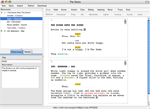
In many ways, this seems to be the screenwriting program I yearned to write. It’s open source, standards-based and well thought out. If I’d known I could get what I want by sitting on my ass and doing nothing, I would have not-done it sooner.

Celtx uses the Mozilla Application Framework, the same underlying technology as [Firefox](http://mozilla.org). That goes a long way towards making it platform independent, since Mozilla can run under Windows, Linux and Mac OS X. It’s a two-edged sword, naturally: for sake of compatibility, it can’t use some only-on-Mac features and eye-candy.

[](http://johnaugust.com/Assets/celtx-full.png)
Unlike Final Draft, which strives to keep the screen matching up exactly to the printed output, Celtx takes a more relaxed approach. All the standard formatting blocks are there (Scene Header, Action, Character, Dialogue, Transition), but there are no rulers or page breaks. That’s a reasonable choice; you shouldn’t worry about every (more) and (cont’d) as you write. The program generates .pdfs, rather than trying to print directly — again, a smart call. However, I suspect many writers will find they need more control when it comes time to print.

One of the biggest psychological hurdles with Celtx is how it handles screenplay files. Currently, they seem to reside on Celtx’s server, rather than staying local on a writer’s individual computer. (I say “seem” because each project shows a URL, and you’re not prompted where you’d like to save your file.) This client/server model makes a lot of sense for collaboration, but would make a lot of writers nervous, both in terms of access and security.

**Update:** The developer wrote in to say that files are indeed kept locally on your computer, unless published to the server. A “Save As…” feature is in progress, according to the support forum.

You can import an existing script from Final Draft or other screenwriting applications, but only by saving it first as a formatted text file. (Final Draft uses a proprietary file format; if any reader out there has figured out how to decode it, please write in.) My import test was a mixed bag. Most of the formatting came through intact, but it lost all of the character names at the head of dialogue blocks. I suspect that’s an easily-addressable problem, however.

More impressive than its importing function is Celtx’s ability to export. It generates .pdfs and HTML, which, if you look through the source code, is actually properly formatted with CSS, as opposed to Final Draft’s ridiculous wrapped text file.

I haven’t fully examined Celtx’s outline and resource capabilities, but you can flag elements such as characters and props, which can be useful for generating reports. (Not that I ever use this feature in Final Draft.)

Celtx is currently in beta. Right now, it doesn’t offer enough to get me to switch from Final Draft. But I’m certainly fascinated by it, and would encourage any interested reader to give it a try.

Scriptnotes, Episode 721: Preparing to Direct (with Eva Victor), Transcript

February 17, 2026 Scriptnotes Transcript

The original post for this episode can be found here.

John August: Hey, this is John. Standard warning for people who are in the car with their kids, there’s some swearing in this episode. Hello and welcome. My name is John August.

Craig Mazin: My name is Craig Mazin.

John: You’re listening to Scriptnotes, Episode 721, a podcast about screenwriting and things that are interesting to screenwriters.

Let’s say you have finished writing that script that only you could write and perhaps only you could direct, but how do you learn how to direct? Today on the show, we’ll talk with the writer, director, and star of the much-acclaimed film, Sorry, Baby, about their journey behind the lens, which landed them best directorial debut by the National Board of Review and a lot of other awards attention. Welcome to Scriptnotes, Eva Victor.

Eva Victor: Oh, thank you for having me. You know what? You guys have gotten me through some interesting, difficult days. Your voices are very comforting to me. It’s interesting to see your faces.

John: Weird, huh?

Eva: I totally attribute faces to voices, and it’s a very surreal moment. Thank you for this. I’m excited to be here.

Craig: It’s great having you. I’m sorry if we are disturbing you, if the cognitive dissonance is freaking you out.

Eva: Exactly. Thank you for saying that.

Craig: Yes. I want you to feel okay about this, but you might not. I get that. I remember the first time when I was a kid, I would listen to Howard Stern on the radio. I had no idea what Howard Stern looked like. Then they started putting up ads for Howard Stern around the subways and stuff. I was like, “What?”

Eva: That’s a particularly surprising one.

Craig: Yes. That was really shocking. Well, Eva, I have a little bit of like, okay, you were comforting me, too, because even though I don’t spend a lot of time being cool and looking at things that other people are looking at, for some reason, back when you were doing videos, I guess on YouTube, but maybe there was something else, I saw you did one where you’re talking to your imaginary or potentially real offscreen boyfriend, “Babe,” about the heterosexual pride parade. I loved it so much, and it sent me down a whole rabbit hole of all of your videos, and I just thought you were hysterical. It’s so funny.

I have to say, not surprised at all that somebody as funny as you has made a movie like this because I think funny people are better at drama than drama people.

Eva: You know what? That is so cool. The journey of the year has been accepting that I did make videos in the past. I think I was-

Craig: You’re awesome.

Eva: At that moment, it felt really right for that to be what I was talking about. Looking back, I’m like, well, that day that video made sense, but now it’s random, but also have to give it up for whatever journey your journey is. It’s your journey, and that’s okay.

Craig: Tell me about it.

Eva: I’ve come to terms with the fact that there were skills built there. One of the main ones is moving through humiliation and putting yourself out there and feeling devastated by yourself to make something happen, and the pain of not doing something is greater than the pain of doing something and feeling ashamed.

Craig: Sure. Well, that’s what we do, and I like the way you phrase that. The pain of not doing things is worse than the pain of doing them, but the point is pain. Welcome to the show.

Eva: Welcome to the show, okay.

John: I wanted to save talking about short-form video to the bonus segment because we had Quinta Brunson on the show, and she came up at a BuzzFeed, and you were doing Comedy Central, and she learned so many crucial skills there. I want to talk about what skills transfer, what skills don’t transfer, and what you learn from that, but before we get that, we’re obviously going to talk about your film. I also want to answer some listener questions on talking to actors, writing exercises, when to share the script with people.

I also want to confess that the poster for your film is great. It’s you holding a cat, and so I assumed for months before I watched the film that, oh, the baby is the cat, that she’s talking to the cat, and the spoiler is that it’s not about the cat. It’s not about the cat. The cat is a small part of the movie, the adorable part of the movie, but not a large part of the movie.

Eva: I know, and the poster conversation was one of the more intense parts of making, because I went in this huge circle, and the main issue was trying to communicate a tonal movement through an image, and all the images that I was compelled by were sentimental value. I was like, oh my God, that’s the best version of a dramatic poster, and that’s what, if we had made a drama, simply a drama, it should have been– It was interesting, after having worked on posters, to be like, “This is the best image for the film.” That said, it is deceptive, and then I got a lot of feedback that people were like, “I can’t watch because the cat dies,” and I was like, “Oh my God, no.”

John: Again, another spoiler, the cat does not die. The cat thrives in the film.

Eva: That’s the only thing that does okay.

Craig: The cat starts healthy and just gets healthier?

Eva: No, grows up. It’s perfect. It’s a perfect cat.

John: Indeed. There’s another famous screenwriting book called Save the Cat, which apparently your film follows, but we have our own script notes book that’s out there in the world, and we have two little bits of follow-up on that before we get into the meat of the episode.

Eva: Whoa, look.

John: What, wait, what? Oh my God, there it is.

Craig: She’s got it in front of her. Oh my God, incredible.

Eva: Because you know what? I really need it. I’m a little bit through it, but I have to pause because it got to, it called me out a little too much, and I need to recuperate.

John: Not by name, but just by implication.

Eva: It’s like, “Eva, you are a bad writer in it.” I was like, “Oh.”

John: Oh my God. We almost took that one out and it almost dropped in the line edits, but you know what?

Craig: We figured it would be motivating. John, what do we– oh, we have some follow-up from Liz.

John: Drew has the flu, so he’s on the call, but he’s a rough voice. Craig, do you want to be Liz in the script notes book?

Craig: Sure, I’ll be Liz. Liz writes, “I bought the script notes book for my husband Nick, a longtime listener, for Christmas. I’m an author and through a series of unexpected events, ended up in a pitch meeting for a script this week, my very first time pitching a script. My husband suggested I read the pitching chapter in the book. I did, and the advice in there was such a huge help. The meeting was a big success, so thank you so much for writing this book.” That is so nice, it’s almost too nice.

John: Yes, it’s really nice.

Eva: Tell me the me- where’s the sad part?

Craig: There’s no conflict.

Eva: Where’s the underdog? Jeez, [unintelligible 00:06:32] must be nice.

Craig: Right. I kept waiting for my husband. Once I heard my husband suggest it, I thought, oh, this is going to lead to we’re getting a divorce, but-

Eva: Story-wise, interesting, yes.

Craig: Unfortunately for us, Liz’s life is nearly perfect.

Eva: Liz, I’m so happy for you, but you are incredibly unreadable, but congratulations.

Craig: Liz and her perfect husband Nick. Well, thank you. It is very nice. I’m glad. Listen, that was the point, Liz, was that we would help people. It’s nice to see that it’s working in the world.

Eva: You know what? The paper is good paper for a book that’s more– because it’s very paper-paper. It’s not glossy. It gives the energy of more of a manual that you can look to where you need to. That, to me, the paper makes the stakes approachable. It makes the book approachable to me. I thought that was very thoughtful. Orange is amazing, so you guys nailed it with that. The content of the book is amazing too, but also the look and the feel is really powerful.

John: All right, so that is a review from Eva Victor, acclaimed filmmaker.

Craig: That’s pretty great.

John: A lot of people have been leaving reviews online, which is great also because it helps people find the book. Thank you for leaving them on Amazon or Goodreads. I want to single out one reader who gave us only four stars. Fine, you can give us four stars.

Craig: That’s good. It’s four out of five. That’s great.

John: Yes, but most people are five stars. Four, it pulls down our average when someone gives us four stars rather than five stars, which is fine. This man wrote, “2,105 words on the Scriptnotes’ book.”

Craig: What?

John: I’ll put a link in the show notes too so people can read through it because it’s really impressively written. It’s a guy, Dimitri Papadimitropoulos.

Craig: His name is 2,105 words.

John: It’s incredible. What I like so much about his review, he says, “The book’s generosity is not that it is kind, though it often is, but that it treats the reader as an adult, someone who can tolerate complexity, contradiction, and the unglamorous truth that artistry is frequently indistinguishable from persistence.

Eva: That’s a five-star review to me. I don’t know where that–

Craig: It feels like it’s a six-star, and he might have tried to go to six, but it just busted him down to four.

Eva: That’s okay.

Craig: That’s common.

John: Eva, I thought that was a good jumping-off point to talk about artistry frequently is indistinguishable from persistence because that is the thing about filmmaking is that you say, “Oh my God, that was an amazing movie,” and it’s like, “Yes, but it wasn’t just brilliant because it was brilliant because the person had this great idea, it was so much hard work day after day, year after year to get things done.”

I think it’s the thing we talk about a lot on the show, but as I went through my career and as I’ve met and worked with some great directors, it’s just been always such a revelation. It’s like, “Oh, you’re just working really hard.” I think it’s a thing that’s just underappreciated, especially as we get into sometimes award seasons and you think, “Oh my God, this is the person is a genius, that person is a genius.” It’s like, “No, they’re just working really hard.” There’s luck and there’s all these things. There is talent, but it’s all these things.

I want to maybe frame some of our conversation with you around this because you came up, you have some experience, but as I’m reading through the press notes on this, you wrote the script not even necessarily intending to direct it. Can you talk us through the journey to this is a script and now this is a script I’m going to try to direct?

Eva: Yes, totally. I think that theme is very relevant for me. I feel like there was a moment that I realized my career would never be made by somebody else. It picked me up out of oblivion and gave me an amazing role that was the big role for my– There was this realization of you are the one who has to get you where you want to go. I have always been like, “Well, I’m not going to fail because I don’t work hard. I’m going to fail because I’m missing some intrinsic quality that people have.” I was like, “It’s never going to be because I don’t put in the hours.”

That discipline has kept me from I think mentally losing my mind. It’s like, “Well, what can’t I control?” I can write more. I can study. I can watch films. I can get my day job to a place where I’m making enough so I have these hours. I had a development deal with the studio that happened because of my internet videos. That was a very difficult experience because I was turning in page one drafts for, honestly, years thinking that if I just wrote the perfect draft, then I would get the momentum and attention from the people I needed to make that film happen but that didn’t come. That made me lose my goddamn mind. It made me really internalize something about I am fraudulent, I can’t do this, I’m not meant to write.

Then I wrote scripts for a body horror thing that didn’t make sense, but it had a lot of heart. I sent that around to people through my agents at the time. My rejections were very impersonal nos. The one person I’d met before I sent this script to read it and said, no, but the rejection letter meant everything, was Pastel, Barry Jenkins company. When I met Barry, he was like, “Your videos…” which I was even at that point ashamed of or whatever. He was like, “It’s filmmaking. It’s just not the way that other people do it. It’s a small version, but you are directing this. You’re making decisions about how people look, where the camera’s going, and what people are saying.”

I think that gave me this optimism or like, “Oh, man, someone sees the hard work behind these.” Then when I sent them the script, they sent a very generous no and made this really beautiful letter about the script and what was valuable about it emotionally. Then why they weren’t the right partners for it. That was weirdly like a letter that I read and cried out of like, “Oh, but there are people out there who are understanding.”

Then I had been, over the course of five years or so, been stewing on the idea for Sorry, Baby, but was like, “Man, the words, if I start writing them down too soon just for this particular project, I’m going to get too depressed about how bad it is compared to what the story means to me.” It took me a really long time to piece together the writing of it. Then finally, I sat myself down in a cabin in Maine and was like, “It’s time. You’re writing this.” I wrote it and sent it to Pastel again because I was like, “They get me.” They were like, “Okay, what do you dream of for this?” I was like, “Well, I’m going to act in it…” hoping that–

John: I want to clarify, at this point, you are an actor who’s been cast in things independently because you have acting credits. It’s not crazy to think that you’re going to be acting.

Eva: Right. It’s not crazy, but it is a different thing.

Craig: Yes, but there’s that concern that, oh, well, if we had Jennifer Lawrence, then maybe we would get the blah, blah, blah.” You’re like, “No, it’s going to be me.”

Eva: It was very clear that when I’m the lead actor, that means that the film is this big.

Craig: This big. [chuckles]

Eva: I was like, “I’m willing to sacrifice whatever thing that is.”

John: Eva, can I ask you about the script that you sent to Pastel? Does it closely resemble the movie that Ashley has made? The footprint of the film is very small. It’s a cabin in the woods and while the times are shifting around it, the actual literal geography it’s inhabiting is very small. Was it always that way?

Eva: Yes, it was always that small. It’s very similar to the script that we shot. There are some changes. Mainly, I did a little work with Pastel around the character of Lydia. Then once we got Naomi, that opened it up for me of how this person talks. There were a few scenes that we adjusted the dialogue. I have not had this sense, and I don’t know if I will, how little we had to work on the scripts. What do you think?

Craig: I think you worked on the script a lot. I think that what people sometimes think is that all the work on the script happens after the “first draft,” which is never really a first draft. Some people do write first drafts, but a lot of people hand a script over that they have been– you’ve been thinking about it for years. Then when you went to your Stephen King cabin, what came out was something that was already thought through. There was an enormous amount of intention and structure and care and thought.

I suspect, having seen the movie and having seen the way you directed it, that you had already directed the movie in your head. You saw it. You saw it, you heard it, you felt it, you smelled it. It’s all there. It’s okay for that work to happen earlier. I think it’s the best thing. I think it’s why people say yes. There’s a certain kind of movie that you can write that’s about, oh my God, the aliens are crashing to the moon, and you can figure that shit out as you go. For this, what I was so impressed by was how seamless the writing and the direction was. You are a walking billboard for what I think should be the gold standard for how we make feature films, a writer-director.

I just feel like even though there’s a conspiracy to convince all of us that somehow directing is this unattainable thing as opposed to writing, which we can all do, no. No, it’s not. You’re doing it already.

Eva: There is so many layers of the reasons why I didn’t think I would want to direct it that all have to do with not understanding what the job is and you can learn things to do a job. That you’re not born with information, even though it feels like you are. The college I went to, I never had any interest in directing. It was mostly plays where I went. I had no interest because I was like, “Well, this kind of guy does that and that kind of looks this way and talks this way. I don’t want to be in charge like that because I’m not compelled to be him.” It’s like, “Oh, I have my own way of doing that.”

It took a bit of soul searching to realize, oh my God, I’m desperate to direct this. I know how it looks and feels. I need to hire geniuses around me to help me find the words for visual language. It was a lot of, I don’t know, but I want to do it. I think I don’t know is so awesome.

Craig: Best words.

Eva: You’re allowed to make your first movie. You’re allowed to be doing something for the first time because you have to do it. I really fell in love with also– What was reassuring to me was the process of collecting images and moments and pieces, almost like a little scrapbook of information was a very enjoyable private process of building a world. I felt, as the work of director unfolded and I discovered what it was as I was doing it, each part of it felt like a miracle.

At one point in the edit, I was like, “Thank fucking God I like this and it’s [crosstalk].” I love it and I need it. Thank God because otherwise, why would you ever put yourself through this deeply intense experience that lasts forever?

Craig: It lasts forever and every day lasts forever, but also is way too short. It’s this nightmare of time that is never enough and is yet too much. I just feel like you’ve put your finger on something incredibly important, which is we all have a sense, whether we’ve learned it from school or from culture of the kind of person director should be. A kind of person a director should be is a man and he is a big– He’s Michael Bay. Basically, in my mind, it’s–

John: A bit of that personality.

Craig: It’s Michael Bay and I am not Michael Bay. I will never be Michael Bay. I don’t have whatever that is. That’s not me or Ridley Scott. I’m also not that. I am an ink-stained wretch, but ink-stained wretches are also wonderful directors. I love that you overcame the internalized image of what is because I honestly think that’s the thing that hurts us the most is we just start with a belief that we’re not.

Eva: Yes. Trust me, now it’s a different issue, but that one I overcame. I’m not to get through that, but I’m like, now it’s the first, honestly, if we’re going–

Craig: Please.

Eva: Now, because the writing of this film, now my experience of it is nostalgia for a time when I now remember it as flow. I don’t think it was. I toiled over that script. It was just I sent it when I was done with it. Now I’m like, “Oh, yes, directing, whatever, but writing, you guys, this needs oil. This is squeaky or something because it’s been so long. Now there’s eyes on me.” I thought the most painful thing was not having–

Craig: It’s the worst thing.

Eva: It’s the worst. Then this is also like, yes. I’m like, “Okay, now you’re trying to kill me by celebrating my film?”

John: How dare you say yes?

Eva: Well, just be honest, but also be nice. I’ve made a film. I only know how to make that film. It’s a mind fuck.

Craig: It is.

John: Can we rewind and talk about how you learned to make that film? That’s what’s so useful for so many of our listeners, is that you have a script and you have people say like, “We agree you should direct this. Now learn how to direct a film.” What did you assign yourself? What did other people send you to look at? What’s the process?

Eva: You know what? Yes. This I would love to talk about. First off was like, okay, you didn’t go to film school, so there’s a lot of fraudulence around not knowing things about film. I learned lenses will be good. Encyclopedic, ordering the books from film school, reading the books from film school. Research that was very dry, but I was like, “Let’s just read this. Let’s put post-its through it.” Quickly realized like, “Okay, this is simply information that actually I need.” It was a process of constantly being like, “Okay, that fills that need. Now what is missing still?” Then it became, I need to watch a million movies. I’d been watching movies, which is why I wrote a movie, but I was like, “I need to watch films. Then as I’m watching them, not fall into watching them, instead watch them.”

John: Look at them, study them, pull them apart. See what they’re doing.

Eva: Exactly. I became very into backwards shot listing films. A photo of every setup and blending them up and understanding when we return to the same set, it was very mathematical. When are we returning to the same setup? How long are we on Laura Dern’s face and Certain Women before we get to his face? Why? I became more aware of my taste. I was like, “Oh, I like the economy of not moving until we have to.” I became aware of what the film was needing from a visual standpoint.

I was backwards shot listing and would write out the shot list. Obviously, it’s not a complete picture because you never know what someone left out, but you get a sense of how cohesive vocabulary is built in a film. Certain Women was a really helpful one for me because that is three parts. There was chapters to that film and they’re related. How do you make three women who are strangers become related?

Then I created a shot list for my film, which instead of shot listing, because that felt random, I drew storyboards of everything. By the way, I had ample time. Man, fill your day with some shit to do because no one is knocking right now. We were just taking our time. It was drawing everything and every frame of the film. You could go through the storyboard and watch the film, which some of the shots are really what is in the storyboard. Then obviously, some very important changes were made in collaboration with my DP, Mia, who making decisions for good reasons later on. It was like an instinctual storyboard. What is the first thing that feels right?

Then I shadowed my friend Jane Schoenbrun on I Saw the TV Glow. I was like, “Oh, I’m ready.” I’m not ready, but I’m ready to start being ready. I’d been on set as an actor, but on set as an actor, it’s like, “Come in. Do you need water? Do you need Diet Coke? You’re good for the day. Good job.” I find acting very stressful in moments, especially when you’re there for some time, but not the whole time because it’s so vulnerable, but it is a different experience of things are hidden from you to protect you, which I feel complicated about, but whatever. Some things are just not your job to know.

When you’re on set sitting behind a director with nothing to do on the set besides watch that person, you realize how different people advocate for their film and the different styles of how people advocate, but also how a film is built moment to moment. It’s non-miraculous. It’s like by the end of the shoot, you have the pieces to go to the kitchen. Mixing metaphors is okay, I guess. That was my stuff. Then what you do is you take meetings with different heads of department, and through, they made a lookbook. Actually, I’m going to make a lookbook in return, and then you have a conversation with Image, and then you become specific.

The cool thing about directing a film is you make decisions every day over time. The film is built over time, and that was reassuring to me too because at first you’re alone, but then you bring people in, and it’s not just yours. That’s a relief really to, okay, you got that character thing, fucking God, that’s yours. Say it how you want to say it.

Craig: I think that what you just said from start to finish is, I’m going to use the word probably because I want to be kind and charitable to film schools, it is probably worth more than four years of film school. What you just laid out there, in part because you just belied the need for film school. You taught yourself what you needed to learn. I love that. I went through the same thing because I didn’t go to film school. There’s a special technical film school for directing, which you didn’t go to, and I didn’t go to, but we’re smart. We read stuff quickly and learned things quickly.

The thing about lenses, I don’t need a semester on lenses. I need 30 minutes on lenses to get the basic breakdown of it, and then I need to be on set and go, “Can we try something longer?” The cinematographer’s like, “Yes, you know what? 50. That’s cool.” Then you’re like, “Oh my God, that’s the thing.” You start to get muscle memory. All of these things you laid out, the way you storyboarded, the way you broke things down, reverse-

John: Reverse shotless thing is so crucial.

Craig: -shotless thing is genius. That’s genius.

John: I want to just pause for a second because people may not quite know what we’re describing. You’re watching a scene in a movie, and you can figure out, okay, well, we are a close-up of her, but there’s also a two-shot and there seems to be a wider shot, and so you can basically figure out, what were the actual shots they had on the day to make that thing? That was the plan going into it, but then you can also look at, how did they actually use it? When did they move into coverage? When did they stay wide? All the information is right there. You can see it because it’s in the film, and that is so useful.

Part of this is reminding me of, I don’t know, people who watch Drag Race. There’s bedroom queens who basically, who do really good drag at home, and they’re on Instagram. There’s also obviously queens who need to go out and actually perform in front of other people. That to me is the transition from you shotlessing at home and then going to a set and seeing Jane direct it on the set for her movie because you are watching like, “Oh, this is what it’s actually really like. This is what the actual decisions look like in the field where it can’t be perfected on Instagram.” You’re making choices moment by moment.

I’m sure you found this, and Craig, I know you’ve encountered this. When you are on a set and it’s not your movie. You’re still watching the monitor, and you have so many opinions. It’s like, “I can’t believe we’re moving on. There’s no way that’s going to cut right. That’s not what it is.” You recognize, no, but the director knows what they need. They know that, okay, between these two things, they know what’s important.

Craig: Sometimes.

John: Sometimes. Craig’s also a show writer who obviously does have control of a film.

Craig: Every now and again, they go, “Okay, we’re moving on.” I go, “No, we’re not.”

John: No, we’re not.

Eva: Declaring we’re moving on is like, well, that’s crazy. You can’t really go back on moving on. Okay, you have to be sure.

Craig: My thing on moving on is before I move on, I check with the tent. Who’s in the tent? My script supervisor is in the tent, and a producer is in the tent. My assistant is in the tent, people who have been watching this, and I’m like, “Are we feeling okay about this? We’re good? Do you think we got it? We got it? We got it. I feel like we got it. Okay, moving on.”

You’re absolutely right. It’s like an abandonment, and it’s the worst part of directing is that you have to do more than you have time to do so you move at such speed, but you get better as you go. You are, I assume, a much better director week– I don’t know how many weeks you shot for. Let’s say five, four?

Eva: 24 days.

Craig: Five weeks. Week five, you were a better director than week one, almost certainly.

Eva: Definitely. You know what? You don’t really self-reflect like that but then Naomi was there the whole time. She was there the first day, and she was there the second to last day. She was like, “Bitch, what the hell?” She was so proud of me. I was like, “Realize, so true.” You know what? There was actually something else I wanted to add, which was a really pivotal part of my building the film two years, was we did shoot two scenes from the film in a very small– Me and my DP and a group of my DP’s students at NYU came to shoot in an Airbnb in New York where we both lived two scenes, and the prompt for my producers who produced it and it was a practice setting, the prompt was, two scenes that scare you.

I did a scene that was terrifying for me to direct because I didn’t understand the mechanics of the movement of the people, a lot of movement. Then the other one was as an actor, this scene in the bathtub where Agnes tells Woody what happened.

John: It’s a Sundance Labs thing. That’s exactly what you do.

Eva: Exactly. Then I worked with an editor, Kate Broca, who that was the moment when I was like, “Oh, you cannot cut from a Y to a Y.”

Craig: Ah, love this.

Eva: I’m like, “Oh, man, what a master class in failure and a good [unintelligible 00:30:51]. I didn’t really realize it was a test, but then there was this moment when they were like, “What would you have changed about how you shot it?” That was the moment when they were like, “Okay, yes, you understand what you would change.” Also shadowing a set is very interesting because I shadowed a couple days on Billions, the show that I was on, just to watch those directors. The budget of that shoot is one real particular thing. The vocabulary of the show is very heavily covered. We go over every shoulder, clean, we do everything.

Then Jane’s film was a particular budget that was much larger than the budget I was going to have but to go backwards, to get a sense of scope and how much can you get done in a day when you have more days, when you have less days, when you have an actor who can only be there three days. Just to get a sense of a few different things, to understand that things on your set will be particular to your set.

Craig: I think you did a fantastic job. It’s funny, I was watching through and I was noticing, first of all, I have a particular– It’s just taste. It’s not that I don’t like when people move cameras around. I just don’t like it when cameras move around for no fucking reason. I like a camera to be still and I like the people to move around. I loved how still it was so frequently.

I noted as I was watching how many scenes didn’t really seem to need coverage. You had a nice two-shot and it worked that way. That’s how the character were interacting and it was great. The scene that I was like, there’s one that was probably tricky, was when Decker and all of his grad students are around a table. Shooting around a table is a nightmare. It’s a nightmare that nobody– I’d rather shoot a car chase than a scene with that many people around a table.

Eva: That makes me feel better because I’m like, “How do you fucking shoot a car chase?” Would never break that–

Craig: It turns out it’s because you can edit the shit out of car chases, but the eye lines around a table, that’s nightmare stuff for me. You did it really well.

Eva: Thank you. There are a few mistakes in the film, continuity issues, and one of them is in that scene, I’ll never say what it is. Okay, you just have to live with the fact that happened. I think, honestly, Billions prepared me for that.

Also, so much of understanding a scene is who is the scene about and his special attention to Agnes. It’s like, that helps. That helps these boys can be in a two-shot, a three-shot, and they will be cut to highlight that this is less vulnerable.

Craig: Then you got to explain that to them. Sometimes actors don’t like that.

Eva: No. They’re my close friends, so they understand.

Craig: It’s a tricky one. You’re like, “No, I actually think that you guys come through better in this.” [crosstalk]

John: Just so we can see the chemistry between the two of you.

Eva: When I’m in a movie, i.e. one other time besides this, now there’s no bullshit of I know I’m a character. If I’m next to someone who is on set every day and I’m here three days, I get it. I’m here to get you here. It’s interesting. It’s interesting.

John: Eva, you’ve perfectly set up a question we have from Anne. She writes, “How should writers talk to actors? Specifically, do you tell them about their function within a script, or do you just talk about the human being their character is?” It’s that balance between this is the character, this is who you are, the world is that, and functionally, this is what I need you to do. This is your job at this scene. What’s your instinct there? How you talk to actors?

Eva: Depends on the actor. I feel like I’ve now been in enough rooms where people don’t know I’m an actor or they forget. I hear people talking about actors, “Be careful.” I don’t talk about actors like that. I really think what they do is psychotically intense and next-level vulnerable. When I wrote Sorry, Baby, every character I wrote as if I got to play the character. I was like, “You’re going to say something I like. I want the words to be good because what if I do it?” It was very important to me that every actor was who they were in the film. I obviously was a part of every casting decision, but I’m like, “The world is as important as the people who lead it.”

I don’t know, talking to actors, you get a sense of how an actor wants to be treated. Some actors want to be handed off the role, and that I love to do. I love to be like, “You’re the expert now, go fly, you know more than me.” Often actors who are writers too are like, “I get who I am in this.” It was interesting because Naomi is completely brilliant. We never rehearsed. She really wanted to just do it. She’s so connected.

It was a very different process than, for instance, Lucas Hedges, who is brilliant as well, equally brilliant. We rehearsed for weeks beforehand. It was amazing to work with actors who I was learning from who were more seasoned than me because I was like, “Oh, every actor, their soul is how they do things.” It’s great if an actor knows themselves well enough to say, this is how I like to be treated.

John: Let’s go back the other way then. You’ve cast an actor in a role. What is that conversation like? If you’re the director, how do you have that conversation about let’s talk about how you like to work? Any tips on how to have that conversation with an actor?

Eva: My thing was always offering up meetings, calls, rehearsals, and going off of how they responded to that and what they needed for their process. My process as an actor was- I worked with Rebecca Dealy, who is an amazing casting director and also an acting coach, and so my process was also about building my character privately- I think offering everything that anyone could want and then respecting whatever they need.

Craig: That’s a great way of thinking about it because as much as I understand the impulse here that Anne has, which is tell me how to talk to actors or should we give actors this information? They’re all different. Big surprise. They’re all different. One thing that one actor craves is the thing that another actor will throw an absolute fit over. Learning that is easier for some people. It’s probably easier for you, Eva, than it is for me. I’m a little dense. It takes me some time sometimes to realize, oh, this person doesn’t need that and this person does need that. Just because this person needs it doesn’t mean that person.

It takes me a little bit of time. I’m not instant with it. I let them know when I start. I’m like, “Feel free to tell me, hey, this would help, this would not help.” Then my attitude is, I’m here to get the best performance out of you. Help me help you. What do you need?

Eva: There is, I discovered, a lot of value in acting across from your actor because it’s like you’re not coming down from on high with a note. I don’t really believe in the idea of a note. Anytime a director has given me a note– I like the idea more that a director delivers a secret or an idea or just that like, “What if she had this thought?” To me, there’s an immediate trust that happens if you’re in a scene with someone of, I have to have your back and you have to have my back. When I’m acting with you, I can’t judge your performance, [unintelligible 00:39:05] whatever you say. If I have an idea of what you could do differently, I’m going to give you something different, which is–

Craig: Oh, that’s interesting.

Eva: It’s less condescending of, I have an answer. It’s more like, “What if I said it like this? What happens with you?”

Craig: You direct them by altering your performance.

Eva: Not in secret.

Craig: No. You let them know. That’s amazing. It’s funny. I do wish they were like– because I want to be a good boy. Really, more than anything, I don’t want actors to feel like, I don’t know, I don’t want them walking away going, “He’s just difficult today.” I want to do right by them, but sometimes it’s impossible.

John: Craig, you’re trying to balance, you want their performance to be fantastic and you also have to look at the entire scene and entire story, everything around it. That’s the challenge, is you’re always balancing all these different competing desires.

Craig: I’m not acting.

Eva: Every day on set, you have to make a calculation of like, “Okay, if I give this person this thing, then this is taken from this person.” If I go late this day to make sure I know I have it, but does this actor need to feel like they have it, that will report me because it’s their first day, because this scene is vulnerable or whatever. That calculation of like, “Okay, we are going into overtime and because I haven’t done that, I can do that this day,” constant calculations of what is best for the film. Having to kill your darlings even of like, that person will not be happy with me tomorrow, but I won’t go late tomorrow. It’s a busy mind.

Craig: Oh, man, is it ever. It’s like your busy mind has made something absolutely beautiful. I really do appreciate it. I know we have more questions, but this isn’t a question. This is for me. It’s just a statement. What I love so much about what you did was you made a movie about relationships and half of the movie, and I’m just guessing, but half of the movie by weight is you alone, and it’s still about relationships. It’s always, there’s always a ghost in the room with you. It’s incredible how dialed in you are to the only thing I care about in stories which is relationships, and just so well done, just so well done.

Eva: Thank you so much. There are so many ghosts that are on the cutting room floor that in the script, I was like, “Yes, that is my favorite thing in the script that just once the film starts to become–”

John: It tells you what it wants to be. I was looking through the script yesterday and I noticed like, “Oh, these are whole scenes that are in the movie,” and basically what you cut were things that broke out of your POV. The script had scenes that did not have you driving the scene, and then those scenes, they didn’t last in the movie, and that’s not surprising, and I’m sure they were delightful. I’m sure they’re really funny, but the things that were there, they weren’t absolutely necessary, and therefore they fall out.

You had the first scene at a sandwich shop. You had two guys talking about paninis. You had an Agnes and Natasha scene. You had two jurors talking. They’re all funny and great, and I could totally imagine why they were in the script, and I can completely see why they weren’t in the finished movie, and that’s also directing.

Eva: If you had told me we were cutting those scenes, I would have been like, “Let’s just not fuck each other.”

Craig: That’s the fun part. You don’t know.

Eva: It’s crazy, and it makes me so relieved that we shot more than we needed. I mean, I know obviously there are sacrifices that have to be made when you have more pages. It just took everything, but honestly, strategically, those scenes for me, the way I felt about them in the script were like, “I’m deliberately giving my audience intermissions, energetically intense stuff,” but then it’s like, right, an intermission makes tension fall through the floor, so why would you ever do that?

I was like, I didn’t understand that they would change the pace of the film and would be so jarring that whatever tonal shifting I was trying to do that kept people locked in, there was a jolt that was too jolty and would make no one trust me with the other transitions of tone.

Craig: Yes, people lose confidence.

John: Absolutely. Well, I’m really happy that the script you’re putting out there shows the scenes in there because it’s such a good lesson for like, you can see like, oh, this is the shape of a movie before it films, and that this is the shape of a film afterwards, and you discover things along the way. My question is, how early did you know those scenes were dropping out? Was it after the first assembly where like, “Oh,” or did it take a while to figure out that those were things that weren’t helping you out?

Eva: I went through the mental intensity of shooting the film mainly happened in the edit where I was finally seeing myself on screen and the energy of the film wasn’t diluted by cut, and then you shoot a piece at a time, but when you watch it, you’re like, “Oh my God, this is a sad movie.” I was surprised somehow that it was a sad movie and I had to [unintelligible 00:44:19]. Take a second, I really fought for the sandwich scenes, but the second that, for instance, there was a first scene with John Carroll Lynch, and then there’s a panic attack scene, and the second, that first scene–

John: It’s so good. The second scene is so good.

Eva: The second scene becomes-

John: Important.

Eva: -completely different. What that scene did in the film was it gave us too much information about Agnes being mentally unwell that it’s math. It’s constant calibration, constant, “Well, yes, what if we try?” It’s like puzzle making, and you just have to try everything because you are going to get basically questioned by everybody on why each thing, and you can only choose it if you know what it is.

Craig: You have to be able to justify it. Everything does impact everything. It’s like making a jigsaw puzzle, but when you put one piece down, the colors change on the other pieces. It’s a really weird thing to do, and it is hard to say to a great actor like, “Oh, by the way, we left one of your–” People have left scenes with Meryl Streep on the cutting room floor. You just have to do it sometimes because you find what you needed, and everything was a theory. The fact that your theory worked out 98% of the time is insane. It’s miraculous.

Eva: Really wonderful actors, they know that the movie working makes their scenes work. In the Natasha scene that got cut, when I told Kelly, who plays Natasha, “We cut this one scene,” and she was like, “Yes, that makes sense. It was the same scene as a scene before.” I was like, “Oh, sweet, Kelly, nice to know.” I was just like, “Oh, yes, people get it.” People understand that what that does for something else is more.

John is able to be proud of the film because of how his character experienced as a breath of fresh air, completely new energy, 75% of the way through the film. There’s real power in that. Yes, it’s nice when actors get why. I wish every script that you could read was a shooting script. My God, would that be– That is the one cool thing about when you get to know people. There’s a lot of cool things about getting to know people who do this, but one of them is you can make them send you shooting scripts instead of–

John: The sanitized, yes.

Eva: I’m just like, “This is a key to the kingdom,” which I feel like should be more possible.

Craig: Yes, I agree with you. It’s also comforting to see how a great movie had a shooting script that was 90% correct.

John: I think we’ve actually achieved our goal and our thesis, which is basically that it’s not brilliance, it’s actually mostly just hard work. You can’t distinguish and differentiate between the two of them. This conversation about like, “Oh, no, it was just really hard work.” Yes, inspiration and incredibly talented people, but also hard work and constant questioning of, “Wait, am I actually doing this right?” Eva, thank you so much for this education.

Eva: I have a question for you guys. You have both had psychotically successful things. I am curious about your return to the page. Maybe this isn’t your experience, but I am–

Craig: I’m scared.

Eva: -conflicting that– Well, beyond scared. I think reconciling with the fact that each process is humblingly different than another process and work in a new way that you have to relearn, but coming off of attention.

Craig: Attention is the poison, so you can’t. In my experience, when attention is as focused and relentless as it is on something like you and your movie during award season, it is poison in your veins. It’s a beautiful thing, of course. It’s a sign that people connected and loved what you did, but attention causes pain and you need to be alone to write. I really believe that. I don’t think you can write in a room with glass windows and everybody staring at you. You need a little time. You need a little time to flush it out.

I call it going down the well. That’s what Bella Ramsey and I call it, going down the well. You’re going to go down the well and you’re going to be at the bottom of a well for a bit. People are going to wonder, why are you at the bottom of a well? You should be on top of the world. You’re like, “I’m crying a lot.” They don’t understand, but that’s okay. Then the attention, this is the best part.

Eva: Goes away.

Craig: I mean, oh my God. You think it won’t because they just can’t take their eyes off of you and then it’s gone. Then you’re like, “Oh, thank God.” Then, of course, later you’re like, “Oh, no, it’s going to come back.” That’s a different dread. My advice is give yourself a little bit of time.

Eva: Thank you for saying that. As you’re saying that, there was this journey. I was making these videos. It was daily attention on the videos. The turnaround was so psychotic. DMs from people that would break my mind. What had to happen was I stopped. I had Cold Turkey run away for a few years and decide who am I, what is going on, what do I want to write, what do I care about, and it’s like, “Oh my God.” I totally did that and I needed so much silence. Hearing you say that, I’m like, “Oh shit, I actually know about that and that’s amazing.” It’s a different thing, but it is this crazy thing.

John: I would also say that I suspect your curiosity will overcome your fear at a certain point because your curiosity is, as I’m sure driving you through a lot, there’s things you want to explore and do. Just the same way you were intentional about thinking about how you want to direct, you’re going to be intentional about thinking about what do I want to do now? What is interesting to me? What is a thing I want to tackle? You’ll find a clever way to do it.

It could be a new original story or it could be an adaptation of something that you’ve always like, “Oh, I know how to do this thing. Why does this thing not exist in the world?” Then you’ll make that thing and it’s going to be awesome.

Eva: Isn’t that crazy? Thank you so much. You guys are so nice. Always time with everything. Yes.

Craig: It’s really annoying. It’s annoying. We have no problem accepting that for our physical selves. No problem at all. You cut yourself as a kid, it hurts, and then it scabs up, and the scab is itchy, and then it goes away, and then it’s pink and weird, and then it’s okay, and then it’s like it never happened, and it’s just time. We are so frustrated that our emotional pain takes time.

That’s what Dennis Palumbo, who’s a therapist that I went to for many years, and he came on our show and talked on our show, he would often say to me, I would say like, “When does this stop?” He would say, “Tincture of time.” I’m like, “Shit, but also good.” Tincture of time. Yes. A little bit of time. You’re going to be fine. You’re going to be more than fine. You’re going to be great.

Eva: Thank you.

John: Let’s do our one cool thing. I have a book that I’m reading that I really love that I want people to read. It’s called Girl on Girl: How Pop Culture Turned a Generation of Women Against Themselves. It’s by Sophie Gilbert. It’s really good. I think you’d both like this a lot. It goes back to some earlier times and the cycles of feminism, post-feminism, and to this churn that happens. Women, and particularly young women, get co-opted into this system of beliefs and any attempt to form an identity for themselves gets marketed back towards them. It’s really smartly done.

Here’s from her opening chapter, which is her thesis. She says she wanted to understand how a generation of young women came to believe that sex was our currency, our objectification was empowering, and that we were a joke. Why were we so easily persuaded of our own inadequacy? Who was setting the agenda? I just loved her framing on all of this because it just does feel like you have girl power, and then it becomes a thing that is sold back to women that they can buy and purchase.

It’s about culture. It’s capitalism. It’s also really about porn, which I hadn’t thought so much about, but the degree to which porn is always on the edges of culture and warping things in a weird way. I thought it was just a great book. Sophie Gilbert’s Girl on Girl. It’s a book out from last year, but I’m just now reading it.

Eva: That is amazing.

John: Craig, what do you got?

Craig: My one cool thing is the Vancouver SkyTrain. I love riding a train, but I’m a New York boy. I love the subway there. The subway goes pretty much everywhere, and I love it. Vancouver is not New York. It’s a much smaller city. It doesn’t have a subway. It’s got this little monorail thing. I just never took it. I never got on it. I was just like, “Oh, it’s a train.” The studio complex where we are based and where all of our stages are is just walking. It’s like a two-minute walk from a SkyTrain station. I was like, “Should I take a train?”

I am so obsessed with riding the SkyTrain. It is so much better than driving. It’ so much better. My mood driving to work, I get in my car and I’m already angry that I’m driving. Then my blood pressure and rage accelerate so that when I finally arrive at work, I am already just at a 9 of pissed. Then I have to go to meetings. The SkyTrain is like, ah, and it’s clean. There’s a train that comes every three minutes. In the subway in New York, you’re like, “Oh, I just missed it. It’s going to be 12, which is really 15, or there’s a stoppage.”

This thing never stops. Three minutes, just [onomatopoeia] and it’s lovely. I’m not saying anything that a lot of Vancouverites don’t know, but if you do live in Vancouver and you haven’t taken the SkyTrain, and you’re wondering, fantastic way to get around.

John: Love it.

Eva: They’re going to be so happy you said that.

Craig: I should get money.

John: Absolutely. Eva Victor, do you have something to recommend to our listeners?

Eva: Yes. I was going to do this mini Nutella that I got in Spain today. Instead of that, I have decided to shift my one, so this is me sneaking in two things. There is a website called rainymood.com. If you go rainymood.com, you can listen to rain sounds and it can be a tab open on your computer while you do other things. I find it incredibly relaxing. You can also listen to music while you listen to rainy sounds, which I think is really beautiful. Rain has always been a comfort to me and consider checking it out.

Craig: The website has rain. It’s like you’re looking through a window that has rain coming down. It’s a beautiful website. This is really nice. The SkyTrain is its own vibe. Also, it’s Vancouver. It’s always a rainy mood. This is shocking right now, what’s going on behind me, the fact that it’s not raining. When I go to sleep, my iPad is doing white noise, but it’s technically brown noise because I’m baby still. I’m just an old baby. The older I get, the closer I return to looking like an actual baby. Soon, the diapers will come.

This actually seems like something that might be nice for when I’m writing because I don’t like specific noises, but rain is comforting like that. This is lovely.

John: Love it.

Eva: No word.

John: No words.

Craig: Love it.

John: Great. Awesome. Thank you so much. That is our show for this week. Scriptnotes is produced by Drew Marquardt and edited by Matthew Chilelli. Our outro this week is by Nick Moore. If you have an outro, you can send us a link to ask@johnaugust.com. That is also the place where you can send questions like the ones we answered today. You’ll find transcripts at johnaugust.com along with our signup for our weekly newsletter called Interesting, which has lots of links to things about writing.

The ScriptNotes book is available wherever you buy books. Eva Victor has hers with her in Spain. You’ll find us on Instagram @ScriptNotesPodcast. You’ll find clips and other helpful video on our YouTube. Just search for ScriptNotes and give us a follow. We have T-shirts and hoodies and drinkwear. You’ll find us at Cotton Bureau. You’ll find the show notes with links to all the things we talked about today in the email, you get each week as a premium subscriber. Thank you to all our premium subscribers. You make it possible for us to do this each and every week. Eva Victor as a premium subscriber. Nice.

Craig: We’ve been siphoning $5 a month out of her pocket for a long time.

Eva: Five is a fucking steal. You guys are seriously doing more than $5 a month, but I love it.

Craig: Thank you.

John: Thank you so much.

Craig: Maybe just Venmo then.

Eva: I’ll send a [unintelligible 00:58:02] to you two.

Craig: You’re a big filmmaker now. I don’t know.

John: Absolutely. You can send and become a premium member at scriptnotes.net where you get all those back episodes and bonus segments like the one we’re about to record on short-form video versus directing feature films. Eva Victor, congratulations on your directing of your feature film, your writing of it, your starring in it. All the attention for it, which is wonderful, but will also pass and then allow you to do the thing after that next. It was so great having you on the show. We’ve tried for a while and I’m so glad it finally happened.

Eva: I am so happy. This is such a milestone for me in a way that’s beyond, so thank you.

Craig: Thank you, Eva.

[Bonus Segment]

John: All right. Eva Victor, we first became aware of you, Craig specifically, because you were making funny videos. You were working at Comedy Central. You were doing other stuff too. Can you talk to us about what you learned making those videos, but why it didn’t take a transfer directly to what you were doing for making a film? That era in making short videos, what was that like for you?

Eva: The most important skill, as someone acting in the film that I was directing, was to look at a take and quickly know if I had what I needed in my performance or if I needed to go again. The muscle of judging my own self and giving myself a note was quite harnessed, which was really helpful because I wasn’t afraid of what I saw. I knew what I looked like. I knew how I sounded. Mostly, was noting myself. I rarely gave notes to other actors. It was more just like, “Let’s do one like this.” I wasn’t building someone. They did that. They did an amazing–

I think also, understanding visual vocabulary and having one vocabulary for one piece. I was making videos, and then that got me the job at Comedy Central. I started making my videos at Comedy Central. I had this series there, which was this web series on their YouTube called Eva vs Anxiety. I got an episode of that, and they made me script stuff. I was like, “Oh, man, I like to come up with the things.” They’re not funny once I write them down or something. I liked when it was more exploratory, but I had to script them for the process of working there.

The first episode we shot was shot with, in my opinion at that time, high production value. It became clear to me, this is not funny for this medium. It actually requires me to hold the phone, and I have to be the director of it because if someone else is, you can tell. It just was, oh, the visual vocabulary that’s appropriate for this medium right now is handheld. You can almost see my arm in it. It has to be for this thing to be funny.

Craig: Editing that chops off the last word. It’s a very–

Eva: Yes, like no air. Yes, exactly. I think part of the reason when I got to, Sorry, Baby, I was like, the first shot’s going to be like 100 seconds because I now can take time. Just understanding that each thing is going to have its own way of being and a way it needs to be. Also, me just doing a monologue, listen. Also, it was interesting because at the time, whenever I took meetings, the only thing I ever heard was, “Well, what’s your Fleabag?”

I always said to people, you would not recognize it because it wouldn’t look a damn thing like Fleabag. What are you talking about? I think there was this limited idea at the time that like, “Oh, if I make these videos online and those translate to Twitter, that means when you make a film, it has to be as close to that because that’s what we know get the views on Twitter.” I’m like, “No, it would be a totally different scope and story.”

In a lot of ways, it opened a door to me practicing a lot and messily trying to understand how to build something. Also, it got me in the door. Once I was in the room, it was hard to find people who could see past the idea of a viral video. That’s what I was useful for.

Craig: I think it’s notable that you dealt with authority in an impressive way because I think when I was starting out, I was young, I was maybe 24, 25, I would put authority ahead of my own instincts all the time because I’m like, “But that’s their job. What the fuck do I know?” I think one thing that your generation has the benefit of is that you had a platform to do it yourself minus any authority. The authority came to you because of the things you did without the authority. When they start to dish out the authority, it feels like there’s a reasonable chance for you to go, “No.”

Eva: Yes, or you make something with the authority and you’re like, “Well, yes, this isn’t working.” They are like, “Wait, so how do you make it work?” It’s like, “Well, right.”

Craig: I stop listening to you and the things that you want me to do.

Eva: Something that was hard about working at Comedy Central was we would have meetings on a weekly basis about who was watching the videos and how much they hated any of the women working there would comment about how ugly everyone was. We would have meetings about how are we going to work on that. Then it was also like, “Well, the viewership base is people who we can’t isolate.” It was a lot of corporate stuff that I was like, “This is crazy I’m in this meeting.”

Then again, I guess that probably also prepared me for nothing shocking to me now. Sometimes you meet with people and it’s like, “Damn, that’s a crazy thing to say to me but the men on the internet said something so much worse.”

Craig: I made the mistake of going to– I never go on Instagram. I have an Instagram account, but I never use it. I went there because my daughter put something on there and I wanted to watch it. Then because I never use Instagram and I’m on the website, there’s things on the left that have red numbers. I’m like, “Are these my friends talking to me?” I click on it and it’s just like a list of people literally telling me to die. Because I make a show based on a video game and it is a little crazy.

It didn’t feel great, but then I was like, “Wait, close the box, put box back in lead lined coffin, put coffin back in ground, never look at again.” No one is ever going to tell me in a meeting like, “Honestly, our feeling is that you should die.”

Eva: Not your people, but just people in general.

Craig: Maybe right on again.

John: Craig, I suspect that five years from now, you and I are going to be talking with a filmmaker who came out of Instagram, Reels, and TikTok. Just like there’s a film grammar for what you’re doing at Comedy Central for those videos, there’s a film grammar for TikTok, for Reels. These people are incredibly talented at what they’re doing. They’re so smart and so sophisticated and they have such high production values, but it’s just not a film TV kind of thing. Them learning how to do that, it’s going to be so fascinating.

A friend of mine has a bunch of YouTube creators who are so smart and so good, but this last summer they did this thing where they all made short films, which is just really trying to learn what the film grammar is like. It’s just so different. Because you’re really good at one thing, you think anything, I’m great at being in front of a camera, but it’s different as Eva will tell us.

Eva: I will say, if you want to figure out how to do something, you have to watch a million things that they want to do. It’s the only way. If you want to make a movie, you watch movies. You have to watch movies from every time of the world. It’s interesting because I feel very grateful that when I was making videos on Twitter, there was 13 people doing that. Man, is it a crazy place now? I don’t know. There’s so much talent.

I am really excited to see what comes because access to an audience has never been easier, and that is so much of what stands in the way of people being able to do things. Having an iPhone is like–

John: Yes, it’s crazy. Eva, thank you so much. Congratulations again.

Craig: Absolute joy.

Links:

  • Sorry, Baby
  • Read the Sorry, Baby screenplay
  • Eva vs. Anxiety
  • Eva’s straight pride parade video on X
  • Demetri Papadimitropoulos’s review of the Scriptnotes Book
  • Certain Women
  • I Saw the TV Glow
  • Girl on Girl by Sophie Gilbert
  • Vancouver SkyTrain
  • Nutella mini jars
  • rainymood.com
  • Get your copy of the Scriptnotes book!
  • Get a Scriptnotes T-shirt!
  • Check out the Inneresting Newsletter
  • Become a Scriptnotes Premium member, or gift a subscription
  • Subscribe to Scriptnotes on YouTube
  • Scriptnotes on Instagram
  • John August on Bluesky and Instagram
  • Outro by Nick Moore (send us yours!)
  • Scriptnotes is produced by Drew Marquardt and edited by Matthew Chilelli.

Email us at ask@johnaugust.com

You can download the episode here.

Scriptnotes, Episode 698: Movies that Never Were, Transcript

August 19, 2025 Scriptnotes Transcript

The original post for this episode can be found here.

John August: Hello and welcome. My name is John August.

Craig Mazin: My name is Craig Mazin.

John: You’re listening to Episode 698 of Scriptnotes. It’s a podcast about screenwriting and things that are interesting to screenwriters.

Today on the show, we discuss movies that never existed, from high-profile projects that got shelved at the last minute, to our own experiences with unmade projects. Then, it’s time for some listener questions covering multi-language dialogue and multi-part movies, among other things.

In our bonus segment for premium members, if no one paid us to write screenplays anymore, Craig, if they would never get made, would we continue to write them as a form?

Craig: Uh. [chuckles]

John: Yes, you have an hour to think about that.

Craig: I don’t know if I need an hour, but all right.

John: We’ll talk about the pros and cons of the screenplay format. It’s a literary thing independent of a way to make a movie. Craig, this last week, I ran the San Francisco Half Marathon.

Craig: Congrats.

John: Which was really fun. I’d done the second half of it six years ago. This week, I did the first half. As I was running it, I was thinking like, “I wonder if Craig knows these things.” How do they know when a racer crosses the finish line? How do they know the time of a racer?

Craig: If I had to guess, I don’t think it’s as fancy as like an RFID tag in a bib.

John: It is an RFID tag in a bib.

Craig: Oh, it is? It is as fancy as that.

John: The day before the race, you go and you pick up your bib, and that’s the thing you have paper-clipped onto your shirt, or we have little fancy magnets now because we’re fancy. On the back of that bib is an RFID tag, and so as you’re running the race, you’re constantly passing through gates that are tracking that you ran through. There’s an app that you install on your phone-

Craig: For friends and family to follow on.

John: -to find you, but also, it tells you in real time what your pace is.

Craig: Oh, so you actually carry a phone with you as you’re running?

John: I do carry a phone with me as I’m running.

Craig: Because that’s extra weight.

John: It’s extra weight, but it’s fine. Most people are, I think, are running with phones these days.

Craig: Running with phones, yes. It would be rough if you were tracking this, your loved one is in a marathon and they just stop.

John: Yes.

[laughter]

Craig: They stop for a long time, then you hear sirens. It’s rough.

John: It’s not good.

Craig: No.

John: It’s helpful for your friends and family because that way, they can figure out where you are on the race, so they can come and cheer you on on a certain place.

Craig: Yes, that makes absolute sense. It’s a nicer scenario than the one I suggested.

John: The whole idea of RFID and tracking leads to a bigger question because earlier this summer, I was on a cruise in Alaska. On this boat, you wear this little medallion that has an RFID with you, and it’s super handy because, again, you pull up the app and it’s like, “I want a cup of coffee.” Wherever you are on the boat, [crosstalk] press one button, they find you, they bring you this stuff. It’s nice.

Craig: Oh, they’re bringing it to you?

John: They bring it to you, not to your cabin, just to you-

Craig: To you.

John: -directly, wherever you are.

Craig: Yes, right now, I guess our phones are that thing, but eventually, we’ll all be chipped at birth.

John: Both the race and the cruise ship were cases where that kind of constant surveillance I liked, but I don’t want to have it everywhere all the time. I don’t want to be forced into it.

Craig: No, I don’t want to have a situation where a corporation can track me wherever I go, although, currently, that is the situation I have. Let’s face it.

John: It is, yes.

Craig: They know everything. I was just thinking in my mind, if you did start to chip human beings at birth.

John: Yes, because you’re a parent who wants to know where your kid is.

Craig: Let’s say the state has decided. In our rougher scenario, every human shall be chipped. I’m trying to think biologically where to put this so that it won’t be dislodged by growth. I’m struggling. I think everything grows. Nothing is fully sized when you’re born, not even one little tiny thing.

John: Yes, your eyes are bigger, proportionally bigger, but the eyes are still going to continue to grow.

Craig: Everything grows, so I don’t know where to put it.

Drew Marquardt: With animals, they’d put it under the skin and it sits on top.

Craig: Animals grow, yes, and they don’t grow as much as we do. Humans are ridiculous. We’re born so stupidly small compared to–

John: Early because–

Craig: Early, because of our dumb heads.

John: Otherwise, we wouldn’t fit through the birth canal.

Craig: Yes, but I think you could put it under the skin, I suppose. I just wonder if it would get irritated, or it could move, it could shift.

John: Yes, you might swap that at a certain point.

Craig: Yes, maybe you do like a little baby tag. Then you do a kid tag. It’d be great. Kids would love it.

John: Oh, fantastic. Alrighty, the issue of tracking your kids and turning on Find My Friends and Find My is a thing. I remember talking with you at a certain point, and we realized that I think our daughters are at the same concert in Boston. You’re like, “Let me pull up,” and was like, “Oh yes, she’s there.” You did that. I didn’t do that because I sort of have an unspoken thing that I don’t find my friends when she’s not in Los Angeles.

Craig: Oh, that’s interesting. I never have to look at it, but when Jessie was in school in Boston, I never went to go look for her. I would look for Melissa, like, “Where’s my wife?” Always at the tennis. The tennis is where she is. It has a list. It’s like, “Melissa is 8 miles away. Jessica is 3,000-something miles away.” Then I’d be like, “Oh yes, look, there she is in Boston somewhere.”

John: I only share location with family. I don’t share with

Drew. That feels like–

Craig: I share my location with Drew, which is weird.

John: It’s just strange. Yes.

Craig: I just want him to know. No, just family. Just really, just actually, not even my full family, just Melissa and Jessica. You know what I don’t use enough? When you are meeting somebody somewhere in a large public place, you can share your location with them, which obviously Drew and his generation does constantly. I’m like, “Oh yes, I forgot.”

John: Yes. I will do that temporarily, but I don’t do it with friends. Drew, do you share your location with any friends?

Drew: I only do the temporary. Even me and my wife don’t share. We don’t have Find my Friends.

Craig: What? Oh wow.

John: Wow.

Drew: Pure trust.

Craig: It’s not about trust. It’s not like I think, “Oh, she’s going whoring again.” I–

John: To me, it’s always like, how close is Mike to being home?

Craig: Yes, exactly. If I’m going to order food, should I see if she’s going to be here or–?

Drew: I don’t know. It feels like a threshold that because I haven’t crossed it yet, I don’t want to cross it yet.

John: Yes, exactly.

Craig: You’re up to something.

Drew: [laughs]

John: It’s all– [crosstalk]

Craig: I am absolutely [unintelligible 00:06:01] Drew is up to something.

Drew: I’m whoring.

Craig: You’re whoring?

John: Absolutely.

Craig: I love whore as a verb–

John: He’s a secret assassin. He’s out there killing people.

Craig: Not anymore.

John: Not anymore. Some follow up. Hey, remember we wrote a book?

Craig: Oh my goodness. We wrote a book, and John, I have an author page-

John: On Amazon.

Craig: -on Amazon, which as you can imagine is populated with almost nothing. It’s got my picture.

John: Yes, got your picture. People have been sending Drew their pre-order receipts, which is great.

Craig: Amazing. How are we doing? Are we going to be doing a lot of signing?

Drew: We have about 150 so far.

Craig: Oh, that’s pretty good. Of just people that sent receipts?

Drew: Just people who sent receipts.

John: Oh. A reminder, if you pre-order the book from wherever you order it from, so not just Amazon, but any place– [crosstalk]

Craig: Sure, anywhere.

John: Send your little receipt through to Drew, ask@johnaugust.com, and we will send you something cool. We’re not quite sure what it’s going to be yet. It could be a bonus chapter. It could be some successful video report.

Craig: It could be a brand new car.

John: It could be something cool, but we’ll send that out well before the book comes out.

Craig: Do we have any sense, other than the receipts that you have received, does Amazon tell you how many people are buying it or–?

John: Pre-ordering it? I think Crown, our publisher in the US, has had this,-

Craig: Oh, they got– [crosstalk]

John: -and so at some point, they’ll tell us.

Craig: At some point they’ll give us the bad news.

John: They’ll say, “We’re really worried, John, Craig.”

Craig: [laughs]

John: No, I think they’re happy with almost anything.

Craig: Wow.

John: No, because here’s the thing, it’s–

Craig: That’s a low bar.

John: There are books that need to be giant hits out of the gate and needs to hit those lists. We are a catalog title, where there’s like, we’re evergreen.

Craig: We are not the latest Stephen King novel.

John: Yes. Questions that I got off of Reddit and other people asking, audio book. Yes, if you see, there’s a listing with a little button for audio book, there’s plans for an audio book. There’s nothing to announce yet, but there’s going to be an audio book. It’s not me and Craig talking.

Craig: Should we just get Ryan Reynolds to do it? [laughs] Just hold Ryan down and force him to do it at some point?

John: Yes.

Craig: It’ll be fun.

John: Yes, good.

Craig: Because occasionally, in the middle of an audio book, you get the sense that the person reading it is a hostage. [chuckles] They try and run, and there’s scuffle, and then they come back and resume reading.

John: For the podcast, they did lauch about the [unintelligible 00:08:02] books. The episode I did about the audiobook was actually really fascinating because I met the guy in LA, who actually recorded the book, and just his whole process was great and crazy.

Crown came to us and said like, “Hey, do you and Craig want to record the audiobook?” I’m like, “No. We record a podcast every week, and that’s plenty. No. No, thank you.

Craig: Yes, it’s too much reading.

John: It’ll be great to have a real professional do it.

Craig: Yes, terrific, so Ryan Reynolds?

John: Or somebody like Ryan Reynolds.

Craig: Yes, somebody bigger.

John: Yes.

Craig: Tom Hanks? [chuckles]

John: Yes. Crown said we should go for Tom Hanks.

Craig: Tom Hanks would be great.

John: Yes.

Craig: is he doing stuff? We’ll check into it.

John: I’ve heard that the Britney Spears biography that is read by Michelle Williams is incredible, so maybe Michelle Williams should be the choice.

Drew: That would be perfect.

Craig: That’s kind of amazing.

John: The person who I think is actually going to record it, is actually listening to the podcast right now, and he’s so upset that–

Craig: He’s like, “I’m an effin’ person.”

John: He’s an effin’ person in the world.

Craig: I’m an effin’ person.

John: Other questions were about the international versions, and so, there are no plans right now for a translation, probably because if you’re listening to this podcast, you speak English, you can probably read English. People ask about like, “Oh, I want to buy it in Europe. I want to buy it in Asia. Where do I get it from?” I asked, and the real answer is, wherever you get your English books is where you should go, so go to whatever bookstore or whatever online site is that you buy books in English, because they will have it. They’ll either get the US or the UK version. They’re both basically the same.

Craig: Yes, it’s an interesting question. I suppose that the marketplace will determine these things, if there’s a clamoring from a particular country. I’m looking at you, Brazil.

John: Yes, my agent was saying that there are cases, you’ll be in India, and you’ll see the US and the UK version side by side on a shelf. That’s just what happens.

Craig: Does just that color is spelled differently?

John: No. Honestly, the UK version is not changing our spelling.

Craig: What is the difference? Page size?

John: I think page size and slightly different pricing.

Craig: Oh.

John: Because of imports and–

Craig: What, tariffs?

John: Tariffs and things.

Craig: What? What? What?

John: What? What? What? Books are physical things that are printed in places. Other bits of follow up. My game Birdigo that I made with Corey Martin is out now on Steam. It’s a whopping $8.49.

Craig: Oh my God.

John: It’s a huge burden.

Craig: Ugh.

John: Ugh. We’ve gotten so many good reviews in the press,-

Craig: Great.

John: -and we’re currently 100% positive on Steam itself, which is great.

Craig: Only 100%?

John: Only 100%.

Craig: If I go in there just as a jerk, I can get it to 99%? [chuckles]

John: Weirdly, it would actually help us a little bit because how Steam ratings work is that it’s based on total number of reviews. We’re at the threshold where we’re listed as positive, but once we get to the next threshold of reviews, which is 50 or 100, then it becomes very positive.

Craig: I see.

John: Then it becomes overwhelmingly positive.

Craig: I see.

John: If you are a person like Craig who has played the game and enjoyed it and want to leave us a review, leave us a review because it actually does help.

Craig: That makes sense because if you put something on there, you could say, “Hey, I’m going to get 50 of my friends to do a review.” They need to know that it’s more than just the friends and family. I get that.

John: Yes, so that’s what–

Craig: That’s fantastic.

John: Yes, that’s good news.

Craig: Birdigo.

John: More follow up. Last week, we talked about Solar Storms as part of How Would This Be A Movie. Drew, what did we hear?

Drew: Multiple people wrote in that it sounded very much like the novel Aurora by a former Scriptnotes guest, David Koepp.

John: David Koepp, that hack.

Craig: Koepp, what can he do? By the way, David Koepp has quietly crushed the Summer Box office. Everyone was going on about Superman and Fantastic Four. Meanwhile, Jurassic, Jurassic-ness?

John: The Jurassic World Rebirth.

Craig: Jurassic World Rebirth has done better than both of those movies. It’s just massive.

John: Massive. Massive.

Craig: It’s like it’s grossed like almost $800 million globally. That’s David Koepp still doing it.

John: Also, Presence, a movie that Drew and I both saw, directed by Steven Soderbergh.

Drew: Black Bag too.

John: Yes, Black Bag also.

Drew: Black Bag is great.

John: Just killing it.

Craig: Just Koepp, just–

John: Keopp it in. Koepping it real.

Craig: You cannot beat David Koepp. Also, side note, and we’ve had him on this, one of the loveliest people. Just incredible guy. Love him.

John: Love it. I should not be surprised that he saw the scientific thing that exists in the world. It’s like, I should–

Craig: Of course he did.

John: I should write a book about this.

Craig: Yes, he’s sort of casually predicted that we would eventually get that and fumble it. Although, if you have a David Koepp novel, and it has not yet been turned into a movie, that is an indication that it should not be a movie because you know people must have tried.

John: Yes. What’s wrong with a book that it’s not–?

Craig: I think the book is probably great, it’s just that it’s not movie-ish.

John: Maybe.

Craig: How does that not happen?

John: He’s so angry now listening to this podcast.

Craig: I hope he is.

John: Yes. We were talking back in Episode 675 about lost genres or genres that people should see at least one example of a movie in. A bunch of people wrote in with recommendations for genres that people need to at least see one thing in. Drew, help us out.

Drew: Andrew writes, “Yakuza films, they are more often than not just as economical as noir films, but even more stylish, cynical, and tragic.” He recommends Pale Flower from 1964.

John: I’ve not seen any of these in the genre, and I think it’s a good recommendation.

Craig: Sure.

John: What else do we got?

Drew: John James recommends giallo, which is Italian horror.

Craig: Of course, yes, no.

Drew: Dario Argento’s Deep Red.

Craig: No.

Drew: No?

Craig: No. Not for me.

Drew: Not for you?

Craig: I’ve seen some of it. It’s not for me. It’s gross.

John: I’ve seen an Argento movie, and I do understand it as a genre. It’s just nothing for me. Either too, but it’s–

Craig: Right, other people, sure.

John: Should see it.

Craig: I think Suspiria-

John: Suspiria, yes.

Craig: -that’s the one to see, and then you would know.

Drew: I think nerds say that that’s not quite a giallo for some reason.

John: Oh.

Craig: No.

Drew: That would be my pick.

Craig: Nerds say that?

Drew: Yes.

Craig: I’m not going to listen. Let’s see if some of them write in. [chuckles]

John: What if we said like, David Koepp’s genre is dinosaurs, and then it’s just like, “Oh, but I also made Black Bag.” There’s no dinosaurs in Black Bag.

Craig: Black Bag’s not quite a dinosaur film. Then we’re like, “Yes, it is, nerds.”

Drew: [chuckles] Absolutely, and they just get angry.

John: Because this is about old spies and young spies.

Craig: Yes, it’s dinosaurs.

Drew: Dwayne writes, “Post-Michael Moore Americana documentaries, featuring cheeky editing, eccentric people, and small stories about the alluring weirdness of pre-9/11 Middle America. Documentaries like Hands on a Hard Body, or American Movie, or Wonderland.”

Craig: You know what? I’ve seen two of those movies. Yes, they were both interesting snapshots of a time.

John: Yes. Also like a style in editing. It’s good to point out what it is. It’s not that Michael Moore’s sort of like, “Here’s a broad statement about a thing.” It’s very specific on people and behaviors.

Craig: Hands on a Hard Body probably got 40% of its audience just from title confusion. Just brilliant.

John: Love it. So good.

Craig: Do you know what Hands on a Hard Body is though?

John: Absolutely, it says something about–

Craig: Oh, you might have seen even the show. They made a show.

John: Yes, they made a Broadway show of it.

Craig: Yes, I saw that show.

John: I never saw the show, but how are the songs? Were they–?” [crosstalk]

Craig: I remember there was one great one. I remember that. There was one really good, like eleven o’clock-ish kind of number.

John: How was the truck? Was the truck good?

Craig: The truck was great. They had it on a turntable, and the cast had to keep their hands on it. Although they were allowed to sort of like astral project forward to sing their solos and then move back to the truck.

John: Oh yes, that makes sense.

Craig: Yes.

John: Yes. Did you ever see Waitress either on stage or-

Craig: No.

John: -the musical version? It’s one of the rare cases where they captured the Broadway version and really filmed it in a way that’s impressive. I’d recommend it for people who want to see it. Last one.

Drew: Last one is Aldo says, “If John likes Memories of a Murder, he’ll probably dig Cure by Kiyoshi Kurosawa in the Japanese horror genre.

John: I don’t know very much about Japanese horror, and that’s another good recommendation for me. If we could combine Yakuza horror,-

Craig: I’m sure that’s good.

John: -that’s has to have– Oh my God. As I said the sentence, like that one can happen.

Craig: Japanese horror is pretty cool. I had a pretty cool moment. Then Korea came along and just ate its lunch-

John: Yes, crazy.

Craig: -for East-Asian horror films. Kairo, aka Pulse is Japanese, they tried to– Well, they attempted to adapt it here in the US. Didn’t go well, but that movie has one of the scariest single scenes in it where basically, nothing happens. Totally worth it for that. Just the scene of a ghost walking down a hallway. It was very cool.

John: Love it.

Craig: If you know, you know.

John: Some more follow up. We had Scott Frank on and we’re talking about writing education.

Drew: Tim says, “I’m a high school film and TV teacher, and I’ll admit I’ve been guilty of teaching structure as a shortcut to storytelling, mostly because I don’t get much time with my hundred plus students before we need to move on to the rest of film and TV production. The conversation about craft versus voice really landed.

The Scott Frank school of screenwriting seems to emphasize practice as a path to discovering voice, which also helps to answer a question I’ve been wrestling with. Why teach students to write screenplays if AI can do it better than most of them? The answer is ChatGPT doesn’t have a unique voice, we do. This year, I hope to shift my focus to helping students find their voice and maybe a little less on the proper use of a parenthetical.”

Craig: Oh, wonderful. That sounds great. Because structure and all the rest of it, these parentheticals, margins, rules, format, all that stuff, you can pick that stuff up in three days if you feel like it. What you can’t pick up in three days is knowing what to write. I could certainly see a class where everybody has to write the same scene, and they have to rewrite it and rewrite it and rewrite it and rewrite it, until it’s something special. This is how you find your voice.

John: Love it.

Drew: More follow up, this one from Kate. “I’m a playwright and I teach theater at a small high school. I actually had to step into this job mid-year when the other teacher had to leave unexpectedly. I was so excited because in addition to my theater classes, I’d be teaching a screenwriting and playwriting course. The previous teacher had focused a lot on pitching outlines and working on index cards. Students wanted to talk about their ideas, but had trouble putting anything on the page.

I often got the feeling that students felt stuck or afraid when it was time to write their projects because they had an outline that they had to follow. Almost like they were afraid to write a scene because it may be wrong or different from their original outline. When you suggested writing short scenes with no pressure to be part of a larger script, I was practically fist pumping in my car. Yes, short exercises give young writers permission to experiment. Be messy, make mistakes. This is how we learned to write.”

Craig: Hallelujah. Hallelujah. Look, we may be changing things one teaching program at a time. Again, here’s your assignment, a scene. Write it, rewrite it, rewrite it, rewrite it, rewrite it. Have your classmates perform it. Rewrite it, rewrite it, rewrite it. If you could take a class where you end up with one great three-page scene, you’ve come so far, baby.

John: Absolutely. Because you would probably have started this class thinking, “I cannot do this thing. I have no idea what this looks like in my head,” but the ability to actually visualize, “Okay, this is what’s happening in the scene, that I can picture the whole thing. I can hear the whole thing. Now I’m going to capture it down on paper in a way that makes sense,” is so crucial.

A thing I did for myself when I was in high school, I think, is I had an episode of Star Trek: The Next Generation that I had recorded on probably VHS. I just went and transcribed it, and then actually tried to write what the actual scene would look like on the page. That’s a good practice too, just like how do you– You see a thing, but what does it actually look like in words on paper?

Craig: Yes. The iteration, I think, is an incredibly important thing. I think that that’s not given enough attention. Being forced to rewrite the same thing over and over, it sounds bad, except you write a scene and then you share it. It is exposed. You learn how it’s landing. People give you feedback. Are we bored? Are we interested? Do we have questions? This doesn’t make sense. Or I’m just bored. What else could you do here? How could this be richer? What does the room smell like, look like? All those wonderful things we do. Then you rewrite, and you rewrite, and you rewrite. At some point, you’re going to find something.

John: Yes. As you talked about in the episode, acting classes are so helpful because that paradigm of just like, you have to be on your feet and doing a scene and you’re getting feedback on it. It’s just like, you just have to do it.

Craig: You have to do it.

John: You can’t talk about acting a lot.

Craig: Because you’re performing the scene, you are required to think about the things that happen in between your lines. Where were you the moment before? Massively important. How did that statement land with you? Are you lying? All these wonderful things need to be in the scene you write when people are learning how to write. If they’re concentrating on hitting the fricking midpoint, whatever the hell, they’re just not going to get it.

John: All right, let’s go to our main topic today, which is movies that never were. I’m not quite sure how this idea came to me. It could have been an article I read, but this week, I got thinking back about giant movies that never happened, things I sort of know about or I’ve heard about, but it never actually became movies that we saw in the theaters.

A lot of these are superhero movies. There was the Tim Burton version of Superman with Nicolas Cage.

Craig: Yes, I remember that.

John: McG Superman that had a script by JJ Abrams. Okay. James Cameron’s Spider-Man. I’d actually read that script a zillion years ago.

Craig: Oh, okay.

John: It was a, Spider-Man versus Electro. There was like a–

Craig: Oh, which they ended up doing anyway.

John: Yes. There was a Justice League that was supposed to be directed by George Miller.

Craig: Oh.

John: Yes. I think it was around the time of the earlier Record strike. Of course the Batgirl movie that was actually shot, but then it got shelved.

Craig: It got shelved.

John: Which is a really rare situation. Superhero movies are really common for this, but also Jodorowsky’s Dune is sort of legendary. There’s a documentary about that. Then Mouse Guard, which was the very expensive adaptation of a beloved children’s book or middle-grade book that Wes Ball I think was supposed to direct. They pulled at it the very last minute.

Craig: There are also these movies that I’m sure you either wrote on or somebody asked you to write on them that have been floating around seemingly forever.

John: Yes. Did you ever work on Bob: The Musical?

Craig: No, but I know that Alec Berg did.

John: Yes, I wrote on it. The amount of money spent on scripts for that movie, it’s got to be astronomical. Real composers did songs for it.

Craig: There are things like this.

John: Here’s the good scene of Bob: The Musical, a man who hates musicals wakes up and discovers he’s in a musical and has to get out of the musical. It’s a comedy in the world of a Liar Liar or those kinds of things.

Craig: Sure. Which it sounds like the premise of Schmigadoon!, which obviously came after the 800 years of development of Bob: The Musical. Yes, they’re just these movies. I remember in the ‘90s working on Stretch Armstrong. There are movies that they really wanted to make out of a toy or an object. Eight Ball’s been floating around for a while, the Magic Eight Ball. Then Monopoly. Monopoly–

John: Oh, yes. There have been so many versions of Monopoly.
Craig: I think they announced a new one recently. Every year, a new Monopoly is going to not happen.
[laughter]

Craig: It’s actually kind of amusing that that’s the property that people lose so much money on. [laughs]

John: Let’s just talk about the pure development projects. Because Monopoly, as far as I know, never went to pre-production, never spent that money. It was probably just on scripts.

Craig: Yes, endless development.

John: The endless development things, sometimes it’s all with one company. Therefore, it’s one property that has hundreds of thousands or millions of dollars of script fees against it. Some cases, which I suspect is the Monopoly case, they didn’t set up this place or that place or this place or that place. Those all become new projects, essentially.

Craig: The rights lapse.

John: Therefore, the studio burned a certain amount of money on a script, but they can’t make the property anymore.

Craig: Clue they’ve been trying to redo again. Risk is one that was going around for a while. What are you supposed to do with that exactly?

John: No. Yes. There’s a version of that movie that could have been terrific, but we never saw it.

Craig: Board games are not a great idea to adapt. I understand why everybody went for them.

John: Yes, it’s a recognizable title.

Craig: Clue–

John: Clue is a better idea than most. It actually has characters.

Craig: The Clue that was made is a cult classic and I love it. It is probably the one that’s most– Because there’s a narrative to it. Someone killed somebody with a thing in a place. Monopoly, Risk, they’re just words we know.

John: Here we’re talking about the IP that is just like, is that even a really good idea for a movie? In other cases, like they are good ideas for movies that are based on a really good book.

Craig: They just don’t seem to be able to happen.

John: Absolutely. Let’s talk about the things that don’t happen and why-

Craig: Sure.

John: -they don’t happen. Sometimes there’s a piece of talent who was keyly involved in getting it set up and getting the momentum going on it. Like a Will Smith. I’ve been on a couple of really expensive projects with Will Smith that didn’t go forward. He loses interest or another thing comes up in front of it. When a director or a star has like 10 projects, nine of those aren’t happening generally. Sometimes you’re one of those things. People are gambling like this is going to be the one that they’ll say yes to.

Craig: Sometimes there’s projects where everybody, it feels like, is tight. The pressure to make it, the costs of the rights, some sort of window to get an actor or a director makes everybody tight. Everyone’s tense. Everything is overexamined, overthought, overanalyzed, and nothing can survive that generally. Nothing is natural about that process. Everything is hyper-coordinated, and you end up with a hyper-coordinated script, which nobody wants to make.

John: Some cases it’s not the script that was ultimately the problem though. It was that to actually make the movie, it just became impossibly expensive.

Craig: There is that BioShock.

John: Yes, so BioShock is a great, great property, but the world building in it is so expensive that it’s hard to justify making that as the movie. They’re trying to do it as a series now, we’ll see what that is, but those are real issues.

Craig: I think now in the era of these big streaming shows, it’s doable to do BioShock, for sure. I do remember being on the Universal lot. There was a building that used to be Ivan Reitman’s company, Montecito. It’s a big building, and they had all this great Ghostbusters stuff in there, and then–

John: Was that the big blue house or a different one?

Craig: No, it wasn’t big blue house. It was more like this squarish modernish building. It was pretty cool. It was near the big blue house. Then it got taken over by Gore Verbinski when they were well on their way to making that BioShock. I remember going in there, I think to meet with Gore, and there was a big daddy– I don’t know [unintelligible 00:26:23] Just this big oldie timey diver suit with a drill hand, full life size in the lobby. I’m like, “Oh, this is going to be awesome.”

John: Then, it didn’t happen.

Craig: Then, it didn’t happen.

John: Let’s talk about that because more than I think the money you’re spending on scripts, that kind of R&D where you’re actually starting to really go into prep, that’s where you’re spending some real money. There was a project I was on a few years ago that I finally asked, “What actually happened?” I realized and I was told, they spent tens of billions of dollars that I did not know they were spending on storyboards and everything else.

That momentum, it’s a weird thing. You think, “Oh, it’s a sunk cost policy, so therefore, they’ll make it because we have to keep going because we already spent all this money,” but at a certain point, they realized like, oh, no, no, that the movie itself is going to be too expensive to make and we have to stop.

Craig: One of the things that is true about Hollywood, and I’m not sure it’s quite as true in other industries, is that there’s much more turnover. Now, Hollywood has actually been a fairly stable place leadership-wise over the last few years. When you look at how long Donna Langley has been running Universal, Bob Iger came back to continue to run Disney.

Generally speaking, every three, four years, somebody got kicked out and a new person got put in, and that was the point where they would sit down, look at stuff and go, “This isn’t my Concorde fallacy.

John: No.

Craig: -this thing is absolutely turning around.” They would just drop the axe on those things knowing full well that they couldn’t be blamed for the money that was spent. They could only be rewarded for not spending more money. In that regard, Hollywood had these weird safeguards against the sunk cost fallacy.

John: I’m sure there is a corollary to the sunk cost fallacy where if someone just recognizes it doesn’t matter how much we’ve spent before. With the project I see right now, is there a way to go forward and have this make sense?

Craig: Yes, that’s the fallacy part, right?

John: Yes.

Craig: Somebody else comes in and goes, “Oh, I see we’ve all been engaging in the sunk cost fallacy on this. It’s over.” That’s a traumatic thing. When we talk about storyboards, and a large statue, and rooms of people that are trying to find locations. There’s a lot of jobs. A lot of those jobs at least used to be here too. Now, those too start to go away.

John: There’s other issues that come up. Once you think you’re making a movie, you’re starting to reserve a stage space, and so you’re like, “Oh my God, we need to shoot this in Australia. We need to shoot this in London. We need to scramble to get these things,” so you’re putting holds on things. I remember talking with a producer who coming out of the pandemic, it was like, “We have to reserve stage space, but I think we’re going to be okay to start shooting, but I’m not sure we’re going to be–“ Just having to make these calls, because it’s like, you can be losing hundreds of thousands of dollars on a stage that you’ve rented that you can’t actually use.

Craig: Stage space is probably the largest pressure behind ratings for any network streamer to decide if they’re going to renew a show. They may be on the fence ratings-wise, but while they’re there, somebody from that show is going to say, “If you don’t renew us in the next week, we won’t have stages and we won’t be able to make the show.”

John: No.

Craig: “Are we going or are we not?” Stage space is the thing that makes some places– As attractive as the tax credits may be. For instance, in Australia, not a ton of stages.

John: No.

Craig: UK, amazing tax credits but not as many stages as you would think.

John: When I was shooting my one and only TV show up in Toronto, it was at a Canadian boom. There were so many things shooting in Canada, we couldn’t find stage spaces, so we ended up having to shoot like a warehouse.

Craig: Warehouses.

John: That was not really meant to be this. I’m sure you ran into similar situations like Calgary was not intended to have as much production as you were doing.

Craig: No, Calgary had one facility that was actually constructed to be stage space. The other large facility was two massive warehouses that they had retrofitted, but barely. In Vancouver there are both kinds, but there are a lot. Part of our thing, we’re going to be up there I think going side by side with Shogun this time, so Justin, and Rachel, and I are like, “Hey, are you using this person?” “Yes.” “Can I have that?” “No.” Where are your stages? Who’s your makeup person? It’s been a lot of that.

They have constructed more stage space there. When you look at other places the other issue is size of stages. Northern Ireland built quite a few stages during the Game of Thrones boom, but size like sometimes you need an enormous. Then there are the specialty stages, like at Warner Brothers, which has 20-something stages that are currently sitting mostly empty. Just tragedy. They have one, I think it’s stage 16, with the floor actually, you can remove the floor and it’s got a pit, which is very cool for all sorts of interesting things.

John: Let’s talk about this from a writer’s point of view and how this matters and what to think about with this. Some of the properties you mentioned early on, like the superhero movies or the things that are based on titles, the reason why a screenwriter might pursue them and take them is because they will pay you money to do the thing. It’s not like some wildfire. They’re actually going to pay you your quote to do a thing, and that can be great and that’s fantastic. I always go into those jobs knowing it’s like I might so naive to think like I’m the one person who’s going to crack the Monopoly movie that everyone else has been trying to do.

Craig: Yes, absolutely. I remember I think somebody had asked Ted Elliott around the time that the third Pirates movie came out, and they were saying, “How do you pick projects? Because people come to you and offer you things. What kind of movie do you want to write?” He said, “Movies that are getting made.” [chuckles] That was it.

John: That’s always been my answer about what genre- [crosstalk]

Craig: Genre is movies that are getting made. Yes, when you take one of those jobs, you have to know I am seventh in a line of 14.

John: You have to go in both hoping and expecting that it’s going to work, and then also, holding your heart a place that like, I understand why it could not work.

Craig: Yes, it’s a job. Yes. Everyone’s looking at it that way too. Sometimes the executives are like, “We don’t know why somebody made some deal with a wraith and we have to make this film or we’ll be cursed forever. We don’t want to, so we don’t really care.”

John: I want to distinguish between those two things. Listen, this is the luxury of where I’m at in my career, that I don’t pursue those things that I just don’t care about. Like Drew will say, like a lot of stuff comes my way, and it’s like, “No, that’s not for me.” I’ll often say like, “That’s not for me, but there’s a writer out there who will love that, and I’m so excited for them to do that adaptation of–

Craig: Monopoly.

John: Yes. There’s somebody who said that’s their favorite property at all time, but I try not to approach those jobs with such cynicism. For a weekly, if I’m just going on to fix a problem for a person–

Craig: Yes, I’ll do anything for a week.

John: Yes. Oh I know some of the movies you’ve worked on.

Craig: I’ve worked on just Extraordinary Girl. I’ll work on anything for a week. What do I care? You know what? I can’t make it worse.

John: No.

Craig: I try, I do my best, I make sure to listen to everybody, and I improve it. I really do.

John: Yes, exactly.

Craig: I do the job I’m paid to do. What I know is, and I’ve said this at times to them, I’m like, “I just want you to know I’m making this corpse okay for an open coffin funeral. That’s what I’m doing. Just so you guys know. This is not a patient I can cure, but you’ll be able to look at it.”
[laughter]

Craig: They’re like, “Great. We thank you. That’s what we were hoping for. We just want mom to be able to see her boy there in his little suit. Sometimes that even that’s hard.

John: Yes. Sometimes there’s just this fundamental problems.

Craig: Yes, but I’m always honest about it, but yes, for a week. To actually do a movie– When I started out, there are movies where I’m like, It’s job. A job’s a job.

John: A job’s a job.

Craig: I got to to it. I need money. You know what, I will learn along the way.

John: I did.

Craig: I did. I will also gain fans along the way. People that hire writers. Everybody calls everybody and asks. They all have their lists. Writers move up and down the list.

John: I was on Zoom this week with an executive who I’ve known and then talked about parties and had meetings with for 30 years. I’ve never worked with him or for him, but like, “Oh it’s great to catch up with you, Michael. I’ve not seen you.” I’ve not had a chance to do it, and it would be great to be able to do this project with him.” Going and knowing like it may not happen, and it’s okay also it doesn’t happen.

Craig: Sure, yes. There are some things you can just sort of smell the curse on them.

John: Yes, and I will run away from those. I’ve also learned, it’s like, “Oh, there’s this terrible person who’s attached to this intellectual property.” I will never touch it because that person, I cannot have in my life at all.

Craig: Correct. There are things where people start talking about them, and I think, “Oh, this is– Oh. Oh.”

John: Sure, yes.

Craig: “I wonder why this hasn’t–“

John: Absolutely. I remember loving that book and like, “Oh that guy.”

Craig: “Oh, this person’s involved.” Goodbye.

John: All right, let’s get to some listener questions. What do we got first, Drew?

Drew: Vanessa writes, “I’ve been listening to your podcast for a while now, and every time the intro comes around and the chime starts playing, I think I’ve heard that before. This email is asking if the chime is fully original or inspired by a movie or something like it.”

John: That is the “boop, boop, boop, boop, boop.” That is a thing I wrote originally for my short film, The Remnants. I thought I just needed a quick little intro that I sort of felt like The Office, but even quicker than that. I think it’s original, but you can actually find it in other things. Over the years, people have said like, “Oh, I found this theme from the ‘70s, which actually that has the same chord progressions.” It’s so simple that–

Craig: Yes, I know, it’s five notes. It’s five notes. Of course. It’s five notes that resolve. Yes, it will be in other things. It’s not like an identifiable jingle from any popular thing. Yes, but sure, you can find a five note progression before. There’s no new five note progression.

John: I will say, as we come up to episode 700, one of my favorite things about the show is that our incredible listeners starting with Matthew [unintelligible 00:37:03] who did so many of the incredible early intro, but just have taken those five notes and just done remarkable things with them. I’ll have a new one this week and every week. Please keep sending in your interpretations of the intro to make our outros.

Craig: Love it.

Drew: Larry writes, “”What’s the best way to watch a movie to put money back in the pockets of the people who made it? I half remember at one point that renting something out iTunes was better for y’all, but I feel like perhaps that’s out of date.”

Craig: No, that’s in date.

John: In date. We’re talking about the rental on iTunes or Amazon or wherever you rent those things. That rate is actually really good for us.

Craig: That is the best residual rate we have of anything. We got that all the way back in 2000. Yes, 2000, I’m pretty sure it was, or 2001. I think we got it mostly because the companies hadn’t really caught on yet. They were like, “What are you? Okay.” I remember the deal was that they refused to do sales. It was they were just like, “We’ll give you rentals. We’ll give you a great rate on rentals.”

John: If I’m this is a movie that I want to watch and I feel like I’m going to watch it once, I will rent it. If the movie is like, I think I may want to watch it again or if there’s something like an adaptation, I’ll buy it off of iTunes. Listen, there’s times where it’s like, “Oh, it’s got to go be streaming someplace,” and it’s like, “Sure, I’ll spend like two minutes to look see if it’s streaming someplace,” but just buy the movie or rent the movie because it’s just, I just have it.

Craig: I will say too that is very nice that he’s asking, but the truth is, the nicest way to watch anything, assuming you’re not pirating, is to watch it however you want. Rent, buy, stream, add support, doesn’t matter, just do it. Then, if you like it, tell other people to watch it too because the that’s the best residual rate we get is popularity. Spread the word, and that’s as best you can do, but you don’t need to be too concerned about the ethical viewing. [chuckles]

John: Yes, as long as you’re not pirating it, you’re making ethical choices. My movie The Nines, I think it’s it showed up on streaming every once in a while, but it’s basically always been a purchase or download, and so just like it’s cheap, it’s like $3.99 to rent the movie. Just watch the movie. It’s a good movie.

Craig: Just watch that.

John: Just watch the movie.

Craig: It’s all good.

Drew: Jeremy writes, “As a non-american, I’m horrified to watch what’s happening in your country, and my screenwriter brain was wondering how you would go about writing it in a humane, empathetic way. How do you write scripts in the era of neo-fascism that won’t dehumanize those who suffer most?”

Craig: I’m not sure I understand the question.

John: Yes, I think we may be some language barriers here, but I think I take this to mean like recognizing that your country’s is falling into fascism, how do you go approach writing movies, and does that change how we’re thinking about the stories we’re trying to tell and the choices we’re making?

Craig: if you’re writing a story that touches upon themes like that, then yes, you would want to touch on things, the part that I’m not quite getting is the, how do you be humane?

John: Humane. I think, from the context of the whole email, it’s something along the lines of like, if you’re writing about these big things, making sure that you’re thinking about the people who are affected by these big things.

Craig: Isn’t that what you would be writing about?

John: Here’s an example I can take from my own life. A project that we’ll see if I can end up getting it set up, but there’s a big military and international cooperation aspect of it, and it’s like, oh, it’s a different movie now than it would have been three or four years ago.

Craig: Sure.

John: Just because our allies are not our allies again. Europe isn’t necessarily on our side, and so those things change. You have to understand that, but in pitching it, it was actually nice to be able to say, “No, this is actually a moment where international cooperation becomes incredibly important, an outside threat unites us all together about a thing,” and that felt good and useful. In terms of, I’m not writing, I don’t have an extra appeal writing something dystopian and bleak, I think because I’m living in a bleak, dystopian moment, and I also know that I’m not going to get joy from writing that, but I also know that no one’s going to want to make that.

Craig: Right. I guess people have been writing about fascistic regimes, terroristic regimes, repressive regimes forever, whether they live in them or not. We are all, as artists, impacted by what’s going on around us. I don’t think it should be a challenge for anybody to write victims humanely.

I think sometimes there is an undertone of fear in some of the questions we get, and I don’t mean fear of fascistic regimes, although we should have that and quite a bit of it, fear that we’ll make a mistake in our writing. You use the phrase, make sure to, which is a very defensive position when you’re writing. I just want to make sure that I don’t blank, or I want to make sure I don’t blank. Make sure that you write something good, true and honest. If you do, some characters are going to be ugly, and I mean ugly on the inside, and like all of us, some victims will be imperfect. That’s part of what makes it true, interesting, and upsetting.

The weird attraction that Spielberg gave Ralph Fiennes in Schindler’s List, that strange hypnotic power he had, made that interesting more than just, there’s the dickhead Nazi. Because he understood that the truer that person gets, the scarier he gets. Yes, I wouldn’t worry so much. I would just write what’s true.

John: Absolutely, and I also need to recognize that your movie, when it happens, will resonate with the culture of the time that it comes out. The most recent Superman movie really resonates with this moment that we’re in terms of world crisis, and yet it was two years ago, three years ago, that it got put in motion. It wasn’t actually responding to the moment that we’re in, it’s just because of when it comes out, it resonates with the world that it’s actually in.

Craig: Yes, things take on stuff. I wasn’t thinking about, Donald Trump wasn’t the president when I started working on Chernobyl. Truth wasn’t necessarily under global attack at that moment. If you write about things that are evergreen concerns for humanity, and you write them truly, without fear of making a ‘mistake,’ then I think you’re off to a good start.

John: Let’s go to this question here from John about stamina.

Drew: “I’m quite fortunately a consistently working writer who has had a handful of produced credits, and I feel like I’m firmly in the prime of my career. I’m suddenly becoming very aware that my stamina as a writer is nowhere near where it used to be. I’m starting to have more anxiety over whether this means I’m losing my love for the job, or that sometime soon I won’t be able to do it at a high level anymore. Then I stress over the actual work itself. Do you have any tips for how to keep your energy for the job up when you know that you’ll never be the version of yourself that you were 10 or 20 years ago?”

John: Oh, for sure. Yes, I nod with all of this, and I do recognize it. I think, John, you already have the insight of that you’re just never the same person you were at 20 or at 30. Because on those, I could stay up to like four in the morning writing a thing, and my life was just different. It was before I had kids. We often talk about how kids are just career killers.

Craig: Vampires.

John: Vampires sucking away at your life and your time, and yet, I’m still productive. I still get a lot done. I think if you actually look at the output of work that I’m able to do now, it hasn’t really diminished much. I have found my habits changing, and I do write in shorter sprints and get stuff done, but stuff does still happen. You can both recognize that your stamina has changed and not panic that it makes it incapable for you to write stuff.

Craig: This is one of those areas where– first of all, John, I’ve felt all of those things that you’re feeling, and I feel all of them. The other day, I had lunch with Brian Johnson the other day, and we were both talking about how like, “Are we just slowing down?” It feels like we’re slowing down, but the work keeps coming, so the problem is feels like. It feels like it sometimes.

I think part of it is because, okay, John says he’s in the prime of his career. What that tells me is he’s done enough work now at a professional level, seen enough of it go in and out of the machinery to have improved. As you improve, it becomes harder to write because you can’t write garbage the way you used to. When you start out, you’re just wee, right? I’m awesome. Because you don’t know enough to know that you’re not. You’re freer. It’s a lovely feeling. Then later, after life has beaten that a lot of you, but also after you create a little bit more of a sense of inner scrutiny, then the crucible of your own judgment becomes much hotter.

Yes, then it is a little harder, and it can feel like you’re losing stamina, but you’re not. You’re just more exacting, so you know more. You have the burden of knowledge, John. Your anxiety is normal. Just make sure to not draw any conclusions from it. You’ve made a mistake of drawing a conclusion from it. You think because you’re anxious, you are in trouble. You are not, you’re just anxious.

One of the things I’ve really tried to accept as I’m getting older now is that part of why I do what I do is because my brain is attuned to scary things. Everybody that we write about, we’re usually writing about somebody that’s afraid of something. We have very fear-attuned minds. No surprise, I’m afraid all the time. I just have to accept that is part of the package of doing what we do. What you’re feeling right now is incredibly normal. It’s actually a fantastic sign that you are a good professional writer. If you felt as free now as you did when you started, oh boy, I don’t know what to say. Something’s wrong with you.

John: If you were a professional athlete, you would have the same kind of questions, like, I don’t have the same stamina as I did earlier in your career. It’s like, well, that’s true. That’s objectively true. You can actually measure those sort of things. What we would have is experience, technique and all the other things that make it worthwhile. Unlike a professional athlete, there is no forced retirement date. You’re never going to break your back and be unable to play again.

At a certain point, you may decide you don’t want to keep doing it, which is great, but that’s not what I’m hearing in this letter. I think I agree with Craig, it’s just anxiety and fear.
Craig: Yes, you’re not at the place yet where you actually are slowing down and preparing to stop. That will be a different feeling. I don’t think I’m at that place yet.

John: A friend of mine did retire and he actually is a writer friend who worked in TV for many, many years and it’s just like, “Yeah, I’m done.” I love it for him.

Craig: Listen, in the throes of certain phases of making a large TV show, I fantasize about just pulling the old ripcord, but I know that it’s not time yet. Really what I’m reacting to there is this is hard.

John: It’s hard.

Craig: When things are hard, there’s a little boy or girl in us that wants to quit. Then there’s our memory of our mom, dad, coach, older sibling, somebody saying, “You can want to quit, don’t yet, don’t.”

John: In the time of doing this podcast is when I started distance running. I will say that it’s been a useful metaphor for some of this stuff because it’s like, you just want to stop running. You just want to stop and just walk for a while. It’s like, no, but you actually, you really can just keep running and you just keep running.

Craig: You’ll be fine though, John. You’re in a good spot, actually, weirdly. It’s an encouraging question.

John: Let’s take two more questions, first from Kat here.

Drew: I wonder if you could settle a rumbling question for my university peers and I.

John: We can.

Craig: For my university peers and me.

John: Sure.

Craig: I’m just going to correct right away. For me, object of the preposition.

John: We understand that it’s standard to render non-English languages as English on the page with the indication in parentheses that it is in Mandarin or whatever the language is, potentially mentioning whether or not it should be subtitled. Then along came Celine Song, who, as you’re aware, used Korean text on the page in past lives, setting an industry precedent by writing bilingually with all Korean translated into English.

My tutor has said that for the purposes of the degree with Celine’s industry precedent, I can use Chinese in my script. I would very much like to use this. Characters speak in their native language unless noted otherwise. Where rendered in English, the dialogue will be subtitled. Where written in Mandarin or Taiwanese is the intention not to use subtitles.
My cohort feels this would be unacceptable. to the industry. I could be getting the characters to say all sorts of nasties, unbeknownst to the producers.

What are your thoughts on the wider industry acceptance of having small parts of the script unintelligible?

Craig: The answer is in the question. Celine, by the way, one of the best people. I like that when she did that, it became an industry precedent and therefore is now allowable at universities. That just tells me how broken the university instruction system is around screenwriting.

John: Because if there’s one movie from a filmmaker that was successful, now, I guess, sure.

Craig: What was the point of all of that dogmatic nonsense to begin with? The answer is do whatever you want. Clearly do whatever you want. She was nominated for an Oscar. Why is this person worried about what the university will think?

John: All choices you’re making have pros and cons. It’s the question of like, is it a problem that certain blocks of text in your script will not be intelligible to a person who only speaks English? It could be, but maybe it’s absolutely fine. You won’t know until you try it. Yes, if it makes sense for you, you should do it.

Craig: The whole point is to say to an English reader, you won’t understand this. Isn’t that the point?

John: Yes.

Craig: So, do it. The idea that you would be putting in stuff that so like, after the movie comes out, they’re like, oh my God, one of those characters said the Holocaust didn’t happen. That’s not a thing.

John: That’s not happening.

Craig: It’s not happening. That’s such a not worry. Who asked this question?

Drew: Kat.

Craig: Kat, listen, you write this however you want. If you are a good writer, Kat, who is going to succeed as a screenwriter, you are already beyond the concerns of this university. You have already escaped its surly bonds. If you’re not, you’re not, so it doesn’t matter. You write whatever you want.

John: Last question here from Henry.

Drew: A few big films recently are the first of a multi-part series, and while I’ve enjoyed watching them, I always leave the theater feeling that I’ve only seen half a movie. I think there’s something off with the structure here, where they’re basically making one really long film instead of discrete parts that can be watched on their own, because I don’t feel this way with, say, The Empire Strikes Back or The Fellowship of the Ring. Do John and Craig have any insight into what’s going on here?

Craig: Money.

[laughter]

I mean money’s going on. Harry Potter, the seventh book, was broken into two books, because it was very long, and I think they looked at it and they were like, okay, so on the one side, a very long movie. First of all, people don’t like to see very long movies, so we’re going to lose some people. Two, fewer showings per day on a blockbuster, we’re going to lose some money, or we split into two and we get two hit movies.

John: Let’s say, hypothetically, there was a screenwriter who was approached with the property of Wicked, and was just like, so Wicked, you could do it as one long movie.

Craig: Somebody smart.

John: Somebody smart would say like, no, and actually, let’s approach it from the start, saying like, what if at the act break, we actually split it into two movies? How do we make sure that the first movie is as rewarding and successful as possible, and the second movie is as rewarding and successful as possible? I think Wicked made completely the right choice.

Craig: Oh, I’m sure they did.

[laughter]

John: Now, Henry, I will say that there have been some movies recently where I did feel a little bit of that, what, because I wasn’t expecting it. That rug pull can be a thing. I felt a little bit on the last Spider-Verse movie, where it was like, oh, wow, I really thought we were going to resolve this, and we didn’t, it’s just a cliffhanger. Same thing happens in the 28 Years Later, where the movie resolves nicely, but then there’s a code that’s not a post-credit scene, that just basically sets up the whole next movie. I’m like, wait, what?

Craig: Right. Certain things have built-in dotted lines that you could see yourself folding or tearing the page. Wicked is obviously one of them. It has a huge intermission, and the last song before the intermission is Defying Gravity and as I recall, someone saying to the people there, “How in God’s name can you sit around after Defying Gravity?” Defying Gravity happens, roll credits, go home. There are certain circumstances where it makes absolute sense.

There are movies like Harry Potter, where you’re like, look, you’ve been on this ride for six movies. Let us give you a larger feast for seven and eight. Henry, I do know what you mean, and I think sometimes there’s been a little bit of indulgence. It’s that same indulgence I see in limited series sometimes, where it’s like, oh, this is a seven or eight episode limited series. It should have been a five episode limited series.

John: There’s some padding and some, oh, yes.

Craig: It’s just some sort of stretch and pull and froth, and yes, I can see that is sort of happening as movies try to accomplish some of the things that television series can accomplish. In television, we can just work with a bigger canvas, and movies want that, but I know what you mean, and I think we all smell it when it’s happening.

John: The Avengers finale, which was a split over two parts, I enjoyed the entire experience, but I really couldn’t tell you what happened in one part versus the other part. It’s just like, it was a big two-part thing.

Craig: Again, if you have successfully laid out another sequel, I don’t know how many movies we’re talking about at any given point in that one. I think it was four total, right? Then, okay, if you want the finale to be a big, big finish, sure. If you’re just starting and you’re like, hey, or if it’s part of a series, but it’s not really like, each one of the series is its own thing.

For instance, I don’t know how many James Bond movies we’re up to, but if the next James Bond movie, just being made by Denis Villeneuve, it’s going to be awesome. If the next James Bond movie did that, it wouldn’t necessarily be earned because James Bond isn’t like, okay, it’s one, two, three, done. Avengers, I got that. They want to do a big finish. [crosstalk] Yes, I’m cool with that.

John: I’m cool with that, too. It’s time for one cool things. My one cool thing is actually on the back of my phone right now, Craig, I’m going to show it to you.

Craig: Great.

John: It’s called the Mott Magnetic Wallet Stand.

Craig: This is very much in my interest.

John: It is a little thing that magnetically clips to the back of your phone, and it magnetically clips down, so you can have it be a stand vertically.

Craig: I didn’t think that was going to be what it was.

John: Or horizontally.

Craig: Okay, that is cool. For what that is, what I thought I was getting shown was one of those back of the phone wallet replacers.

John: It is awesome. In that little slot, you can put two cards.

Craig: Two cards?

John: Only two cards now. If you want more than that, you’d need a different thing.

Craig: This is very slim.

John: It’s slim, and I don’t use a case on my phone.

Craig: Really?

John: I’ve never used cases on my phone.

Craig: Interesting.

John: Not for a very long time. I also use it, just I loop a finger through it and just to help hold my phone, so that I’m not bending my pinky– I’m not holding the weight of it on my pinky.

Craig: What would you call the color of that, out of curiosity?

John: I would call it–

Craig: I have a color in mind, but I don’t know if I’m right.

John: Purple is probably the closest, but I think purple is a scrappier than that.

Craig: I’m going to say mauve.

John: Mauve, okay, yes.

Craig: But is that right?

John: That was my go, Mauve. Mauve, yes.

Drew: Mauve.

John: Yes, it’s a good color, I like it.

Craig: It’s like a grayish purple.

John: Yes, I like it. If you’re looking for something to help hold onto your iPhone, the Mott Magnetic Wallet Stand, it’s like $28.

Craig: That’s fantastic. Oh, 28, that’s not bad. Just a little bit more than that, and you can get the Scriptnotes book.

John: Yes, delivered to your home.

Craig: Really, if you had a choice, I would say Scriptnotes.

John: I haven’t put it out, but as soon as I put it, it’s also available as a e-book. People are like, oh.

Craig: Of course, and that’s even cheaper, I assume.

John: People ask about the paperback, and there’s not currently plans for a paperback. We’ll see.

Craig: If it does well, there will be a paperback.

John: Probably, but there’s also increasingly some books are just never going to paperback, because-

Craig: Because the e-book sort of takes that place.

John: It does, and it’s also, our D&D books are never paperbacks, because they would rip apart. For something that you’re referring to a lot, it could be useful.

Craig: Sure. I remember my Syd Field book was paperback, and I’m sure the many Save the Cats is paperbacks.

John: Yes, are paperbacks.

Craig: My one cool thing this week is a podcast that I appeared on as a guest. I don’t know if it’s– it must be out by now. The podcast is called Total Party Skill.

John: I’m guessing it’s a D&D podcast.

Craig: You know it, a little take on Total Party Kill, and it is a Dungeons & Dragons podcast that is, I wouldn’t say hosted the podcasters, are Gabe Greenspan, Dylan McCollum, and the delightfully named George Primavera. George Primavera, by the way, sounds like a bad character name, like– [chuckles]

John: Yes. Oh, 100%.

Craig: Yes, like Gene Parmesan from– [laughs] George Primavera, and all three of these guys were absolute gentlemen and scholars, all three deeply, deeply well-versed in Dungeons & Dragons as players and DMs. They’re just fun.

John: That’s great.

Craig: We had a fun–

John: You’re not playing the game, you’re just talking through stuff?

Craig: The topics, one topic was just, “Okay, it’s been a minute since we’ve got the 2024 rules. Now that we’ve had a chance to play with them for a while, what are the things that we really love? What are some of the pain points of things we don’t love?” We had a pretty good in-depth discussion of that.
Then they did a little fun draft where we were drafting classes.

John: Right.

Craig: The question was, you’re drafting classes to survive an apocalypse. Then, I think they’re a Patreon thing. One of their Patreon subscribers wrote in to say, “Oh, here’s a name of something. What would you home brew this thing to be? Item, spell, weapon, what would it be?” It was just a joy talking with those guys talking with those guys.

John: Love it. Sounds great.

Craig: Check it out, Total Party Skill, on wherever you get your podcasts.

John: I listen to so many podcasts, and deliberately have not added any D&D podcasts, because that’s just too much. I’m sure there’s so much good content that would just eat up more of my time.

Craig: You know I don’t listen to podcasts, but I actually will listen to this podcast.

John: That’s great.

Craig: Not the one I’m on, the other ones.

John: For Craig to start listening to a podcast is a pretty big deal.

Craig: It’s got to got to be about D&D, basically.

John: That is our show for this week. Scriptnotes is produced by Drew Marquardt, and edited by Matthew Ciarlelli. Outro this week is by Steve Piotrowski. If you have an outro, you can send us a link to ask@johnaugust.com. That is also a place where you can send questions, like the ones we answered today. You’ll find transcripts at johnaugust.com, along with a signup for our weekly newsletter called Interesting, which has lots of links to things about writing.

You will find clips and other helpful video on our YouTube. Just search for Scriptnotes. We have t-shirts and hoodies and drink wear. You’ll find those at Cotton Bureau. You’ll find show notes with links to all the things we talked about today in the email you get each week as a premium subscriber. Thank you premium subscribers. You make it possible for us to do this show each and every week, along with our videos and other things.

You can sign up to become a premium member at scriptnotes.net. We get all those backup episodes and bonus segments, like the one we’re about to record on whether we would still write screenplays if we weren’t going to sell screenplays.

[laughs]

Thank you for pre-ordering the book. Pre-order those books and send those receipts to drewaskatjohnaugust.com, and we will send you something cool. Thanks, Craig. Thanks Drew.

Craig: Thank you.

[music]

John: This bonus topic came from a question. Drew, would you read us the question?

Drew: Your recent Scott Frank episode wrapped up with a bout of brutal honesty concerning the likelihood that any of us will have a career in screenwriting. I realized this was in an effort to encourage folks to be unique, advice I think I need myself, but I’d love to hear your perspectives on the idea of art for art’s sake. If, for whatever reason, nobody could ever pay you for a script again, would you still write them?

Craig: I wonder if Fraser– it feels like Fraser’s really asking this for themselves. Do I have permission to write screenplays if I’m not doing it professionally? The answer is, absolutely. I think for me, it’s a different question because I’ve written 4,000 scripts now and drafts and versions and things, and so, would I want to do it just for fun? No. I don’t think that’s a thing anymore. I would always want it to have a purpose just because I would.

If I hadn’t done so much screenwriting, I could see absolutely doing it for enjoyment.

John: I take this more as a question about the format of screenwriting as a worthwhile literary pursuit or a thing to spend your time on if it weren’t in the pursuit of actually making it into a movie or making it into a TV show. I agree with you. If I hadn’t done this job for so long, I could start writing screenplays.

I enjoy the form. I think it’s a great form, but it’s not a very shareable form. It’s not a form that other people are going to read and enjoy with you. I think having written books, and I have a graphic novel coming out next year, having written other things, I think there’s better stuff to write that for people out there in the world to read. You don’t have to write for other people to read stuff. You can just write for your own purposes and your own self.

Given what I like to do, I think I do like to write for other people to read it. I think books or stage musicals, or other things would be a better– it’s how I would spend my time.

Craig: One thing that this prompts is the idea that people pursue artistic expression for its own sake because it makes them feel good. It is part of our behavior as humans. We want to express ourselves creatively and artistically. I think it’s important that anyone give themselves permission to do so, as long as they acknowledge that they are not entitled to an audience.

If you want to write songs to make yourself happy, just don’t force your family to listen to 12 of them. You can play one maybe at Christmas, see how it goes. If you want to write a book or a poem or screenplay, great. Don’t make everyone read it. If people want to, great. I guess my point is, if you’re doing it for yourself, do it for yourself with no expectation because I think sometimes people say they’re doing it for themselves. What they really want is for everybody to tell them how great they are, and that’s a different thing.

John: It is. I feel like Fraser’s question is especially relevant in this era of increasingly powerful AIs that can generate things that look like the work that we’re doing, and just do it with seemingly effortlessly. Why even bother spending the emotional time and energy to write a thing when I can just generate a thing?

I still think there is meaning and value, and there’s discovery that happens when you’re actually trying to write a thing that is unique and wonderful. Those moments when I’ve written something, even if no one read it, I felt really good to have written it. Yes, fantastic, but I don’t necessarily need that to be a screenplay form. It could be something else.

Craig: It’s its own pleasure, right? If Fraser wants to write a screenplay because he enjoys writing screenplays and he’s able to accept that perhaps he may not write professionally, but that’s okay, he just likes writing, then that’s fantastic. There doesn’t need to be any reason to do that because there’s really no reason to do anything if we consider our mortality. What’s the point of anything? There is none. You die, so really, do you need to paint that painting? No.

We do it because it feels good. It helps us figure ourselves out and it might help us connect to one person. Beyond that, yes, just lower the requirements.

John: I always love the stories when they find some person who died and they find all this incredible writing or all these paintings that this person did. It’s like, oh my God, this person would have been a known artist, but they just chose not to do it or whatever circumstances, they didn’t. The work still is valuable and if they still enjoyed doing that thing, they did it for their own.

Craig: It’s not valuable for them anymore.

John: Intrinsic motivation versus extrinsic motivation. They did it because it was meaningful to them.

Craig: Absolutely, it felt good. Then there’s the counterpart to that, which is the Kafka situation where while Kafka’s alive, he goes, “You know what, I hate all of this, I’m burning most of it.” No, don’t, and he did. That can happen too.

John: It can.

Craig: I think, make a good point, there are authors that are discovered posthumously, there are artists that are discovered posthumously, but it just doesn’t matter, actually. If you’ve decided it doesn’t matter, it doesn’t matter. Certainly, I would say, give yourself permission for it to not matter.
I wish I liked writing screenplays enough to just wake up and go, “You know what I’m going to do today? I’m going to write some screenplay. Make myself feel good.”

John: Yes, that’s not me.

Craig: It’s not me. That’s the way I approach solving puzzles.

John: Playing D&D.

Craig: Playing D&D. Playing D&D, what’s the point of that?

John: No, it’s absolutely pointless.

Craig: Fellowship.

John: It is fellowship.

Craig: Fellowship, and it feels good. It’s fun, it’s interesting.

John: It’s problem solving.

Craig: It’s problem solving, but it’s creative. We get to–

John: Collaborative.

Craig: It’s collaborative, it’s creative. We get to express ourselves, does all these things. For its own sake, we are not critical role. Look, if we wanted to go, hey, some platformer, even if we went to the critical role people were like, hey, it’s me and John, and we’ve got Tom Morello and Dan Weiss and Chris Morgan, and all these cool da-da-da, Phil. Hey, we’re going to go ahead and just do it. Yes, they’d be like, yes, we’ll do it. You can make money off of it.

John: It would ruin it.

Craig: Of course, it would ruin it.

John: It would ruin it.

Craig: It would be horrible.

John: Also, the things we say around the table would get us canceled immediately.

Craig: I don’t think we would make it past a minute, but even if we could, the point is we’ve never even considered it because we don’t need it.

John: No.

Craig: Not because it’s that we don’t need money, it’s that we just don’t need to do it for a reason. It is ontological.

John: Also, we’re happily amateur D&D players.

Craig: Absolutely.

John: Yes, and so I want to shout out to community theater because community theater is pointless, and also amazing and wonderful.

Craig: It is professionally pointless, but it fills people’s spirits and souls. And Waiting for Guffman, if that is not the most beautiful love letter to community theater, I don’t know what is.

John: Love it. Thanks, Craig. Thanks, Drew.

Craig: Thanks.

Links:

  • Preorder the Scriptnotes Book!
  • Birdigo on Steam
  • Aurora by David Koepp
  • Pale Flower
  • Deep Red
  • Suspiria
  • Hands on a Hard Body
  • American Movie
  • Wonderland
  • Hands on a Hardbody the musical
  • Cure
  • Pulse
  • Moft magnetic wallet stand
  • Total Party Skill podcast
  • Get a Scriptnotes T-shirt!
  • Check out the Inneresting Newsletter
  • Become a Scriptnotes Premium member, or gift a subscription
  • Subscribe to Scriptnotes on YouTube
  • Craig Mazin on Instagram
  • John August on Bluesky and Instagram
  • Outro by Steve Pietrowski (send us yours!)
  • Scriptnotes is produced by Drew Marquardt and edited by Matthew Chilelli.

Email us at ask@johnaugust.com

You can download the episode here.

« Previous Page
Next Page »

Primary Sidebar

Newsletter

Inneresting Logo A Quote-Unquote Newsletter about Writing
Read Now

Explore

Projects

  • Aladdin (1)
  • Arlo Finch (27)
  • Big Fish (88)
  • Birdigo (2)
  • Charlie (39)
  • Charlie's Angels (16)
  • Chosen (2)
  • Corpse Bride (9)
  • Dead Projects (18)
  • Frankenweenie (10)
  • Go (29)
  • Karateka (4)
  • Monsterpocalypse (3)
  • One Hit Kill (6)
  • Ops (6)
  • Preacher (2)
  • Prince of Persia (13)
  • Shazam (6)
  • Snake People (6)
  • Tarzan (5)
  • The Nines (118)
  • The Remnants (12)
  • The Variant (22)

Apps

  • Bronson (14)
  • FDX Reader (11)
  • Fountain (32)
  • Highland (74)
  • Less IMDb (4)
  • Weekend Read (64)

Recommended Reading

  • First Person (87)
  • Geek Alert (151)
  • WGA (162)
  • Workspace (19)

Screenwriting Q&A

  • Adaptation (65)
  • Directors (90)
  • Education (49)
  • Film Industry (489)
  • Formatting (128)
  • Genres (89)
  • Glossary (6)
  • Pitches (29)
  • Producers (59)
  • Psych 101 (118)
  • Rights and Copyright (96)
  • So-Called Experts (47)
  • Story and Plot (170)
  • Television (165)
  • Treatments (21)
  • Words on the page (237)
  • Writing Process (177)

More screenwriting Q&A at screenwriting.io

© 2026 John August — All Rights Reserved.