• Skip to primary navigation
  • Skip to main content
  • Skip to primary sidebar

John August

  • Arlo Finch
  • Scriptnotes
  • Library
  • Store
  • About

QandA

Symphonies and screenplays

August 5, 2011 Story and Plot

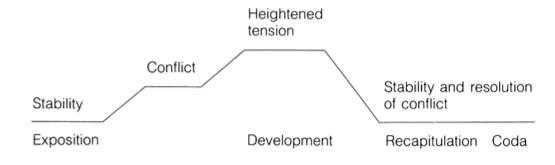
Roger Kamien’s description of the sonata form, a building block of the classical symphony, will seem familiar to screenwriters:

> The amazing durability and vitality of sonata form result from its capacity for drama. The form moves from a stable situation toward conflict (in the exposition), to heightened tension (in the development), and then back to stability and resolution of conflict. The following illustration shows an outline:

This line of rising action is also the basis of modern screenplay structure.

No matter how you dress it up with templates and turning points, most movies work this way: you meet your players and themes, set them against each other, let things get rough, then find a new normal.

> Sonata form is exceptionally flexible and subject to endless variation. It is not a rigid mold into which musical ideas are poured. Rather, it may be viewed as a set of principles that serve to shape and unify contrasts of theme and key.

With its long arcs and built-in act breaks, I’d argue that TV writing is even more symphonically-structured than features. Showrunners are our composers; Hollywood is our Vienna.

(I’m reading Kamien’s book on [Inkling](https://www.inkling.com/store/music-roger-kamien-7th/) for iPad, which is a remarkably good way to handle a textbook about music. The built-in tracks and listening outlines are ingenious. The chapter on classical music is currently free, and highly recommended.)

The two kinds of endings

August 2, 2011 Indie, Story and Plot

In [The Art of Fiction](http://www.amazon.com/Art-Fiction-Notes-Craft-Writers/dp/0679734031), John Gardner makes an interesting point about endings:

>[Stories] can end in only one of two ways: in resolution, when no further event can take place (the murderer has been caught and hanged, the diamond has been found and restored to its owner, the elusive lady has been capture and married), or in logical exhaustion, our recognition that we’ve reached the stage of infinite repetition; more events might follow, perhaps from now till Kingdom Come, but they will all express the same thing–for example, the character’s entrapment in empty ritual or some consistently wrong response to the pressures of his environment.

> Resolution is of course the classical and usually more satisfying conclusion; logical exhaustion satisfies us intellectually but often not emotionally, since it’s more pleasing to see things definitely achieved or thwarted than to be shown why they can never be either achieved or thwarted.

Observed: very few Hollywood movies take the logical exhaustion route, but you find it all the time in indies and foreign films.

/via [Susan Wise Bauer](http://books.google.com/books?id=7T-1jnYgIWUC&pg=PA79&lpg=PA79&dq=logical+exhaustion+well+educated+mind+Bauer&source=bl&ots=Ym29VX-nHL&sig=Wau7gV-KQ2PfnTVn-i7l_58w714&hl=en&ei=vEU4TpaACcPTgQfLyvSEAg&sa=X&oi=book_result&ct=result&resnum=1&ved=0CCsQ6AEwAA#v=onepage&q&f=false)

R-rated comedies to the rescue

July 28, 2011 Film Industry, Genres

Pamela McClintock points out that this summer, R-rated comedies edged out the usually dominant [superhero genre](http://www.hollywoodreporter.com/news/box-office-shocker-r-rated-215730):

> Combined, the summer’s five R-rated comedies have grossed $1.05 billion to date, an astounding total for a genre of movies that was considered second-rate only a few years ago.

> That number is slightly ahead of the $1.01 billion earned so far by the usual parade of summer superhero pics — Thor, X-Men: First Class, Green Lantern and Captain America: The First Avenger.

True, she’s comparing the totals of five movies against four, but the comedies also cost much less than their superhero brethren. And the usual knock against American comedies — that they don’t travel well overseas — appears to be lessening:

> Bad Teacher and Bridesmaids also are doing well overseas, grossing $71 million and $70.4 million to date (both are still rolling out). Likewise, Horrible Bosses got off to a strong start at the international box office over the weekend of July 22-24, grossing $3.4 million in the U.K.

Now if we can just get some big hit dramas.

Cinematic geography and the problem of genius

July 26, 2011 Directors

A few weeks ago, Shay from Jerusalem wrote in:

> I’m researching about Big Fish’s textual references to other auteurs or to the film canon in general. At first, I noticed the 8½ style ending, then the freeze scene reminded me of Scolla’s “We loved each other so much” exposition. Further more I thought Calloway’s character interestingly resembles a crossbreed between Dr Caligari and the Tramp.

> Also lots of visual cues of circles which it think refer to Chaplin’s “The Circus”, that do not appear in the final script.

> Have I overestimated your script/Burton’s directing? Blindly missed?

I don’t know if “overestimating” is a polite way to put it, but no, none of those references were in my head for Big Fish. And while I never spoke with Tim about the specifics on how he chose to shoot things, I’d be very surprised if those other films were conscious aspects of his process.

Academia teaches us to ask questions like Shay’s — and generally, to answer them ourselves. So we find parallels and influences that make sense on paper without worrying too much about whether they’re actually true.

To his credit, Shay tracked me down and asked his questions. I probably ruined the thesis of his research paper by answering honestly.

I was reminded of my email exchange with Shay by a video [Daring Fireball](http://daringfireball.net/linked/2011/07/26/shining-spatial-impossibilities) linked to this morning:

[The Shining — spatial awareness and set design](http://www.youtube.com/watch?v=0sUIxXCCFWw).

(The video continues in [part two](http://www.youtube.com/watch?v=IfJ8rK7eJeQ&feature=related).)

Rob Ager’s analysis of spatial impossibilities in The Shining is entertaining but naive, the video equivalent of Shay’s unwritten paper:

> These blatant design anomalies would not have occurred by accident. Set designers would have noticed them and brought them to Stanley’s attention at the blueprint stage. The only way they could occur is if Stanley wanted them there.

I’m sure there is a more official name, but let’s call this situation the genius fallacy. We start with a god-like figure such as Stanley Kubrick, well-known for his [exacting attention to detail](http://somecamerunning.typepad.com/some_came_running/2011/06/test.html).

Ager’s thesis seem to be: Since Kubrick was a perfectionist, anything that seems like an error in Kubrick’s work *must not* be an error, but must instead be a deliberate choice.

Yes, that sounds like fundamentalism.

Ager does have logic to support his narrative. After all, the Overlook Hotel is meant to be vast and confusing. The movie features a hedge maze as a major component. Kubrick is clearly playing with themes of disorientation, both physically and mentally. So it makes sense his choices would emphasize these aspects.

But —

The windows are there for light.

The walls are placed to best frame the scenes.

The big hedge map was moved because he didn’t want it in the shot. (Or, more likely, it was moved *into* the shot when he wanted it.)

In his analysis of cinematic geography, Ager is ignoring a tremendous amount of silent evidence. Namely, *every movie ever made.* Any film subjected to the kind of scrutiny applied here will reveal moments of spatial impossibility.

Here are just three reasons why:

**Cinematic geography is largely transient.** The audience pays attention to where things are within a scene, which is why we worry about camera direction and [crossing the line](http://en.wikipedia.org/wiki/180_degree_rule). But the minute you cut to another scene, our brains safely discard the perceived geography.

**Sets are designed to do things real locations can’t.** Walls move, giving the director the choice (and decision) how much to bend reality in order to position a camera where it couldn’t physically be.

**Even when movies use real locations, they are often assembled from various pieces.** The exterior of the Overlook Hotel is actually [The Timberline Lodge](http://en.wikipedia.org/wiki/Timberline_Lodge) in Oregon. And yes: the rooflines and windows don’t match closely with Kubrick’s sets.

But what would Ager have Kubrick do? Should an infallible genius director build a new exterior to match his vision of the interior, or should he alter his vision of the interior to match the realities of the exterior?

The fact is, Kubrick doesn’t have to do either. Audiences easily accept that the two locations are the same, not because Kubrick has perfected some form of cinematic spatial disorientation, but because that’s how movies work.

When Shelley Duvall is crawling out the window, what matters that we believe it’s the same window inside and outside — not whether it’s a corner apartment. Kubrick isn’t performing some amazing psychological trick here.

He’s getting away with cheating a location. That’s what directors do.

Filmmaking is essentially the art of sustaining the suspension of disbelief: from shot to shot, scene to scene. On location scouts, we talk about “selling” and “buying” and “reading.”

DIRECTOR

I’m not buying this as an upscale Miami restaurant. It’s reading very Dennys-in-Topeka.

FIRST A.D.

It fits on the schedule. We can’t change the schedule.

LINE PRODUCER

Bring in some white tablecloths, some palm trees to sell Florida. Done.

DIRECTOR

Maybe a flamingo could walk through the shot.

LINE PRODUCER

We can’t afford animals.

DIRECTOR

I was being sarcastic.

LINE PRODUCER

We can’t afford that either.

The Shining is a great movie. Kubrick was a great director. At the end of the second video, Ager focuses on a few points well worth highlighting, because they are very deliberate and very effective demonstrations of Kubrick’s skills.

Notice how the camera tracks Danny as his tricycle loops around the hallways — and how that ties into the final set piece in the maze.

Observe how Kubrick isolates his characters by placing them in vast sets and landscapes.

But don’t obsess about which way the freezer door swings. By making too much of too little, you miss out the bigger picture.

« Previous Page
Next Page »

Primary Sidebar

Newsletter

Inneresting Logo A Quote-Unquote Newsletter about Writing
Read Now

Explore

Projects

  • Aladdin (1)
  • Arlo Finch (27)
  • Big Fish (88)
  • Birdigo (2)
  • Charlie (39)
  • Charlie's Angels (16)
  • Chosen (2)
  • Corpse Bride (9)
  • Dead Projects (18)
  • Frankenweenie (10)
  • Go (29)
  • Karateka (4)
  • Monsterpocalypse (3)
  • One Hit Kill (6)
  • Ops (6)
  • Preacher (2)
  • Prince of Persia (13)
  • Shazam (6)
  • Snake People (6)
  • Tarzan (5)
  • The Nines (118)
  • The Remnants (12)
  • The Variant (22)

Apps

  • Bronson (14)
  • FDX Reader (11)
  • Fountain (32)
  • Highland (73)
  • Less IMDb (4)
  • Weekend Read (64)

Recommended Reading

  • First Person (87)
  • Geek Alert (151)
  • WGA (162)
  • Workspace (19)

Screenwriting Q&A

  • Adaptation (65)
  • Directors (90)
  • Education (49)
  • Film Industry (490)
  • Formatting (128)
  • Genres (89)
  • Glossary (6)
  • Pitches (29)
  • Producers (59)
  • Psych 101 (118)
  • Rights and Copyright (96)
  • So-Called Experts (47)
  • Story and Plot (170)
  • Television (165)
  • Treatments (21)
  • Words on the page (237)
  • Writing Process (177)

More screenwriting Q&A at screenwriting.io

© 2026 John August — All Rights Reserved.