• Skip to primary navigation
  • Skip to main content
  • Skip to primary sidebar

John August

  • Arlo Finch
  • Scriptnotes
  • Library
  • Store
  • About

Film Industry

Which side of the pond should I choose?

October 4, 2005 Education, Film Industry, QandA

questionmarkAs a long time reader of your blog, I have finally decided to pose a question to you which for myself irritates and intrigues me. I am currently 18 years old and in the midst of a gap year before taking cinema studies and scriptwriting next September.

However the thing is, as I live in the United Kingdom, more accurately England, I often wonder what is the potential in the future in script negotiations, optioning etc overseas? Is this possible, and if not would it be required to move to the wannabe writer over-saturated Los Angeles or attempt to firmly establish myself within my own countries Film and television network?

— Paul
Birmingham, England

Stay in England, study film, then decide whether it’s British or American movies you want to make. I won’t even try to describe the differences between the British and American film industries, but you’ll have a gut feeling about where your instincts lie. (Hint: If you find yourself saying, “This would be perfect for Jessica Alba!” then you belong in America.)

You’ll be at no disadvantage coming to Hollywood at 23 or 24, though you may find the visa situation a little trickier if you’re not enrolled in some sort of university program.


[Does a Brit have a chance?](http://johnaugust.com/archives/2003/does-a-brit-have-a-chance)
[Is film school necessary?](http://johnaugust.com/archives/2003/is-film-school-necessary)
The sky is not falling

October 1, 2005 Film Industry, Rant

To me, one of the most annoying non-stories of the summer — trumping even items involving Britney Spears — has to be the “crisis” caused by the box office slump.

For those who’ve somehow missed the articles, here’s the quick summary: weekend-by-weekend, the total box office was less than it was for 2004. This slump lasted from February until July, a total of 19 weekends. Along with the numbers, every Monday brought new speculation about just what was causing the downturn, and What It Really Meant. Could the problem be the poor state of movie theaters, the growth of DVD, the price of gasoline? Fingers were pointed everywhere, but most often at the movies themselves.

The movies stunk.

Whew! Glad we got that settled. You hear that Hollywood? You have to start making better movies! Movies people want to see!

Thank God we have the conventional wisdom. All we have to do is keep repeating it, and everything will be okay. Just this morning, the Los Angeles Times had a front-page story on the issue: [“This Just in: Flops Caused Box Office Slump.”](http://articles.latimes.com/2005/oct/01/business/fi-boxoffice1) In the article, various studio big-wigs take responsibility for how badly the summer movies fared:

After months of hand-wringing and doomsday forecasts about the permanent erosion of moviegoing, the lunchtime chatter at Mr. Chow in Beverly Hills and other industry haunts has turned decidedly inward. Now, four straight weekends of crowded theaters have forced moguls and creative executives to admit in public what they have spent months avoiding: They were clueless about what audiences wanted.

The story has quotes from the likes of Amy Pascal and Brian Grazer. I can imagine how those conversations went:

__Journalist:__ “Would you say the slump was caused because the movies were awful?”

__Executive:__ “Umm, maybe. I guess.”

__Journalist:__ “No, seriously. _Say_ it.”

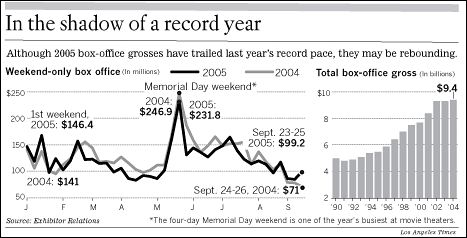
What makes this self-flagellation so annoying and unwarranted is that the “box office slump” is basically a myth. The Los Angeles Times included a chart which ostensibly shows the crisis, but in reality disproves it.

Box Office Chart

Week by week, the black line is a little below the gray line — except when it’s above it. More importantly, it tracks very closely. A more honest chart would have also included a line for 2001, which was at the time the pinnacle of box office grosses. This summer had that beat.

An analogy: Let’s say one year you have record rainfall. If you’re a journalist covering the weather, you write about how much above average it is.

The next summer, you’re back to a more typical rainfall. That’s not interesting. That doesn’t merit a story. But if you write about the “shortfall” compared to last year, well, now that’s worrying. And fallacious.

To their credit, buried deeper in the story, the LA Times writers do reveal the less-exciting truth: “Ticket sales lag behind 2004’s numbers by only 6%, with attendance off 8.7%.” Since Labor Day, the numbers have been running significantly ahead of last year, so by the time January rolls around, the year-end totals may not be very far from the $9.4 billion that movies brought in last year.

Which leaves an open question: did this summer’s movies really stink? There were some outright bombs ([Stealth](http://imdb.com/title/tt0382992/), [Bewitched](http://imdb.com/title/tt0374536/)) and some quality misfires ([Cinderella Man](http://imdb.com/title/tt0352248/)). But I think trying to correlate a quantitative measure (how much movies make) with a qualitative one (how good they are) is pseudo-science at best. Case in point: [Fantastic Four](http://imdb.com/title/tt0120667/) made a lot of money, but it won’t end up on any best-picture lists.

Let’s ask the question: What if one of the late-spring movies had made a fortune? Say, [xXx 2: State of the Union](http://imdb.com/title/tt0329774/). Just one mega-hit would have erased the supposed slump, and the week-to-week numbers would be higher. Which brings up two points:

1. Is there really an industry crisis if just one movie would eliminate it?
2. If the numbers were better, would you still write about how bad the movies were this summer?

The final apples-to-oranges comparison in the story is perhaps the most annoying. [Bennett Miller](http://imdb.com/name/nm0587955/), a talented documentarian whose first narrative film [Capote](http://imdb.com/title/tt0379725/) opens soon, is asked to comment on the state of the box office. What he says is less revealing than the fact that they asked him at all. It’s like writing a story about the auto industry and interviewing a guy who makes bicycles.

I hope Capote is great. But I’m not counting on it to save the film industry, which, for the record, I don’t think needs to be saved.

Hollywood makes some shitty movies. It always has, and always will. But trying to conflate popular sentiment with specious data does a disservice to everyone.

Being a reader

September 23, 2005 Film Industry

I’ve [written before](http://johnaugust.com/archives/2004/getting-a-reader-job) about being a freelance reader in Hollywood — it was my first job in the industry, as it was for many screenwriters. It’s been almost ten years since I’ve written coverage, but looking through Scott the Reader’s [own explanation](http://alligatorsinahelicopter.blogspot.com/2005/09/mailbag.html) of his job, it seems that not much has changed.

Not even the pay: $50 a script. Adjusting for inflation, that sucks.

You can read Scott’s recap [here](http://alligatorsinahelicopter.blogspot.com/2005/09/mailbag.html).

Curse of the Pop-In

September 19, 2005 Film Industry

flandersJosh Friedman, whose purported [screenwriting blog](http://hucksblog.blogspot.com/) is actually just an excuse to make up pseudonyms for our mutual acquaintances, recently [wrote](http://hucksblog.blogspot.com/2005/09/swimming-with-shrimps.html) about almost bailing on an assignment because he didn’t want to drive to Santa Monica.

While that may sound ridiculous to most readers, I can relate. I increasingly share his Life’s Too Short principle, particularly when it comes to dealing with westside traffic.

His attempted solution is smart, but runs into a vexing problem:

Agent’s Assistant calls Producer Friend’s Assistant and says I want to convert Santa Monica meeting to a lunch. The assistant explains that this is not possible as Producer Friend’s Fancy Boss wants to “pop his head in the meeting.”

As far as I know, “pop-ins” are strictly a Hollywood phenomenon. Basically, the powerful boss who is too busy and important to have a sit-down meeting with you has several goals with this maneuver:

1. Confirm that you are an actual person who appears sane.
2. Establish dominance over the junior executive.
3. Be able to say, “I met with Josh Friedman last week…”

Just this morning, I survived a pop-in. They’re not always bad.

But what can be very frustrating is the Pop-In That Never Comes. Here’s how it happens.

The meeting starts. You talk about the weekend’s movies. Executive says, “Fancy Boss will be popping in at some point.” You say, “Great.” You talk about the project. You make decisions. Someone takes notes. Everything is going well.

And at just the moment the meeting should be over, Executive realizes that Fancy Boss has never popped in. She goes to check on Fancy Boss, to see if he’s going to be able to stop in. Yes? No? Two minutes? How soon will he get here?

(You hear this conversation while you’re sitting in the Executive’s office, wondering why every single person in Hollywood has that big fat [CENTURY](http://www.amazon.com/exec/obidos/ASIN/0714838489/) book on her shelf.)

Executive comes back and apologizes, saying “Fancy Boss is running late, but he really wanted to meet you.” At this point, you’re officially screwed. You could demur and say that you have to get back to feed the baby (note: babies are handy excuses), but there’s no question that all the positive mojo has now been lost in a sea of awkwardness.

What usually happens is that just as you come up with your excuse, Fancy Boss swoops in, shakes your hand and then hurries away. The total encounter takes less than 30 seconds. And then you get a call later from your agent saying, “Fancy Boss said he really liked you…”

Sigh.

« Previous Page
Next Page »

Primary Sidebar

Newsletter

Inneresting Logo A Quote-Unquote Newsletter about Writing
Read Now

Explore

Projects

  • Aladdin (1)
  • Arlo Finch (27)
  • Big Fish (88)
  • Birdigo (2)
  • Charlie (39)
  • Charlie's Angels (16)
  • Chosen (2)
  • Corpse Bride (9)
  • Dead Projects (18)
  • Frankenweenie (10)
  • Go (29)
  • Karateka (4)
  • Monsterpocalypse (3)
  • One Hit Kill (6)
  • Ops (6)
  • Preacher (2)
  • Prince of Persia (13)
  • Shazam (6)
  • Snake People (6)
  • Tarzan (5)
  • The Nines (118)
  • The Remnants (12)
  • The Variant (22)

Apps

  • Bronson (14)
  • FDX Reader (11)
  • Fountain (32)
  • Highland (73)
  • Less IMDb (4)
  • Weekend Read (64)

Recommended Reading

  • First Person (87)
  • Geek Alert (151)
  • WGA (162)
  • Workspace (19)

Screenwriting Q&A

  • Adaptation (65)
  • Directors (90)
  • Education (49)
  • Film Industry (489)
  • Formatting (128)
  • Genres (89)
  • Glossary (6)
  • Pitches (29)
  • Producers (59)
  • Psych 101 (118)
  • Rights and Copyright (96)
  • So-Called Experts (47)
  • Story and Plot (170)
  • Television (165)
  • Treatments (21)
  • Words on the page (237)
  • Writing Process (177)

More screenwriting Q&A at screenwriting.io

© 2026 John August — All Rights Reserved.