• Skip to primary navigation
  • Skip to main content
  • Skip to primary sidebar

John August

  • Arlo Finch
  • Scriptnotes
  • Library
  • Store
  • About

Film Industry

Spec, or write it for the producer?

July 11, 2006 Film Industry, Pitches, QandA

questionmarkI recently went out to about 10 companies with a comedy pitch. I had some good response, although no sale, as I somewhat expected as a new writer. But it was a great experience to pitch it, meet new people, etc.

*One of the producers I pitched to loved the overall concept but had issues with my execution of it. He wants to develop it with me as a script.*

*On the one hand, I can see the value of having an experienced exec’s insight. Plus he was very excited about the idea and got it on a thematic level.*

*On the other, I am so sick of developing this idea which I’ve been working on for months and really want to start writing it now. (Even though it didn’t sell, I still think i can execute it well enough to sell.) I’m worried the producer’s ideas for plot changes were pretty major, and I may not agree with all of them. Plus I’d have to cater to his views in order for him to bring it to the studio. My inclination is to just go ahead and spec it, then show it again to him and everyone else. But I’m wondering what you think. I’d hate to pass up a good opportunity.*

*–KR*
*Los Angeles, CA*

I don’t know the producer, so I can’t speak to his taste. But I think your instincts are right.

Look at it this way: Say you write the script and it still doesn’t sell. At least if you wrote the script the way you wanted, you’d always have something you believed in. But if you wrote it to the producer’s vision and it didn’t sell, you’d be stuck with a script that’s not really what you wanted in the first place.

So I say, spec it and take it to the producer first. If he still wants it his way, you can decide whether it’s worth the work to try it. He may even option it. But whatever happens, you’ll always have your version in the vault.
Are you somebody?

May 5, 2006 Film Industry, First Person

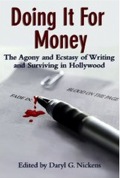
doing it book coverThe Writers Guild Foundation has a new book out, Doing It For Money, in which working screenwriters contribute short pieces about the pleasures and pitfalls of working in Hollywood. I’d feel bad about giving my essay away for free, except that pretty much every entry in the book is at least its equal. Buy the book. You’ll like it.

* * *

There are no famous screenwriters.

There are rich screenwriters with houses in Malibu. There are acclaimed screenwriters with awards on their mantels. But none of them are actually famous. Your aunt in Pittsburgh can’t name a single screenwriter — except for you, her little champ, working so hard to make it in Hollywood.

She’s proud of you, but worries. Who wouldn’t?

True, there are the hyphenates: writer-directors can be famous, not to mention actor-writer-directors, whose many hats only add to their publicity value. But no one gets famous just for writing 120 pages of 12-point Courier. You should know this going in, because if you have any interest in becoming “a household name,” your best bet is to pick a pseudonym like Crisco or Clorox.

Here’s an example of someone who is actually famous: Drew Barrymore. A few years ago, paparazzi took pictures of us having lunch. In the caption, I was the “unidentified companion.”

I wasn’t offended, honest. By this point I had fully accepted that I would never be recognized. The more time you spend with actual famous people, the more you realize that it pretty much sucks to have random people taking your picture, or asking for autographs while your dog is pooping at Runyon Canyon Park.

Well-paid anonymity is a luxury, frankly. I came to enjoy it.

And then one day, someone recognized me.

My boyfriend and I were at LAX, flying to Colorado for Christmas vacation, with both our dogs in carriers. Out of nowhere, a young guy on crutches came up to me and stuck out his hand: “I just wanted to say, I’m a big fan.” I stammered and thanked him, then went back to my dogs.

At the time, I was busy promoting Big Fish, so I figured that Crutches Guy had been at one of the countless Q&A screenings. He’d seen the film, liked it, and remembered me as the guy sitting next to Danny DeVito. I was flattered, and enjoyed the little jolt of adrenaline, but quickly wrote it off as a one-time thing.

But it wasn’t.

As I’ve done more publicity, and talking-head interviews on various DVDs, I’ve found that random people are recognizing me and saying hello with increasing frequency. It’s once a month or so — nothing alarming — but it always comes when I least it expect it: shopping for strollers, in line at the movies, at breakfast with the woman carrying my baby.

The hand-shakers are invariably polite, so I can always genuinely say, “It’s nice to meet you.” But what’s fascinating is how everyone around us reacts. Remember: as a screenwriter, I’m not actually famous. Yet suddenly someone is treating me like I am. I love watching that double-take as bystanders try to figure out who I could possibly be.

Once a nearby woman actually asked me, “Are you somebody?”

Almost apologetically, I said I was a screenwriter. Her face showed a combination of confusion and disappointment that would have been devastating at another point in my life.

While I stand by my no-famous-screenwriters rule, I need to issue a clarification. It is apparently possible to be recognizable among the subset of “aspiring screenwriters living in Los Angeles.” That’s far short of famous, but quite a bit better, in my opinion. Screenwriters are commendable folk. (Except for one guy who asked me to sign his hat, then dissed me in his blog.)

If there’s a downside to being recognized, it’s that occasionally I get half-recognized. At a restaurant, someone will see me and know that they know me from somewhere. Throughout the rest of their meal, they will steal glances, wracking their brains to figure out who I could be. A musician? A contestant on The Apprentice? The Neo-Nazi from last night’s West Wing? By the time salads arrive, I can feel their growing frustration.

So I take off my glasses.

With 18 inches of vision, the rest of the world blurs out, leaving me alone in my happy anonymity. Unless that guy comes over and asks if I am somebody. Then I don’t know what I’ll say.

Does the editor even read the script?

February 14, 2006 Directors, Film Industry, QandA

Does the editor read the script and use it as a framework when the screenwriter is not involved in editing? How else does she make sense of all the footage the director has shot to cut into a cohesive whole? Also, do you see the editor’s role as bringing to screen the vision of the screenwriter?

— dabba
via imdb

The editor almost certainly reads the script at least once, before she signs on for the job. After that, it’s hard to say.

Pretty much everyone who’s ever taken an editing class has had some variation of this common assignment: given a bag of random footage (or a folder, in the digital age), you’re told to assemble it into a meaningful sequence.

And the thing is, you can. So even if editors never cracked the script open, they could still do their job. Every scene has a scene number associated with it, which comes from the script, so there’s not even a question of, “Does the car chase come first, or the bank robbery?”

Is it the editor’s job to bring the screenwriter’s vision to the screen? Nope. The editor’s job is to make the best movie possible given the footage shot, which is often a source of potential conflict between the screenwriter and editor. The screenwriter says, “This scene is about Kyle forgiving Mary!” The editor replies, “No, it’s about Mary looking for her keys. That’s what was shot. I can’t make it something it’s not.”

While I’ve had good relationships with most of the editors on the films I’ve written, there’s no question that the editor works primarily for the director. To the degree I’ve been able to help out in post-production, it’s been providing thoughtful notes that not only point out problems but offer solutions.

I always write up my notes so the whole team can read them, and agree or disagree. On a first cut, that might mean 12 pages of notes. But so far, at least, it’s proved to be a help. Editors, like screenwriters, are generally bombarded by the opinions of people who think they know best. So I make sure the tone is respectful.

For example, from the first Charlie’s Angels:

The outside tables
We should flop the order of business in this scene, starting with Vivian Wood looking though the file and trying to get them to hand over full access to the computer. Only after she’s denied does Knox ask them to go out.

Here’s the big change: the subtitled Finnish is completely different. The angels are still in work mode, talking about how Knox could still be in danger, this may not all be over, et cetera. We exit on a look between Dylan and Knox, setting up that there may be potential ahead.

My notes are always addressed to the director, but they’re ultimately for the use of the editor, who can implement whatever seems workable.

When the editor and screenwriter respect each other, I think it can be a very fruitful relationship. The screenwriter generally has more distance from the production, and can look with fresher eyes than the editor, who know where all the bodies (and bad takes) are buried.

Why most scripts never become movies

January 22, 2006 Film Industry, QandA

questionmarkOn September 5th you had said that “most scripts don’t become movies, and a hundred things could go wrong in the process.” What exactly was meant by this, and of the scripts that you have written and you deemed worthy of the silver screen, how many actually made it there?

–Sweta
via IMDb

We’ll start with the second part first. By my count, I’ve written 18 feature-length scripts. I have seven produced credits, which means I have a 39% production rate.

That’s actually not bad. It gives the illusion of being prolific when in fact it’s just a combination of luck and careful picking. As I’ve said before, my favorite genre is “movies that get made.”

I’ve also done significant-but-uncredited rewrite work on seven other screenplays, five of which have been made.

Your question includes the qualifier, “[that] you deemed worthy of the silver screen.” I can honestly say that at the time I wrote them, I considered every one of my scripts worthy of the screen.

Now? Not so much.

But for the sake of example, let me list my never-made scripts and briefly explain why they won’t be playing soon at a theatre near you.

__Here and Now__
My first script. Nicely written but largely plotless.

__How to Eat Fried Worms__
Was actually made this year, but with a script by a different writer.

__A Wrinkle in Time__
Was made for television, with a draft that pre-dated mine.

__Untitled Zombie Western__
Will probably get made at some point, in some form.

__Fenwick’s Suit__
The studio didn’t like my script, and let the underlying rights lapse.

__Demonology__
The studio thought it was too expensive for what it was.

__Thief of Always__
The director and the author hated my draft. Hated.

__Secret Project I Can’t Talk About__
Will hopefully get made soon.

__Barbarella__
The two studios bickered and dickered until the underlying rights fell out.

__Fury__
Probably will get made at some point, in some form.

__Tarzan__
In a perpetual holding pattern at the studio.

Studios develop a lot of projects that never end up getting made. Every few years, an outsider with a lot of money will come to Hollywood and vow, “We’re not going to waste money. We’re only going to develop the projects we’re going to make!”

And a few years later, they’ll have a dozen projects in various stages of development, and maybe one or two movies. Because it’s not just the script that determines whether a movie gets made. You need the right director, the right stars, the right way to market the movie. You can be a week from shooting when a hurricane destroys your location, or a strike shuts down production. Or the exchange rate takes a dive.

As the screenwriter, there are hundreds of variables I can’t control. So I consider it a minor miracle any time a movie gets made.

« Previous Page
Next Page »

Primary Sidebar

Newsletter

Inneresting Logo A Quote-Unquote Newsletter about Writing
Read Now

Explore

Projects

  • Aladdin (1)
  • Arlo Finch (27)
  • Big Fish (88)
  • Birdigo (2)
  • Charlie (39)
  • Charlie's Angels (16)
  • Chosen (2)
  • Corpse Bride (9)
  • Dead Projects (18)
  • Frankenweenie (10)
  • Go (29)
  • Karateka (4)
  • Monsterpocalypse (3)
  • One Hit Kill (6)
  • Ops (6)
  • Preacher (2)
  • Prince of Persia (13)
  • Shazam (6)
  • Snake People (6)
  • Tarzan (5)
  • The Nines (118)
  • The Remnants (12)
  • The Variant (22)

Apps

  • Bronson (14)
  • FDX Reader (11)
  • Fountain (32)
  • Highland (73)
  • Less IMDb (4)
  • Weekend Read (64)

Recommended Reading

  • First Person (87)
  • Geek Alert (151)
  • WGA (162)
  • Workspace (19)

Screenwriting Q&A

  • Adaptation (65)
  • Directors (90)
  • Education (49)
  • Film Industry (489)
  • Formatting (128)
  • Genres (89)
  • Glossary (6)
  • Pitches (29)
  • Producers (59)
  • Psych 101 (118)
  • Rights and Copyright (96)
  • So-Called Experts (47)
  • Story and Plot (170)
  • Television (165)
  • Treatments (21)
  • Words on the page (237)
  • Writing Process (177)

More screenwriting Q&A at screenwriting.io

© 2026 John August — All Rights Reserved.