• Skip to primary navigation
  • Skip to main content
  • Skip to primary sidebar

John August

  • Arlo Finch
  • Scriptnotes
  • Library
  • Store
  • About

News

Featured Friday: Back to School

August 16, 2024 News

Weekend Read, our app for reading scripts on your phone, features a new curated collection of screenplays each week.

This week, it’s back to school! We look at stories that articulate the excitement and ease the pain of starting another academic year.

Our collection includes:

  • 10 Things I Hate About You by Karen McCullah Lutz & Kirsten Smith
  • Big Little Lies – “Somebody’s Dead” by David E. Kelley
  • Bottoms by Rachel Sennott & Emma Seligman
  • Clueless by Amy Heckerling
  • Dead Poets Society by Tom Schulman
  • Dear White People by Justin Simien
  • Easy A by Bert V. Royal
  • Fast Times at Ridgemont High by Cameron Crowe
  • Friday Night Lights – “Its Different For Girls” by Andy Miller
  • Harry Potter and the Sorcerer’s Stone by Steve Kloves
  • Lady Bird by Greta Gerwig
  • Mean Girls by Tina Fey
  • Napoleon Dynamite by Jared Hess & Jerusha Hess
  • Never Have I Ever – “Pilot” by Mindy Kaling & Lang Fisher
  • Rushmore by Wes Anderson and Owen Wilson
  • School Daze by Spike Lee
  • Sex Education – “Episode One” by Laurie Nunn
  • The Perks of Being a Wallflower by Stephen Chbosky
  • Wednesday – “Wednesday’s Child Is Full Of Woe” by Alfred Gough & Miles Millar

Read these and other featured collections only on Weekend Read 2, available on all Mac and iOS devices. Download for free!

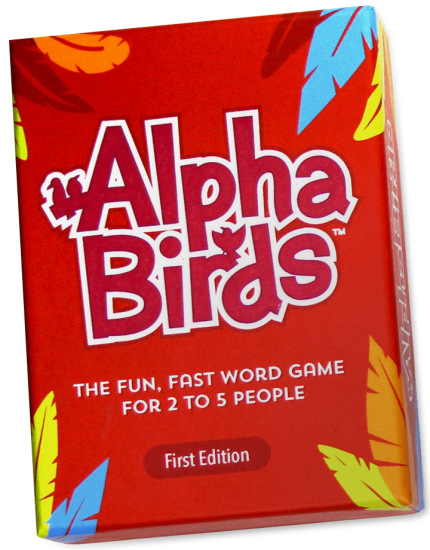
AlphaBirds, our favorite office game

July 16, 2024 News

Back in 2017, friends and I came up with a fun little game called AlphaBirds. ((Originally it was called Sparrow, but AlphaBirds was a better name.)) We’ve been playing it in the office nearly every Friday since then.

It’s a word game like Scrabble or Wordle, but faster and more fun. And it’s ridiculously simple to learn.

  1. On your turn, draw two cards.
  2. Play one card in front of you, and one in front of any other player.
  3. Make words if you can. Longer words are worth more points.

Yes: there are more rules. But that’s the gist. Most players pick it up in 30 seconds or less.

It’s the perfect game for lunchtime or beer o’clock. You can carry on a conversation while playing, and don’t have to keep things in your hand. You draw; you play; you’re finished until it’s your turn again. Most games last about 10 minutes.

We printed 100 copies of the game and shared them with friends. Then we got busy doing other things.

This spring, we decided to officially launch the game. We registered the official trademark, locked down the barcode, and redesigned the box for our new American manufacturer.

We also made a short how-to-play video.

Starting today, you can buy AlphaBirds for yourself! The game is now available both on our site and on Amazon. This isn’t a pre-order. It’s in stock and shipping today.

Because we’re a brand-new game, we currently have zero online reviews. So if you’ve played AlphaBirds and love it, please leave a review so others can see it’s an actual game humans enjoy.

And the nominees are…in Weekend Read

January 31, 2024 Apps, Awards, News, Weekend Read

This year’s Academy Award nominees for best original and best adapted screenplay are a terrific mix of genres and styles, with scripts by established names and newcomers alike.

Craig and I talked through a bunch of them on a recent Scriptnotes, but that’s no substitute for reading them yourself. Fortunately, studios have made most of these scripts available online.

To make it even easier, we’ve added a new And the Nominees Are… list to Weekend Read. Here you’ll find everything from American Fiction to Zone of Interest.

screenshot of Weekend Read, listing scripts with poster artwork

Completists will notice that two scripts are missing. The screenplay for Past Lives hasn’t been released, while Anatomy of a Fall has a fascinating non-traditional format that can’t be converted out of PDF.

Weekend Read 2 is free on the App Store.

Speaking to the FTC about generative AI

October 4, 2023 News, WGA

This afternoon, I represented the WGA at a virtual roundtable organized by the Federal Trade Commission on the impact of AI on creative professions. It ended up being a great panel that brought together a range of disciplines from writing to music to visual arts.

In her opening remarks, FTC Chair Lina M. Khan called out the WGA’s recent wins in establishing AI protections, as did commissioners Rebecca Slaughter and Alvaro Bedoya.

The full video of the panel will be up at some point, but in the meantime, here are my opening remarks, prepared with our incredible Guild staff members Laura Blum-Smith, Erica Knox and Rachel Torres.


I’m here on behalf of the Writers Guild of America West, a labor union representing thousands of writers of film, television and streaming series. Our members, and the members of Writers Guild of America East, have just concluded a 148-day strike where artificial intelligence was a key issue. Our fellow artists at SAG-AFTRA are still on strike, with AI as a core issue for them as well. But the fight for protection over our craft and livelihoods doesn’t stop at the bargaining table—while we have been able to achieve groundbreaking protections for writers, we need public policy solutions too. 


Obviously, copyright is an area of government scrutiny, both the copyrightability of AI-generated works, and the degree to which training AI models infringes on copyright. WGA writers do not hold copyright for the scripts we write; those are works made for hire, so the studios—our employers—hold the copyright. But through the power of our union, we have over the decades negotiated an assortment of contractual rights in the works we create, including the right to payment for reuse of our work. It’s a good reminder that while copyright is important, it’s not the end of the story when it comes to protecting artists.


The Guild’s new agreement offers helpful guidance in thinking about future public policy on AI. Our agreement defines that AI is not a writer and that the material it generates is not equivalent to human writing for the purposes of our contract. That means AI cannot rewrite us, nor can it compete with a human writer for credit and the associated financial benefit of that credit. Further, the studios now have to tell us if they are providing us with material generated by AI, and they cannot require us to use AI tools.

We won these protections because we’re a strong union that successfully carried off a nearly five-month strike. But we need to remember that most writers and most artists in this country don’t have unions to protect them. It’s best to think of writers and other artists as tiny businesses, each competing in the marketplace to sell their work. Writers and artists each develop a unique style, voice and brand in order to distinguish themselves. AI fundamentally disrupts that market in ways that could be devastating to the creative economy.


Large language models like the one that underpins ChatGPT have scraped massive volumes of data including our words, our unique perspective. This is theft, not fair use. Our works—protected by copyright and our own contractual rights—are being used entirely without our authorization, without any attribution or any compensation. Right now, you could ask ChatGPT to write something “in the style of” a particular writer, and it would try to do that—appropriate the unique voice of a writer, without that writer’s consent.

As FTC Commissioner Alvaro Bedoya recently suggested, this could constitute an unfair method of competition. It is using stolen goods to undercut the price of a seller and create market confusion. And it’s not a hypothetical. Right now, authors are finding AI-generated knock-offs of their work published on Amazon. They’re having to fight to get those fakes taken down, and protect their brands.

This form of AI appropriation may also have consumer implications. From electronics to organic eggs, consumers expect to be told the origin of a product, and its authenticity. Consumers make choices based on that information. The same will likely be true with AI.

With this strike and this contract, the Writers Guild was able to win groundbreaking AI protections for writers. But it’s important to remember our deal only covers the film and television studios. Most of the real work in AI is being done by companies like Google, Facebook and OpenAI, with which the Guild has no contractual relationship. Public policy will play a crucial role in protecting our members.

In conclusion, AI has the potential to assist the creative community, but only with the consent of that community. Without guardrails, AI poses a profound threat to writers and the integrity of our creative work. AI and its use raises major questions of intellectual property, of transparency, of competition, all of which requires careful oversight to protect the creative economy.

Thank you for the opportunity to speak on behalf of film and television writers.

« Previous Page
Next Page »

Primary Sidebar

Newsletter

Inneresting Logo A Quote-Unquote Newsletter about Writing
Read Now

Explore

Projects

  • Aladdin (1)
  • Arlo Finch (27)
  • Big Fish (88)
  • Birdigo (2)
  • Charlie (39)
  • Charlie's Angels (16)
  • Chosen (2)
  • Corpse Bride (9)
  • Dead Projects (18)
  • Frankenweenie (10)
  • Go (29)
  • Karateka (4)
  • Monsterpocalypse (3)
  • One Hit Kill (6)
  • Ops (6)
  • Preacher (2)
  • Prince of Persia (13)
  • Shazam (6)
  • Snake People (6)
  • Tarzan (5)
  • The Nines (118)
  • The Remnants (12)
  • The Variant (22)

Apps

  • Bronson (14)
  • FDX Reader (11)
  • Fountain (32)
  • Highland (75)
  • Less IMDb (4)
  • Weekend Read (64)

Recommended Reading

  • First Person (87)
  • Geek Alert (151)
  • WGA (162)
  • Workspace (19)

Screenwriting Q&A

  • Adaptation (65)
  • Directors (90)
  • Education (49)
  • Film Industry (489)
  • Formatting (128)
  • Genres (89)
  • Glossary (6)
  • Pitches (29)
  • Producers (59)
  • Psych 101 (118)
  • Rights and Copyright (96)
  • So-Called Experts (47)
  • Story and Plot (170)
  • Television (165)
  • Treatments (21)
  • Words on the page (238)
  • Writing Process (177)

More screenwriting Q&A at screenwriting.io

© 2026 John August — All Rights Reserved.