• Skip to primary navigation
  • Skip to main content
  • Skip to primary sidebar

John August

  • Arlo Finch
  • Scriptnotes
  • Library
  • Store
  • About

John

One Hit Kill is now on Kickstarter

May 12, 2015 One Hit Kill

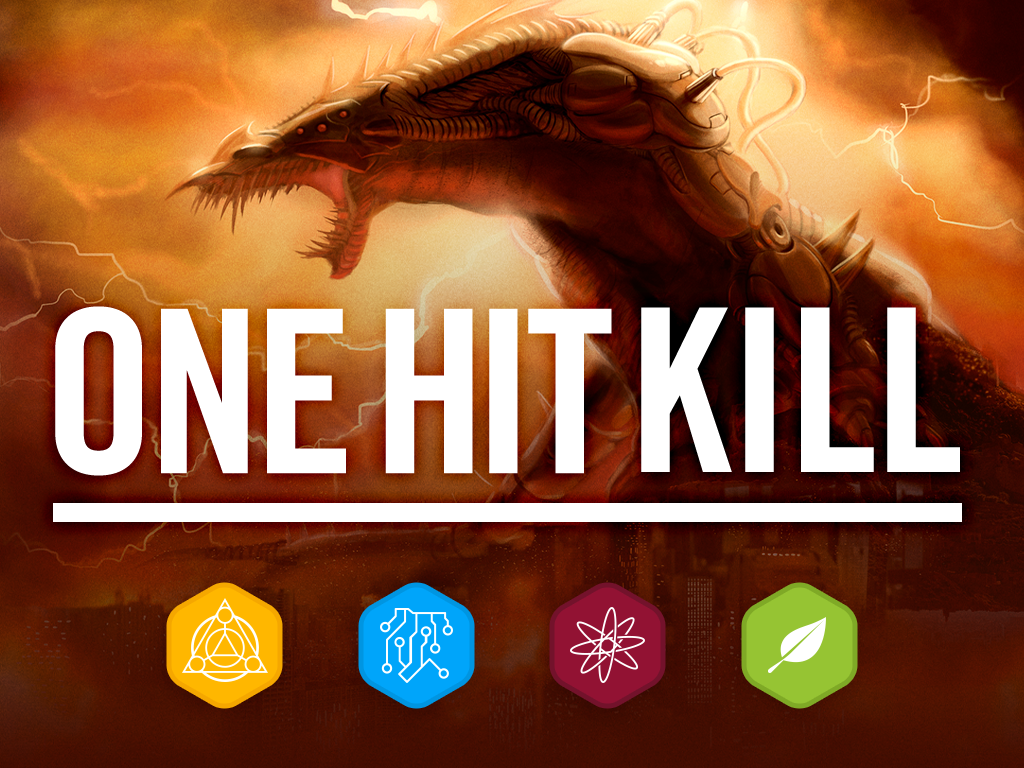
OHK Key Art

Minutes ago, we launched the Kickstarter for [One Hit Kill](https://www.kickstarter.com/projects/913409803/one-hit-kill?utm_source=Blog&utm_medium=jalink&utm_campaign=OHK-Kickstarter), our new card game of ridiculously overpowered weapons and monsters and cuddly rabbits.

**UPDATE:** We funded! Really quickly. We’ll be sending out the game in September — and this will probably be the [only chance to get it this year](https://www.kickstarter.com/projects/913409803/one-hit-kill?utm_source=Blog&utm_medium=jalink&utm_campaign=OHK-Kickstarter), so don’t wait. We also announced our [stretch goals and achievements](https://www.kickstarter.com/projects/913409803/one-hit-kill/posts/1233627), including an app.
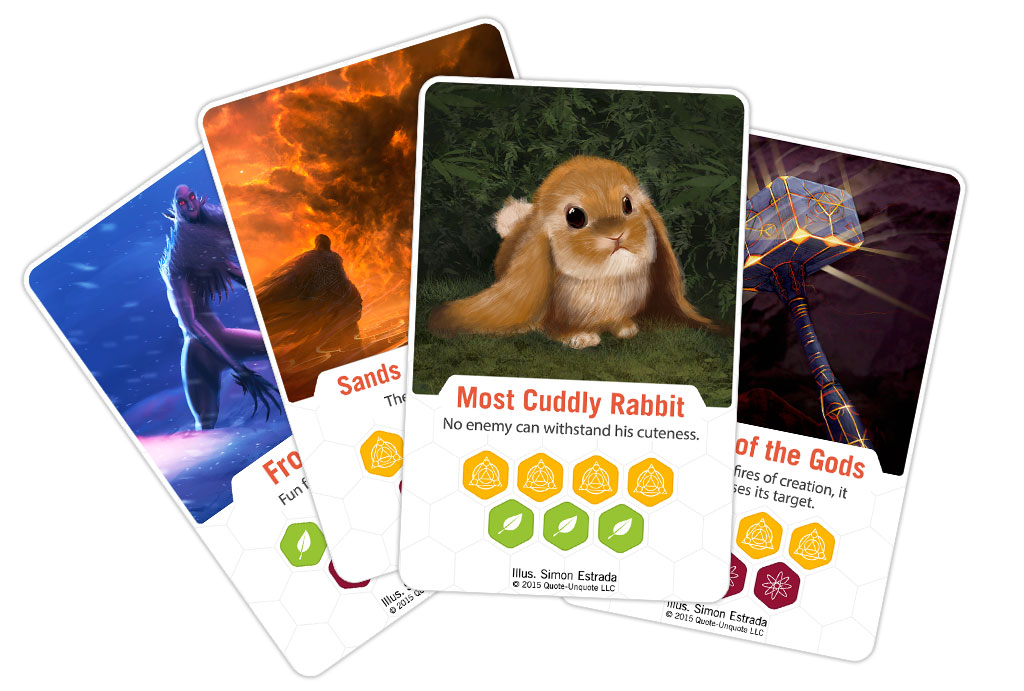
weapons

After months of work and testing, we’re damn excited to show you what we’ve designed. We’ve been playing the game non-stop, and it’s time to release it into the world.

With your help, One Hit Kill might become your new favorite game. Please [check it out](https://www.kickstarter.com/projects/913409803/one-hit-kill?utm_source=Blog&utm_medium=jalink&utm_campaign=OHK-Kickstarter)!
Check out the game we’re making

May 4, 2015 One Hit Kill

Back in March, I put out a call for playtesters. They answered, and together we took over a game store on Wilshire for one night, working through the new card game we’re developing.

We had temp cards with no artwork — even the title of the game was omitted. Didn’t matter. The players dug it.

> “Fun + fast. Catan meets Magic meets Uno.”

> “Old-fashioned and modern at the same time.”

> “If a mad scientist created a card game, this would be it.”

There’s still plenty more to do, but it’s time to start telling people about the game — including the name.logo

**It’s called One Hit Kill.** It’s a game full of ridiculously overpowered weapons, drawn from science fiction, myth and popular culture.

It has Krakens and Portals to Nowhere. There are Time Machines, Elven Bows and Railguns. Even Cthulhu’s Granddad makes an appearance.

You can check out some of the weapons and other cards at our prelaunch website: [onehitkillgame.com](http://www.onehitkillgame.com/42a6101f5d5c)

Sign in, and you’ll get a special URL to share with friends to unlock additional cards. (Yes, even the prelaunch is sort of a game. We can’t stop ourselves.)

The first person to unlock all the artwork will receive one of the numbered decks from the playtest. ((Yes, the system logs IPs, so spamming a bunch of fake email addresses isn’t going to win you anything.))

We anticipate launching One Hit Kill sometime next week. Follow us on our brand-new Twitter account for details: [@onehitkillgame](http://twitter.com/onehitkillgame)

Thanks again to our 30 brave playtesters. Excited to show the rest of the world what you helped shape.

Spalding Gray, depression, and the Big Fish connection

April 24, 2015 Big Fish, Psych 101

Writing for The New Yorker, Oliver Sacks recounts his interactions with [monologist Spalding Gray](http://www.newyorker.com/magazine/2015/04/27/the-catastrophe-oliver-sacks):

> Spalding had had occasional depressions, he said, for more than twenty years, and some of his physicians thought that he had a bipolar disorder. But these depressions, though severe, had yielded to talk therapy, or, sometimes, to treatment with lithium. His current state, he felt, was different. It had unprecedented depth and tenacity. He had to make a supreme effort of will to do things like ride his bicycle, which he had previously done spontaneously and with pleasure. He tried to converse with others, especially his children, but found it difficult. His ten-year-old son and his sixteen-year-old stepdaughter were distressed, feeling that their father had been “transformed” and was “no longer himself.”

Sacks traces Gray’s mental state to both a recent brain injury and a family history of depression. Gray described himself as a “failed suicide,” and was hospitalized several times.

> He said that his mind was filled with fantasies of his mother, and of water, always water. All his suicidal fantasies, he said, related to drowning.

> Why water, why drowning? I asked.

> “Returning to the sea, our mother,” he said.

Anesthesia from surgery would lift his symptoms temporarily, but the darkness always returned. He would ultimately take his life.

> On January 10, 2004, Spalding took his children to a movie. It was Tim Burton’s “Big Fish,” in which a dying father passes his fantastical stories on to his son before returning to the river, where he dies—and perhaps is reincarnated as his true self, a fish, making one of his tall tales come true.

> That evening, Spalding left home, saying he was going to meet a friend. He did not leave a suicide note, as he had so often before. When inquiries were made, one man said he had seen him board the Staten Island Ferry.

I learned about Spalding Gray’s connection to Big Fish the day after his death. Daniel Wallace, who wrote the novel Big Fish, emailed me a link to an article about Gray’s disappearance and presumed suicide, which included the detail that Gray had just seen the movie.

At the time, Big Fish was in theaters, and we were in the middle of the awards season campaign. At press events and roundtables, journalists would occasionally inquire about Spalding Gray and his relationship to Big Fish.

What was I supposed to say? I had no insight on Spalding Gray’s mental state, so I stumbled around saying nothing, or as little as I could before getting back to safer questions.

But privately, I wondered: Was it all just a morbid coincidence? Was there a thematic correlation? Or could one reasonably claim that Big Fish killed Spalding Gray, as some web sites suggested?

Eleven years later, Sacks’s article finally offers the missing context. Gray’s suicidal thoughts had arisen years earlier, and despite the efforts of Gray, his family and his doctors, the impulse to drown himself ultimately won out.

It’s tempting to imagine Gray seeing himself in Edward Bloom; both are storytellers facing their own mortality.

It’s also a mistake.

Real people aren’t fictional characters. They don’t follow a plot. None of us wakes up in the morning with the aim of advancing our narrative or reinforcing our core themes. Instead, we simply live, pursuing our interests while adapting to the changing circumstances around us. It’s messy. It’s unwritten.

As Sacks makes clear, Gray killed himself after seeing Big Fish, but it wasn’t his first attempt, and the film wasn’t the cause in any meaningful sense.

Still, our story brains want the movie to be the cause. We want A to lead to B, post hoc ergo propter hoc, especially when there seems to be such thematic similarity between the two events. As a writer, it’s an instinct Gray no doubt understood.

Even Sacks, the famous neurologist, concludes his article with the detail of Big Fish. For all his discussion of the “delicate mutuality” between the frontal lobes and the subcortex, Sacks still looks for a narrative reason to answer the question, “why now?”

And maybe that’s the right choice.

One of the key points in Big Fish is that there’s often a middle ground between the facts and the fiction, an emotional truth that is more universal and ultimately more useful. Science tells us how things work, but stories tell us how things feel.

The truth of Spalding Gray’s connection to Big Fish exists in both the realms of fact and feeling. It’s important to understand the clinical realities of depression, and also to empathize with those affected. Eleven years later, this new account of Gray’s struggle has helped me do both.

Ghost and Jacob’s Ladder at the WGA

April 23, 2015 News

As hoped, the WGA screening series has opened up my Q&A with screenwriter Bruce Joel Rubin to everyone. It’s free for everyone. Seating is first-come, but the theater is pretty large, so don’t feel like you have to get there an hour early.

This Saturday, April 25
5pm GHOST (followed by the Q&A)
8:30pm JACOB’S LADDER

Writers Guild Theater
135 S Doheny Dr
Beverly Hills, CA 90211
[(map)](https://www.google.com/maps/place/Writers+Guild+Theater/@34.065923,-118.389842,17z/data=!3m1!4b1!4m2!3m1!1s0x0:0x2d1ad93cf6e008ae)

WGA members should [still RSVP](http://www.wga.org/content/default.aspx?id=229) to guarantee a seat.

Back in [Episode 163](http://johnaugust.com/2014/ghost), Craig and I did a beat-by-beat breakdown of Ghost. I’m really looking forward to the chance to talk about the movie with its screenwriter.

« Previous Page
Next Page »

Primary Sidebar

Newsletter

Inneresting Logo A Quote-Unquote Newsletter about Writing
Read Now

Explore

Projects

  • Aladdin (1)
  • Arlo Finch (27)
  • Big Fish (88)
  • Birdigo (2)
  • Charlie (39)
  • Charlie's Angels (16)
  • Chosen (2)
  • Corpse Bride (9)
  • Dead Projects (18)
  • Frankenweenie (10)
  • Go (29)
  • Karateka (4)
  • Monsterpocalypse (3)
  • One Hit Kill (6)
  • Ops (6)
  • Preacher (2)
  • Prince of Persia (13)
  • Shazam (6)
  • Snake People (6)
  • Tarzan (5)
  • The Nines (118)
  • The Remnants (12)
  • The Variant (22)

Apps

  • Bronson (14)
  • FDX Reader (11)
  • Fountain (32)
  • Highland (75)
  • Less IMDb (4)
  • Weekend Read (64)

Recommended Reading

  • First Person (87)
  • Geek Alert (151)
  • WGA (162)
  • Workspace (19)

Screenwriting Q&A

  • Adaptation (65)
  • Directors (90)
  • Education (49)
  • Film Industry (489)
  • Formatting (128)
  • Genres (89)
  • Glossary (6)
  • Pitches (29)
  • Producers (59)
  • Psych 101 (118)
  • Rights and Copyright (96)
  • So-Called Experts (47)
  • Story and Plot (170)
  • Television (165)
  • Treatments (21)
  • Words on the page (237)
  • Writing Process (177)

More screenwriting Q&A at screenwriting.io

© 2026 John August — All Rights Reserved.