• Skip to primary navigation
  • Skip to main content
  • Skip to primary sidebar

John August

  • Arlo Finch
  • Scriptnotes
  • Library
  • Store
  • About

John

Short cut-aways, and the value of BACK TO:

August 17, 2015 Formatting, Words on the page

The script I’m writing has a character who is reconstructing past events. In several scenes, we cut away to these memories, always returning to the current scene.

There are several ways to do this on the page.

The first technique is to simply use full scene headers. (This example is made up just for this blog post.)

Roger squints in the glare of light.

CUT TO:

INT. EXAMINATION ROOM – NIGHT [FLASHBACK]

ORDERLIES strap Roger’s forehead to the table. A DRILL WHIRRS as a BRIGHT LIGHT swings overhead.

BACK TO:

INT. COPY ROOM – DAY

Roger squats down, suddenly reeling.

That BACK TO: is your friend. It’s a reminder to the reader that you were in the middle of another scene, and it’s still happening. Yes, you could just use CUT TO. But it’s ambiguous. Are you still in the same scene, or is this a different place/time?

BACK TO: is also a huge help if the cutaway involves multiple locations — the finale of Big Fish, for example. It’s a signal to the reader that all of the cutting is done.

### Doing less

If you’re cutting away to the same thing often, using the full scene header gets annoying. It’s like that guy at a party who keeps introducing himself.

We know who you are, Dave. You can stop.

In the example above, if we’ve been to that examination room scene before, I’m more likely to write it like this:

As Roger squints in the glare of light --

ORDERLIES strap Roger’s forehead to the table. A DRILL WHIRRS as a BRIGHT LIGHT swings overhead.

BACK TO SCENE.

Roger squats down, suddenly reeling.

Removing the location and the transitions feels like cheating, but it better reflects my intention with the scene. This cutaway is meant to be a nibble, not a meal.

Setting it off with italics isn’t required, but it signals the reader to pay attention — we’re doing something special here. Bold or underline would also work. (If you use special formatting for flashbacks like this, don’t use it for any other narrative device.)

That BACK TO SCENE is also optional, but here I like it as a tiny speed bump to make sure the reader understands that we’re out of flashback mode.

Is it weird to have BACK TO SCENE without a CUT TO? Kind of. You could use a CUT TO: and even skip the italics. But it’s extra lines, and I don’t think the reader is likely to get lost.

### In production

When it comes time to make the movie, everything needs a scene number. We generally think of scene numbers going with scene headers, but the reality is that anything can have a number attached, including the italicized action lines above.

There are different philosophies for how to number flashback scenes, but my preference would be to keep the copy room scene as a single scene number (e.g. 34) and group together all of the examination room scenes as a sequence (e.g. A900, B900, C900). This way, the copy room scene doesn’t get divided across a few strips, potentially confusing everyone.

Numbering scenes is a conversation to have with the director, A.D. and line producer. It’s a luxury problem, because it means your movie is getting made.
Weekend Read gains new features, fixes an annoying bug

July 23, 2015 Apps, Weekend Read

Weekend Read 1.5.4, [available now](https://itunes.apple.com/us/app/weekend-read/id502725173?mt=8), adds optional push notifications for new scripts in the For Your Consideration section. It also fixes a really annoying bug where the app might insist that your library was full when it wasn’t.

It’s a free update for all users.

We’ve been adding a lot of new scripts recently — but you could easily miss them if you’re not checking the app every day. With push notifications turned on, you’ll get a banner telling you the moment there’s something new to download.

And there’s a lot to download. Each Friday this summer, we’re putting up new scripts in the Featured Friday section. These scripts are only available for the weekend, so you don’t want to miss them.

Tomorrow’s theme is Pilots, and includes early drafts of shows you’ve seen plus unproduced work from the Black List.

### Keeping count

For the past few weeks, nearly 100% of our support emails were a version of the following:

> I love Weekend Read, but it keeps telling me my library is full when I only have one (or two, or zero) scripts in it. Help!

No matter what we did, we couldn’t reproduce the error. We could offer affected users a fix — delete the app and reinstall it — but that didn’t solve the underlying problem.

Nima finally figured out what was wrong. Because of an API change, scripts imported directly from Mail were getting double-counted. Even when they were deleted, the count was wrong.

The fix took several weeks, then several minutes, but now it’s done.

You can find Weekend Read [on the App Store](https://itunes.apple.com/us/app/weekend-read/id502725173?mt=8).

How descriptive narration gets written

July 21, 2015 Film Industry, Follow Up, Television

On [this week’s episode](http://johnaugust.com/2015/why-movies-have-reshoots) of Scriptnotes, I wondered aloud how descriptive narration for the blind was written, and whether those writers consulted the screenplay.

Several listeners quickly pointed me to WGBH, and [this FAQ](http://ncam.wgbh.org/mopix/faq.html#created):

> Closed captions and descriptive narration are created as part of a movie’s post production process. Once a film has been finalized, a script and a copy of the film are provided to WGBH’s Los Angeles production office.

While the screenplay is a good starting place for captions, descriptive narration really depends on the finished work:

> Descriptions are written by specially trained writers called describers.

> A describer initially listens to the film without watching it, in order to approximate the experience of a person who has limited or no vision. The describer pays close attention to what is already communicated by the soundtrack. The describer uses specially designed computer software to map out the pauses in the movie and then crafts the most expressive and effective description possible in the space available.

> After a script is written, it is edited and rechecked several times. The script is checked for timing, continuity, accuracy, and a natural flow. Professional narrators then read the script while watching and listening to the program.

Thanks to everyone who wrote in. We’ll try to arrange a conversation with a describer for a future episode.

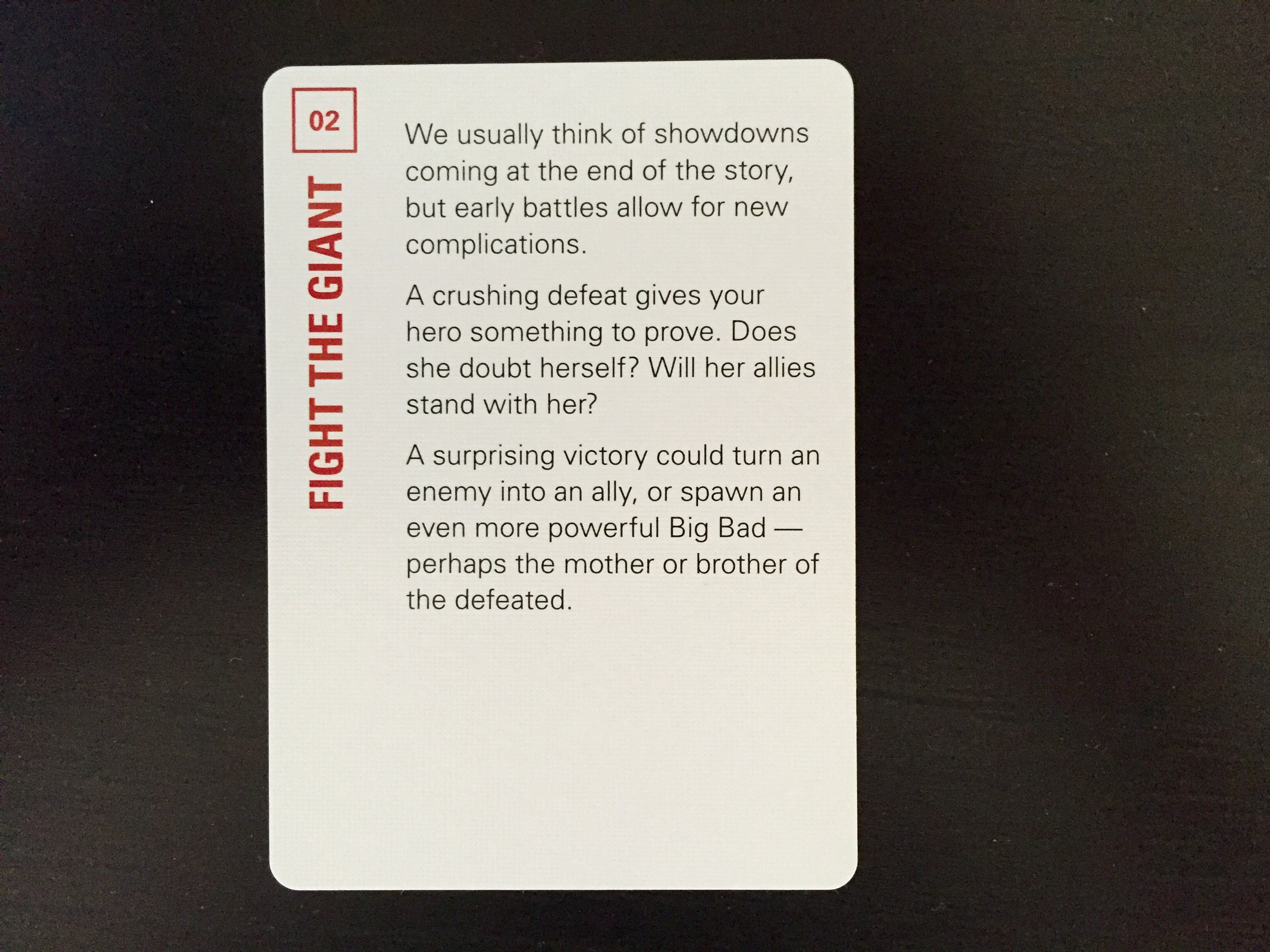
Fight the Giant, or Moving Up the Showdown

July 10, 2015 Story and Plot, Writer Emergency, Writer Emergency Pack

In most stories built around a heroic quest, the big confrontation comes at the end. The heroes face off against their well-established nemesis, and likely prevail. After that, there’s a little time left for wrap-up and rebuilding.

This is the common pattern for most feature films, with a battle or competition happening in the third act.

But it’s not just movies. In novels, the showdown generally happens in one of the final chapters. In series television, the quest to defeat the Big Bad might span a whole season, but the main event comes in the finale. In videogames, this stage even has a name: The Boss Level. The player finally has the skills and hit points to kill Diablo.

Whenever you see such a clear narrative pattern, there’s a great opportunity to subvert it.

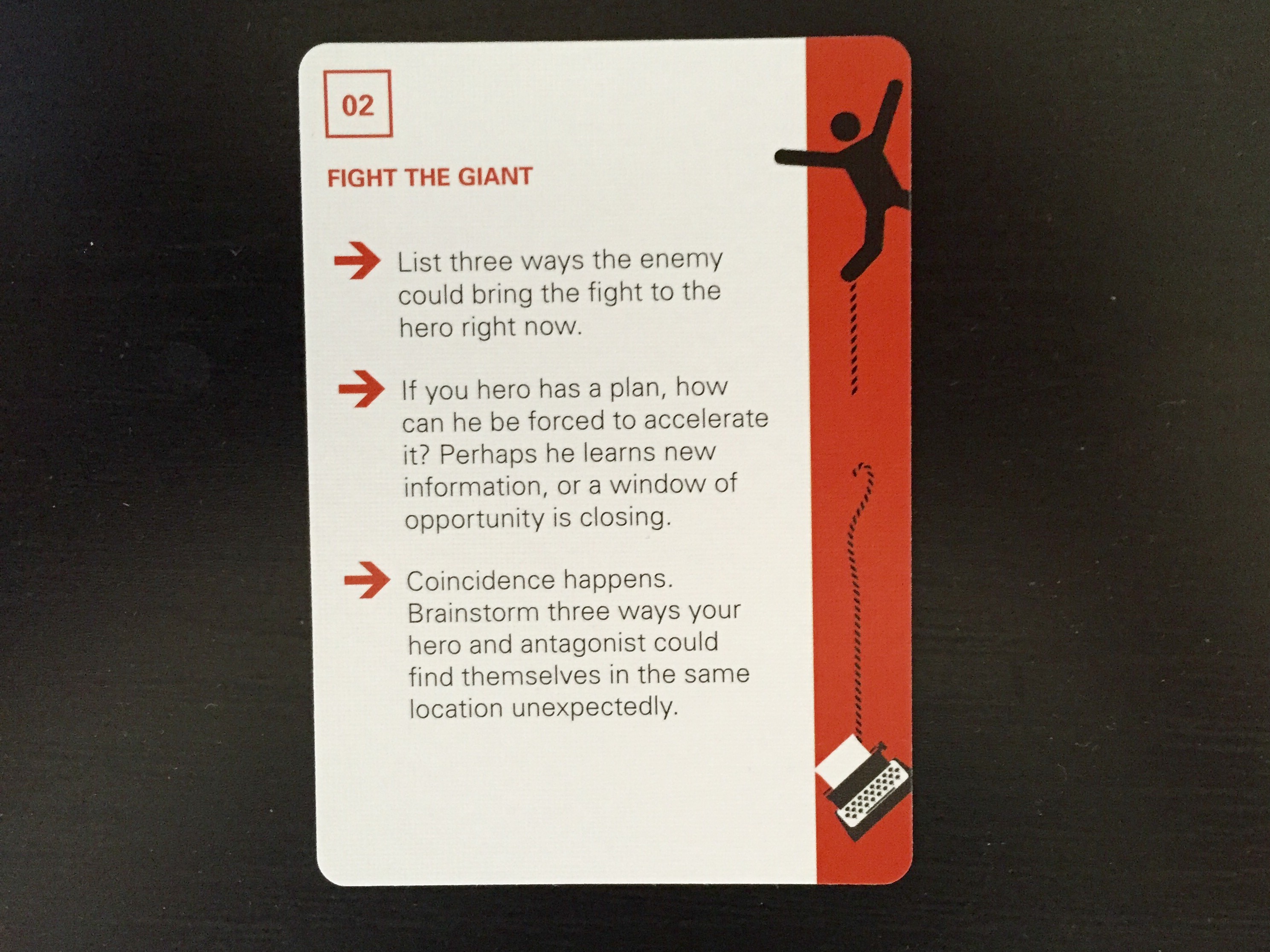
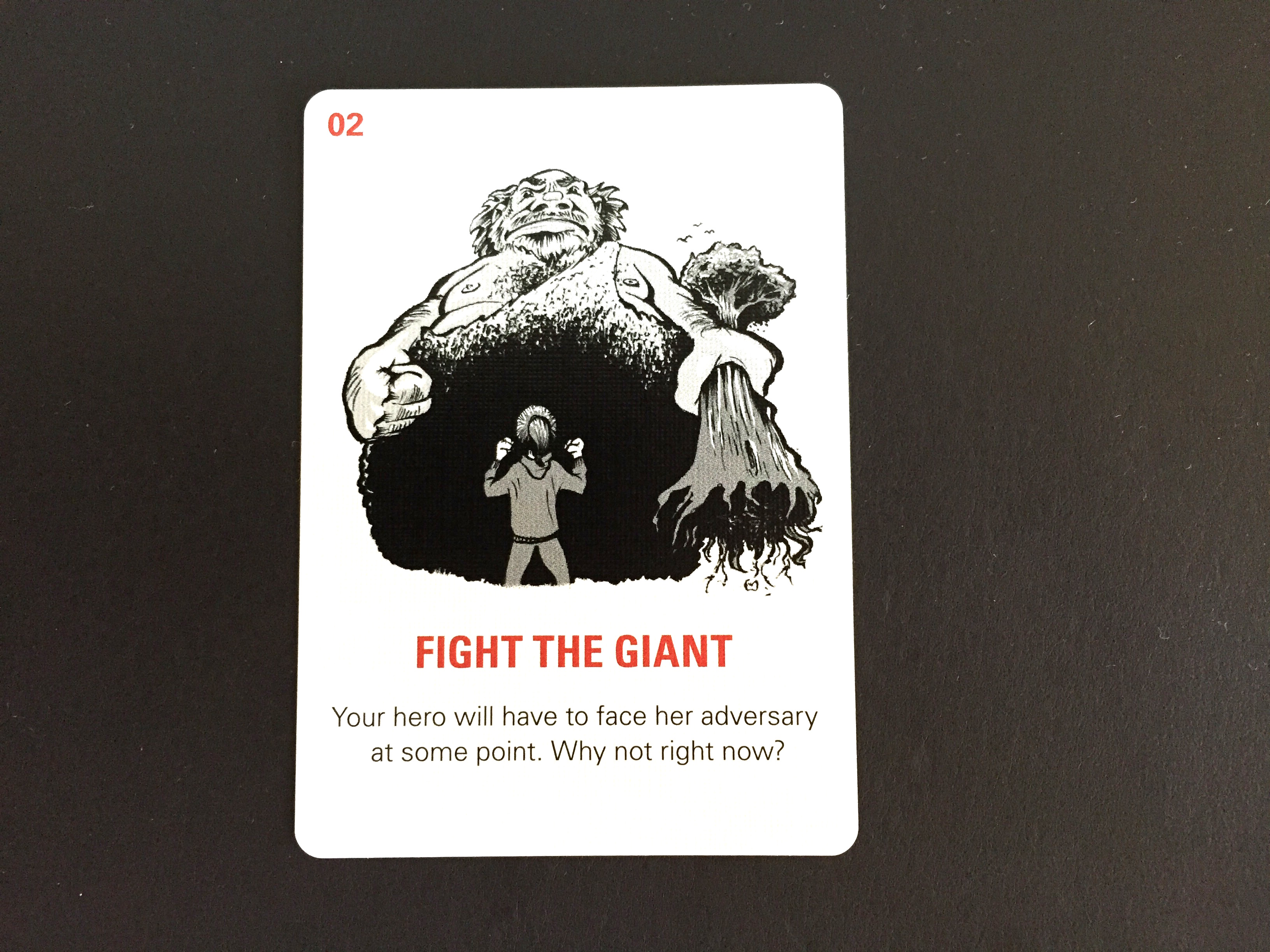
card

Moving the fight earlier can take both your reader and your hero by surprise.

card

There are three basic structures for getting the fight to happen earlier than expected.

The hero rushes in. Perhaps the hero gets a tip that the villain is momentarily exposed. She is forced to make a decision: go in fast or wait for the next opportunity. She decides to strike now, for better or worse. Without the benefit of time and planning, she is forced to improvise.

The villain surprises the hero. Rather than wait for the hero to show up, smart villains often attack first. In Harry Potter and the Goblet of Fire, J.K. Rowling lets Voldemort trap Harry so he can battle him face-to-face, breaking the expectation that the showdown would only happen at the very end. In the real world, the Japanese attack on Pearl Harbor is an example of the enemy changing the narrative with a surprise attack.

Fate intervenes. Some outside force — the boxing commission, an avalanche, pure coincidence — puts the hero and the villain in the same space when neither was quite ready for it.

However your hero and villain end up battling, the outcome should have a huge impact on the rest of your story.

Letting the giant score an early victory helps in several ways:

  1. You’ve established what a powerful threat the villain is.
  2. You’ve knocked your hero down. Almost anything that’s bad for your hero is good for your story.
  3. You’ve warned the reader not to assume your story will follow conventional patterns.

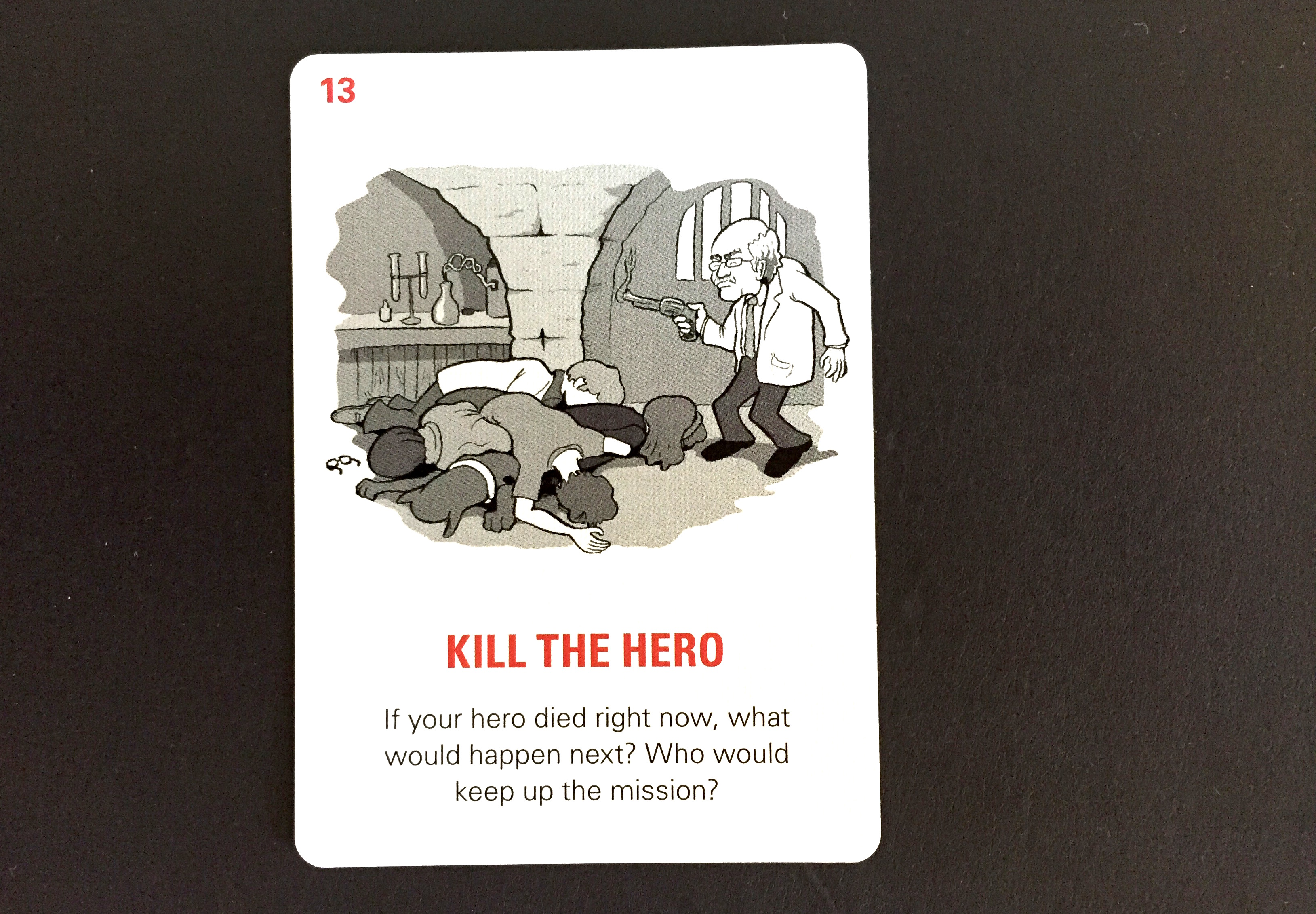
Maybe you’ve even decided to Kill The Hero:

card

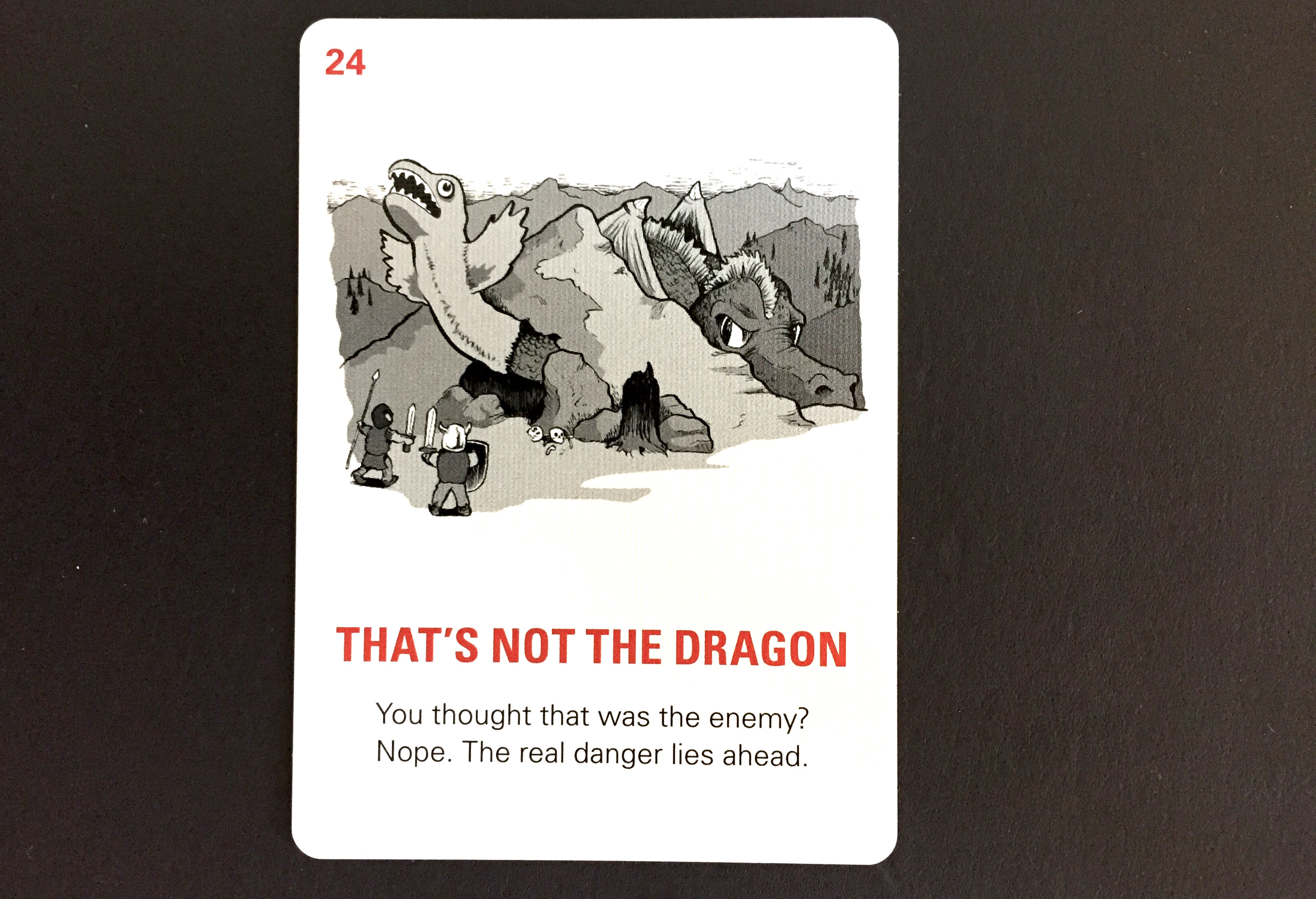
Sometimes, it’s fun to let your hero win this early battle. Maybe the presumed villain wasn’t the ultimate villain after all — or in killing him, the hero has unleashed something much worse. Perhaps That’s Not the Dragon:

card

In most cases, both hero and villain will survive this early brawl, but both will be changed by the encounter.

card

Using Fight the Giant

Like every card in Writer Emergency Pack, Fight the Giant can be used at both macro and micro levels of the story process.

Fight the Giant might be a key plot point on which your entire story hangs. Perhaps an unexpected, early defeat sends your hero’s allies packing, and he must now assemble and train a new army from the remnants.

On a sequence level, Fight the Giant is a great way to ratchet up the tension. Your hero had a plan for how this was supposed to go down, but the villain had a plan of her own. And she moved faster.

Finally, Fight the Giant can be a great focus in a single scene. Your cat-burglar hero was expecting three minutes notice when the villain would be returning to his penthouse, but suddenly he’s here in front of him.

No matter how you use Fight the Giant, make the most of its surprise factor. Catch your hero flat-footed, and keep your heroes on their toes.


Fight the Giant is Card 2 of 26 in Writer Emergency Pack, which you can find in the Store and on Amazon.

« Previous Page
Next Page »

Primary Sidebar

Newsletter

Inneresting Logo A Quote-Unquote Newsletter about Writing
Read Now

Explore

Projects

  • Aladdin (1)
  • Arlo Finch (27)
  • Big Fish (88)
  • Birdigo (2)
  • Charlie (39)
  • Charlie's Angels (16)
  • Chosen (2)
  • Corpse Bride (9)
  • Dead Projects (18)
  • Frankenweenie (10)
  • Go (29)
  • Karateka (4)
  • Monsterpocalypse (3)
  • One Hit Kill (6)
  • Ops (6)
  • Preacher (2)
  • Prince of Persia (13)
  • Shazam (6)
  • Snake People (6)
  • Tarzan (5)
  • The Nines (118)
  • The Remnants (12)
  • The Variant (22)

Apps

  • Bronson (14)
  • FDX Reader (11)
  • Fountain (32)
  • Highland (75)
  • Less IMDb (4)
  • Weekend Read (64)

Recommended Reading

  • First Person (87)
  • Geek Alert (151)
  • WGA (162)
  • Workspace (19)

Screenwriting Q&A

  • Adaptation (65)
  • Directors (90)
  • Education (49)
  • Film Industry (489)
  • Formatting (128)
  • Genres (89)
  • Glossary (6)
  • Pitches (29)
  • Producers (59)
  • Psych 101 (118)
  • Rights and Copyright (96)
  • So-Called Experts (47)
  • Story and Plot (170)
  • Television (165)
  • Treatments (21)
  • Words on the page (237)
  • Writing Process (177)

More screenwriting Q&A at screenwriting.io

© 2026 John August — All Rights Reserved.