• Skip to primary navigation
  • Skip to main content
  • Skip to primary sidebar

John August

  • Arlo Finch
  • Scriptnotes
  • Library
  • Store
  • About

John

Why does anyone still use Internet Explorer?

January 25, 2005 Geek Alert, Rant

One benefit of switching my new webhost, [TextDrive](http://textdrive.com), is that they have a much cooler statistics program called [Urchin](http://urchin.com). With it, I can see a lot of information about who’s visiting the site, and what articles they’re reading. Plus, I can learn what browsers they’re using. Here are the current percentages:


26% Internet Explorer
22% Firefox
 5% Safari
 3% Opera

(The numbers don’t add up to 100%, because I’m omitting RSS readers, robots and specialty browsers, such as those on mobile phones.)

I’m genuinely curious to find out why anyone is still using Internet Explorer, when there are much better options. [Firefox](http://www.mozilla.org) is available for both Windows and Mac, and is superior on just about every level. It’s faster; it blocks pop-ups; it offers modern tabbed browsing. It even automatically imports all your old bookmarks.

If you haven’t at least tried it, stop reading and [get it](http://www.mozilla.org).

One thing the official site doesn’t explain is that it actually makes web pages look much better. That’s because it properly supports modern standards like CSS and .png graphics. For instance, compare the brad icon in the upper left right corner:
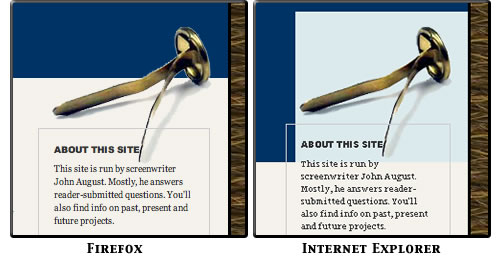
brad comparison

Currently website developers have two choices. They can make their sites compatible with published standards (and support Firefox, Safari and Opera), or they can support Internet Explorer. Increasingly, they’re simply giving up on Internet Explorer, which hasn’t been properly updated in a long time.

That’s what I’ve chosen to do. With a day or two of work, I could probably get johnaugust.com looking better with IE, but I’m convinced it’s not worth the bother.

Other interests and hobbies

December 30, 2004 First Person, QandA

Do you play guitar, or do some other type of hobby in order to get inspiration for your writing?

— Jesse Leal

I don’t play guitar, though I’ve always wanted to learn. I tried to teach myself on my father’s guitar, but never even mastered tuning it, which made the rest of the process painful to the ears.

I can read music, and play piano and clarinet on a grade-school level. But I wouldn’t say either of them inspire my writing. So, for the truly curious, here’s a quick run-down of John’s Other Interests:

* Gadgets [Treo 650](http://palmone.com)? Check. [TiVo](http://tivo.com)? Check. (Early Adopter points: I got my first digital video recorder in 1998.) [Toyota Prius](http://www.toyota.com/prius/)? Check. (We have two in the family.) [Wireless Weather Forecaster](http://www.radioshack.com/product.asp?cookie%5Ftest=1&catalog%5Fname=CTLG&category%5Fname=CTLG%5F010%5F001%5F001%5F000&product%5Fid=63%2D1085&hmsub=ad2)? Check.
* Languages
I like to travel, but my interest in languages is borderline obsessive; I spent six weeks learning Japanese in preparation for a 72-hour visit to Tokyo. I’ve spoken Spanish since grade school, and French since high school. I’m fascinated by the evolution of languages, particularly how English lost its Germanic declensions and re-imported so much of its vocabulary from French (which resulted in having both ‘regal’ and ‘royal’).
* Warcraft My name is John, and I have Warcraft problem. Kudos to the good folks at [Blizzard](http://blizzard.com) for their digital crack.
* Reality Television If I only watched The Amazing Race, no one would question my taste. But my TiVo also holds Big Brother, The Real World, and The Real World/Road Rules Challenge.
* Home improvement I’ve renovated two houses in four years, by which I mean telling a contractor what I wanted and blissfully ignoring the actual labor involved.
* Information architecture
Beyond the work I do designing and running this website, I also love to keep up on XML, RSS and other emerging standards.
* D.C. heroes I know there’s a lot of love out there for the Marvel pantheon, but I’ve always been a D.C. guy. Ever since I watched Superfriends as a kid, Superman and his brethren were my gods on Mount Olympus. I was never much of a comics reader, but somehow I learned all of the heroes’ mythology.

Are four scripts better than one?

December 17, 2004 Film Industry, QandA

questionmarkI have finished penning a dramatic quadrilogy (four scripts
that interlock) and now that I’m finished, I fear that
there isn’t enough action to make this a serious contender
for production and that it would not find an audience.

Do
you have any advice for making works a little more
commerically viable to today’s market?

— Christopher Bishop

First problem: “dramatic quadrilogy.”

I applaud your ambition, but the concept of four interlocking scripts feels better suited to European arthouses, rather than mainstream Hollywood. If the latter is your intention, I’d recommend figuring out which of your four scripts is the strongest, and focussing all your efforts on that one, even if it means ripping stuff out of your other scripts.

You’re much better off with one good screenplay than four noble intentions.

Dialogue versus exposition

December 16, 2004 QandA, Words on the page

What is a good way to distiguish good dialogue from exposition?

— Josh Hatfield

Dialogue:

FRANK

Let’s say we try to keep the dysfunction indoors, huh?

Exposition:

O’MALLEY

Thompson was a down-on-his-luck bookie who thought he could swindle Ackland out of the ticket profits. He wasn’t counting on Rickman having the same idea.

Always ask yourself: Would the character actually say this, or is he only saying it because you need the audience to know some fact or detail? If the answer is the latter, you’re writing exposition and not dialogue.

That’s not good.

At its worst, you risk “M Syndrome,” named for the James Bond boss whose sole function seems to be telling 007 all the backstory so he knows who to shoot. (This was parodied in the Austin Powers movies by Michael York’s character, Basil Exposition.)

Honestly, there are times when you really do need to have a character say something that’s purely plot. In certain genres, like police procedurals, exposition is pretty much par for the course. But to the degree possible, try to avoid situations where characters are spouting information.

Wherever possible:

1. Show the information, rather than having a character say it.
2. Try to follow a natural line of thought: A to B to C.
3. Simplify. The reader may not need to know everything.
4. Keep your hero active in learning the information, rather than passively listening.
5. Balance natural speech patterns with efficiency. People rarely say things as concisely as they could.

Avoiding exposition is hard, especially in plot-dependent stories. But it’s one of the first things a reader notices, so spend the time to deal with it.

« Previous Page
Next Page »

Primary Sidebar

Newsletter

Inneresting Logo A Quote-Unquote Newsletter about Writing
Read Now

Explore

Projects

  • Aladdin (1)
  • Arlo Finch (27)
  • Big Fish (88)
  • Birdigo (2)
  • Charlie (39)
  • Charlie's Angels (16)
  • Chosen (2)
  • Corpse Bride (9)
  • Dead Projects (18)
  • Frankenweenie (10)
  • Go (29)
  • Karateka (4)
  • Monsterpocalypse (3)
  • One Hit Kill (6)
  • Ops (6)
  • Preacher (2)
  • Prince of Persia (13)
  • Shazam (6)
  • Snake People (6)
  • Tarzan (5)
  • The Nines (118)
  • The Remnants (12)
  • The Variant (22)

Apps

  • Bronson (14)
  • FDX Reader (11)
  • Fountain (32)
  • Highland (75)
  • Less IMDb (4)
  • Weekend Read (64)

Recommended Reading

  • First Person (87)
  • Geek Alert (151)
  • WGA (162)
  • Workspace (19)

Screenwriting Q&A

  • Adaptation (65)
  • Directors (90)
  • Education (49)
  • Film Industry (489)
  • Formatting (128)
  • Genres (89)
  • Glossary (6)
  • Pitches (29)
  • Producers (59)
  • Psych 101 (118)
  • Rights and Copyright (96)
  • So-Called Experts (47)
  • Story and Plot (170)
  • Television (165)
  • Treatments (21)
  • Words on the page (237)
  • Writing Process (177)

More screenwriting Q&A at screenwriting.io

© 2026 John August — All Rights Reserved.