• Skip to primary navigation
  • Skip to main content
  • Skip to primary sidebar

John August

  • Arlo Finch
  • Scriptnotes
  • Library
  • Store
  • About

John

Bear spray is not stronger than pepper spray

January 24, 2019 Arlo Finch, Books, Words on the page

For the third [Arlo Finch](https://johnaugust.com/arlo-finch) book, I was considering having one character use bear spray on a non-bear adversary. Since the books take place in the mountains of Colorado, it was very believable that the character would have it handy.

I also assumed that bear spray is stronger than conventional self-defense pepper sprays because, well, bears.

But it turns out, [I was wrong](https://www.selfdefenseninja.com/bear-spray-vs-pepper-spray-whats-difference/):

> Although pepper spray and bear spray contain the same active chemical, they are not the same thing. Bear spray has a much lower concentration of oleoresin capsicum, and should only be used as a bear deterrent.

> Pepper spray is a self defense weapon intended to incapacitate human threats, and it is very effective at doing this due to its higher concentration of oleoresin capsicum. If you are serious about self defense, go purchase some pepper spray. If you are a hiker or camper in bear country, buy some bear spray.

What’s more, bear spray is designed to [put out a wide cloud](https://cottagelife.com/outdoors/whats-the-difference-between-bear-spray-and-pepper-spray/), filling the air with droplets, discouraging the bear from attacking. On the other hand, pepper spray is a targeted stream designed to incapacitate a person close to you. ((I really want “incapacitate” and “capiscum” (pepper) to have the same word origin, but it appears they’re not especially close.))

Bear spray isn’t designed to fend off humans, but one reason you might see people carrying it for self defense (in real life and in fiction) is that it’s legal in places where pepper spray isn’t. It just isn’t as effective.

You’ll have to wait until book three to see if and when oleoresin capsicum gets used.
Is it the show, or the venue?

January 22, 2019 Television

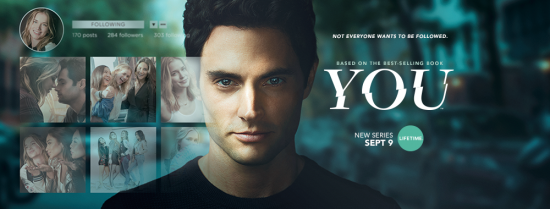
I remember seeing a billboard for a new TV show called “You” last fall. It was the first I’d heard of it, so I was basing my opinion strictly on the artwork.

you artwork

The title sounded like a romantic comedy, and it starred that guy from Gossip Girl. Yet the slashes through the typeface gave off a serial killer vibe. I then noticed that it was on Lifetime, and it all sort of clicked: maybe it was a romantic murder show.

My hunch was right; that’s basically what You is. I never watched it on Lifetime, and neither did anyone else. It tanked, with around 650,000 viewers per episode. They didn’t order a second season.

And then it [went to Netflix](https://www.nytimes.com/2019/01/21/business/media/netflix-you-ratings.html):

> Last week, Netflix declared “You” had drawn the sort of audience to make it a “huge hit.” The streaming service said that “You” was on track to be watched by 40 million households within its first four weeks on the service.

You can’t directly compare Netflix’s numbers to Nielsen ratings, but it’s not hard to gauge the cultural moment happening on social media. For most viewers, You is a Netflix show, just like Unbreakable Kimmy Schmidt and Queer Eye. And they dig it.

I think the bigger story is that for a lot of people, Netflix *is* television. They don’t think about channels and networks anymore. They just expect all of the shows to be available at every moment. The streamers make this possible, and Netflix is by far the biggest player.

While it’s good news for You, I wonder if it’s bad news for Us as creators. This feels like a tipping point where one outlet is so dominant that not being on its main screen is akin to invisibility, and not being in its catalog is a death sentence. I have friends working on great shows that no one notices because they’re on cable. As writers, we want the most venues possible for our work, and I don’t know how some of these networks are going to survive the transition to streaming.

Ultimately, I did watch the pilot for You, on Netflix. It’s really well done.

But does it spark joy?

January 16, 2019 Genres, Psych 101, Random Advice

Yesterday, I was talking with a colleague about a project I’m considering writing. It would be an adaptation of a very successful series I’ve long admired, and falls in a genre that’s comfortable to me. Even better, the studio really wants to make it, so it wouldn’t be pushing a boulder uphill.

But there are downsides that keep it from being a no-brainer.

Commensurate with its high profile, the property comes with a lot of strong voices and opinions. And it would be a tremendous time commitment, which would prevent me from working on some other long-simmering projects.

So, should I pursue it? My colleague asked a question inspired by Marie Kondo’s book and Netflix series:

“Does it spark joy?”

She sort of meant it as a joke, ((It reminds me of B.J. Novak’s short story “The Girl Who Gave Great Advice” in which the title character alternates between asking, “What does your heart tell you?” and “What does your gut tell you?”)) but it was exactly the right question. It clarified everything.

Some projects really do spark joy. You feel it from the first moment you start thinking about the idea. For me, these projects include Charlie’s Angels, Go, Big Fish, Charlie and the Chocolate Factory, plus an unannounced movie I just turned in.

Yes, they were all exhausting slogs at some point. Work is work. But when I compare them to other assignments with equivalent pay checks, the difference is stark.

So: does this new project spark joy?

Not really. It sparks curiosity and nostalgia. It would cool to work on it, and a very high-profile assignment. But if I didn’t get the job, I wouldn’t miss it. Which is exactly why I shouldn’t pursue it. The studio will find another writer who dreams about the chance to tackle that adaptation — or at least fakes it convincingly.

As a screenwriter, you often don’t have luxury of being so choosy. I went after a lot of projects for which I was faking that spark, especially at the beginning of my career. ((I have a folder in Dropbox with pitches for everything from Highlander to My Three Sons.)) As I talk about on the most recent Scriptnotes, there’s no shame in hustling to get work.

But it’s also important to recognize when you need to stop hustling. To stop hoarding. To let some things go.

How Can This Possibly End Well?

January 15, 2019 Directors, Story and Plot, Words on the page

Interviewed with other screenwriters for the New York Times, Christopher McQuarrie makes a great point about [action sequences](https://www.nytimes.com/2019/01/01/movies/gillian-flynn-john-krasinski-barry-jenkins-christopher-mcquarrie.html):

> The best action sequences are free of exposition, with stakes that are established in advance or, better still, self-evident. They don’t ask an audience to think, to process, to remember. Instead, they keep the audience’s collective subconscious focused entirely on one simple question.

> The question is not how will it end? If this mattered, there would be no Ethan Hunt, James Bond, Jason Bourne, John McClane, Indiana Jones, Buster Keaton, Harold Lloyd or Charlie Chaplin. We know they’ll come out on top in the end. We count on it. It is a contract, a sacred pact between filmmaker and audience.

> The only question that matters is, how can this possibly end well?

McQuarrie just signed on to make [two more Mission: Impossible movies](https://www.hollywoodreporter.com/heat-vision/christopher-mcquarrie-talks-direct-new-mission-impossible-movies-1176012). You can hear my interview with him about his transition from writer to writer-director in [Scriptnotes episode 300](http://johnaugust.com/2017/from-writer-to-writer-director).

« Previous Page
Next Page »

Primary Sidebar

Newsletter

Inneresting Logo A Quote-Unquote Newsletter about Writing
Read Now

Explore

Projects

  • Aladdin (1)
  • Arlo Finch (27)
  • Big Fish (88)
  • Birdigo (2)
  • Charlie (39)
  • Charlie's Angels (16)
  • Chosen (2)
  • Corpse Bride (9)
  • Dead Projects (18)
  • Frankenweenie (10)
  • Go (29)
  • Karateka (4)
  • Monsterpocalypse (3)
  • One Hit Kill (6)
  • Ops (6)
  • Preacher (2)
  • Prince of Persia (13)
  • Shazam (6)
  • Snake People (6)
  • Tarzan (5)
  • The Nines (118)
  • The Remnants (12)
  • The Variant (22)

Apps

  • Bronson (14)
  • FDX Reader (11)
  • Fountain (32)
  • Highland (74)
  • Less IMDb (4)
  • Weekend Read (64)

Recommended Reading

  • First Person (87)
  • Geek Alert (151)
  • WGA (162)
  • Workspace (19)

Screenwriting Q&A

  • Adaptation (65)
  • Directors (90)
  • Education (49)
  • Film Industry (489)
  • Formatting (128)
  • Genres (89)
  • Glossary (6)
  • Pitches (29)
  • Producers (59)
  • Psych 101 (118)
  • Rights and Copyright (96)
  • So-Called Experts (47)
  • Story and Plot (170)
  • Television (165)
  • Treatments (21)
  • Words on the page (237)
  • Writing Process (177)

More screenwriting Q&A at screenwriting.io

© 2026 John August — All Rights Reserved.