• Skip to primary navigation
  • Skip to main content
  • Skip to primary sidebar

John August

  • Arlo Finch
  • Scriptnotes
  • Library
  • Store
  • About

John

Read the first 30 pages of the Scriptnotes book

October 30, 2025 Scriptnotes Book

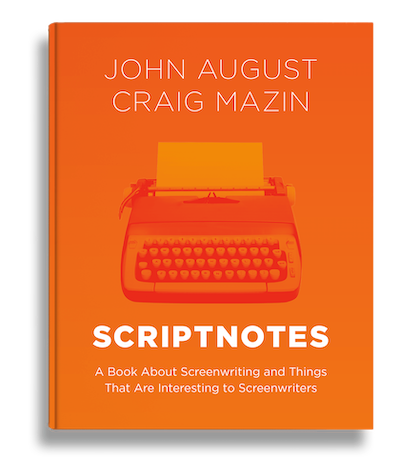
scriptnotes book coverScriptnotes Premium listener Martin Schneider wrote in with a great suggestion:

Gentlemen, as a person who is very conversant in publishing and speaking entirely figuratively, I WOULD KILL TO BE ABLE TO HOLD THAT GALLEY IN MY HANDS FOR THREE MINUTES. It would satisfy some curiosity in me, and it would also spark an interest in seeing the rest.

So then I went to the website you have set up for the book and I clicked on the “SAMPLE PAGES” tab and looked at the inside of your book.

No, of course I did NOT do that because your website has no such section. I think you should have such a section, it is a perfect analog for a movie trailer, to give people a glimpse of the contents of the book.

We’ve all been to Trader Joe’s and we all know that giving you a cracker with a tiny slice of cheese on it can act as a doorway to buying a full box. You should do the same thing.

Martin’s right! We should have put up pages, and now we have.

Head to scriptnotesbook.com to read the first 30 pages of the Scriptnotes book.

You’ll see the table of contents with all our chapters and special guest interviews. Then read Chapter 1: The Rules of Screenwriting and our First Person interview with Christopher Nolan.

Next, please preorder your own hardcover copy!

The Scriptnotes book comes out December 2, 2025. But the time to order it is now.

Preorders are essential for the success of this book. They signal to bookstores and libraries that they should actually stock copies of our book. Plus, they might land us on best-seller lists, which would be kinda remarkable for a book about screenwriting (and things that are interesting to screenwriters).

Once you’ve preordered your book, send Drew a copy of the receipt → ask@johnaugust.com.

Next week, we’ll be sending out a BONUS CHAPTER that didn’t make it into the book: “Getting Stuff Written.” But only to folks who have preordered the book.

We can’t wait for you to read the Scriptnotes book. Get started with the first 30 pages right now.

AFF 2025 – Three Page Challenge

October 24, 2025 News

For our live Three Page Challenge segment at the Austin Film Festival, we look at three entries submitted by attendees.

Download the PDFs here if you want to read along!

Tall Poppies by Becca Hurd

High North by Teddy Johnson

Ancient Grains by Michael Warnecke

Writing for microdramas, aka verticals

September 24, 2025 Film Industry, Follow Up, Los Angeles, Television

Over the last six months, we’ve discussed microdramas (aka verticals) several times on Scriptnotes. For readers who don’t know, microdramas are a format originating in Asia in which a filmed narrative is broken into very short episodes intended to be watched on your phone. They’re often called verticals because they’re shot to be watched on a phone held vertically.

Typically, the first few episodes are free, and then each subsequent episode requires an in-app purchase. The overwhelming majority of microdramas are romances, often feeling like a heightened soap opera.

They’ve recently hit American shores, with U.S. productions shooting in Los Angeles, largely using non-union crews. They have provided work for underemployed actors and crew members — particularly recent film school graduates — and have some experienced producers kicking the tires.

Here’s an example from the ReelShort series The Hidden Billionaire in First Class.

Note that the WGA contract does cover this type of work. Guild writers should not be working on these productions unless they’re under a Guild contract.

We asked listeners who have written on these productions to share their experiences. Several wrote in. Here are two examples.


Risky Business writes:

I spent six months writing for Reelshorts. As a writer, it was terrible.

The first 10 chapters were pored over with repeated rewrites until all the joy was taken out of them, then pretty much they didn’t care. The rest of the story had little oversight as they didn’t expect people to watch.

The CEO repeatedly criticized the writers in company wide messages, while giving 100% of the credit for successes to the editors.

All while paying $22 an hour, with ‘no work’ orders between feedback cycles, and a constant “your contract can be cancelled at any time” hanging over your head, and expectation that you’d be immediately available the second they had feedback, which sometimes took over a week to receive. It ended up being less than minimum wage to basically hold all the blame for a possible failure poured on you from the entire company.

Creative decisions were entirely made by algorithms based on what was selling. The whole prediction model that hollywood is always trying to master contracted by the short production schedule.

I have not had the pleasure of joining any union, but the success of reelshorts definitely scares me. If the model succeeds, AI will definitely be writing the scripts, and the CEO can have his dream of never having to rely on a writer’s creativity again


Another listener wrote in with their experience:

In episode 693, Risky Business shared about his negative experience writing for verticals. I recently started as a screenwriter for one of the larger vertical drama companies as well, and I wanted to offer my perspective since I’ve had a more positive experience.

My salary is about $1540 a week–about $40/hr–with benefits. My lawyer also negotiated that my agreement be non-exclusive, so I am free to keep developing and writing non-vertical projects. Since I’m staffed, I still get paid when I’m waiting for feedback.

For sure, figuring out the soapy, melodramatic tone and structure of verticals has been a tough nut to crack. Even though there’s some room for innovation and creativity, at their core verticals are reverse-engineered around data-driven formulas. It’s kind of like doing a fill-in-the-blanks puzzle. It can be fun and even playful, but it’s a very different process from anything else I’ve done.

Because writing verticals often feels more like solving a puzzle than writing from scratch, I usually have a lot of creative energy left over to keep working on my own projects. I’m also able to write remotely outside LA, which has been a godsend for family reasons.

As a non-WGA writer, I’d love to see verticals get WGA coverage. But at this point, especially with the current state of the industry, I’m grateful for a screenwriting gig that pays the bills while leaving space for my own stuff.


To clarify, verticals already do have WGA coverage. WGA writers shouldn’t be writing on them, just as they shouldn’t be writing any film and television that’s produced without a Guild contract.

Robert Redford, RIP

September 16, 2025 News

Robert Redford built a remarkable career as an actor and a director, but most industry folk would agree his greatest achievement was creating the Sundance Institute. That’s the organization he co-founded in 1981 which runs the annual Sundance Film Festival. It’s no hyperbole to say that Sundance transformed the American independent film landscape, bringing attention and prestige to films (and filmmakers) that might otherwise go unnoticed.

But while the festival is the public face of Sundance, I believe the less-seen work of the Sundance screenwriter and director labs is an equally important legacy. Under the direction of Michelle Satter and her team, the labs bring together seasoned advisors with emerging filmmakers to work on their next films. I’ve had the privilege of serving as a Sundance advisor since 2000.

Pre-pandemic, the labs happened on-site at Redford’s gorgeous Sundance Resort in Utah. If Redford wasn’t off shooting something, he’d come to morning meetings, listening and offering suggestions. That’s where I met him. Given our handful of interactions, I can’t say I have any particular insight about him, but I greatly admired how he was able to build an organization that operated so well without his direct supervision. He chose great people and let them do great work. It’s a lesson more founders could learn.

I was sad to hear of Redford’s passing today, but I have no worries about its impact on the remarkable institution he envisioned. That’s a legacy to admire — not just what you accomplish in your life, but the good work that can continue long after you’re gone. May he rest in peace.

« Previous Page
Next Page »

Primary Sidebar

Newsletter

Inneresting Logo A Quote-Unquote Newsletter about Writing
Read Now

Explore

Projects

  • Aladdin (1)
  • Arlo Finch (27)
  • Big Fish (88)
  • Birdigo (2)
  • Charlie (39)
  • Charlie's Angels (16)
  • Chosen (2)
  • Corpse Bride (9)
  • Dead Projects (18)
  • Frankenweenie (10)
  • Go (29)
  • Karateka (4)
  • Monsterpocalypse (3)
  • One Hit Kill (6)
  • Ops (6)
  • Preacher (2)
  • Prince of Persia (13)
  • Shazam (6)
  • Snake People (6)
  • Tarzan (5)
  • The Nines (118)
  • The Remnants (12)
  • The Variant (22)

Apps

  • Bronson (14)
  • FDX Reader (11)
  • Fountain (32)
  • Highland (74)
  • Less IMDb (4)
  • Weekend Read (64)

Recommended Reading

  • First Person (87)
  • Geek Alert (151)
  • WGA (162)
  • Workspace (19)

Screenwriting Q&A

  • Adaptation (65)
  • Directors (90)
  • Education (49)
  • Film Industry (489)
  • Formatting (128)
  • Genres (89)
  • Glossary (6)
  • Pitches (29)
  • Producers (59)
  • Psych 101 (118)
  • Rights and Copyright (96)
  • So-Called Experts (47)
  • Story and Plot (170)
  • Television (165)
  • Treatments (21)
  • Words on the page (237)
  • Writing Process (177)

More screenwriting Q&A at screenwriting.io

© 2026 John August — All Rights Reserved.