• Skip to primary navigation
  • Skip to main content
  • Skip to primary sidebar

John August

  • Arlo Finch
  • Scriptnotes
  • Library
  • Store
  • About

John

Pronunciation jokes

August 8, 2011 Television, Words on the page

In Crazy, Stupid, Love there’s a running joke where the characters keep mispronouncing Kevin Bacon’s character’s last name (Lindhagen). There’s a similar kind of joke in The Hangover where Zach Galifianakis’s character puts the emphasis on the wrong syllable of a naughty word. On film these jokes are extremely funny, but these seem like the kind of jokes that wouldn’t work as well on paper. So my question is two fold:

1. Do you think these types of jokes would be effective on the page? (aka “Should I even bother?”)

2. If so, any thoughts on how best to write something like this? Use accents and junk in dialogue, use a parenthetical, or cue in the reader in an action line?

— Nima
New York, NY

Pronunciation jokes have a tendency to feel cheap and hoary. But when they work, they work — and it’s easy enough to show them on the page.

MARY

(checking form)

Are you Mr. Donaldson?

MAN IN COAT

Doe. Nald. Sohn.

MARY

Excuse me?

MAN IN COAT

The o’s are long.

MARY

Oh.

MAN IN COAT

Yes. Not ‘uh.’ There is no schwa.

MARY

Doughnaldsone.

MAN IN COAT

Three syllables. Doe.

MARY

Doe. A deer.

MAN IN COAT

(unamused)

Nald.

MARY

Nald.

MAN IN COAT

Sohn.

MARY

Sohn. Doe-Nald-Sohn.

MAN IN COAT

Close enough.

Back to her form. A beat.

MARY

Mr. Doe-Nald-Sohn, I’m sorry to tell you your dog is dead.

Frankly, without more context my example feels like a [clam](http://www.janeespenson.com/archives/00000338.php) — a joke that’s become musty through over-use.

But I can imagine scenarios in which its familiarity would actually work in its favor. [Archer](http://www.fxnetworks.com/shows/originals/archer/) could probably weave in this kind of joke simply because of the heightened-deadpan nature of the show. And in the context of a dramedy, the setup is flat enough that it doesn’t really feel like a joke is coming, so the punchline is genuinely a surprise.
Symphonies and screenplays

August 5, 2011 Story and Plot

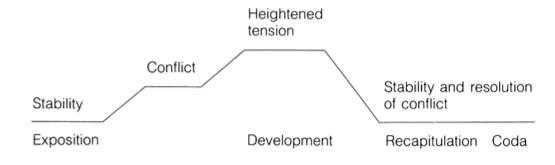
Roger Kamien’s description of the sonata form, a building block of the classical symphony, will seem familiar to screenwriters:

> The amazing durability and vitality of sonata form result from its capacity for drama. The form moves from a stable situation toward conflict (in the exposition), to heightened tension (in the development), and then back to stability and resolution of conflict. The following illustration shows an outline:

This line of rising action is also the basis of modern screenplay structure.

No matter how you dress it up with templates and turning points, most movies work this way: you meet your players and themes, set them against each other, let things get rough, then find a new normal.

> Sonata form is exceptionally flexible and subject to endless variation. It is not a rigid mold into which musical ideas are poured. Rather, it may be viewed as a set of principles that serve to shape and unify contrasts of theme and key.

With its long arcs and built-in act breaks, I’d argue that TV writing is even more symphonically-structured than features. Showrunners are our composers; Hollywood is our Vienna.

(I’m reading Kamien’s book on [Inkling](https://www.inkling.com/store/music-roger-kamien-7th/) for iPad, which is a remarkably good way to handle a textbook about music. The built-in tracks and listening outlines are ingenious. The chapter on classical music is currently free, and highly recommended.)

The two kinds of endings

August 2, 2011 Indie, Story and Plot

In [The Art of Fiction](http://www.amazon.com/Art-Fiction-Notes-Craft-Writers/dp/0679734031), John Gardner makes an interesting point about endings:

>[Stories] can end in only one of two ways: in resolution, when no further event can take place (the murderer has been caught and hanged, the diamond has been found and restored to its owner, the elusive lady has been capture and married), or in logical exhaustion, our recognition that we’ve reached the stage of infinite repetition; more events might follow, perhaps from now till Kingdom Come, but they will all express the same thing–for example, the character’s entrapment in empty ritual or some consistently wrong response to the pressures of his environment.

> Resolution is of course the classical and usually more satisfying conclusion; logical exhaustion satisfies us intellectually but often not emotionally, since it’s more pleasing to see things definitely achieved or thwarted than to be shown why they can never be either achieved or thwarted.

Observed: very few Hollywood movies take the logical exhaustion route, but you find it all the time in indies and foreign films.

/via [Susan Wise Bauer](http://books.google.com/books?id=7T-1jnYgIWUC&pg=PA79&lpg=PA79&dq=logical+exhaustion+well+educated+mind+Bauer&source=bl&ots=Ym29VX-nHL&sig=Wau7gV-KQ2PfnTVn-i7l_58w714&hl=en&ei=vEU4TpaACcPTgQfLyvSEAg&sa=X&oi=book_result&ct=result&resnum=1&ved=0CCsQ6AEwAA#v=onepage&q&f=false)

R-rated comedies to the rescue

July 28, 2011 Film Industry, Genres

Pamela McClintock points out that this summer, R-rated comedies edged out the usually dominant [superhero genre](http://www.hollywoodreporter.com/news/box-office-shocker-r-rated-215730):

> Combined, the summer’s five R-rated comedies have grossed $1.05 billion to date, an astounding total for a genre of movies that was considered second-rate only a few years ago.

> That number is slightly ahead of the $1.01 billion earned so far by the usual parade of summer superhero pics — Thor, X-Men: First Class, Green Lantern and Captain America: The First Avenger.

True, she’s comparing the totals of five movies against four, but the comedies also cost much less than their superhero brethren. And the usual knock against American comedies — that they don’t travel well overseas — appears to be lessening:

> Bad Teacher and Bridesmaids also are doing well overseas, grossing $71 million and $70.4 million to date (both are still rolling out). Likewise, Horrible Bosses got off to a strong start at the international box office over the weekend of July 22-24, grossing $3.4 million in the U.K.

Now if we can just get some big hit dramas.

« Previous Page
Next Page »

Primary Sidebar

Newsletter

Inneresting Logo A Quote-Unquote Newsletter about Writing
Read Now

Explore

Projects

  • Aladdin (1)
  • Arlo Finch (27)
  • Big Fish (88)
  • Birdigo (2)
  • Charlie (39)
  • Charlie's Angels (16)
  • Chosen (2)
  • Corpse Bride (9)
  • Dead Projects (18)
  • Frankenweenie (10)
  • Go (29)
  • Karateka (4)
  • Monsterpocalypse (3)
  • One Hit Kill (6)
  • Ops (6)
  • Preacher (2)
  • Prince of Persia (13)
  • Shazam (6)
  • Snake People (6)
  • Tarzan (5)
  • The Nines (118)
  • The Remnants (12)
  • The Variant (22)

Apps

  • Bronson (14)
  • FDX Reader (11)
  • Fountain (32)
  • Highland (75)
  • Less IMDb (4)
  • Weekend Read (64)

Recommended Reading

  • First Person (87)
  • Geek Alert (151)
  • WGA (162)
  • Workspace (19)

Screenwriting Q&A

  • Adaptation (65)
  • Directors (90)
  • Education (49)
  • Film Industry (489)
  • Formatting (128)
  • Genres (89)
  • Glossary (6)
  • Pitches (29)
  • Producers (59)
  • Psych 101 (118)
  • Rights and Copyright (96)
  • So-Called Experts (47)
  • Story and Plot (170)
  • Television (165)
  • Treatments (21)
  • Words on the page (237)
  • Writing Process (177)

More screenwriting Q&A at screenwriting.io

© 2026 John August — All Rights Reserved.