• Skip to primary navigation
  • Skip to main content
  • Skip to primary sidebar

John August

  • Arlo Finch
  • Scriptnotes
  • Library
  • Store
  • About

Archives for 2011

Born on the Fourth of The Nines

May 11, 2011 QandA, The Nines

questionmarkIn The Nines, was there a particular reason you chose to make Dahlia and Gavin’s birthday the same, November 21st?

— Guarionex
Florida

answer iconIf you look through the screenplay of The Nines in the [Library](http://johnaugust.com/library), you’ll see that many scenes in the second section of the movie are basically unscripted.

Here’s that scene as written (italics in original):

INT. SUSINA COFFEESHOP – DAY

Gavin meets with Dahlia Salem. She’s pretty, funny, and very cool.

They talk about the other pilot (Gatin’s), the role, and how fucked up it is to be having these double-top-secret conversations. It goes well. They seem to genuinely like each other.

When filming these scenes, I was beside the camera as it was rolling, telling the actors what to talk about. I told Dahlia that she and Gavin had the same birthday, and she went with it. (In fact, she misunderstood at first, and assumed that she and Ryan Reynolds had the same birthday.) Ultimately, it didn’t really matter what they were talking about, just that they were talking and seemed to click.

All of Part Two was shot essentially this way. Even in scenes with traditional dialogue, I would “wind the clock back” a minute and have the actors talking about something else, eventually getting to the text of the scene.

The conceit of this section is that it’s a half hour episode of a reality TV show, so I needed lots of little pieces to suggest the conversations have been stitched together in editing. Non-scene conversation got the right rhythms goings.

Part Two was the last section we shot, and by far the most fun. It was like real-time writing. A lot of things that came up in the moment could easily be incorporated; I’d say something, then have Ryan say it. Melissa McCarthy talks about buying a house because just that day she bought a house.

The Nines was a very special case, and the only time I’ve done it. I wouldn’t suggest trying such non-writing in your own scripts unless there’s a particularly good reason for it.
Write the way you speak

May 6, 2011 Psych 101, Words on the page

As he loses his voice to cancer, Christopher Hitchens writes about the idea of [literary voice](http://www.vanityfair.com/culture/features/2011/06/christopher-hitchens-unspoken-truths-201106?currentPage=1):

> To my writing classes I used later to open by saying that anybody who could talk could also write. Having cheered them up with this easy-to-grasp ladder, I then replaced it with a a huge and loathsome snake: “How many people in this class can talk? I mean, really talk?” That had its duly woeful effect.

> I told them to read every composition aloud, preferably to a trusted friend. The rules are much the same: Avoid stock expressions (like the plague, as William Safire used to say) and repetitions. Don’t say that as a boy your grandmother used to read to you, unless at that stage of her life she really *was* a boy, in which case you have probably thrown away a better intro. If something is worth hearing or listening to, it’s very probably worth reading. So, this above all: Find your own *voice.*

College was the first time I started writing how I speak.

Or, more accurately, college was when I stopped trying to write the way I thought I *should* write. Whether through explicit instruction (topic sentences, Roman outlines) or imitative insecurity (we all had a Hemingway phase), any unique quality in my prose had been flattened. The occasional quirks were mostly borrowed from Spy magazine, whose pithy precision I worshipped without really understanding.

A freshman year newswriting class probably changed me more than anything. J54 taught us how to align fact-bearing sentences in a deliberate pyramid structure so that the story could be truncated at any point without losing its meaning.

We learned the rules. We wrote the articles. The process was almost automated; given the same facts, any two news writers should generate very much the same story.

I hated it. I revolted. Why should I waste my time writing something anyone else could have churned out?

Writing isn’t harder than speaking, but it’s lonelier. It’s a conversation with someone who isn’t there.

When you’re writing, you end up hearing your own voice a lot. I think that’s why so many people struggle with it. We don’t like to be alone with our thoughts. They scare us. But in the same way people don’t stutter when talking to a dog, it helps to envision a friendly reader at the far side. Let writing be talking with someone you like.

Staying indie after getting big

May 2, 2011 Film Industry, Indie, Talk

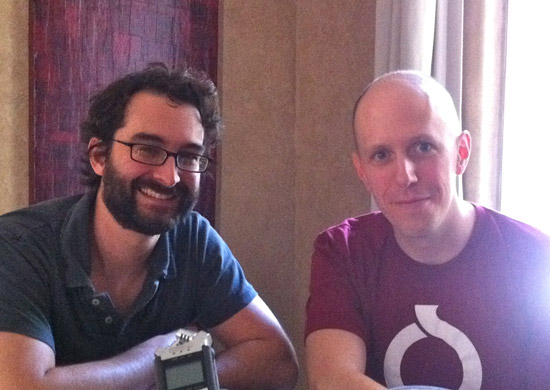
Jay Duplass and John August Prompted by a recent [post about Kickstarter](http://johnaugust.com/2011/raising-movie-funds-on-kickstarter), writer/director Jay Duplass (The Puffy Chair, Baghead, Cyrus) emailed me about an indie documentary he’s putting together through the crowdfunding site.

His email suggested a larger discussion about why filmmakers continue to pursue indie projects after they’ve found studio success. I certainly do it, with both The Nines and The Remnants, along with other experiments like The Variant.

None of them are a good use of time, at least in a monetary sense.

I’d make more money simply writing more screenplays. If I want to direct something, it should be a studio feature. My agent tells me this. It’s his job to tell me this.

And yet Jay and I still find ourselves drawn towards the little, difficult, uncategorizable things. Is it boredom? Fear of failure? The appeal of new frontiers? A desire to reclaim our scrappy youth?

Rather than keep the conversation between us, I suggested to Jay that we record it. He was game, so he came by the office today.

This is our half-hour conversation, un-edited:

https://johnaugust.com/wp-content/uploads/2011/05/jay_duplass_john_august_kickstarter.mp3

Some links to things we mention:

* [Jay’s documentary Kevin, on Kickstarter](http://www.kickstarter.com/projects/2035579744/kevin)
* [Jay’s credits](http://www.imdb.com/name/nm0243231/)
* [The Remnants](http://vimeo.com/2755105)
* [Topspin](http://www.topspinmedia.com/)
* [A Thousand True Fans](http://www.kk.org/thetechnium/archives/2008/03/1000_true_fans.php)
* [Lena Dunham’s Tiny Furniture](http://tinyfurniture.com/)

Runtime is 30 minutes. You can also download this as [an MP3](http://johnaugust.com/Assets/jay_duplass_john_august_kickstarter.mp3).

My thanks to Jay. Check out his doc.

Can my script be as short as Somewhere?

April 23, 2011 Film Industry, QandA, Words on the page

questionmarkA few months ago, I downloaded the PDF version of Sofia Coppola’s “Somewhere” screenplay from the Focus Features website. When I saw that it was only a 44 page download, I had assumed that it was either a teaser or a short version of the script.

An hour later after reading it, and then going to the theater, I had realized that the 44-pager that I had downloaded was indeed the real thing. Even now, after owning the DVD, I’m amazed that she managed to turn a 43-44 page script into a 97 min movie.

As a screenwriter, with no aspirations of getting behind the camera, how hard is it, or would it be to sell a spec script, that could possibly be a 100-110 min movie, but only a 65-70 page script? Understanding that execution is key, is it even possible to get your screenplay looked at, with it being so short?

— Craig
DC

answer iconNo one would take you seriously.

With Somewhere, Sofia Coppola had already made three well-received and languorously-paced features. So a producer or studio can read her very short script with the expectation that (a) not very much will happen, and (b) what does happen will take a while. So 44 pages feels less crazy than it otherwise would.

Coppola has her style and her fans. I’m one of them. But without her credits, there’s no way that the Somewhere script would make sense in a spec situation. You have to understand her as a filmmaker when reading it.

Almost all feature scripts are over 100 pages. ((Animation is often shorter; Corpse Bride is 67 pages.)) The only live-action screenplay I ever turned in that was shorter was the rewrite of a yet-unproduced fable with giant set pieces. It was 91 pages, but if/when it gets made, I think it will still be a nearly two-hour movie. Describing those set pieces in the script took a lot less page length than the corresponding time in the movie. (e.g. Gone with the Wind: “Atlanta burns.”)

« Previous Page
Next Page »

Primary Sidebar

Newsletter

Inneresting Logo A Quote-Unquote Newsletter about Writing
Read Now

Explore

Projects

  • Aladdin (1)
  • Arlo Finch (27)
  • Big Fish (88)
  • Birdigo (2)
  • Charlie (39)
  • Charlie's Angels (16)
  • Chosen (2)
  • Corpse Bride (9)
  • Dead Projects (18)
  • Frankenweenie (10)
  • Go (29)
  • Karateka (4)
  • Monsterpocalypse (3)
  • One Hit Kill (6)
  • Ops (6)
  • Preacher (2)
  • Prince of Persia (13)
  • Shazam (6)
  • Snake People (6)
  • Tarzan (5)
  • The Nines (118)
  • The Remnants (12)
  • The Variant (22)

Apps

  • Bronson (14)
  • FDX Reader (11)
  • Fountain (32)
  • Highland (73)
  • Less IMDb (4)
  • Weekend Read (64)

Recommended Reading

  • First Person (87)
  • Geek Alert (151)
  • WGA (162)
  • Workspace (19)

Screenwriting Q&A

  • Adaptation (65)
  • Directors (90)
  • Education (49)
  • Film Industry (489)
  • Formatting (128)
  • Genres (89)
  • Glossary (6)
  • Pitches (29)
  • Producers (59)
  • Psych 101 (118)
  • Rights and Copyright (96)
  • So-Called Experts (47)
  • Story and Plot (170)
  • Television (165)
  • Treatments (21)
  • Words on the page (237)
  • Writing Process (177)

More screenwriting Q&A at screenwriting.io

© 2026 John August — All Rights Reserved.