• Skip to primary navigation
  • Skip to main content
  • Skip to primary sidebar

John August

  • Arlo Finch
  • Scriptnotes
  • Library
  • Store
  • About

Archives for 2011

Oh, they’ll remember his name

August 15, 2011 Film Industry, News

There are better ways to [attract agency attention](http://latimesblogs.latimes.com/lanow/2011/08/script-left-for-talent-agents-is-instead-blown-up-by-cops.html):

> Beverly Hills police responded shortly after 9 a.m to an office building in the 400 block of North Camden Avenue after an unidentified man brought a locked briefcase to a talent agency with the hope that someone in the office would review the script inside.

Nearby offices were evacuated. The briefcase was blown up by the bomb squad, with the man’s laptop and script inside.

No word on whether the agency plans on representing the writer but yeah there’s no way. Don’t do this. Stunts often backfire.

Ye Olde Shoppe never existed

August 15, 2011 Words

That quaint “yee” was actually pronounced “the.” The confusion with the “y” sound began because Medieval scribes had to make some [difficult choices](http://www.bbc.co.uk/dna/h2g2/A2922077):

> Medieval English thus contained a variety of signs for the sound ‘th’ – the digraph ‘TH’, the thorn, and the eth (or thok). Scribes ended up using a mixture of these, although some tried to make a distinction between those used for a voiced ‘th’ sound and the signs used for a voiceless ‘th’. As a result, reading medieval texts today can be enormously confusing. Is that a ‘y’? Is it a ‘p’? Or a ‘th’? The problem is compounded by the inclusion of yet another runic sign which made it into Medieval English – the wen, a symbol that looks very like a thorn, except that the triangular portion sits even higher, giving it a strong look of an angular ‘p’.

The thorn symbol persists in UTF-8 character sets – Þ – but was lacking in early typesetting.

> There was no thorn sign in the printing fonts, as they were usually cast outside of England. So, since the sign for thorn slightly resembled the lower-case ‘y’, that’s what was substituted.

In screenwriting, you’re always balancing accuracy with expectation. Thus, the warriors of Sparta speak English with British accents — because anything else would feel strange to the audience.

But in portraying your characters’ world, you have wide latitude. If you’re writing a broad comedy set in Medieval times, go ahead and ye it up. Put it Zapf Chancery if it helps sell the joke.

But in more serious films, I’d love to see written English portrayed more as it would have been in the time. That is, really odd to modern eyes, filled with runic characters and odd constructions.

(Link from the BBC via [Andy Baio](https://twitter.com/waxpancake/status/103166642791522304) via [Phil Nelson](https://twitter.com/#!/philnelson).)

From pixel-pusher to TV writer

August 12, 2011 First Person

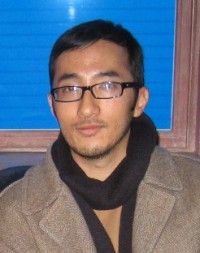
Kiyong Kim spent ten years working a day job as a web designer while he wrote and made short films on the side. Things came into focus for him when a friend of a friend got into the Nickelodeon Writing Fellowship.

You can read more from Kiyong on his [blog](http://kiyong.wordpress.com/).

————–

first person

I didn’t major in screenwriting. I didn’t go to film school. I went to art school in Boston and studied illustration. I can draw you a picture of the zero connections I had to the entertainment industry.

Despite that, I wanted to be a writer.

I had written short stories in high school, and in college I learned what a screenplay is. I read some books on the subject, and then wrote my first script, Brobot, which I submitted to the Slamdance Screenwriting Competition. It came in 4th. This was before they had a separate short script competition, so my short beat out feature scripts, and got me some attention from managers and producers. I completely squandered that opportunity because I had nothing else to show, but it gave me the confidence I needed to take this whole writing thing seriously.

Trying to write while having a day job
———

Even though I wanted to be a writer, I had a full time job as a web designer. It’s really depressing to be good at something you don’t like. Had I known better, I would have started out as a PA and tried to get a job as a writer’s assistant. Instead, I paid the bills by pushing pixels around in Photoshop, and wrote on nights and weekends.

I was very disciplined with my writing and made a lot of sacrifices to hone my skills. I took jobs that paid less but had better hours, had more flexible vacation days, were closer to my house, or had any other factor that would give me more time to write. I would write during lunch breaks, and save up my vacation time to work on scripts. I also wanted to become familiar with the production process, so I took classes in directing, editing, and animation.

While I spent all this time writing, I was painfully aware of the opportunity cost of what I wasn’t doing. But I kept at it, because my shorts would get into festivals, or my scripts would place in contests. I had to continue.

Then one day, a friend of a friend got into the [Nickelodeon Writing Fellowship](http://www.nickwriting.com/). I knew the odds were ridiculous—less than 1 in a 1000—but actually knowing someone who succeeded made it seem within the realm of possibility. I decided to apply.

Rocky, I & II
——-

In order to apply to the writing programs, you need a television spec script. I had written several shorts and a couple features, but never a spec. So I read some books on TV writing, and wrote an episode of The Office.

In the fall, I heard I was a semifinalist for the Nick Fellowship. I had a phone interview, an in-person interview, and ended up as one of four finalists. That brought three days of interviews with executives, writers, and show creators.

Only three fellows were chosen that year, and I was the only finalist who did not make it. I had gotten too nervous in some of the interviews. During those interviews, they don’t even look at your writing; they look at your personality, and at how well you sell yourself. I was horrible at selling myself; writing ability alone isn’t enough.

When Rocky fought Apollo Creed the first time he didn’t win, but he didn’t lose either. Just getting to that point was a personal victory for me. It was validation that I was on the right track, and that all of the hours spent writing hadn’t been a complete waste. If I could have another shot, I could make it.

Cue the music for a Rocky training sequence.

I immediately went to work on another spec, this time for 30 Rock, and applied again. I took an improv class, a TV writing class, and made another short. That fall, I was a semifinalist again. I was prepared for all those interviews this time.

In Rocky II, (spoiler alert) Rocky wins. I made it into the Fellowship.

Hello, Fellow
——-

The Nickelodeon Writing Fellowship is a full-time, paid program. We started out writing new specs as well as rewriting our application specs. We usually have six weeks to write a script, which includes researching a show, pitching premises, outlining, and doing multiple drafts, and we’re usually working on several scripts at once.

I was used to writing in short bursts at nights and on weekends, not for eight hours a day, and I used to write scripts leisurely over the course of several months, not in six weeks. My writing muscles were quickly whipped into shape.

After writing several specs for network shows, each of us was given the opportunity work with the EIC (Executive in Charge) and write a spec of a Nickelodeon show. I got the new animated show Robot & Monster, which hasn’t aired yet, and has no finished episodes to watch and study. I had seen some of the character art and was given the show bible and a bunch of scripts, but I didn’t know how the characters would look or sound, or what the show’s timing and rhythm would be like. It was a challenge, but the EIC provided guidance along the way.

Besides just paying us to write, the Fellowship opens doors by setting up meetings with people at the studio, including current and development execs, line producers, coordinators, writers, and Fellowship alumni. We’re working on more specs as well as a pilot, and I’m about to sit in on the writers’ rooms for Robot & Monster.

Ideally, I would love to get staffed on a Nickelodeon show before the Fellowship ends, and then at some point, I’d like to put my art school education to use and pitch my own animated show. We’re halfway done with the Fellowship, and it has already been a life changing experience.

Formatting notes in a screenplay

August 11, 2011 Formatting, QandA, The Nines

questionmarkI’ve searched through The Hollywood Standard and most of your site’s scripts, and nothing pings for “WRITER’S NOTE.” Does that mean they don’t really exist or should never be used?

If they can be used, what would you suggest as a way to format instances where the screenwriter wants to stop and point something out that helps the readers read? Even saying that makes it sound like you shouldn’t do it, but I swear I’ve seen them used before…even though I can’t find any examples now.

— Steve Maddern

answer iconIn most cases, you can handle things like this in scene description. For example, if you have a recall of a character we haven’t seen in a long time:
Durban’s massive Henchman -- the same one we saw in the opening sequence -- emerges from wreckage, cut and bruised but somehow still alive.

Or to describe how a sequence is meant to be shot:

In a dreamy, super-saturated haze, Celia makes her way through the crowded party, a grin stretched ear-to-ear. She is floating, with TEENAGERS rushing past her.

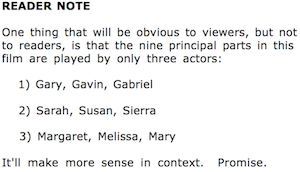
Only very rarely do you have to do a full dead stop to explain something to readers. I’ve probably done it twice in 40+ scripts. For The Nines, I have a note to readers right after the title page:

nines reader note

But that’s a really odd case.

You’ll almost always be able to handle it in-line with scene description. Set it off with parentheses, brackets or dashes if it helps. But there’s no need to label it as a writer’s note or somesuch.

« Previous Page
Next Page »

Primary Sidebar

Newsletter

Inneresting Logo A Quote-Unquote Newsletter about Writing
Read Now

Explore

Projects

  • Aladdin (1)
  • Arlo Finch (27)
  • Big Fish (88)
  • Birdigo (2)
  • Charlie (39)
  • Charlie's Angels (16)
  • Chosen (2)
  • Corpse Bride (9)
  • Dead Projects (18)
  • Frankenweenie (10)
  • Go (29)
  • Karateka (4)
  • Monsterpocalypse (3)
  • One Hit Kill (6)
  • Ops (6)
  • Preacher (2)
  • Prince of Persia (13)
  • Shazam (6)
  • Snake People (6)
  • Tarzan (5)
  • The Nines (118)
  • The Remnants (12)
  • The Variant (22)

Apps

  • Bronson (14)
  • FDX Reader (11)
  • Fountain (32)
  • Highland (73)
  • Less IMDb (4)
  • Weekend Read (64)

Recommended Reading

  • First Person (87)
  • Geek Alert (151)
  • WGA (162)
  • Workspace (19)

Screenwriting Q&A

  • Adaptation (65)
  • Directors (90)
  • Education (49)
  • Film Industry (489)
  • Formatting (128)
  • Genres (89)
  • Glossary (6)
  • Pitches (29)
  • Producers (59)
  • Psych 101 (118)
  • Rights and Copyright (96)
  • So-Called Experts (47)
  • Story and Plot (170)
  • Television (165)
  • Treatments (21)
  • Words on the page (237)
  • Writing Process (177)

More screenwriting Q&A at screenwriting.io

© 2026 John August — All Rights Reserved.