• Skip to primary navigation
  • Skip to main content
  • Skip to primary sidebar

John August

  • Arlo Finch
  • Scriptnotes
  • Library
  • Store
  • About

Archives for 2009

Nice to meet you. Again. Maybe.

February 3, 2009 Film Industry, Psych 101, QandA

questionmarkLet’s say I’m a development exec and I’m going into a meeting with a writer (a big, successful one) whom I’ve met before — but it was a brief conversation and it was ten years ago, possibly longer.

When the writer says, “Nice to meet you,” I shouldn’t say, “We’ve actually met before, but it was a brief conversation and it was ten years ago,” should I? I should just act like we haven’t met before, right?

Or would the writer be flattered that I’d remember the conversation and was excited to have it, since the writer is a big deal? Which is the truth?

— Anonymous

Okay: It’s entirely possible that I was the writer who didn’t remember you. I’m sorry. We’ll get to why it happens (The Kevin Williamson Problem) in a second. Let’s solve your issue first.

In the situation you present, there’s generally a way to point out history without making too big a deal out of it.

WRITER

Nice to meet you.

EXEC

You probably don’t remember, but I met you years ago on that Goblin Bikers project at Cinergi.

WRITER

Wow. Whatever happened to Cinergi?

...and so on.

It’s for exactly this reason that I’ve gotten in the habit of saying “Hi” or “Hello” instead of the default “Nice to meet you.” And I don’t end a meeting with that phrase either. “Great talking with you” or a simple “Thanks” does the trick.

But why does it happen in the first place? Are writers such social abominations that they can’t even remember who they’ve met before?

No. And the perfect person to illustrate this fact is another screenwriter.

The Kevin Williamson Problem
====

I’ve named this phenomenon in honor of Kevin Williamson, a screenwriter who is now a friend, but who for many years was the guy who couldn’t remember that he’d met me. We would be introduced by a mutual acquaintance, and he’d go right to “Nice to meet you.” Nevermind that we’d met three times before. Nevermind that we had shared interests, friends and connections (such as Katie Holmes). He was perfectly nice to talk with, but I sensed that every time I walked away the slate was wiped clean.

What a jerk.

Except of course, he wasn’t. He’s a nice guy. The problem was the complete disparity in our rememberability. The fair question wasn’t, “Why can’t Kevin Williamson remember me?” It was, “Why can I remember Kevin Williamson?”

Simple: When I met Kevin Williamson, I already knew who he was. He had movies in theaters and a show on TV. He had profiles in EW. So the first time I shook his hand, I knew a lot about him, and had already formed opinions. Again, *I knew him before I met him.*

The first time he met me, I was a brand new person. So after a brief conversation, he was no more likely to remember me than any other cocktail party guest.

I understand this because I now suffer from the Kevin Williamson Problem all the time. Among the tiny subset of people who pay attention to screenwriters, I’m “famous” enough that [strangers sometimes recognize me](http://johnaugust.com/archives/2006/are-you-somebody). This is odd. And even when I enter a conversation heretofore anonymous, the projects I’ve written get attached to me: *He’s the guy who wrote that Willy Wonka movie*. So, after a brief conversation, I’m more likely to be remembered than do the remembering.

In the situation presented, you as a development executive have had the chance to see this writer’s name in the trades for years. You’ve had a lot of memory reinforcement. He hasn’t. So it would be pretty remarkable if he remembered you. Therefore, it’s smart of you to provide a lot of context and no implied request for apology.

They grow so fast, don’t they?
=====
A related situation I’ve been grappling with is how many new people I’m expected to remember now that my daughter is in preschool. It’s not just the fifteen kids in her class; it’s all of their parents, and siblings. A weekend birthday party can mean 45 names I’m suddenly supposed to be able to recall. Is Daphne Kate’s mom, or is Kate Daphne’s mom? Add in bouncy houses and screaming, and the name buffer quickly overflows.

Luckily, there’s cake.

The biggest TiVo in the world

February 3, 2009 Film Industry, Follow Up, Television

follow upIn my post on [Cablevision and the infinite TiVo](http://johnaugust.com/archives/2009/cablevision-and-the-infinite-tivo), I argued that a proposed virtual-DVR service could be a Very Bad Thing for the film and television industry, and anyone who aspires to work in it.
But as a consumer of content, I would love it. That’s why studios, networks, guilds and operators need to keep working on ways to make it legal and cheap to watch any show, any time.

They just need to call it what it actually is: video on demand.

Much of the criticism in the ensuing comments came from one Anonymous poster, who claimed he wasn’t a lawyer, but sure wrote like one. And he didn’t deny that he worked for Cablevision, so it’s no surprise he had a strong opinion and very specific knowledge of the legal [proceedings thus far](http://johnaugust.com/archives/2009/cablevision-and-the-infinite-tivo#comment-167455):

> If you read the 2nd Circuit holding you will see that it is simply not the case that the holding could inadvertently extend to the very different system you imagine. If the Supreme Court hears the case, neither will their holding inadvertently extend to completely different systems. Agree with them or not, the justices are hardly a group of fools. The Court is certain to tailor the decision quite deliberately.

>That the system you imagine is achievable is irrelevant. Cases get decided based on the facts of what parties actually do, not based upon completely different facts that others concoct, regardless of whether those concocted facts are achievable.

But of course, the point of a blog is conjecture and analysis. And the job of a screenwriter is to ask what-if questions. What if the Yellowstone supervolcano exploded? What if monsters were afraid of us? What if SkyNet developed consciousness?

I’m certainly not qualified to argue about the language of the 2nd Court holding. But I’m very qualified to ask what-if questions. Nothing about the system I outlined in my original post is crazy. In fact, it’s all so reasonable that it seems very likely to be implemented, if not by Cablevision, then by another provider.

Anonymous [continues](http://johnaugust.com/archives/2009/cablevision-and-the-infinite-tivo#comment-167531):

> Let’s also remember that even when major changes are faced, the only thing that can be assured is that there will be widespread predictions of doom. Doom actually occurring is much less frequent. The Betamax case is an excellent example of such a change that spawned similar predictions of doom for the film and television industry, yet went on to have the exact opposite effect, vastly increasing revenues into that industry.

Revenues increased because *copyright holders* suddenly had an entirely new market for their product, which had hitherto been sitting on a shelf. The system I foresee Cablevision building wouldn’t create a new market. It would redefine an existing market (video on demand) and let them keep the profit for themselves.

I disagreed with almost everything Anonymous wrote, but it was a pleasure having such an eloquent spokesperson for the other side. I was serious when I said he/she needed to get a blog of his/her own.

[Sérgio Carvalho](http://johnaugust.com/archives/2009/cablevision-and-the-infinite-tivo#comment-167356) wonders if we’re just putting off the inevitable:

> You do understand that if personal DVRs are allowed, forbidding Cablevision’s “community disk” is a stopgap measure. It buys about ten to fifteen years. Moore’s law (applied to physical storage) coupled with codec evolution means personal DVRs will reach a virtually unlimited storage capacity at some point in the near future.

There’s a big difference between unlimited storage capacity and unlimited access to all television aired. Even if you had an infinitely big hard drive, you couldn’t simultaneously record every channel; there isn’t an infinitely big cable coming into your house. No matter what the storage capacity, a personal DVR is still limited to recording those things you’re interested in, or think you might ever be interested in.

[Nick](http://johnaugust.com/archives/2009/cablevision-and-the-infinite-tivo#comment-167361) offers a perspective from north of the border.

> In fact, in Canada, where the laws are different (though no less draconian in several ways) many cable companies are already offering a service like this: you can watch any show in an on-demand fashion if it is currently airing, but eventually those shows cycle out of your list of available shows.

The U.K. has a similar system, and it sounds useful. It’s the kind of thing networks and providers can offer jointly, with profit for both. While some WGA’ers disagree with me, I think it’s reasonable to define a window of time in which an episode is considered “new,” and doesn’t require any additional payment. ((To me, the window is a week. Maybe ten days.))

No matter what happens with the Supreme Court case, I think you’re going to see the clash between networks and providers become a much more public brawl in the next few years. Recently, Viacom threatened to pull 19 channels from Time Warner Cable when they couldn’t reach a deal. They played rough, with print ads featuring a crying Dora, and ultimately got the deal done.

If a company like Viacom decided they didn’t want their channels recorded on Cablevision’s DVR service, they could make that part of the deal — or walk. Cable isn’t a monopoly anymore. While Viacom would lose a lot of money, they don’t need one cable company as much as that one company needs them.

But again, the smarter solution is to work together find ways to let consumers watch any show at any time for the right price. Sure: easier said than done. But that’s the only way to ensure sustainability.

Comic book grammar

February 2, 2009 Comics, Formatting

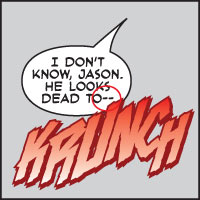
comic bookNate Piekos has a [great piece at Blambot](http://www.blambot.com/grammar.shtml) explaining the grammar and tradition of comic book lettering. It’s worth a look for any screenwriter considering writing for the paneled medium.

> Comic book lettering has some grammatical and aesthetic traditions that are quite unique. What follows is a list that every letterer eventually commits to his/her own mental reference file. The majority of these points are established tradition, sprinkled with modern trends and a bit of my own opinion having lettered professionally for a few years now. The majority of these ideas have been established by Marvel and DC, but opinions vary from editor to editor, even within the same company.

Many of the examples, such as when to use ellipses verus dashes, have parallels in modern screenwriting. But as a former font nerd, I was surprised I never noticed the rule about crossbar I, or the existence of breath marks. They were always there, but when used properly, completely disappear.

(Thanks to [Daring Fireball](http://daringfireball.net) for the link.)

The rat is dead

February 2, 2009 Follow Up

follow upLast month, [a visitor](http://johnaugust.com/archives/2009/the_visitor) made an unwelcome appearance in our kitchen, eating oranges on the counter. He was first caught virtually by my laptop’s iSight camera, then later physically by a classic spring-lever trap.

It was loud; it was unsettling; it was over.

I actually like rodents as pets. I grew up with gerbils and hamsters, and enjoy watching rats in the cages at Petco. If my daughter wanted one at some point, I’d be game. But my qualms about nixing this specific rat were minimal. [Roof rats](http://www.extension.org/pages/Roof_Rats) like this one are not California-native, so trap-and-release would just be dooming some bird or other indigenous creature.

He was apparently a loner. Since his demise, we’ve sealed up a few possible entry points. He likely came inside to escape an unusual cold snap earlier this year.

« Previous Page
Next Page »

Primary Sidebar

Newsletter

Inneresting Logo A Quote-Unquote Newsletter about Writing
Read Now

Explore

Projects

  • Aladdin (1)
  • Arlo Finch (27)
  • Big Fish (88)
  • Birdigo (2)
  • Charlie (39)
  • Charlie's Angels (16)
  • Chosen (2)
  • Corpse Bride (9)
  • Dead Projects (18)
  • Frankenweenie (10)
  • Go (29)
  • Karateka (4)
  • Monsterpocalypse (3)
  • One Hit Kill (6)
  • Ops (6)
  • Preacher (2)
  • Prince of Persia (13)
  • Shazam (6)
  • Snake People (6)
  • Tarzan (5)
  • The Nines (118)
  • The Remnants (12)
  • The Variant (22)

Apps

  • Bronson (14)
  • FDX Reader (11)
  • Fountain (32)
  • Highland (73)
  • Less IMDb (4)
  • Weekend Read (64)

Recommended Reading

  • First Person (87)
  • Geek Alert (151)
  • WGA (162)
  • Workspace (19)

Screenwriting Q&A

  • Adaptation (65)
  • Directors (90)
  • Education (49)
  • Film Industry (489)
  • Formatting (128)
  • Genres (89)
  • Glossary (6)
  • Pitches (29)
  • Producers (59)
  • Psych 101 (118)
  • Rights and Copyright (96)
  • So-Called Experts (47)
  • Story and Plot (170)
  • Television (165)
  • Treatments (21)
  • Words on the page (237)
  • Writing Process (177)

More screenwriting Q&A at screenwriting.io

© 2026 John August — All Rights Reserved.