• Skip to primary navigation
  • Skip to main content
  • Skip to primary sidebar

John August

  • Arlo Finch
  • Scriptnotes
  • Library
  • Store
  • About

Archives for 2009

Reading scripts on a MacBook, book-style

December 3, 2009 Follow Up, Geek Alert

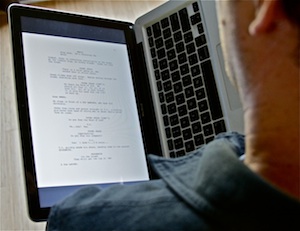
bookstyleIf you could physically remove your laptop screen and hold it vertically, it would be the perfect size for reading a script. That’s the hope behind the mythical Apple tablet that always seems six months away.

But until Mr. Jobs decides we’re ready for the future, reader [Douglas](http://johnaugust.com/archives/2009/reading-scripts-on-the-kindle#comment-174771) has a suggestion that is surprisingly close. Turn your laptop on its side, and hold it like a hardcover book.

No, really. It works much better than you’d think, particularly with one of the unibody MacBooks.

I suspect there’s a way to get the screen rotated in the proper direction on almost any laptop. But on a Mac running Snow Leopard, it’s pretty easy to get a .pdf turned the right way.

1. Open the .pdf in Preview.
2. Click on one of the pages, then Select All (⌘-A) to highlight all the pages.
3. Choose Rotate Right (⌘-R) or Rotate Left (⌘-L).
4. Choose Full Screen (Shift-⌘-F).
5. Click the zoom-to-fit button.

I’ve found it more comfortable to read with the screen on the left-hand side, using my right hand to advance pages with the arrow keys. But experiment to see what works best for you.

**Update:** Several readers have pointed to a free utility called [ReadRight](http://www.twilightedge.com/mac/readright/) which basically does steps 1-6 all at once, with some other handy options thrown in. I particularly like being able to advance pages with a click on the trackpad.

Since Preview is already included on every Mac, I’ll keep it as the general-case solution.
Reading scripts on the Kindle

December 1, 2009 Follow Up, Geek Alert

kindle
Ever since I got my Kindle, ((I started with the original model, and later replaced it with the Kindle 2
.)) I’ve been looking for a good way to read scripts on it.

Emailing a .pdf would result in mangled margins and bizarre gaps. Converting to a .doc format with a very specific template would give me something almost acceptable, but meant a lot of extra labor, and wouldn’t work for .pdfs of existing scripts.

So it was with great anticipation that I installed the free [2.3 software update](http://www.amazon.com/gp/help/customer/display.html?nodeId=200324680) that finally gave my little Kindle the option of using honest-to-goodness .pdfs.

It works just as I had hoped, except for the fact that the type is pretty damn small. Like, list-of-ingredients small. My friend Cort pointed out that the Kindle screen is only as wide as a buck slip, so there’s only so much real estate available.

After all this wishing and hoping, I’m not sure I’ll be reading many scripts on my Kindle. (The upcoming Nook from Barnes and Noble has essentially the same size screen, and will likely have the same kind of problem.)

The update gives you the option of rotating the screen, so you can see it much closer to full size, but then you have to read half a page at a time. The update is also supposed to increase battery life dramatically.

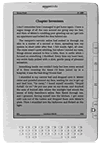
kindle DXBottom line: if you have a small Kindle, install the update. You might be willing to live with the tiny type (or half-pages) for reading screenplays.

If you’re thinking about buying a Kindle, take a second look at the bigger Kindle DX, which has a screen better suited for scripts. I know a lot of people who are using it daily to read screenplays.

Zombie-class situations

November 19, 2009 Genres

Zombies are more than the walking dead. They’re a useful paradigm for a range of common scenarios in many genres.

Whenever your hero is facing off against a system or mob rather than an individual, that’s potentially a zombie-class situation. Any given opponent isn’t necessarily that formidable; it’s the sheer numbers that make it so difficult for the hero.

War movies are frequently zombie-class, as are comedies about plucky outsiders. Science-fiction and horror revel in zombie-class situations, from the Borg to the Visitors to those troublesome tribbles.

If you find yourself writing a zombie-class situation, here are some helpful class features to keep in mind:

* **You can’t fight the ocean.** In a zombie-class situation, heroes ultimately won’t get far trying to defeat their opponents, who have the advantage of both numbers and replaceability. Rather, your hero must set an achievable goal such as escape, survival, or retrieval of a key asset.

* **Ants vs. Elephants.** It’s great to be big, but it’s better to be numerous. Just as heroes will often rally a crowd, opponents can do the same — popular opinion is a hard thing to fight. And look for ways to use your hero’s size (or reputation) against him.

* **Zombie processes.** In programming, zombies are bits of code that unintentionally keep running in the background, sucking cycles and threatening a crash. That’s a useful framework for many stories: noble intentions run amok. Just as [every villain is a hero](http://johnaugust.com/archives/2009/every-villain-is-a-hero), every zombie was somebody’s baby.

* **One of us.** In the Romero tradition, zombies eat brains. But this can be generalized to assimilation: your hero has something the opponents need. Can your hero figure out what they’re after — what makes the hero special — before it’s too late?

A zombie-class situation is a key difference between Alien and Aliens.

In the former, Ripley and company mostly battle a single creature. Survival means killing it, so that’s pretty much the only goal.

In the sequel, the aliens are so numerous that there is no hope of defeating them. Rather, Ripley’s goal is simply escape. Once Newt is captured, Ripley must face off against the Queen, but defeating her in no way impacts the hordes of aliens left behind.

That’s how zombie-class situations often end: the hero’s victory leaves the world just as dangerous as before.

Script-a-scene contest

November 19, 2009 Challenge

Jessica Bendinger (Bring It On, Stick It) is [hosting a competition](http://www.thesevenrays.com/script-a-scene/) centered around her new novel, inviting readers to adapt a bit from it into a scene.

It’s like one of this site’s [scene challenges](http://johnaugust.com/archives/category/challenge), but based on an actual real book rather than my random themes of science and/or self-amusement.

You can check out the rules for Jessica’s competition [here](http://www.thesevenrays.com/script-a-scene/).

« Previous Page
Next Page »

Primary Sidebar

Newsletter

Inneresting Logo A Quote-Unquote Newsletter about Writing
Read Now

Explore

Projects

  • Aladdin (1)
  • Arlo Finch (27)
  • Big Fish (88)
  • Birdigo (2)
  • Charlie (39)
  • Charlie's Angels (16)
  • Chosen (2)
  • Corpse Bride (9)
  • Dead Projects (18)
  • Frankenweenie (10)
  • Go (29)
  • Karateka (4)
  • Monsterpocalypse (3)
  • One Hit Kill (6)
  • Ops (6)
  • Preacher (2)
  • Prince of Persia (13)
  • Shazam (6)
  • Snake People (6)
  • Tarzan (5)
  • The Nines (118)
  • The Remnants (12)
  • The Variant (22)

Apps

  • Bronson (14)
  • FDX Reader (11)
  • Fountain (32)
  • Highland (73)
  • Less IMDb (4)
  • Weekend Read (64)

Recommended Reading

  • First Person (87)
  • Geek Alert (151)
  • WGA (162)
  • Workspace (19)

Screenwriting Q&A

  • Adaptation (65)
  • Directors (90)
  • Education (49)
  • Film Industry (489)
  • Formatting (128)
  • Genres (89)
  • Glossary (6)
  • Pitches (29)
  • Producers (59)
  • Psych 101 (118)
  • Rights and Copyright (96)
  • So-Called Experts (47)
  • Story and Plot (170)
  • Television (165)
  • Treatments (21)
  • Words on the page (237)
  • Writing Process (177)

More screenwriting Q&A at screenwriting.io

© 2026 John August — All Rights Reserved.