• Skip to primary navigation
  • Skip to main content
  • Skip to primary sidebar

John August

  • Arlo Finch
  • Scriptnotes
  • Library
  • Store
  • About

Archives for 2004

When Final Draft won’t open under OS X

February 9, 2004 Geek Alert

I’m posting this in hopes of saving other screenwriters a few hours of potential frustration with Final Draft. After installing the OS X version, or upgrading your system software, or sometimes for no discernible reason at all, Final Draft will occasionally refuse to open. It bounces one or twice in the dock, then quits. Sometimes it gives you a message; other times it doesn’t.

Obviously, you can go through the help forums at Final Draft to look for an answer, but if you’re using the OS X version for Mac, first check for one specific thing: a corrupted font file.
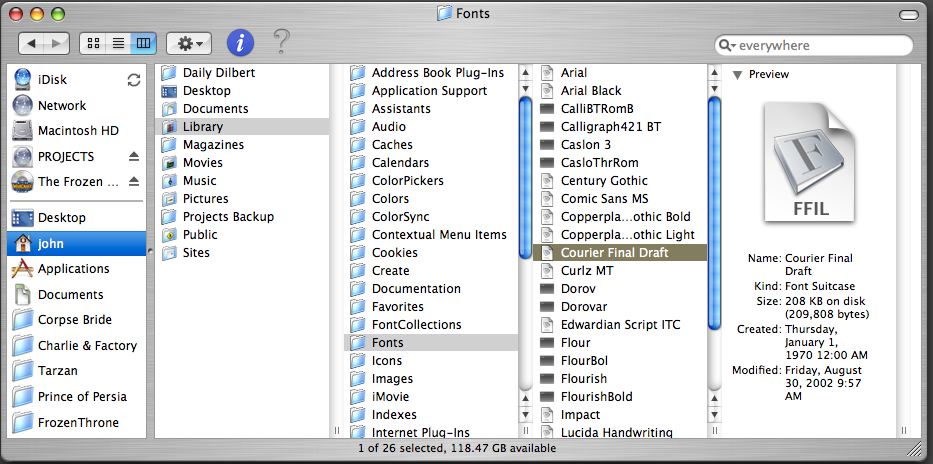
courierfdIn the “Fonts” folder of your account’s “Library” folder (that is, John/Library/Fonts, rather than the main system-wide Library) look for the file “Courier Final Draft.” (Confused? Click the thumbnail to show you where to find this file.)

Drag the “Courier Final Draft” file to the trash. Log out, then log back in. Try to launch Final Draft. If it works, problem solved. Go to the website to download a non-corrupted version of Courier Final Draft, and put it in the main library’s fonts folder.

If that doesn’t work, make sure you’ve updated to the most recent version of Final Draft, then start digging through the support forums.

Script in March 2004 Esquire

February 9, 2004 News

esquireI have an 11-page piece in the March 2004 issue of Esquire, the one with Mark Ruffalo on the cover.

A bit of backstory: When doing publicity last year for Big Fish, I agreed to model for this fashion piece Esquire was doing. Considering that I loathe having my picture taken, this was a big deal for me. But the Esquire people were friendly, and they gave me a free jacket, so hey.

Afterwards, the editors called and asked if I would write a short script about Hollywood for them. They would then have a photographer shoot the “stills” from this never-to-be-made film as a fashion piece. I thought it sounded fun.

I was wrong.

I was happy with the original script I wrote — it was short, funny and mean, sort of a Jayson Blair riff on THE PLAYER. Then, after I turned it in, the photographer (Jonathan Skow) had notes. Notes, really? From a photographer? I bit my tongue and listened. Ultimately, I changed about ten things that I could live with. But my enthusiasm had definitely waned.

When I saw the page proofs, I thought Skow’s photos were good and everything else sucked. Not only had Esquire taken out all reference to the main character’s race — a significant plot point — but they had reformatted the script to make it almost incomprehensible, and were still looking for about half a page of cuts.

To their credit, the editors ultimately stepped up and reformatted the piece so that it could run in its not-quite-entirety. And for that, I am grateful. The piece itself is not as cool as I’d hoped. But that’s Hollywood, I guess.

Does lack of confidence lead to great writing?

February 5, 2004 Psych 101, QandA

In an earlier question about finding confidence as a writer, you stated: “Most good writers weren’t popular growing up.” While this is true in my case (that I wasn’t popular growing up), do you think also being an unpopular adult (which I am as well) could make a GREAT writer? Or just a whiny, self-obsessed loser who writes nothing but whiny, self-obsessed drivel (which I’m starting to suspect I do)?

–Dave
Albany, NY

Just to be clear, I don’t think childhood unpopularity is a golden ticket to success as a screenwriter. I would never give my child a bad haircut, or rub him with cat litter, just in the hope that he’ll win the Oscar when he’s 40. There are many, many unpopular children who grow up to be terrible writers. Maybe, Dave, you’re one of them.

Or maybe not. The simple fact is, one can’t judge a writer’s talent based on how many Friendsters he has. But I would posit that at least in terms of screenwriting, being extremely unpopular is a detriment. Unlike, say, a novelist, the screenwriter has to put on a clean shirt and meet with executives, humoring them when they offer insipid notes and feigning interest in their personal lives. These delicate social skills are hard to pick up if you frighten small children and annoy the elderly.

It’s this social component of screenwriting that explains why some less-talented writers (the proper term is “hacks”) seem to have undeserved success. They’re good at being screenwriters, if not particularly good at screenwriting.

My advice to you, Dave, is contrary to what I’d tell most writers. Don’t write about what you know, since that seems to be limited to whiny self-obsession. Instead, write like the kind of writer you wish you were: bold, courageous, unafraid to piss people off. Think Hemmingway, but with marketable good-looks.

In summary: Pretend you’re confident. Eventually, you will be.

Metaphors in Big Fish

February 4, 2004 Big Fish, QandA

My wife and I just saw Big Fish and loved it. We spent hours talking about the metaphors you used, especially what Spectre represented. How do you decide whether to hit people over the head with it or leave it up for interpretation? And are you okay with people coming up with different interpretations?

–Pete Safran

Like pornography and irony, metaphors are hard to define, but easy to spot: “The ship plowed the sea,” or “She was a bobcat in the sack.” Ships don’t plow, and bobcats don’t sleep in beds, but in both cases the author’s intention is clear. Essentially, a metaphor uses the meaning of one term (the “meta” part) to carry over (the “phor” part) to an otherwise unrelated situation. Basically, a metaphor is a comparison — something “like” something else — but without using the word “like,” which would make it a simile.

Still with me?

In terms of Big Fish, metaphor doesn’t feel like quite the right word to describe Spectre. While there are lots of things Spectre is “like” — Heaven, Hell, the Afterlife, a ghost town, Utopia, Oz, Shangri-La — any comparisons the viewer draws are based on how he interprets the imagery and events of the scene. For instance, everyone is dressed in shimmering whites and yellows (which seems Heavenly), but the river is full of leeches and alluring sirens (not Heavenly). The town’s mayor welcomes Edward with a clipboard and finds Edward’s name (which feels like the Afterlife), but people grow old (which doesn’t).

So if you try to force just one interpretation onto Spectre, you’re going to be disappointed. And in fact, Spectre is supposed to be a lot of different things at once. It’s the mythical town that Edward was hoping to find, but he found it too quickly. It’s a poor Southern town subject to liens and bankruptcy, which only Edward can save. It’s the location of Edward’s sexual awakening (the girl in the river) and his near-affair (with Jenny Hill). If anything, it’s a beautiful trap that Edward stumbles into twice.

Interestingly, the original inspiration for Spectre was quite a lot darker. In Daniel Wallace’s novel, this section is the road out of Ashland, and features a dog that bites your fingers off. For the movie, Spectre became its own place, and the dog got moved to the circus scene.

Am I okay with people coming up with their own interpretations? Well, I have to be. Unless I want a character to explicitly state what a story element represents, there will always be different interpretations. And the point of the film is that finding the actual, hard truth behind things is often a fool’s errand. The issue of whether Edward Bloom ever visited Spectre in his youth is ultimately less important than what he said, and why.

« Previous Page
Next Page »

Primary Sidebar

Newsletter

Inneresting Logo A Quote-Unquote Newsletter about Writing
Read Now

Explore

Projects

  • Aladdin (1)
  • Arlo Finch (27)
  • Big Fish (88)
  • Birdigo (2)
  • Charlie (39)
  • Charlie's Angels (16)
  • Chosen (2)
  • Corpse Bride (9)
  • Dead Projects (18)
  • Frankenweenie (10)
  • Go (29)
  • Karateka (4)
  • Monsterpocalypse (3)
  • One Hit Kill (6)
  • Ops (6)
  • Preacher (2)
  • Prince of Persia (13)
  • Shazam (6)
  • Snake People (6)
  • Tarzan (5)
  • The Nines (118)
  • The Remnants (12)
  • The Variant (22)

Apps

  • Bronson (14)
  • FDX Reader (11)
  • Fountain (32)
  • Highland (74)
  • Less IMDb (4)
  • Weekend Read (64)

Recommended Reading

  • First Person (87)
  • Geek Alert (151)
  • WGA (162)
  • Workspace (19)

Screenwriting Q&A

  • Adaptation (65)
  • Directors (90)
  • Education (49)
  • Film Industry (489)
  • Formatting (128)
  • Genres (89)
  • Glossary (6)
  • Pitches (29)
  • Producers (59)
  • Psych 101 (118)
  • Rights and Copyright (96)
  • So-Called Experts (47)
  • Story and Plot (170)
  • Television (165)
  • Treatments (21)
  • Words on the page (237)
  • Writing Process (177)

More screenwriting Q&A at screenwriting.io

© 2026 John August — All Rights Reserved.