• Skip to primary navigation
  • Skip to main content
  • Skip to primary sidebar

John August

  • Arlo Finch
  • Scriptnotes
  • Library
  • Store
  • About

Archives for 2004

Hiring a “script doctor”

August 9, 2004 QandA, So-Called Experts

I just got to LA a few months ago. I have written a few screenplays, well received from a manager, producer and teachers at my college. But have not landed an agent or manager, yet. I am writing a new script, it’s a hard write but very rewarding. It not only has commercial appeal but I think it is my step in the right direction.

A fellow writer suggested this script doctor to me, just to help me after I got through the “grunt” of my script and really help me polish it. I have tried workshops and things like that with my other scripts, but I do not find them very effective. I figure I would rather take the money and give it to a pro, get a one on one meeting with them and get good notes, of course do the re-writes myself, but getting someone else to look at it and help. My friend the writer tells me he would not send anything out before it goes through her. He swears by her. I think I might try it. Any advice about going to a script doctor?

–Silla Desade
Los Angeles

“Script doctor” generally means something different in the industry, so I want to draw a distinction between the kind of script doctor you’re talking about and the kind of script doctor [Variety](http://www.variety.com) would talk about.

In the industry, a script doctor is an established screenwriter with a bunch of credits who comes in on a project shortly before production and does a rewrite to fix some specific, nagging problems. (Or, depending on your perspective, destroys the things that made the project unique.) [Steve Zaillian](http://imdb.com/name/nm0001873/) is a highly-regarded script doctor. Arguably, I could be considered a script doctor, because I’ve done a fair number of these 23rd-hour emergency jobs. But no one’s business card reads “script doctor.” It’s a specific task within screenwriting, but not really a profession in-and-of itself.

A lot of times, the work you do on these projects is described as “surgical,” which fits well with the script doctor moniker. Generally, you’re not rewriting the whole script. You’re fixing a few key sections that aren’t working.

The person your friend is recommending to you may or may not be a screenwriter. In some cases, it could be someone analogous to a literary editor, who goes through a text and helps “clean it up” before publication. If so, great. Good writers are not always good proofreaders, and it’s important to have sharp eyes looking over your work.

If this person is truly going to rewrite your script, however, I have to question the legitimacy of your career aspirations. Screenwriting isn’t about banging out a first draft and letting someone else make it shine. If you really have limitations in a given area — dialogue, plotting, whatever — you need a writing partner, not a self-styled guru.
Bringing a ringer for a pitch

August 8, 2004 Pitches, QandA

Would a producer frown on a writer bringing in a ringer to a pitch meeting?  I am the absolute WORST pitcher on the planet.  Could I bring in a friend of mine who is excellent at pitching to do the dirty work for me?  Is this even acceptable?

–Gary

Nope. Not unless your friend is going to be writing it with you.

Believe me, I recognize the fallacy of expecting a writer — whose principal talent is sitting alone in a room for hours on end — to suddenly be talkative and entertaining when pitching a project. Most writers, self included, would much rather toil away in happy isolation. But producers and studio execs want to hear from the writers themselves. So we put on our least-wrinkled clothes, practice what we’re going to say, and try not to make asses of ourselves in pitch meetings.

My standard advice for any pitch: Pretend you just saw the best movie ever, and you want to convince your friend (the producer) why she should see it. Try it with a few real movies and you’ll see that you naturally hop from high point to high point, and don’t dwell a lot on the underlying logic or subplots. That’s a pitch.

Writing the script for a cooking show

August 7, 2004 Formatting, QandA

I am a culinary student with an idea for a cooking show. Every book I have read, and all the websites I have visited regarding script writing focus on television shows and film, but since my idea isn’t the typical script, how would you go about putting it on paper to pitch the idea?

Is there a standard formatting method for cooking shows? I have an outline with my concept and details for various segments, but I would like to give myself a chance and don’t want to embarrass myself by submitting something that isn’t formatted properly.

–Donald
Pennsauken, New Jersey

Non-fiction shows like the one you’re describing usually aren’t written in screenplay format. To the degree they’re scripted, the format is often done in two columns, with video on the left, and audio on the right. The product page for [Final Draft AV](http://www.finaldraft.com/products/av-features.php4) shows what a typical page looks like.

At this stage, I don’t think you need to worry about the script per se. Instead, I would concentrate on writing a proposal for the show, describing the goal, the host, the distinctive style, and how a typical episode would be structured — especially if there are multiple segments within an episode.

If you feel like writing the script for what the host would be talking about in the “pilot” episode, a two-column format would probably make the most sense. If any readers can point Donald to good examples of scripts from other cooking or home shows, please leave a comment.

My new keyboard setup

August 6, 2004 Geek Alert

I’ve had my share of troubles related to typing all day. It’s hard to say if I ever had classic carpal tunnel syndrome, but a few years ago, my hands started going numb if I typed too much. Worse, I would wake up in the middle of the night with both my arms dead asleep.

Since then, I’ve gotten a lot smarter about general office ergonomics. I try to remember to take breaks, and keep aware of not slouching over the desk. But being a geek, my hard-wired inclination is to address the problem with gadgets.

[nuform](http://adesso.com)
**GEEK FACTOR: FOUR**

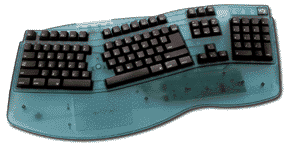
My first life-saver was an ergonomic keyboard. For the last few years, I’ve been using the [Adesso](http://www.adesso.com) NuForm keyboard. Like most ergonomic keyboards, it breaks the traditional keyboard in half, placing the right hand and left hand sides at a slight angle, saving wear-and-tear on the wrists. Most ergonomic keyboards are raised in the center, but the NuForm is basically flat, which I prefer.

After a couple of years on this keyboard, I find it hard to type on a regular straight keyboard. When I’m traveling for work, I usually bring it along. In London this spring for [Charlie and the Chocolate Factory](http://imdb.com/title/tt0367594/), I broke a few keys, but managed to keep it going. Good thing, too: I haven’t been able to find a source for the NuForm anymore.

[keyboard](http://www.safetype.com)

**GEEK FACTOR: NINE**

Screenwriter [Dana Fox](http://imdb.com/name/nm1401416/), who happens to be my former assistant, has had more troubles with repetitive stress injuries than I have. She was the one that turned me on to what is quite possibly the Holy Grail of insane keyboards, manufactured by SafeType.

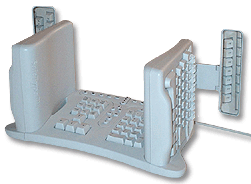
Like most ergonomic keyboards, SafeType breaks the keyboard in half. But it then goes berserk, mounting them vertically, with the number pad and arrow keys placed in between. You obviously need to be a touch-typist, since you can’t see keys. And since no one really knows where the function keys are, there are two “rear-view” mirrors mounted on the back like wings. The function keys are labeled backwards, so in the reflection, you can find F7 or whatever.

As you might expect, the first hour or two using this keyboard is terrifying. I got a headache. After two days, though, you stop thinking about it. Your fingers inherently know where to go, and once you get used to feeling for the home row (the J and F keys have indentations), you rarely screw up. In fact, I’m probably typing just as fast on the new keyboard as I did on the old one.

Ergonomically, the big advantage to a vertical keyboard is that you’re not twisting your forearms around to type. By keeping your wrists neutral, there’s a lot less strain. SafeType recommends a [Quill Mouse](http://www.quillmouse.com/) to go with it, but I can’t imagine life without my mouse
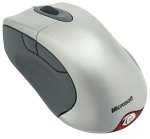
wireless IntelliMouse Explorer, which makes web surfing oh-so-much more pleasant.

If it’s not obvious, I really like the new keyboard. However, I would offer a couple of caveats to anyone thinking of buying one:

1. It ain’t cheap. New, it costs $295. They also sell factory-refurbished models for $149.
2. It isn’t USB. You need to buy an adaptor cable for USB, or for Macs.
3. On a Mac, the extra buttons (volume, etc.) don’t work. But I really doubt I would use them if they did.
4. Command-Key combinations are more difficult. But that can be addressed…

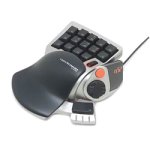
One nice side benefit of my new keyboard is that it takes up less desk space. That lets me keep my mouse a little closer on the right-hand side. With the extra room on the left, I invested in the Nostromo Speedpad n52 controllern52, which I think may catapult me the extra few parsecs into Geek Factor 9.5.

The n52 is really designed for videogames, letting the player keep his right hand on the mouse while hitting all the keystrokes with his left. I don’t play Splinter Cell, but on a daily basis I do a lot of Cut, Copy, Paste, Save, Undo, Hide, Hide Others, etc. Using the Nostromo Array (!) software that comes with it, I have all these functions mapped to the fifteen keys on the n52.

This has made high-volume text editing extremely productive. Right hand selects; left hand clicks. Combined with a good clipboard utility, I can stack up a half-dozen chunks of text to paste at will. You can remap the keys for different applications. I still need to go through and set up macros for Final Draft formatting.

« Previous Page
Next Page »

Primary Sidebar

Newsletter

Inneresting Logo A Quote-Unquote Newsletter about Writing
Read Now

Explore

Projects

  • Aladdin (1)
  • Arlo Finch (27)
  • Big Fish (88)
  • Birdigo (2)
  • Charlie (39)
  • Charlie's Angels (16)
  • Chosen (2)
  • Corpse Bride (9)
  • Dead Projects (18)
  • Frankenweenie (10)
  • Go (29)
  • Karateka (4)
  • Monsterpocalypse (3)
  • One Hit Kill (6)
  • Ops (6)
  • Preacher (2)
  • Prince of Persia (13)
  • Shazam (6)
  • Snake People (6)
  • Tarzan (5)
  • The Nines (118)
  • The Remnants (12)
  • The Variant (22)

Apps

  • Bronson (14)
  • FDX Reader (11)
  • Fountain (32)
  • Highland (74)
  • Less IMDb (4)
  • Weekend Read (64)

Recommended Reading

  • First Person (87)
  • Geek Alert (151)
  • WGA (162)
  • Workspace (19)

Screenwriting Q&A

  • Adaptation (65)
  • Directors (90)
  • Education (49)
  • Film Industry (489)
  • Formatting (128)
  • Genres (89)
  • Glossary (6)
  • Pitches (29)
  • Producers (59)
  • Psych 101 (118)
  • Rights and Copyright (96)
  • So-Called Experts (47)
  • Story and Plot (170)
  • Television (165)
  • Treatments (21)
  • Words on the page (237)
  • Writing Process (177)

More screenwriting Q&A at screenwriting.io

© 2026 John August — All Rights Reserved.