On square miles
A correction in yesterday’s LA Times:
Solar power: A Friday editorial said that according to the U.S. Energy Department, enough sunlight hits a “100-square-mile” portion of the Nevada desert to power the entire country. It should have said “100-miles-square.”
Rearranging two words shouldn’t matter, should it?
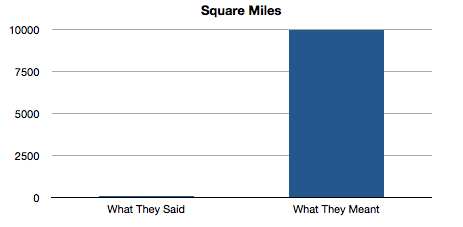
Poor copy editing, sure. More than that, it’s bad language design: “square” and “miles” are alternately (and ambiguously) noun and modifier depending on word order. And the hyphens which transform it into an adjective only make it worse.
I’d argue that “square miles” and “square kilometers” really have no place in popular journalism, because we have little connection to what they mean.
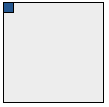
As humans, we never travel a “square mile.” We travel a mile. Or ten miles. If we’re thinking about an area of land, we’re probably mentally walking along two of its edges — which is what the LA Times and the U.S. Department of Energy were doing.
A better version would offer something of a roughly equivalent scale:
“According to the U.S. Energy Department, enough sunlight hits a 100-miles-square portion of the Nevada desert (roughly the area of Vermont) to power the entire country.”


March 29th, 2009 at 8:01 pm
What a huge difference… you’re right. One is a 10mi by 10mi square versus 100mi by 100mi…
I don’t care to read the article (don’t make me do all the work) but I wonder if they also mean that enough solar energy hits that much area total, or that we can power the entire country using that large area of solar powers at the efficiency we can capture the energy now.
Cause if it’s the former, and we’re only at 20% efficiency on our panels, then we’d really need five times as much surface area… or about half the size of Nevada.
March 29th, 2009 at 8:51 pm
Let me guess your available DVR storage… 100%.
March 29th, 2009 at 10:59 pm
I wonder if the correction occured after a badly-needed infusion of investor in the L.
March 29th, 2009 at 11:02 pm
I wonder if the correction occured after a badly-needed infusion of investor capital by some Oil Sheik or the nuclear industry lobby.
Sorry…I’m really bored.
March 29th, 2009 at 11:43 pm
“Square” is one of those words that looks incredibly strange if you read it several times in a row.
On the basis of making the scale understandable I think stating something along the lines of “A square area 100 miles by 100 miles…” is clear enough, if not particularly eloquent to read.
Oh well. We get all our information on scientific news from people whose expertise is in journalism rather than science anyways. Odd when you think of it…but who wants to drudge through scholarly journals I suppose.
March 29th, 2009 at 11:57 pm
John Does this mean that earth is only 2.5 million-years-light away from M31, our nearest galaxy? :) J.
March 30th, 2009 at 7:32 am
Be honest John – when you spotted this, did you basically think “this gives me a really cool idea for a graph”?
March 30th, 2009 at 8:10 am
Why couldn’t they have just said 10,000 square miles? That would have been unambiguous to me. 100 miles square sounds really awkward, I personally would have thought they meant 100 square miles but used a different wording. Now, “a hundred miles by a hundred miles” or “a square a hundred miles wide” would have worked.
March 30th, 2009 at 8:14 am
I don’t have much of a problem with “square miles.” But I agree with kip — why on Earth, if they meant 100 miles square, didn’t they just say ten thousand square miles? It baffles ten squared percent of my brain.
March 30th, 2009 at 8:51 am
“Yet in the end, our government had no mechanism for searching the balance sheets of companies that held life-or-death power over our society and was unable to spot holes in the national economy the size of Libya (whose entire GDP last year was smaller than AIG’s 2008 losses).”
I happened to come across this example just minutes after I’d read John’s post!
March 30th, 2009 at 8:54 am
BTW: AIG’s quarterly loss (not sure when, probably the last quarter of 2008) is $61.7 billion.
March 30th, 2009 at 11:20 am
@Michael: To further complicate things, ten squared percent of your brain is 100%, but ten percent squared of your brain is 1%…
March 30th, 2009 at 1:13 pm
@John August
Just reading the title, I somehow knew the post would be about x mi^2 vs. (x mi)^2
@Anna
… or $248.4 thousand squared.
March 30th, 2009 at 1:49 pm
A square-mile is a unit the same as a hectare or an acre is a unit but generally easier to visualise. Surely the error is that they meant 10,000 square miles and not 100 square-miles. In this case the problem lies in the mathematics rather than the language.
March 30th, 2009 at 2:20 pm
I was going to say $248.4 thousand squared.
March 30th, 2009 at 2:45 pm
Have you been up to Nevada? 100 square miles or 100 miles square, they have the space to spare.
March 30th, 2009 at 3:47 pm
@Michael:
Independent of some comparison, I really have no idea how big 10,000 square miles is. Is that the size of Texas or the size of Houston? It’s unambiguous, but it’s also unimaginable.
A hundred mile square is at least mentally conceivable.
@RMS:
No, the math was correct. The language was ambiguous. It’s a mistake of journalism, not science.
March 30th, 2009 at 10:00 pm
I have to disagree with the notion that we have no reference for a square mile, and that our primary notion of a ‘mile’ is based on walking it. We don’t get the majority of our spatial information from our feet. We get it from our eyes.
Look out a window.
IIRC, the distance to the horizon will be about three miles on reasonably flat ground. A circle with a three mile radius has an area of about 28 square miles. If we take the human field of vision to be about 120 degrees, what you see out the window is an area of about ten square miles.
If you want a referent for a hundred square miles, it’s about three times as big as everything you can see around you, assuming you’re standing outside on reasonably flat ground. If you’re standing on a hill and can see something 5-1/2 miles away, the visible area around you is about a hundred square miles.
I can’t cite the exact numbers off the top of my head, but I’d guess 10,000 square miles is only three to six times what you can see out the window of a commercial jet.
Those aren’t abstract figures, or particularly hard to visualize. And if you do find it hard to visualize “from here to the horizon”, you can always go look out a window.
March 30th, 2009 at 10:14 pm
Maybe I’m in the minority, but I have a pretty decent idea of how big 100mi x 100mi is. It’s roughtly 100 miles from Tucson to Phoenix here in Arizona. So that’s 1 side of the square. Go in the opposite direction another 100 miles, and that’s the space. Its really a lot of land. State wise, it’s roughtly Massachusetts.
March 30th, 2009 at 10:48 pm
Obviously, 100sq miles < the area of the Nevada Desert. ^^
March 30th, 2009 at 10:58 pm
Re: “I’d argue that ‘square miles’ and ‘square kilometers’ really have no place in popular journalism, because we have little connection to what they mean.”
Are “we” the same people who are supposed to make complex decisions like who to marry, how to raise children, and how to invest our savings? :P
March 30th, 2009 at 11:30 pm
Here in the UK, the standard journalistic unit of area seems to be Wales. As in “an area of rainforest x times the size of Wales is cut down every year” etc.
March 30th, 2009 at 11:48 pm
“Independent of some comparison, I really have no idea how big 10,000 square miles is”
That’s your fault for not having a comparison, not “humans’”. For instance, my home town is built on a 2km grid. I can always compare any area measurements to the 4 square kilometre blocks around town with which I’m quite familiar.
Your complaints re imaginability seem more to do with scale than any innate facility with one unit over another. I agree that for a large area the “miles squared” notation works better, but then charging for gas by the millilitre poses similar problems.
March 31st, 2009 at 12:21 am
I actually think it is deliberate obfuscation. For anyone who’s driven to Las Vegas, it’s actually easy too imagine driving 100 miles along the edge of a square that’s filled with nothing, and not too big to deal with, not a big deal at all.
Talk about paving 10,000 square miles with solar collectors, there are going to be angry environmentalists & preservationists coming forward to complain.
Of course, on the other hand, while it probably would be more honest to talk about 100 ten mile squares (or 400 five mile squares, or whatever) you can add to the environmentalists & preservationists the nimbyites and city planners who don’t want anything to spoil their neighborhoods.
It seems these scientists are being factually accurate, letting a lazy media and ignorant populace deceive themselves.
March 31st, 2009 at 12:55 am
The math… Let’s say you want to submit a budget for this initiative. Southern California Edison has a project to install 65 million square feet of photovoltaics at a cost of $875million. That’s 2 square miles. Using that yardstick, 100 square miles would cost around $43billion while 100 miles square would cost around $43trillion. Can you vizualize that?
March 31st, 2009 at 3:09 am
@Mike Stone John’s point is we DO have a reference for one square mile. Not for 10,000.
March 31st, 2009 at 3:13 am
One hectare speaks a lot to me, unlike a square mile, or a mile for that matter. I don’t even know how many metres there are in a mile.
And my weight is 105 kg, and my height is 179 cm.
And speed is expressed in km/h, not mph, or worse, the horrible kph.
This is 21th century, fellow americans.
Greetings from France :-)
March 31st, 2009 at 4:22 am
More misleading is John’s first graph — the one that shows a huge rectangle going up to 10,000 and a skinny line that barely registers. Why ‘misleading?’ Because (though it never claims this) it suggests that the areas of the two shapes are to be compared, and we have trouble visually comparing a line to an area. Better would be if the 100 item were a shape as well, as it is in the second graph. Comparing ‘lines’ to ‘areas’ is like comparing, oh, apples to… breadbaskets? (They’re both food related, but they aren’t the same thing.) ps: I know the ‘line’ is actually an area (it has height), but mentally, it still represents ‘line’ to us.
March 31st, 2009 at 4:23 am
I used to live in Hoboken, NJ – the “Mile Square” city. It’s approximately a mile on each side and has a population of over 40,000 people.
Having driven, walked, ran and drank my way around that place for over ten years, I’d say I have a pretty good idea about what a square mile looks like.
March 31st, 2009 at 6:14 am
Perhaps the visualization of square miles is a regional thing. I grew up in the metropolitan Detroit area. A square mile is the most natural thing in the world to visualize… the whole area is a grid of major roads at one-mile intervals. A square mile is, say, the area between 12 Mile, 13 Mile, Lahser, and Telegraph. 36 square miles is any standard township block (say, Waterford, or Warren+Centerline).
Living in New Jersey now, I have no idea how many square miles anything is. Or, for that matter, how far I drive when I go most places. But back when I lived in flat land that was partitioned according to the Northwest Ordinance of 1787, square miles were plainly obvious.
March 31st, 2009 at 6:51 am
Journalists have similar problems even with small measurements. I saw an ABC News story about a drought in the southeast where they talked about one uncaring home-owner with an unusually large water connection: 2″ instead of the usual 5/8″. Peter Jennings (still alive then) described it as “over twice the size” of the usual supply pipe. That’s bad enough, saying over 2x when it’s over 3x, but it’s the cross-section that matters. He’d have been closer to the truth saying 10x. Even for easily imaginable distances and areas, there was a perfect lack of understanding.
March 31st, 2009 at 7:48 am
@Daniel “Perhaps the visualization of square miles is a regional thing.” Yes, indeed. I grew up in New England and now live in Denver. Out here, where the cow chips fly, a square mile (or 640 acres) is easy to envision as it is called a “section”.
March 31st, 2009 at 8:27 am
I disagree. Given the poor state of education in California I believe that a reader of the LA Times would be just as unlikely to relate to 100-miles-square as they would an area roughly the size of Vermont. I’d put even money on most folks in CA not being able to point out Vermont on a map on the first try.
March 31st, 2009 at 8:27 am
Yeah, anyone who has driven a highway in the Canadian Prairies or the US West has seen a square mile first-hand, and probably even has a sense for driving a hundred of them in a row, twice, at right angles. (And a quarter section is half the length of a section – bad language design or geometry?)
But who the Dickens has a mental picture of Vermont? May as well say four and a half Prince Edward Islands.
March 31st, 2009 at 8:59 am
Lord knows we can’t possibly expect our schools to teach such tedious math, right? Or that people should remember their basic math lessons?
What do they teach in math classes now? I thought it was much tougher than when I was a kid back in the Jurassic 60s. Maybe I’ve been mistaken?
March 31st, 2009 at 9:58 am
No doubt everyone spotted that I meant to say “$4.3trillion”…
March 31st, 2009 at 10:59 am
Is 100-miles-square the correct way to say a square with 100 mile sides? I’ve never heard anyone refer to a 12-inches-square. It’s a 12 inch square.
Of course the more interesting discussion is the actual issue of replacing almost half the Mojave desert with photovoltaic cells. And slabman, I assume $4.3 trillion would only be the cost of the actual cells, not including the potential maintenance required for a powerplant that’s 10000 square miles or the infrastructure needed to get power to the rest of the country.
That said though, what’s $4.3 trillion nowadays?
March 31st, 2009 at 11:22 am
“Miles square” is a cute but by no means universally recognized expression, and its coining is the root of the problem. If you want to explain so that someone who doesn’t get the concept of the unit “square miles” can easily grasp, describe a square 100 miles on edge.
The lack of familiarity with square miles or square kilometers is a defect in math education more than anything else. Catering to that with constructs like “100 miles square”, which really means “an area which would be equivalent to the area occupied by a square 100 miles on edge” is a pretty depressing suggestion. The point is the area; the shape of the area is irrelevant. Should we really just give up on the expectation that readers should be able to understand grammar school math? Or should we require warnings on such articles: “Danger: Really hard, Barbie-stumping math ahead! Do not read if you are offended by basic arithmetic or units of measure!” ;-)
March 31st, 2009 at 11:35 am
I’m a little confused.
Wouldn’t the words “100 square miles”—when interpreted in such a way that the words yield an “order of magnitude” meaning—work out to be a linear measurement?
Applying a context of area measurement becomes the device for disambiguating its meaning.
March 31st, 2009 at 2:01 pm
Journalism is rife with these sorts of errors in the interpretation of scientific data. The consequence of this particular example of sloppiness is rather benign; I’m amazed at the things journalists misconstrue from the medical literature on a regular basis.
Anyhow, I see no problem with using the square mile as a unit. Its values are generally unimaginable like you’ve said. The trouble with your solution is that “100-miles-square” sounds entirely nonsensical to my ear. Maybe it’s a simple matter of hyphenation: do you mean a “100-mile square”? In any case, it’s still obtuse and not immediately intuitive.
March 31st, 2009 at 2:01 pm
Speak for yourself, John. Plenty of people know what a square mile is and know the difference between 100 square miles and a 100-mile square.
What is a square yard? It is 9 square feet. They could form a square or a line or a random pile. The fact that the reporter was clueless about working area measurements is important part.
The source for the story probably wanted his/her solution to sound like not that big of an area. It is not about truth in modern journalism, it is about marketing. Lots easier to sell 100 square miles to the public than to sell 100 miles square.
March 31st, 2009 at 8:22 pm
wow, it’s the power of language
April 1st, 2009 at 5:46 am
Mark, that’s the cause of the confusion, though. The size you’re picturing is 10000 square miles (or 100 miles square). Personally, I think 100 miles square is the better way to phrase it because it’s easy enough to visualize it the way you said.
April 1st, 2009 at 3:03 pm
@carl – you’re right. That’s a back of envelop calc of the capital costs of the photovoltaics which doesn’t take into economies of scale , account running costs or infrastructure. When you start thiking about those last two, you might slightly question the practicalities. What might be workable in the sparsely populated open spaces of Arizona is photo-voltaic railroad track-beds. These would feed overhead wires to power electric trains. It’s at least as practical as the first scheme!
April 1st, 2009 at 3:29 pm
Since the publication was the Los Angeles Times, if they wanted the readership to intuitively grasp the scope of the area they described, a good way to do so would have been to say “a little more than twice the size of the Greater Los Angeles Area.”
Most people in Southern California can relate to “the LA area” in terms of size, which Wikipedia puts at about 4850 square miles (give or take an earthquake or two!). I think the mistakes in reporting were in trying to be too “scientific” and not “informative.” What use is precision if you have no accuracy? ;o)