Stressing over structure
When you write, are you consciously aware of structuring your screenplay, or it is something that is more instinctive?
– Brian
Galway, Ireland
When I was first starting out, I was paranoid about structure — but that’s because I didn’t know what it really was.
I had of course read Syd Field’s book, and I worried that if I wasn’t hitting my act breaks at exactly the right page number, I was a dismal failure. Then at USC I was introduced to a “clothesline” template, which was baffling. People smarter than me would talk about eight sequences, or eleven sequences, and I would nod as if I understood.
And now I do: It’s all bunk.
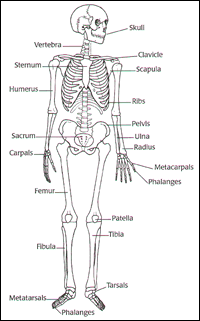
At the risk of introducing another screenwriting metaphor, I’ll say that structure is like your skeleton. It’s the framework on which you hang the meat of your story. If someone’s bones are in the wrong place, odds are he’ll have a hard time moving, and it won’t be comfortable. It’s the same with a screenplay. If the pieces aren’t put together right, the story won’t work as well as it could.
But here’s the thing: not every skeleton is the same.
Think about it in real-world terms.
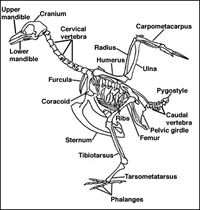
Human skeletons are pretty consistent, but you also have gazelles and giraffes, cockroaches and hummingbirds, each with a different structure, but all equally valid designs. The standard dogma about screenplay structure focuses on hitting certain moments at certain page numbers. But in my experience, these measurements hold true for Chinatown and nothing I’ve actually written.
My advice? Stop thinking about structure as something you impose upon your story. It’s an inherent part of it, like the setup to a joke. As you’re figuring out the story you want to tell, ask yourself a few questions:
- What’s the next thing this character would realistically do?
- What’s the most interesting thing this character could do?
- Where do I want the story to go next?
- Where do I want the story to end up eventually?
- Does this scene stand up on its own merit, or is it just setting stuff up for later?
- What are the later repercussions of this scene? How could I maximize them?
If you answer these questions at every turn, I guarantee you’ll have a terrifically structured screenplay. It might not hit predefined act breaks, but it will be consistently engaging, something that can’t be said for many “properly structured” scripts.


October 21st, 2004 at 2:36 am
Wow, brilliant advice! I feel like the shackles of Sid Field have finally been lifted. I’ve been struggling with my screenplay for a few weeks as it didn’t want to fit into the Chinatown mold - mainly because I’d been asking the right questions (more or less) and the answers didn’t tie up.
Now I know I’m not going mad, I can crack on and complete it as I think it should be done. Marvellous!
October 24th, 2004 at 1:52 pm
I find the Skeleton-metaphor very smart and exaustive…thank you. I think metaphors can help doing the work. I also think that we may appeal to structures when we do not feel the ‘rhythm’ of the story, isn’t it?
October 25th, 2004 at 1:45 am
My new project has the skeleton of a snake!
If you get stuck and your story doesn’t flow nicely then you might wanna check out the hero’s journey - very useful. THE WRITER’S JOURNEY book has a very helpful explaination.
November 3rd, 2004 at 12:05 pm
Hmmm…. this is really unconventional advice - most books say you’re supposed to introduce your metaphor in the first paragraph.
Seriously. Sound advice (as always from the site). It’s 2004 already, can we stop holding Chinatown up as the end-all be-all of story structure?
May 24th, 2005 at 1:34 pm
I like the skeleton metaphor. I think your story, once you know what it is, will dictate its own structure/skeleton. Certain conventions still hold true (for the most part, the old 3 act structure is useful), but a lot of it is bunk written by failed screenwriters. I have a dozen or so screenwriting how-to books on my shelf, only one I’d ever recommend to people. It’s called “Screenwriting Tricks of the trade” by Froug. It’s also the shortest! Read it. It’s excellent.
August 17th, 2005 at 1:01 am
I liked this metaphor too, build your own skeleton… It actually reminds me of this book I just read SCREENWRITING: THE SEQUENCE APPROACH (http://www.amazon.com/exec/obidos/tg/detail/-/0826415687/qid=1124265408/sr=1-2/ref=sr12/104-4577026-6827130?v=glance&s=books) While I know that John was plagued by complicated/annoying “sequence” methods at USC, this book guides you with what you should be thinking about to make your own structure, or skeleton. I too am not writing chinatown, and this book helped me keep a little structure so my script wouldn’t end up…well, spineless.
February 27th, 2006 at 1:40 pm
Your skeleton analogy is one of the best explanations of structure that I’ve heard in a long time…can I use that? ha ha
Seriously though, well put, my friend. Too much formula can be bad, but as we saw with “Million Dollar Baby” last year, it can also be very good. What matters in the end is whether or not “it works”.
thanks
May 2nd, 2006 at 8:13 pm
While I agree with what you say, I think it’s a dangerous comment for beginning writers. Heck, it’s a dangerous comment for experienced (though perhaps not professional) writers.
Somebody had said that there is a rhythm to stories, and I think that’s accurate. However, if you don’t read, write, learn about stories and what makes them work (or not work), then you’re more apt to fail and become discouraged.
Perhaps one of the benefits of writing for Hollywood is that you do get a ton of feedback and a crash course in discussions of story.
While I like the skeleton metaphor, I would ask, do you think that Hollywood is primarily interested in certain kinds of skeletons?
I believe that’s where much of the formula applies. If you want to write a script without rules, doing whatever you please, you are free to do so; however, the further you stray from what Chris Vogler calls the fairytale structure, the less Hollywood is interested.
Also, while many professionals enjoy tossing the rules aside, it’s not wise for newcomers to follow suit without knowing what the rules are and why they exist in the first place.
May 11th, 2006 at 3:16 pm
The skeleton is finally out of the screenplay. Thanks.
July 30th, 2006 at 12:32 pm
I think I am writing an octopus.
April 4th, 2007 at 10:12 am
I thought cockroaches didn’t have skeletons.
Freaking fantastic site. You’ve helped me out in many ways and this thread is no different. I did kind of get it on my own after many years of studying scripts and theories, but you’re explanation summed it all up.
April 6th, 2007 at 8:58 am
Dear God, thank you. I have been putting my soul into this script and it’s become so important to me, more so than anything else I’ve written, and it is the first time I’ve tried to really stick to the “structure” of it. I wanted to throw the whole thing in the Hudson River. I felt like I was cramming scenes in places they did not belong, just to hit a certain goal. So, I started using your skeleton idea and it’s all working. Thank you, thank you, thank you!
February 26th, 2008 at 3:03 am
What you just described is still a structure there, John - bones or no bones, chicken or snake.
It’s pretty dismaying when established writers pooh pooh this stuff because they’ve managed to crack it, can write naturally because they know it and somehow it becomes so second nature and invisible they think they’ve dismissed it altogether! I think it is important to learn structure and why it’s important, get it (like a lightbulb goes off in your head or some such cliche, but it’s true) but keep writing so much that one day it becomes second nature and you stop worrying about it.
Then John can start to worry as there’s more good competition out there