• Skip to primary navigation
  • Skip to main content
  • Skip to primary sidebar

John August

  • Arlo Finch
  • Scriptnotes
  • Library
  • Store
  • About

WGA

WGA election time again

August 31, 2010 WGA

WGAw members should now have received ballots for the Board election. It’s an important vote, because this Board will be setting the agenda for the next round of negotiations.

Reading through the seventeen candidate statements, I was happy to see such a quality crop of candidates, including many writers I know and admire. In making my choices, I’ll be looking for a balance of TV and feature writers at various levels of experience. A showrunner has a different perspective than a spec writer. Both are important.

[Craig Mazin](http://artfulwriter.com/?p=1089) has good suggestions, including a reminder on why you may want to vote a short list:

> “Hey, we’re supposed to vote for eight.” No…you can vote for up to eight. You don’t have to vote for eight. Indeed, if you really want these five to be elected, just vote for these five.

Voting for eight makes it less likely your top choices will make the cut.

I get nervous voting for slates. With the financial and creative issues facing the Guild, I’d rather see healthy debate than easy consensus.

In the non-candidate statements at the back of the book, you’ll see I endorsed two candidates: **Mark Gunn** and **Aaron Mendelsohn**. Both are excellent. Over the past few years, I’ve come to rely on each of them for honesty and pragmatism about WGA matters. I hope to see them returning to the board for another term.

Ballots are due September 16th.
Credits referendum overwhelmingly approved

June 19, 2010 Follow Up, WGA

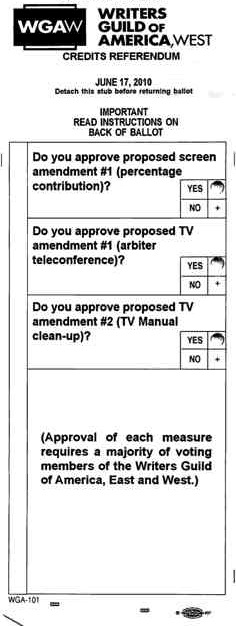
ballotThe WGA’s [three uncontroversial proposals](http://johnaugust.com/archives/2010/wga-credits-proposals) for amending the TV and screen credits process passed by a [large margin](http://wga.org/content/default.aspx?id=4090):

* Screen Proposal – Uniform standard for screenplay credit on non-original screenplays – 85.7% in favor of adopting the amendment (1,237 yes; 197 no)

* Television Proposal #1 – Arbiter Teleconference in the case of non-unanimous decision – 91.4% in favor of adopting the amendment (1,319 yes; 86 no)

* Television Proposal #2 – Consolidation, reformatting, and clarification of Television Credits Manual and Separation of Rights Manual – 92.9 % in favor of adopting the amendment (1,341 yes; 64 no)

Thanks to everyone who voted.

Producers, managers and deals

June 9, 2010 Film Industry, QandA, WGA

questionmarkAfter a year of development with my managers/producers, my script just landed a director. But the “package” we’re putting together is still floating in the ether.

As we now enter another round of notes in an effort to find an actor for our film, I’m suddenly left with the real question of payment — when a studio eventually buys the script, package intact, how much can I hope to earn, and whom do I trust to negotiate the sale?

I have no agent at this point. My manager is very well-connected and on the up-and-up, but as he will take a producing credit for this film, I know he’s after his own interests as well as mine, and I want to make sure he’ll get me the highest possible paycheck for my efforts. Can I trust him to do so?

The line between manager and producer seems a blurry one. Assuming the film’s budget is around $15M and I’m a first-time writer, what can I expect?

— Lee
Los Angeles

Ready? The answer is $86,156.

That’s currently [WGA scale](http://wga.org/uploadedFiles/writers_resources/contracts/min2008.pdf) for an original screenplay. At $15 million, your movie would very likely be made for a company that’s a WGA signatory, and would fall in the “high” budget category. ((Movies with smaller budgets — and microbudgets — can be made under other WGA terms with different rates.)) All of the major studios are signatories, as are most of the production companies you’ve heard of. If you’re with one of these places, the least they can pay you is WGA scale, and you’re automatically a member of the guild. ((Some buyers have non-signatory divisions specifically to get around these requirements, enabling them to hire non-WGA writers for less. But if your producer-manager allows this to happen, he should be run out of town. Your director is probably DGA. Whatever actor you’re attaching will be SAG. You should be WGA.))

So that’s how much you should expect to earn. Should you hope to get more? Yes. And maybe you will, especially if you have multiple interested buyers. But I’d urge you to emotionally condition yourself for that number and be delighted with anything above it.

If a deal comes together quickly, use an entertainment attorney to negotiate on your behalf. You’re right to wonder whether what’s best for the producer-manager is necessarily best for you. It’s an uncomfortable conflict of interest at times. But your interests are absolutely aligned in one way: **you really, really want to get this movie made.** A slightly better offer from a place you don’t believe will make and distribute your movie isn’t a better offer at all.

Once your project starts getting attention — you sign an actor, some deals look possible — you’ll find it easier to start talking to agents. Your manager should be making introductions. Buyers and actors’ agents might have suggestions. Once you sign with an agent, he or she will start making deals on your behalf in concert with your manager and attorney. But it’s not an essential component right now.

It’s scary and exciting think about What Might Be, but far more important is the work in front of you.

Keep writing. I know far too many screenwriters who pinned all their hopes on one script that never quite found footing. The actual career is getting to paid to write, not selling specs.

WGA credits proposals on the ballot

May 24, 2010 WGA

If you’re a WGAw member, you probably got a ballot in the mail over the weekend. There are three proposals, all amendments dealing with credit determination.

If this topic makes your eyes glaze over, just vote YES on all three. They’re not remotely controversial.

wga credits ballotScreen Amendment #1 affects screen credits for feature films.

Under the current rules, if a writer takes a director or producer credit on a film, she risks losing her writing credit. She’s considered a “production executive” and held to a 50% threshold rather than the normal 33%. This proposal would level the playing field when it comes to non-original screenplays — that is, adaptations of previously existing work. Any writer working on a non-original screenplay would need to have written a third of it to receive credit.

Screen Amendment #1 leaves in place the rules with regards to spec scripts. “Production executives” who rewrite someone else’s original screenplay (a spec) must demonstrate that they wrote more than 50% of it to receive writing credit.

TV Amendment #1 allows for the arbitration panel to teleconference. Having been an arbiter, I can promise you this is a good idea. It allows arbiters to maintain anonymity while reaching consensus on proper writing credit. Without a teleconference, it ends up being a lot of little phone calls and confusion.

TV Amendment #2 cleans up the language in the TV credits manual. The ballot pamphlet shows the red-lining.

« Previous Page
Next Page »

Primary Sidebar

Newsletter

Inneresting Logo A Quote-Unquote Newsletter about Writing
Read Now

Explore

Projects

  • Aladdin (1)
  • Arlo Finch (27)
  • Big Fish (88)
  • Birdigo (2)
  • Charlie (39)
  • Charlie's Angels (16)
  • Chosen (2)
  • Corpse Bride (9)
  • Dead Projects (18)
  • Frankenweenie (10)
  • Go (29)
  • Karateka (4)
  • Monsterpocalypse (3)
  • One Hit Kill (6)
  • Ops (6)
  • Preacher (2)
  • Prince of Persia (13)
  • Shazam (6)
  • Snake People (6)
  • Tarzan (5)
  • The Nines (118)
  • The Remnants (12)
  • The Variant (22)

Apps

  • Bronson (14)
  • FDX Reader (11)
  • Fountain (32)
  • Highland (73)
  • Less IMDb (4)
  • Weekend Read (64)

Recommended Reading

  • First Person (87)
  • Geek Alert (151)
  • WGA (162)
  • Workspace (19)

Screenwriting Q&A

  • Adaptation (65)
  • Directors (90)
  • Education (49)
  • Film Industry (490)
  • Formatting (130)
  • Genres (89)
  • Glossary (6)
  • Pitches (29)
  • Producers (59)
  • Psych 101 (118)
  • Rights and Copyright (96)
  • So-Called Experts (47)
  • Story and Plot (170)
  • Television (165)
  • Treatments (21)
  • Words on the page (237)
  • Writing Process (177)

More screenwriting Q&A at screenwriting.io

© 2025 John August — All Rights Reserved.