• Skip to primary navigation
  • Skip to main content
  • Skip to primary sidebar

John August

  • Arlo Finch
  • Scriptnotes
  • Library
  • Store
  • About

Search Results for: outline

Symphonies and screenplays

August 5, 2011 Story and Plot

Roger Kamien’s description of the sonata form, a building block of the classical symphony, will seem familiar to screenwriters:

> The amazing durability and vitality of sonata form result from its capacity for drama. The form moves from a stable situation toward conflict (in the exposition), to heightened tension (in the development), and then back to stability and resolution of conflict. The following illustration shows an outline:
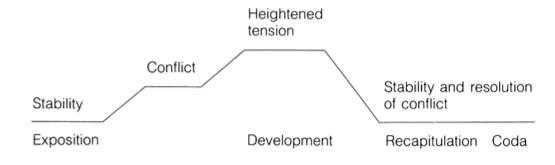
This line of rising action is also the basis of modern screenplay structure.

No matter how you dress it up with templates and turning points, most movies work this way: you meet your players and themes, set them against each other, let things get rough, then find a new normal.

> Sonata form is exceptionally flexible and subject to endless variation. It is not a rigid mold into which musical ideas are poured. Rather, it may be viewed as a set of principles that serve to shape and unify contrasts of theme and key.

With its long arcs and built-in act breaks, I’d argue that TV writing is even more symphonically-structured than features. Showrunners are our composers; Hollywood is our Vienna.

(I’m reading Kamien’s book on [Inkling](https://www.inkling.com/store/music-roger-kamien-7th/) for iPad, which is a remarkably good way to handle a textbook about music. The built-in tracks and listening outlines are ingenious. The chapter on classical music is currently free, and highly recommended.)

Writing Movies for Fun and Profit

July 13, 2011 Books, Stuart

I don’t read many screenwriting books, but Stuart does. So I’ve asked him to start reviewing some.

——

by_stuartAs you would expect from two members of The State, Thomas Lennon & Robert Ben Garant’s *Writing Movies for Fun and Profit* is very entertaining.

It is also full of good information for aspiring screenwriters hoping to write studio movies.

The book is significantly less blithe than its [Funny or Die promo video](http://www.funnyordie.com/videos/5f1df15cc3/writing-movies-for-fun-and-profit), but it is still light in tone. Topics run the gamut, from basic 101s, like story structure (“If Your Screenplay Doesn’t Have This Structure, It Won’t Sell, Or Robert McKee Can Suck It.”), to a step-by-step explanation of how an unpaid intern can make or break your script’s shot with a major.

Some of the seemingly less serious chapters in that same vein are some of the book’s most useful. Lennon & Garant provide a fun and surprisingly helpful studio-by-studio breakdown of how to tell what your employer thinks of you based on your assigned parking spot:

> PARAMOUNT
>
>Important = Melrose gate, VALET. […] Ask the guy in the car next to you if he happens to have some Grey Poupon. He won’t laugh, because almost nobody remembers those commercials anymore.
>
>Not Important = The open parking lot that’s JUST TO THE LEFT of the Valet. You’ll find a spot, sure. And it’s out in the open, under the big fake panorama of sky, no real shame in that … BUT YOU’RE ALSO CLOSE ENOUGH TO THE VALET TO KNOW THAT YOU WEREN’T ALLOWED TO PARK THERE. Yep. And there’re so many open spots in the Valet area? Well, you fell just short of making that list. Chew on that as you walk the extra 300 feet to your car.

In a later chapter, they dispense advice on what to say if a star giving you notes brings up or compares your script to one of her previous flops:

>It’s best not to discuss flops at all. BUT, if they come up, YOU SHOULD HAVE ONE POSITIVE DETAIL ABOUT THEM TO DISCUSS.
>
>For example: you’ve just sat down in the trailer of, say, JENNIFER LOPEZ […]

JENNIFER LOPEZ

Wow. I can’t believe how crappy Gigli turned out.

YOU

I dunno, I thought you looked great in those fight scenes.

JENNIFER LOPEZ

Ha, thanks. I worked really hard on those. Now here’s my notes ...

>Whew! Nice save.

Another particularly useful section breaks down WGA credits and what each means in terms of dollars, with a detailed explanation of the arbitration process and strategies for winning.

The appendix provides three sample outlines, one of which is the treatment/script/plan for the unproduced Reno 911!: Miami sequel. For any Reno fan jonesing for new content, this alone makes the purchase worthwhile.

Newly arrived in Los Angeles

July 12, 2011 First Person, Los Angeles

Matthew Hickman was born and raised in rural Georgia. After dropping out of law school, he started working an hourly-wage job at a UPS store, and saved money for a year in hopes of moving to Los Angeles to begin a screenwriting career.

Several months ago he arrived in Santa Monica, where he now works at another UPS store, writing in his off hours. He recently published a [novella on Amazon Kindle](http://www.amazon.com/gp/product/B004LLIEZW/ref=as_li_ss_tl?ie=UTF8&tag=johnaugustcom-20&linkCode=as2&camp=217145&creative=399349&creativeASIN=B004LLIEZW”) and has just started work on his second feature length script.

—-

first personmatthew hickmanI want to stress my beginnings here because I know that for many of you, getting to L.A. is the battle before the battle. I think many of John’s readers may have a sensation similar to what I felt in the time I read this blog before I moved to L.A., and that’s one of isolation. In the middle of reading all this talk about getting an agent, pitches, script revisions, options, treatments, and copyrights, many of you probably feel left apart entirely from the ability to act on your ambitions. I know I did.

How it starts
—-

As I sit here in my two hundred square foot studio, water is boiling on the stove. I live in a guest house attached to someone’s guest house. I’m not completely broke, but I do eat a lot of spaghetti these days. I don’t have much money to go out with friends, much less go out looking for them.

On the other hand, I recently paid eleven bucks to see a screening of The King’s Speech followed by a Q&A with David Seidler, Tom Hooper, Colin Firth, and Helena Bonham-Carter. The next week it was Darren Aronofsky between screenings of Black Swan and Pi. At my day job I’ve had conversations with Marcus Dunstan, Lester Lewis, and others about advice for new writers. I’ve met Jessica Biel without knowing it, and walked by Paul Haggis on an empty sidewalk on a Sunday afternoon. If I hadn’t been wearing a Cookie Monster t-shirt at the time (don’t ask), I probably could have exchanged a few words with him about what it takes to succeed here. Lastly (and most importantly), I’ve met countless other transplants from Normalville, USA looking to carve out their place in the entertainment industry.

All this has happened during my first four months in Los Angeles. These are a few of the trade-offs I’ve gladly made for a shot at what most of you reading this column want: to be a screenwriter.

Unlike a lot of the first-person columns you’ve been reading the last few months, I haven’t accomplished much yet as a screenwriter. I don’t have any writing credits to my name, none of my work has been optioned. Hell, I don’t even have an IMDb profile. But I have made one significant step toward that dream of being a working writer we all harbor: I made the jump and moved to Los Angeles.

For those unconvinced about the benefits of moving here, see the above paragraph for examples of why you should rethink your position. I’m not just namedropping (Jessica Biel aside).  If a guy freshly transplanted from the foothills of Appalachia can run into all these people, imagine who you could meet here.

And I don’t even have a car.

[Read more…] about Newly arrived in Los Angeles

The only ache should be in your soul

May 19, 2011 QandA, Writing Process

questionmarkI write six days a week, four hours a day. I’m putting together a portfolio for when I move out to L.A. next year. I’ve finished a musical comedy, am in the middle of a comedy drama, and have two children’s films outlined and in the queue. (One of which I’ve already written as a 35,000 word children’s novel.) So I’m on a surprisingly strict writing schedule considering I have no “real” deadlines.

My question to you is: Do your hands hurt?

Mine definitely ache. I stretch and ice them and beg for hand massages from friends and loved ones. I take ibuprofen, etc. I’m trying to determine if this is normal or if I should be freaking out?

Athletes live with a certain amount of pain for what they love. Same for professional writers?

Do you do anything special to take care of your hands?

— Asher Noël

answer iconTake it seriously. I’ve had problems in the past, and regretted waiting as long as I did to do something about it.

At my worst, not only would my hands hurt, my arms would go dead every night. Beyond pins-and-needles. I’d wake up with zombie appendages attached to my body. I’d have to flop over to get blood flowing into them.

I’m better now.

A Google search on ergonomics or carpal tunnel syndrome will give you a ton of information — too much information, probably — but I can synthesize it down for you thusly:

1. __You need to check your setup.__ Feet on the floor, arms at a comfortable 90-or-so degrees. I strongly believe in arm rests, but different things work for different people. Your typing surface probably needs to be a lot lower than you think. My desk lowers to just two inches above my knees. Everyone has different opinions on chairs. I’ve found the expensive ones aren’t necessarily better. Try a bunch.

2. __You need to change your keyboard.__ I use [this one](https://www.amazon.com/SafeType-Keyboard-Black-Color-V902/dp/B0049PFYWQ/ref=cm_cr_arp_d_product_top?ie=UTF8), which rightfully scares people, but I find works great. You may need to try a bunch of different ergonomic keyboards before you find one that works.

3. __You need to take breaks.__ A lot of them. Walk around. You’ll actually get more done if you’re not staring at the screen the whole time.

4. __Like crutches, gloves can help, but they’re not fixing the problem.__ These [Handeze support gloves](http://www.amazon.com/gp/product/B00009LI88/ref=as_li_ss_tl?ie=UTF8&tag=johnaugustcom-20&linkCode=as2&camp=217145&creative=399349&creativeASIN=B00009LI88) saved my life, but I’m happy not to need them now.

When it was really bad, I considered surgery. I’m glad I didn’t do it. I didn’t need it.

You won’t always be writing as much as you are now. But try to get into good habits now.

« Previous Page
Next Page »

Primary Sidebar

Newsletter

Inneresting Logo A Quote-Unquote Newsletter about Writing
Read Now

Explore

Projects

  • Aladdin (1)
  • Arlo Finch (27)
  • Big Fish (88)
  • Birdigo (2)
  • Charlie (39)
  • Charlie's Angels (16)
  • Chosen (2)
  • Corpse Bride (9)
  • Dead Projects (18)
  • Frankenweenie (10)
  • Go (29)
  • Karateka (4)
  • Monsterpocalypse (3)
  • One Hit Kill (6)
  • Ops (6)
  • Preacher (2)
  • Prince of Persia (13)
  • Shazam (6)
  • Snake People (6)
  • Tarzan (5)
  • The Nines (118)
  • The Remnants (12)
  • The Variant (22)

Apps

  • Bronson (14)
  • FDX Reader (11)
  • Fountain (32)
  • Highland (75)
  • Less IMDb (4)
  • Weekend Read (64)

Recommended Reading

  • First Person (87)
  • Geek Alert (151)
  • WGA (162)
  • Workspace (19)

Screenwriting Q&A

  • Adaptation (65)
  • Directors (90)
  • Education (49)
  • Film Industry (489)
  • Formatting (128)
  • Genres (89)
  • Glossary (6)
  • Pitches (29)
  • Producers (59)
  • Psych 101 (118)
  • Rights and Copyright (96)
  • So-Called Experts (47)
  • Story and Plot (170)
  • Television (165)
  • Treatments (21)
  • Words on the page (237)
  • Writing Process (177)

More screenwriting Q&A at screenwriting.io

© 2026 John August — All Rights Reserved.