• Skip to primary navigation
  • Skip to main content
  • Skip to primary sidebar

John August

  • Arlo Finch
  • Scriptnotes
  • Library
  • Store
  • About

Search Results for: espenson

Screenbloggers, live

December 3, 2007 Strike

I’ve enjoyed meeting and picketing with my readership, but it got me wondering: What would happen if a major portion of the screenblogosphere all got together in one place? Let’s find out.

This Wednesday, [Craig Mazin](http://artfulwriter.com/), [Jane Espenson](http://www.janeespenson.com/), [Josh Friedman](http://hucksblog.blogspot.com/) and I will all be picketing the 8-11 a.m. shift at Warner Bros., gate 2/3.

It’s your perfect opportunity to ask Josh about his dead bees, Craig about crazy rumors, and Jane about lunch.
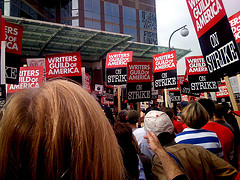
Strike, day five

November 10, 2007 Strike

fox plazaYesterday was the big rally at Fox Plaza, drawing 4,000 protesters to Century City for speeches in front of the Die Hard building.

Zack de la Rocha and Tom Morello of Rage Against the Machine kicked it off with a set, followed by remarks from…

* Jesse Jackson
* WGA president Patric Verrone
* WGA negotiating committee chairman RobJohn Bowman
* WGA executive director David Young
* SAG president Alan Rosenberg
* Family Guy creator Seth MacFarlane, and
* Norman Lear

I’m listing the speakers because unless you were standing pretty close, you’d have had no idea who was talking. Between the picket signs, the helicopters, and an under-powered amplifier, probably half the gathered crowd only cheered because they heard others cheering.

Still, the mood was quite celebratory. It was amazing to see that many writers in one place. I bumped into many people I forgot I knew. Probably my biggest happiness was introducing myself to [Jane Espenson](http://www.janeespenson.com/), whose blog on TV spec writing is so generous I feel the entire town owes her dinner.

Jane shared with me the plight of young writers caught in the prestigious Disney Fellows program. Disney is requiring these non-WGA writers to keep showing up to write their specs — crossing the picket line and jeopardizing their hopes of ever joining the WGA. (If you’re one of these fellows, please write in, anonymously if you need to. This is bullshit apparently getting resolved. See the update.)

I forgot to get a picture with Jane, but remembered in time for a few other snapshots, which I [put up on Flickr](http://www.flickr.com/photos/johnau8ust/sets/72157603071186641/).

**Update:** Jane wrote in with encouraging news:

Hi. My current understanding is that the Guild and Disney and their Fellows are all working together on some kind of solution as we speak. This Fellowship gave me my start and I believe in it and the people who run in. As I think about it now, I’m certain that the right thing will be done and no one will be required to either cross the line or to resign their fellowship. There are only three months left in the term of the fellowship anyway — certainly they will let the kids collect the small amount of pay and benefits owed to them and not give up any chance of ever working again. I have faith in the people involved in this extraordinary program. I’d suggest that we stay cool on this issue while they work out the details.

There’s a lot of talk about “cooler heads prevailing,” but it’s great to hear an example of this actually happening. Thanks for the update.

How to write a scene

January 9, 2007 Words on the page, Writing Process

One of the thing I admire most about [Jane Espenson’s blog](http://www.janeespenson.com/) is that she talks very directly about the words on the page, giving names to techniques I use but never really think about. The [two-percenter](http://www.janeespenson.com/archives/00000251.php), for example.

So one of my goals for 2007 is to get a little more granular in my advice-giving, and talk less about Screenwriting and more about screenwriting — in particular, scene writing.

Spend a few years as a screenwriter, and writing a scene becomes an almost unconscious process. It’s like driving a car. Most of us don’t think about the ignition and the pedals and the turn signals — but we used to, back when we were learning. It used to flummox the hell out of us. Every intersection was unbelievably stressful, with worries of stalling the car and/or killing everyone on board.

It’s the same with writing a scene. The first few are brutal and clumsy. But once you’ve written (and rewritten) say, 500 scenes, the individual steps sort of vanish. But they’re still there, under the surface. It’s just that your instinct is making a lot of the decisions your conscious brain used to handle.

So here’s my attempt to introspect and describe what I’m doing that I’m not even aware I’m doing. Here’s How to Write a Scene.

1. Ask: What needs to happen in this scene?
===
Many screenwriting books will tell you to focus on what the characters want. This is wrong. The characters are not responsible for the story. You are. If characters were allowed to control their scenes, most characters would chose to avoid conflict, and movies would be crushingly boring.

The question is not, “What could happen?” or “What should happen?” It is only, “What needs to happen?” If you wrote an outline, this is the time to look at it.I’m neither pro nor anti-outline. They can be a useful way of figuring out how the pieces might fit together. They’re nearly essential in television, where many minds need to coordinate. But sticking too closely to an outline is dangerous. It’s like following Google Maps when it tells you to take Wilshire. If you didn’t, just come up one or two sentences that explain what absolutely must happen in the scene.

2. Ask: What’s the worst that would happen if this scene were omitted?
===
Imagine the projectionist screwed up and accidentally lopped off this scene. Would the movie still make sense? If the answer is “yes,” then you don’t really need the scene, and shouldn’t bother writing it.

But it’s so dramatic! you say. But it’s so funny!

Tough. Put that drama or that comedy into scenes that are crucial to the movie.Do my own scripts hold up to this (admittedly harsh) standard? Yes, largely, but feel free to correct me where you disagree. Big Fish has quite a few meanders and detours, but that’s very much on-topic — it’s the reason the son is so frustrated. One thing you learn after a few produced movies is that anything that can be cut will be cut, so put your best material into moments that will absolutely be there when it’s done.

3. Ask: Who needs to be in the scene?
===
Scripts are often clogged with characters who have no business being there. But because words are small, it’s easy to overlook that “Haversmith” hasn’t said or done anything for five pages. And sadly, sometimes that’s not realized until after filming.As an example: Kal Penn in Superman Returns. He’s basically an extra.

4. Ask: Where could the scene take place?
===
The most obvious setting for a scene is generally the least interesting, so don’t be too quick to set your scene in the police bullpen, a living room, or a parking garage. Always consider what the characters could be doing, even if it’s not directly related to the focus of the scene. A father-and-son bonding moment at a slaughter house will play differently than the same dialogue at a lawn bowling tournament.

5. Ask: What’s the most surprising thing that could happen in the scene?
===
Give yourself permission to step away from your outline and consider some wild possibilities. What if a car smashed through the wall? What if your hero choked and died? What if a young boy vomited up a finger?

Most of your scenes won’t have one of these out-of-nowhere aspects. But your movie needs to have a few moments that are completely unexpected, so always ask yourself, could this be one of them?

6. Ask: Is this a long scene or a short scene?
===
There’s nothing so dispiriting as writing a great three-page mega-scene and realizing that you could have accomplished just as much in two-eighths of a page.Scenes are measured in eighths. You really do say two-eighths, not one-quarter. So ask yourself up front: How much screen time am I willing to give to this scene?

7. Brainstorm three different ways it could begin.
===
The classic advice is to come into a scene as late as you possibly can. Of course, to do that, you really need to know how the previous scene ended. There’s often a natural momentum that suggests what first image or line of dialogue would be perfect to open the scene. But don’t stop at the first option. Find a couple, then…

8. Play it on the screen in your head.
===
At least 50% of screenwriting is simply sitting there with your eyes closed, watching the unwritten scene loop in your head. The first couple of times through, it’s really rough: a blocking rehearsal. But eventually, you start to hear the characters talk to each other, and the vague motions become distinct actions. Don’t worry if you can’t always get the scene to play through to the end — you’re more likely to find the exit in the writing than in the imagining.

Don’t rush this step. Let the scene percolate. Mumble the dialogue. Immerse yourself as fully into the moment as you can.

9. Write a scribble version.
===
A “scribble version” is essentially a cheat sheet so you’ll remember the great scene you just saw in your head. Don’t write sentences; don’t write full dialogue. It shouldn’t take more than five minutes. Just get the bare minimum down so that you won’t forget the scene in the next hour as you’re writing it.

I generally hand-write a scribble version in tiny print — sometimes literally on the back of an envelope — but you can also type. This is what a scribble version consists of for me:

  • DUNCAN waiting edge of seat
  • ITO
  • I was one of the doctors who worked on your wife
  • accident
  • injuries severe, trauma team, sorry, couldn’t save her
  • (sits, reflex)
  • nature of injuries, concern fetus wouldn’t survive in utero. paramedic able deliver caesarian boy healthy
  • (nodding not hearing)
  • nurse can take you to see him, know a lot to handle
  • what
  • a lot to handle
  • take me to see him?
  • yes
  • see who?
  • your son. paramedic was able to
  • (grabs clipboard)
  • I know this may seem
  • My wife wasn’t pregnant
  • Your wife didn’t tell you…
  • My wife has never been pregnant. been trying three years. fertility clinic last week
  • I examined the baby myself. nearly at term.
  • I don’t know whose baby, not hers.

It’s kind of a mess, and really wouldn’t make sense to anyone but me — and only shortly after I wrote it. But that doesn’t matter. The scribble version is only there so you don’t get lost or confused while writing the full version of the scene. Yes, it’s finally time to…

10. Write the full scene.
===
If you typed up the scribble version, don’t just try to fatten it out. Start clean. The scribble version is deliberately crappy, and rewritten crap is still crap.

The scribble version is your outline for the scene. Yes, allow yourself the chance to detour from your scribble version if a truly better idea comes along. But if you’ve really spent the time to play it through in your head (#8), it’s probably on the right track already.

Depending on the nature of the scene, getting the dialogue right may be most of the work. Regardless, focus on choosing the best words to describe the characters, the action and tone, so your readers will see the same scene in their heads.

11. Repeat 200 times.
===

Turns out, he was busy reconsidering Tyra Banks

July 28, 2006 First Person, Los Angeles

You know how you can go months without seeing someone, then suddenly, they’re everywhere? This morning as I was getting into my little Prius, screenwriter/neighbor/inconstant blogger [Josh Friedman](http://hucksblog.blogspot.com/) rolled up in the Death Star Escalade to discuss our respective children’s nap schedules in anticipation of a playdate.

Yeah, I said playdate. This is how we roll in the Southside.

Of Hancock Park.

I suspect Josh was taking his family to BLD (“Breakfast, Lunch, Dinner”), the new restaurant that took over where Red used to be, and is pretty much exactly like Red but white instead, and without those Mexican Cokes.

In typing that, I realize that I’ve now lived in L.A. long enough that I expect everyone to share my specific geo-cultural references. Or, more bluntly, I’ve now lived here long enough to stop caring when they don’t. It only takes a New Yorker six months to become this jaded. Los Angeles takes a decade.

Later today, I followed a link to the [trailer](http://trailers.apple.com/trailers/universal/theblackdahlia/) for Josh’s upcoming movie, The Black Dahlia. I don’t know how he got his name in red in the credit block, but from now on I’m putting that in my contract. I want red and a little box around it.

Upon checking the feeds this evening, I see Josh has finally posted [something new](http://hucksblog.blogspot.com/2006/07/snakes-on-motherfucking-catwalk.html) on the blog. And while I’d like to take credit for this rare occurrence, the more pressing matter is addressing some corrections/clarifications:

* My assistant does not bring me breakfast, though he often brings lunch. (However, I do not [blog about](http://www.janeespenson.com/) it.)

* In daily life, my house is light-filled like a Richard Curtis movie. However, to achieve the look of this on film for The Movie required giant lights and hard gels velcro-ed to all the doors and windows.

As Tyra knows, beauty takes work.

That’s all.

« Previous Page
Next Page »

Primary Sidebar

Newsletter

Inneresting Logo A Quote-Unquote Newsletter about Writing
Read Now

Explore

Projects

  • Aladdin (1)
  • Arlo Finch (27)
  • Big Fish (88)
  • Birdigo (2)
  • Charlie (39)
  • Charlie's Angels (16)
  • Chosen (2)
  • Corpse Bride (9)
  • Dead Projects (18)
  • Frankenweenie (10)
  • Go (29)
  • Karateka (4)
  • Monsterpocalypse (3)
  • One Hit Kill (6)
  • Ops (6)
  • Preacher (2)
  • Prince of Persia (13)
  • Shazam (6)
  • Snake People (6)
  • Tarzan (5)
  • The Nines (118)
  • The Remnants (12)
  • The Variant (22)

Apps

  • Bronson (14)
  • FDX Reader (11)
  • Fountain (32)
  • Highland (74)
  • Less IMDb (4)
  • Weekend Read (64)

Recommended Reading

  • First Person (87)
  • Geek Alert (151)
  • WGA (162)
  • Workspace (19)

Screenwriting Q&A

  • Adaptation (65)
  • Directors (90)
  • Education (49)
  • Film Industry (489)
  • Formatting (128)
  • Genres (89)
  • Glossary (6)
  • Pitches (29)
  • Producers (59)
  • Psych 101 (118)
  • Rights and Copyright (96)
  • So-Called Experts (47)
  • Story and Plot (170)
  • Television (165)
  • Treatments (21)
  • Words on the page (237)
  • Writing Process (177)

More screenwriting Q&A at screenwriting.io

© 2026 John August — All Rights Reserved.