• Skip to primary navigation
  • Skip to main content
  • Skip to primary sidebar

John August

  • Arlo Finch
  • Scriptnotes
  • Library
  • Store
  • About

Search Results for: book rights

Selling novel rights

August 13, 2007 Film Industry, QandA, Rights and Copyright

questionmarkI am a small publisher that specializes in republishing long out of print books, and I am trying to find out the best way to somehow bring these books to the attention of those who might want to turn them into movies.

I am not in the “biz”, but I was recently “cold-called” by one major producer to obtain the rights to one of my titles. Unfortunately, I do not hold the rights, but have been doing my best to be very helpful (i.e. kissing ass), in hopes that there or more titles of interest. Long story short, he found the book because it is one of his favorites, but does not seem to have an interest in any others.

I have a whole slew of similar titles that I think would make great movies, and I made my “nickel pitch” to the producer: they have Tom Clancy like plots, without Tom Clancy like advances; “Thanks, but I’ll get back to you.”

My specialty is that these books are still copyrighted, but people have given up on reprinting them because the rights-holders or heirs are too hard to find. In my case, I am able to find them and secure the rights.

What would be the best way of getting these books in front of the right people to see if they would like to option them? Also, if there is a proscribed process, what are some standard terms that are used in the business?

— Jamie
St. Pete, FL

Assuming you really have film/television rights to these books, and not just publishing rights, I think you may have stumbled onto a potentially lucrative situation. But it’s going to take a lot of work and patience on your end.

What you have is a form of [intellectual property](http://en.wikipedia.org/wiki/Intellectual_property) — the right to exploit specific literary material. It’s not tangible, but in many ways it’s the same as a piece of physical property. Your Tom Clancy-like book is the equivalent of a few acres of pristine beach property.

The problem is, Tom Clancy is like Malibu. People want property in Malibu, because they know where that is. Their friends have houses there. It has a reputation.

Your book is like an oceanfront property in South America. It might be fantastic, but people don’t know what to make of it. It has no reputation. All it has going for it is its view. So how do you sell it?

By finding someone looking to buy a property like Malibu, but much less expensive.

Who are these potential buyers? In television, I would target the production companies behind shows like Burn Notice, The Wire and The Shield. For features, I would go after directors’ production companies, particularly directors who haven’t had a big movie in a couple of years. And don’t forget screenwriters. If there’s a writer whose work you especially admire — one who is not me — contact them through their agency. It’s fairly common for established screenwriters to set up books at the studios, functioning as their own producers during the adaptation. (That was how BIG FISH got started.)

You could do worse than talking with an entertainment law firm — preferably with a Beverly Hills address. They’re the people who would ultimately make the deal, and would have a good sense of both the process and the opportunities. Depending on how many titles you have, it might be possible to sell (or option) the rights as a block to a producer.

The first step is making it easy to show what you’ve got. You’ll want a written synopsis of each of the books, along with blurbs and quotes. You’ll need both a web and print version. Pay someone good to design it: presentation counts. I’d include downloadable .pdfs of the first chapter for each, assuming they really are good books. And get consider getting a mailing address that isn’t St. Pete, Florida. (Or at least, don’t include the Florida address on any of your materials.)

And when you’ve done all this, be sure to write back in. I have a feeling many of the potential buyers for your books are readers of this blog. (Or more specifically, their assistants read this blog.)
Finding out if a book has been optioned

April 30, 2007 Adaptation, QandA, Rights and Copyright

questionmarkWhat is the best way to find out if a novel has been optioned for a film/screenplay?

–Jon Hanemann
Union City, NJ

I could swear I’ve answered this question before. But in 30 seconds of searching, I couldn’t find my previous answer, so it’s unlikely you could. And it’s so simple, I might as well answer it again.

1. Open the book to the publishing/information page.
2. Note the publisher.
3. Call 212.555.1212. This is New York City information.
4. Ask for the phone number for that publisher.
5. Call that number.
6. Ask for “subrights, please.”
7. You’ll likely get a voicemail telling you to fax your request. Follow their instructions.
8. In your faxed letter — or in the event you connect with a live person — explain that you’re trying to track down film and television rights to THIS GREAT NOVEL by This Author.

You may need to follow up a week or two later, but you’ll eventually get contact information for the author, her agent or attorney. You then write to them to ask.

What if it’s not a New York publisher, or not a US publisher, or some other special case? You can almost always find someone who knows something. Eventually, you need to get through to the author or her representatives. They’re the only people who will really know the status.

Copyright: The Comic Book

March 16, 2006 Rights and Copyright

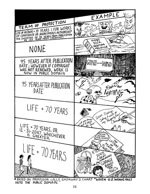
[comic book](http://johnaugust.com/Assets/publicdomain.jpg)It seems every fourth question I get has the word “rights” in it: “Do I need the rights to…”, “How do I get the rights to…”, “Im not a gud speller I like to rights…”

Reader Chris Little wrote in to point out this terrific comic book — [Tales from the Public Domain: BOUND BY LAW?](http://www.law.duke.edu/cspd/comics/index.html) It’s prepared by Duke University’s Center for the Study of the Public Domain. Not only does it describe situations where you have to be careful, it points out the absurdities of modern copyright law, where a cell phone ringing in the background can cost you $10,000.

A lot of the information skews toward documentary filmmaking, but it’s useful for anyone interested in portraying reality, and the near-impossibility of doing it as long as everything is protected by copyright.

You can read it all (for free!) [here](http://www.law.duke.edu/cspd/comics/index.html).

Optioning your book

September 10, 2003 QandA, Rights and Copyright

I have submitted a book to a producer. This is my first book,
but they are wanting to make it. What can I expect as far as monetary compensation
for the
rights to the story being that I am an unknown author?

–Alma

The short answer is, not a lot. The long answer is more complicated.

When a producer buys the rights to a short story or book, usually what is
being purchased is the option on the rights. What this means is that the producer
is buying the right to buy the rights at a later time. He’s saying, "I’m
gonna pay you $1000 today. In exchange for that $1000, you promise you won’t
sell anyone else the rights during the next twelve months. Also, any time during
these twelve months, I can pay you $25,000 and you’ll sell me all the film
rights to the book."

In this example, $1000 is the option price, and $25,000 is the full purchase
(or buyout) price. But those are completely arbitrary numbers. Often the option
price is just $1. Sometimes the full purchase price is $1 milllion. And the
length of the option can vary as well, from six months up to two years or more,
perhaps with a clause allowing the producer to renew the option at fixed price.

In short, the dollars and dates can be anything, but the basic structure of
the deal is the same.

By why does a producer bother with an option? Why not just put down the full
purchase price at the start?

Because it’s a risk. Lots of things can and will go wrong in the process of
trying to make a movie, and the less a producer has to put down up front, the
safer it is. And in many ways, an option protects the original writer as well.
If the producer isn’t able to get the project made, the option expires and
the writer gets all claim back to her work. She even gets to keep the money.
She can set up the book with a different producer and do the whole thing all
over again.

So how much can you, Alma, hope to make from the book this producer wants
to buy? Unless there are a lot of other buyers interested in it, nothing is
going to drive the price up. And since you don’t have any track record of being
paid a certain amount for your work – what’s called a quote – there’s really
no minimum to expect.

At this level, you should expect a low option price, with the possibility
of a bigger full purchase price. I can’t see any advantage to selling out all
rights to the book at this point, because you’d then be giving this producer
the rights forever, and for not a lot of money.

In this situation, you’re mostly just dealing with how much faith you put
in this producer to get the movie made.

« Previous Page
Next Page »

Primary Sidebar

Newsletter

Inneresting Logo A Quote-Unquote Newsletter about Writing
Read Now

Explore

Projects

  • Aladdin (1)
  • Arlo Finch (27)
  • Big Fish (88)
  • Birdigo (2)
  • Charlie (39)
  • Charlie's Angels (16)
  • Chosen (2)
  • Corpse Bride (9)
  • Dead Projects (18)
  • Frankenweenie (10)
  • Go (29)
  • Karateka (4)
  • Monsterpocalypse (3)
  • One Hit Kill (6)
  • Ops (6)
  • Preacher (2)
  • Prince of Persia (13)
  • Shazam (6)
  • Snake People (6)
  • Tarzan (5)
  • The Nines (118)
  • The Remnants (12)
  • The Variant (22)

Apps

  • Bronson (14)
  • FDX Reader (11)
  • Fountain (32)
  • Highland (74)
  • Less IMDb (4)
  • Weekend Read (64)

Recommended Reading

  • First Person (87)
  • Geek Alert (151)
  • WGA (162)
  • Workspace (19)

Screenwriting Q&A

  • Adaptation (65)
  • Directors (90)
  • Education (49)
  • Film Industry (489)
  • Formatting (128)
  • Genres (89)
  • Glossary (6)
  • Pitches (29)
  • Producers (59)
  • Psych 101 (118)
  • Rights and Copyright (96)
  • So-Called Experts (47)
  • Story and Plot (170)
  • Television (165)
  • Treatments (21)
  • Words on the page (237)
  • Writing Process (177)

More screenwriting Q&A at screenwriting.io

© 2026 John August — All Rights Reserved.