• Skip to primary navigation
  • Skip to main content
  • Skip to primary sidebar

John August

  • Arlo Finch
  • Scriptnotes
  • Library
  • Store
  • About

Television

The TV spec of the season

December 12, 2005 Television

Veteran TV writer Ken Levine, whose [blog](http://kenlevine.blogspot.com/) was recently added to the list on the right-hand side, has a post up about [which TV shows would be best to spec](http://kenlevine.blogspot.com/2005/12/my-spec-is-earl.html) this season.

For readers unfamiliar with how TV staffing works, here’s the rundown.

Writers hoping to get staffed on a given show (or frankly, any show — it’s a tough business), write sample scripts of shows currently on the air. So, if you’re looking to get a job writing on a show like CSI, you’d write a sample (spec) episode of a one-hour crime drama. You wouldn’t necessarily write a CSI, but rather a newer show that people like. Maybe Numbers. Or Numb3rs.

God, I hate what Se7en hath wrought.

The goal is to write an episode of a show that most everyone likes, _but isn’t sick of yet._ Ken suggests “My Name is Earl.” For me, the choice would have to be “The Office.” My assistant Chad and his writing partner, who hope to staff on a sitcom this year, wrote a terrific Office spec that should serve them well.

Sadly, I’ve read two or three spec episodes of “D.C.,” the failed drama I created at WB. For a brief time, it was considered a good spec because of the challenging structure (five main characters, at work and at home) and opportunity for comedy.

Trust me: write a show that lasts more than seven episodes.
On accents

December 1, 2005 Television

We’re in the middle of casting the two lead roles for Ops. As I [predicted](http://johnaugust.com/archives/2005/two-sides-to-the-story), the audition scenes have now become gibberish to me. The only advantage to having them so fully etched in my brain is that when an actor makes an interesting choice for a line reading, I suddenly snap back and pay attention.

The two roles are written as Americans, but Jordan and I are both more than willing to change the backstories to accommodate Britons, Australians or other nationalities. After all, almost every country has soldiers. So in addition to hiring on New York and Los Angeles casting agents, Fox was generous enough to bring on casting directors in Sydney and London. We’re getting in new tapes every few days.

Unfortunately, the overseas casting agents aren’t taking us at our word. Almost every actor is trying an American accent.

Almost every attempt fails.

Here’s the thing: If you’re an Australian actor, you can probably suppress your give-away twang, just like most Canadians can — with a lot of effort — distinguish between “about” and “a boot.” But just because you don’t sound Australian, doesn’t mean you necessarily sound American. Often, this lack of accent is worse. We can hear that something’s not quite right, but we don’t know what it is. And while we’re wondering what’s wrong, we’ve lost track of your performance.

Now, obviously, there are some cases where an international actor will simply have to try for a specific American accent, just as an American actor may need to hit a certain British dialect. But if a producer or director tells you to use your natural accent, trust him. It’s not because you suck. It’s because you’re better when you can use every part of who you are.

As a side note, two actors we met with yesterday were Americans whom I’ve only seen play British. [James Marsters](http://imdb.com/name/nm0551346/) and [Alexis Denisof](http://imdb.com/name/nm0219206/) both come from the Buffy/Angel universe. It was jarring hearing them speak, because I kept expecting the same voices I’d heard for eight seasons or so. But even more interesting was recognizing the actors’ own cadences that were the same even without the accent; on a fundamental level, Spike sounds like James Marsters.

To me, it’s further proof that actors shouldn’t dwell so much on accents, but rather focus on giving the words meaning.

Organizing reality

June 21, 2005 Television

Yesterday, the WGA [announced plans](http://www.wga.org/subpage_newsevents.aspx?id=493) to begin organizing writers working on reality television shows. Unlike writers working on traditional dramas or sitcoms, these writers haven’t been covered by the guild, which means they receive no health insurance, no residuals, and no set pay minimums.

As WGAw president Daniel Petrie put it in the press release:

The secret about reality TV isn’t that it’s scripted, which it is; the secret is that reality TV is a 21st-century telecommunications industry sweatshop.

Most readers of this site are familiar with one kind of writing when it comes to film and television. It happens on three-holed paper, with uppercase scene headers and neatly indented blocks for dialogue and parentheticals. But the truth is that much of the work a professional writer does in Hollywood takes on other formats: treatments and beat sheets, outlines and season patterns. Even in non-reality shows, a lot of the writing takes place before you type “FADE IN:”. So it’s a mistake to confuse “unscripted” with “unwritten.”

Many of the people who the WGA would like to organize are currently called producers — which is the norm in television. Be it [The Simpsons](http://imdb.com/title/tt0096697/combined) or [The Sopranos](http://imdb.com/title/tt0141842/combined), many of the writers in television are called producers of some stripe: Executive Producer, Co-EP, Supervising Producer. Despite the title, there’s no doubt they’re writing. Every episode says “written by” or “teleplay by.”

In reality TV, there’s usually no “written by” credit. But it would be a mistake to think there’s no writing.

In addition to the obviously-scripted moments (someone has to tell Jeff Probst what to say), every episode needs writers to figure out what the hell the story is. Yes, video crews will capture the action, and a team of editors at Avids will ultimately cut the footage together, but the decisions about what actually happens in a given episode fall upon the writers, who have to tease plot, character development, comedy and tension out of hundreds of hours of “real life” taking place.

These people are, in fact, organizing reality. Which is why they deserve to be able to organize under the WGA umbrella. You can read more about the situation [here](http://www.wga.org/organizesub.aspx?id=1088).

UPDATE: After reading a note left in the comments section, I don’t want to understate the role editors often have shaping the “what happens” in reality TV. They’re often performing functions that would normally be the purview of writers; the question is, why aren’t they being compensated for it?

[Formatting a reality show proposal](http://johnaugust.com/archives/2004/formatting-a-reality-show-proposal)

Michelle Pfeiffer, Supervolcanoes and the Yellowstone Fallacy

May 27, 2005 Los Angeles, Television

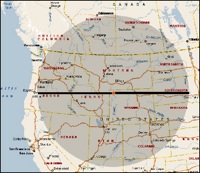
ash falloutI recently watched the Discovery Channel’s [Supervolcano](http://dsc.discovery.com/convergence/supervolcano/supervolcano.html), a docu-drama about what would happen if the massive [caldera underneath Yellowstone National Park](http://en.wikipedia.org/wiki/Yellowstone_Caldera) were to erupt.

The program had been sitting on my TiVo for a while, because it’s hard for me to commit to an hour of [Alias](http://abc.go.com/primetime/alias/), much less a three-hour made-for-cable movie. But I knew I’d eventually watch it, because from the moment I first heard about the Yellowstone supervolcano, it was one of those nagging, back-of-my-mind fears. So much so, that I actually included a lengthy monologue about it for a script I was writing. (That scene got cut, so feel free to write your own.)

For those who don’t know, Yellowstone National Park, home of the Old Faithful geyser, is actually the caldera of a massive volcano. And not just a “theoretical” volcano: it’s erupted at least three times before: 2.1 million years ago, 1.3 million years ago and 640,000 years ago. Which, if you do the quick math, suggests that it erupts every 800,000 to 660,000 years. Which means it’s due to erupt now.

timeline

Which is very, very bad.

When Yellowstone erupts, it will be big-summer-disaster-movie apocalyptic. Think Armageddon x The Day After Tomorrow. Twenty feet of jagged volcanic ash strewn across the Midwest, tapering down to a centimeter on the East Coast. Global temperatures will fall. The monsoon will fail. Drought, famine, starvation lasting for years. As Discovery says on the website:

A modern full-force Yellowstone eruption could kill millions, directly and indirectly, and would make every volcano in recorded human history look minor by comparison.

Suddenly, moving to Australia looks a lot more enticing. Yes, there’s the global famine, but at least you don’t have ash falling on your head.

But here’s the thing: Yellowstone is not actually “due” to erupt. That’s a logical fallacy. And the celebrity spokesperson who proved it to me is [Michelle Pfeiffer](http://imdb.com/name/nm0000201/maindetails).

Let me provide context.

michelle pfeifferIn 1994, my friend Elizabeth and I went to see [The Madness of King George](http://imdb.com/title/tt0110428/combined) at a movie theatre on the [Third Street Promenade](http://www.downtownsm.com/bwhats_happening.shtml) in Santa Monica. The movie theatre was pretty full, so we ended up sitting next to a man and woman — who turned out to be Michelle Pfeiffer and her husband [David E. Kelly](http://imdb.com/name/nm0005082/). Being good Los Angelenos, we pretended we didn’t know they were beautiful and famous. We just ate our popcorn, watched the movie, and gossiped after they left.

[Read more…] about Michelle Pfeiffer, Supervolcanoes and the Yellowstone Fallacy

« Previous Page
Next Page »

Primary Sidebar

Newsletter

Inneresting Logo A Quote-Unquote Newsletter about Writing
Read Now

Explore

Projects

  • Aladdin (1)
  • Arlo Finch (27)
  • Big Fish (88)
  • Birdigo (2)
  • Charlie (39)
  • Charlie's Angels (16)
  • Chosen (2)
  • Corpse Bride (9)
  • Dead Projects (18)
  • Frankenweenie (10)
  • Go (29)
  • Karateka (4)
  • Monsterpocalypse (3)
  • One Hit Kill (6)
  • Ops (6)
  • Preacher (2)
  • Prince of Persia (13)
  • Shazam (6)
  • Snake People (6)
  • Tarzan (5)
  • The Nines (118)
  • The Remnants (12)
  • The Variant (22)

Apps

  • Bronson (14)
  • FDX Reader (11)
  • Fountain (32)
  • Highland (73)
  • Less IMDb (4)
  • Weekend Read (64)

Recommended Reading

  • First Person (87)
  • Geek Alert (151)
  • WGA (162)
  • Workspace (19)

Screenwriting Q&A

  • Adaptation (65)
  • Directors (90)
  • Education (49)
  • Film Industry (490)
  • Formatting (130)
  • Genres (89)
  • Glossary (6)
  • Pitches (29)
  • Producers (59)
  • Psych 101 (118)
  • Rights and Copyright (96)
  • So-Called Experts (47)
  • Story and Plot (170)
  • Television (165)
  • Treatments (21)
  • Words on the page (237)
  • Writing Process (177)

More screenwriting Q&A at screenwriting.io

© 2025 John August — All Rights Reserved.