• Skip to primary navigation
  • Skip to main content
  • Skip to primary sidebar

John August

  • Arlo Finch
  • Scriptnotes
  • Library
  • Store
  • About

QandA

A visit from the ghost of coverage past

December 6, 2010 Education

Reader Jason writes:

> [My boss] was giving our poor assistant the grueling duty of digitizing boxes and boxes of her old scripts. In the mire, he came across something we all found amusing -– coverage you did back in 1992.

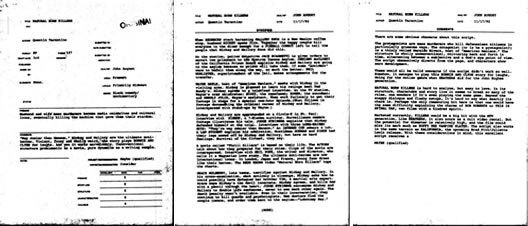
He attaches coverage I wrote for both Quentin Tarantino’s NATURAL BORN KILLERS and Sam Hamm’s PULITZER PRIZE.

I don’t publish reviews of unproduced screenplays (ahem), but I’ll happy share what I wrote about [Tarantino’s NBK](http://johnaugust.com/Assets/nbk.pdf).

natural born killers script

I read it (and wrote this coverage) during my first semester of film school at USC. I probably read 200 scripts that year, but I remember this one distinctly, because upon reaching the last word I promptly flipped back to page one and read it again.

(This was Fall 1992. Little did I know that the following year I’d be working for the movie’s producers during post-production, and would co-write the novelization.)

Next to James Cameron’s ALIENS scriptment, NBK was probably the single screenplay that most made me want to become a screenwriter.

So why the hell did I give it “good” across the board rather than “excellent?”

An acute case of chickenshititis, I suspect. We were strongly discouraged from ever using the “excellent” boxes. Just writing “consider” was a bold move. I’ll cut my younger self a break just this once.

Some extra details about this document, just because I remember:

* I’m pretty sure I wrote this for a class assignment, rather than my reader internship. Laura Ziskin taught our first development class. Each week, we checked out two scripts from her extensive script library. ((The idea of “checking out” something seems quaint, but photocopying was fairly expensive.))

* I wrote this on the Mac, most likely in [ClarisWorks](http://en.wikipedia.org/wiki/AppleWorks). For the cover page, we had a pre-printed template to use. Most readers used a typewriter to do the cover sheets, but with enough finessing, I got the fields in ClarisWorks to line up properly.

* This coverage was probably printed on a StyleWriter. Sometime later that year I bought a LaserWriter — an expensive indulgence at the time, but much cheaper through the USC Bookstore. The LaserWriter had a thin and terrible version of Courier, so I used Fontographer to make a chunkier one I called Dorphic, which I continued to use for many years. (Go is printed in Dorphic.)

In my essay on [Professional Writing and the Rise of the Amateur](http://johnaugust.com/archives/2006/professional-writing-and-the-rise-of-the-amateur), I make a pointed challenge:

> So you have to ask yourself: a year from now, five years from now, how am I going to feel when someone asks me about that thing I wrote?

This coverage is eighteen years old, from the pre-internet era. Further proof you don’t get to choose when to be professional.

You can read the full coverage [here](http://johnaugust.com/Assets/nbk.pdf).

What you see vs. what you say

December 3, 2010 Words on the page

Eric Heisserer offers a good example of why screenwriters need to [read dialogue aloud](http://twitter.com/writerspry/status/10148029843636224):

> “Mos-top eeple ike ash.”

> It sounds awful and hard to understand. The other choice is to slow down and enunciate each word. Also awkward.

Reading it on the page, you wouldn’t think it’s such a problematic line of dialogue:

DEALER

Most top people like cash.

In this case, it’s the duplicated consonants that make it confusing. But there are many reasons a line can look fine and sound terrible, including repeated sounds (“win in Indiana”) and homonyms (“violent sects”).

The only way you’ll know is to read dialogue aloud as you’re writing it, and again with fresh eyes.

Dialogue needs to fit both the moment and the mouth. I’ve found actors can sometimes finesse a line that would leave me tongue-tied. But it’s rarely a gamble you’ll want to take, particularly if you’re not going to be on-set.

Getting paid late

November 22, 2010 Film Industry, First Person, WGA

A screenwriter colleague recently vented her frustration with always getting paid late for her studio jobs. I didn’t have any particularly good advice for her — what she describes is hardly unique. In fact, the situation is so much the norm that I asked if she would write up a post about her experiences, since I’ve never really discussed it on the blog.

Some background info might help readers brand-new to the industry:

* When a screenwriter is hired to write for a studio, the contract is negotiated between her lawyer/representatives and the studio’s. Even when the basic terms are figured out, it still takes a few rounds of back and forth to generate the actual paper contracts you sign.

* Screenwriters are paid half up front. If a writer is being paid $100K for a rewrite, it’s delivered in two chunks: $50K at commencement, and $50K when the draft is delivered.

Much of what we’re talking about here relates only to features. Because of time pressures, TV works differently.

———

first personI’m honored to be asked to guest post for my favorite screenwriting blog, but have decided to do so anonymously for fear of studio retribution. I’d like to note, though, that it’s ridiculous we writers are scared to talk about what is a contractual right — being paid on time.

I have gotten paid late for every project I’ve written in my somewhat nascent career. Often I find myself holding a script hostage… for the commencement check. Not even for the delivery check. My agent and lawyer have said they are frustrated, but it is normal. I started to wonder — does it have to be?

I tried to read what the MBA ((The MBA is the agreement between the WGA and the AMPTP. When we talk about “the contract” with the studios, this is what we mean.)) says on the topic, but because it is 452 pages long and contains so much legal jargon, I almost went blind on the first page. So instead of losing my valuable eyesight, I thought it prudent to attend the Late Pay Seminar recently held at the WGA headquarters.

Some of what I learned was very, very obvious — and also surprisingly helpful.

Here’s what the MBA has to say about payment (in language we can all understand):

1) __”Commencement” for a project begins when there is a signed and dated contract.__ When my agent says, “You’re commenced,” it doesn’t count. When my lawyer says, “It’s okay to start writing,” it doesn’t count. When the producer says, “The studio told us to get started!” it doesn’t count. It doesn’t even count when the studio exec in charge calls you herself to tell you.

A signed and dated contract is the only thing that means you’re commenced. This may seem obvious, but most writers are starting without a signed contract. I have. Every time. It almost burned me on two projects this year alone when, after I had already completed first drafts, there were contractual conditions that had not been met (underlying rights hadn’t been untangled, producer deals hadn’t been completed) and I couldn’t get paid until they were.

2) We the writers (and the signatory companies) are supposed to __send signed copies of our contracts__ to the Guild’s “contracts” department as soon as they are signed. Almost nobody does this, either, but they should because–

3) __The Company is then supposed to pay the writer within seven calendar days of contractual commencement.__ If they don’t, the writer should–

4) __Call the WGA legal department__, who will see to it that the Company not only pays the writer, but does so with interest: 1.5%/month or 18%/year as a late penalty. (That’s more than you can get on any savings account right now!)

5) When a writer submits a draft, he or she is supposed to __submit it to the person named in the contract directly__, not through the producers, and, if possible, invoice that person. Often a writer’s agent does this, and if they do, the writer should request to be CCd.

6) The Company is then supposed to __pay the writer (again) within seven calendar days of receipt__. And, if not, the same interest accrues.

Excuse me a second while I drag this little soap box out of my closet:

When writers don’t follow these steps, most especially when they start writing without a contract, they make it nearly impossible for the WGA to arbitrate and get them paid.

Now that I am armed with this information, I need to have a difficult conversation with my agent about refraining from starting a project until everything is signed.

In theory, agents and lawyers should be all for this. In fact, they should be encouraging writers not to get started until the contracts are signed and the check clears, because that’s when they get paid, too, right? Wrong.

Sympathy for agents
—–

Agents and lawyers deal with the same executives all day long on various projects. If an executive they deal with frequently wants a writer to start on a project because the contract won’t be done for months, it makes the agents/lawyers lives easier to say “sure” so that their next phone call with that executive, about a new deal and a different client, goes smoothly.

That’s not a criticism of the excellent job agents and lawyers often do, it’s just the reality of the business (hell, if I was in their position, I’d probably do the same thing). What it means is that writers have to be the ones to firmly convey to our representatives that we cannot start work until those contracts are signed.

The MBA also apparently states that the Company must make a good faith effort to have a contract to the writer within 10 days of agreeing on the major deal points. In my experience, that has never come close to happening. So, adhering to this rule isn’t always feasible.

One writer at the seminar talked about landing a big project based on a well-known property and the studio demanded he start writing because there was a start date already scheduled for the movie. Had he waited for a signed contract, by the time they sorted out the underlying property rights, he would have been waiting nine months and the studio would have fired him, taken his best ideas, and hired someone else who was willing to start writing before the contracts were signed.

And frankly, I’ve always been so grateful to be working that I’ve been reluctant to say, “Sorry, I can’t write without a contract.” But I left the seminar thinking: If we all tried to adhere to the commencement rule a little more firmly, and actually followed the steps listed above per the MBA, would the companies miraculously be able to turn the contracts and checks around faster? At 1.5% interest/month, we’d make it much more expensive for the studios to pay us late, and would probably be able to at least decrease the frequency of the practice.

It’s not that I think the Companies, or the executives, or the producers are out to get us. They are simply doing their jobs in a bad economy — holding onto their money (which accrues interest for them!) as long as they can while getting projects turned around as fast as possible. This is a business and money is their bottom line.

But we writers are the presidents, secretaries, development executives and janitors of our own little businesses. And money has to be our bottom line too so that we can pay for things like rent and food and overpriced holiday egg nog lattes, and free our minds to be creative, which is what they are hiring us for in the first place.

If we don’t advocate for ourselves, nobody else is going to do it for us.

——

bradHere is where I’ll disagree with the writer a bit. While I understand WGA policy, I’m okay writing without signed contracts. Just pay me commencement.

Studios aren’t eager to do this, obviously. When I ask, I rarely succeed. But it’s a reasonable balance that leaves plenty of incentive for both sides to get contracts finished up (since I still need to deliver).

In doing weekly rewrites on movies going into production, I’ve always been amazed how quickly the checks come when the scene they’re shooting next week is on my laptop. Television has the same time pressure. Business affairs can move quickly when pushed.

On the Amazon film thing

November 18, 2010 Film Industry

Earlier this week, Amazon announced the formation of [Amazon Studios](http://studios.amazon.com).

Whenever new money comes into the film industry, it’s cause for some celebration. The purse strings loosen a little, and more people find work. Since you can’t shoot movies without scripts, screenwriters are among the first to benefit.

Over the years, money has poured in from venture capital firms, foreign investment funds and entrepreneurs from other industries. ((My first reader gig was with a production company bankrolled by Little Caesar’s Pizza money.)) Amazon has a lot of money. It’s understandable why they might want to get involved with creation rather than just the distribution of entertainment.

Steve Jobs got involved with a little company called Pixar, and that’s worked out pretty well.

If Amazon Studios were a simple finance and production outfit like Relativity or Morgan Creek, there would be nothing more to say. But Amazon Studios has an [unusual strategy](http://blogs.indiewire.com/thompsononhollywood/2010/11/16/amazon_launches_new_movie_studio_run_by_roy_price_son_of_frank/?utm_source=twitterfeed&utm_medium=twitter):

> Amazon Studios invites filmmakers and screenwriters from all over the world to submit full-length movies and scripts, which will then get feedback from Amazon readers, who will be free to rewrite and amend. Based on reaction (“rate and review”) to stories, scripts and rough “test” films, a panel of judges will award monthly prizes.

Several readers have written to ask my take on all this. I won’t conjecture about anything beyond what’s on the press release and website, but I’m left with some pretty big questions. I have a hunch other screen-bloggers will be tackling some of the glaring ones, like copyright, authorship and the 18-month free option.

So I’ll just ask one:

**Do you really want random people rewriting your script?**

To me, this feels like the biggest psychological misstep of the venture. Sure, most aspiring screenwriters yearn for access to the film industry and the chance to get their movies made. That’s why they enter screenwriting competitions, including things like Project Greenlight, which feels like its closest kin.

But here’s the thing: each of these writers wanted to get *his movie* made. I’ve never met a single screenwriter who hoped anonymous strangers would revise him.

From the [FAQ](http://studios.amazon.com/getting-started):

> **Can I make it so that no one else can revise my original work?**
> No. But if someone makes changes that are bad, their version is not likely to get a lot of attention. And if someone comes along and makes your work better, you’re more likely to win a prize and get your project made. Sometimes other people can bring a different viewpoint or a different set of skills that take the story in a new direction or add new elements that make it even more compelling.

“Look, I know your script was about a blind cheerleader in Harlem. But ramsey22’s revision making the cheerleader an elephant is *so much funnier.* And blueGoblin has a good point: a safari park is a better setting for a story about elephants.”

In software development, the open source movement has succeeded in bringing teams of strangers together. But writing code is a lot different than writing a screenplay. A bad line of code is obvious; it doesn’t do what it needs to do. A bad line of dialogue is a judgement call. A thumbs-up, thumbs-down voting system isn’t likely to fix this.

Hollywood already has a bad track record of messing up projects by bringing in too many writers — and that’s when they’re paying people who have already written and produced movies. The idea that an undiscovered screenwriter in Wichita will rewrite someone else’s screenplay *on his own time* seems far-fetched, and to me smacks of spec labor.

I’m pro new ideas. I think you can make interesting, artistically worthwhile projects through crowdsourcing, such as YouTube’s [Life in a Day](http://www.youtube.com/user/lifeinaday). I love sites that leverage group energy, like Wikipedia and Kickstarter. I had fun with the [trailer competition](http://johnaugust.com/archives/2007/trailer-winners) for The Nines.

But I don’t see Amazon’s model working, for the reasons above and many others. My readership is pretty much the exact target audience for their venture, so I’m curious to hear your opinions.

« Previous Page
Next Page »

Primary Sidebar

Newsletter

Inneresting Logo A Quote-Unquote Newsletter about Writing
Read Now

Explore

Projects

  • Aladdin (1)
  • Arlo Finch (27)
  • Big Fish (88)
  • Birdigo (2)
  • Charlie (39)
  • Charlie's Angels (16)
  • Chosen (2)
  • Corpse Bride (9)
  • Dead Projects (18)
  • Frankenweenie (10)
  • Go (29)
  • Karateka (4)
  • Monsterpocalypse (3)
  • One Hit Kill (6)
  • Ops (6)
  • Preacher (2)
  • Prince of Persia (13)
  • Shazam (6)
  • Snake People (6)
  • Tarzan (5)
  • The Nines (118)
  • The Remnants (12)
  • The Variant (22)

Apps

  • Bronson (14)
  • FDX Reader (11)
  • Fountain (32)
  • Highland (73)
  • Less IMDb (4)
  • Weekend Read (64)

Recommended Reading

  • First Person (87)
  • Geek Alert (151)
  • WGA (162)
  • Workspace (19)

Screenwriting Q&A

  • Adaptation (65)
  • Directors (90)
  • Education (49)
  • Film Industry (490)
  • Formatting (128)
  • Genres (89)
  • Glossary (6)
  • Pitches (29)
  • Producers (59)
  • Psych 101 (118)
  • Rights and Copyright (96)
  • So-Called Experts (47)
  • Story and Plot (170)
  • Television (165)
  • Treatments (21)
  • Words on the page (237)
  • Writing Process (177)

More screenwriting Q&A at screenwriting.io

© 2026 John August — All Rights Reserved.