Movie speak
When the AD calls out that this is the Abby Singer, what should you do?
Well, nothing, because you’re the screenwriter. But being the observant sort, you might notice that the gaffers start tidying up. Craft service begins putting away the vegetable dip. The second AD dispatches some PAs to make copies of the call sheet.
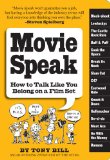
The Abby Singer is the next-to-last shot of the day, or at a given location. And if you’ve never heard of it, or some of the other terms mentioned above, I can recommend Tony Bill’s book Movie Speak: How to Talk Like You Belong on a Movie Set. It’s by far the best guide and glossary I’ve seen to all the esoteric terms you hear on a movie set. And real terms, not goofy had-to-be-there catchphrases.
Keep in mind: as a screenwriter sitting at a computer, you’ll never use most of these terms. You’ll never, ever type them in a script. It’s only when you’re on a working set that you’ll hear them. But knowing them might save you some embarrassment and confusion.
(As a reminder, I’ve previously recommended The Hollywood Standard
as a go-to guide for screenplay formatting.)


March 3rd, 2009 at 11:06 am
I actually did know what an Abbey Singer is, but only after reading a bunch of movie glossary lists as part of my own little film school.
Two of the best lists I’ve found are this one http://www.filmland.com/glossary/Dictionary.html and IMDB’s glossary list http://www.imdb.com/Glossary/A
It’s actually pretty fun to learn about the origin of all the different strange set terms so I’ll check out the book when I get a chance!
March 3rd, 2009 at 1:01 pm
I’m using the Cole/Haag version One for film writing… I know it’s a little bit dated… but most of the book is still on point… would I really be better off updating my style guide going with THE HOLLYWOOD STANDARD?
Okay, so it’s only about 15 bucks, but should I invest? Is there enough disparity between the older book, and this new and improved version?
Anyone have any insight between these two must-have guides?
March 3rd, 2009 at 2:07 pm
That’s two terms that are new to me; I never heard anybody say “next-to-last” before. I’m guessing it’s a North American phrase, is that right?
Here, we just say second last, which, now that I’ve thought about it sounds just as oxymoronic(ish)!
March 3rd, 2009 at 3:14 pm
Brian,
I guess “next-to-last” is a North American (or maybe just American, haven’t spent much time in Canada) phrase, because I hear it all the time.
I’ve yet to hear “second last” but I do hear “second-to-last” on occassion.
March 3rd, 2009 at 3:18 pm
@Ryan Covert:
I’m not familiar with the Cole/Haag book. I recommend Hollywood Standard simply because it’s mostly right, and it saves me having to answer a lot of questions on this site.
@Brian and @Garrett:
Both sound better than penultimate.
March 3rd, 2009 at 6:06 pm
Hey, no knocking “penultimate”.
March 3rd, 2009 at 7:34 pm
“Both sound better than penultimate.”
And much better than “pre-martini” shot.
March 3rd, 2009 at 9:57 pm
Funny how many people use ‘penultimate’ to mean, like, even more ultimate than ultimate …
March 12th, 2009 at 10:27 pm
John, I love you to death, but I do have to take this time to point out that on set, there is one gaffer.
There can be only one. Gaffer per unit, that is. The gaffer is the guy who stands next to the DP and discusses the lighting and then tells us (the electricians) what to do.
The gaffer doesn’t touch lights or wrap equipment.
The people who start tidying up are the electricians, of which there are many.