Strike, days 23 and 24
The days were largely interchangeable, beginning in darkness at 5:30 a.m. at Paramount’s Van Ness gate. Many drivers — both Teamsters and regular motorists — stopped to ask how negotiations were going. Since there’s a press blackout, we have no official information. But two days of talking in rooms beats two days of not talking, so that’s something.
Today, I had a great conversation with Jed Weintrob, whose movie shot in a live-action 3D format. At the risk of invoking a Geek Alert banner, the technology sounds both fantastic and daunting, forcing filmmakers to confront a range of issues I hadn’t considered. In editing, for example, you might choose to cut the “left eye” or the “right eye” footage, but ultimately you’re going to need to watch each cut in converged 3D, since depth changes the perceived speed of shots.
Yesterday was largely about USC. Two current cinema students joined the line, mindful that whatever deal is reached in this strike will likely be the deal they’re working under for the next 20 years. Dana, a recent grad, came seeking validation of her plans for writer-directordom — specifically, whether to heed others’ advice to spec TV. As a general rule, I think most aspiring screenwriters should be ready to write for television, if only because there are many more episodes of TV shot than features. But in Dana’s case, she’s not a TV enthusiast in the slightest. Forcing herself to spec a series she wouldn’t watch is an invitation to misery, both for writer and reader. She’s better off shooting another short film, which she promised to do soon.
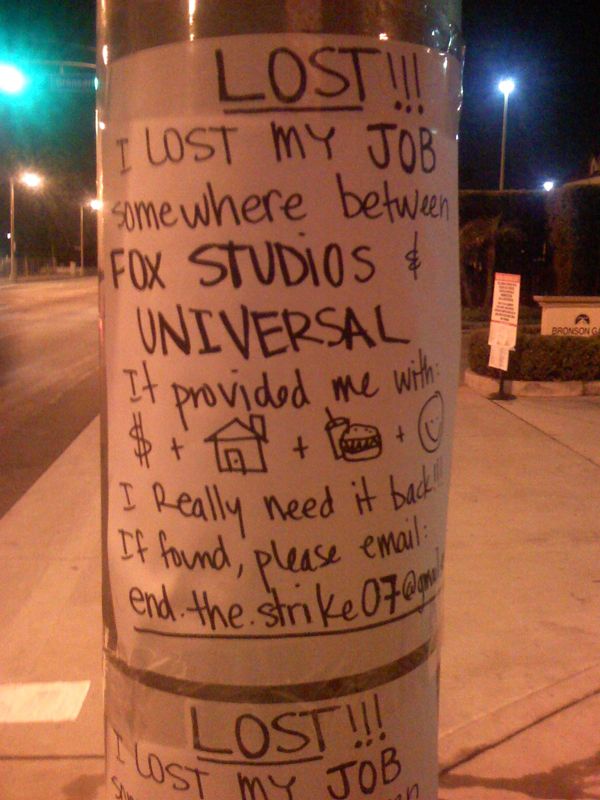
I got an email yesterday from a friend (and USC classmate) who works as an editor on a TV show. He was upset that in my blogging about the strike, I hadn’t talked about the many below-the-line crew members who have lost (or will soon be losing) their jobs as a result of production stopping. The politics and turf wars between the various guilds and unions are far too complex to explain here,1 but suffice to say that many of the non-writing, non-acting folks who are integral to making movies and television feel that the WGA was cavalier in calling the strike.
The thing is, we’ll never know. There were a hundred different ways it could have played out, so to label any event “necessary” or “unnecessary” presumes an impossible combination of hindsight and foresight; not only are you declaring yourself certain of all the facts as they stood, but also that a given change would have had a given effect. Alternative history can make for compelling reading, but it doesn’t get people back to work any sooner.2
The better question — the question I asked my friend the editor — is whether there’s anything he’d strike for, even knowing that it would (at least in the short term) hurt him, his colleagues and others inside and outside of his industry. If the answer is “no,” that a strike is never an option, then he should be prepared to lose his health, pension, and other benefits. Because that’s how they were won.
My singular focus on the writers can seem insensitive to others affected by the strike. But this blog is about the profession of screenwriting, which for the past four weeks has been profoundly changed. So that’s all I’m trying to document. I’m happy to have readers from many fields inside and outside of the industry, and I hope that my writing about the strike has shed some light on the writers’ perspective.
- This is my convenient way of ducking out of it, and hoping Craig Mazin will pick up the torch. ↩
- But if we’re playing with alternative histories, let’s consider what could have happened had the WGA kept working without a contract until the SAG contract expired, at which point the aligned guilds would have had tremendous leverage. There would have been a de facto strike regardless, as studios would have curtailed production on anything that couldn’t be finished before the SAG expiration date. It would have also been summer, outside of the prime TV season, so the strike’s impact would have been considerably delayed. ↩


November 28th, 2007 at 1:28 pm
A friend of mine is an animator for the Simpson’s and while she supports the WGA, she has been fearful form the get go that it might cost her her job. She was told Monday that if matters aren’t resolved in 2 weeks, she’ll be laid off. I talked to her about it and she understands that the strike, ultimately, will benefit her as well as animators get residuals, too. Doesn’t stop the suck, though.
Let’s hope that rumored Good News is true.
November 28th, 2007 at 1:44 pm
“The thing is, we’ll never know. There were a hundred different ways it could have played out, so to label any event ‘necessary’ or ‘unnecessary’ presumes an impossible combination of hindsight and foresight…”
Wait - does anyone hear that siren? Something down the street? Hmmm… I dunno, I just thought I heard a cop out.
November 28th, 2007 at 1:47 pm
from roma: hang in there.
November 28th, 2007 at 1:51 pm
I am a screenwriter, was an aspiring screenwriter until I made my 1st film last month. The experience made me realize the degree to which this process is collaborative - my sound guy had suggested my best shot, and my editor found an amazing ending from my footage, much better than the 2 endings I had written and shot. I see the point of the strike but I am not completely convinced anymore…Agreed, there is nothing as difficult as facing the blank page but so much happens on the way from page to screen. At this moment I truly believe that given that each project is unique, the reward should be based on risk. High risk = high reward. Writers who want a decent % of DVD sales, Internet revenues, etc. must produce.
November 28th, 2007 at 3:09 pm
Today was the International Solidarity Day for the WGA. Various writers guild around the world wanted to show their support for their American colleagues by organizing rallies.
Boy, was it COLD here in Montréal today! But we took the streets anyway to show our support for the WGA. The rally was held both in English and in French, as you can see on this video: http://vimeo.com/407455
To read more about the international support, check out this Facebook page: http://www.facebook.com/event.php?eid=7510970811&ref=mf
November 28th, 2007 at 4:41 pm
It’s difficult to compare something like WGA strike to war, but both ask the inevitable question: Is this necessary or what would you fight to the death for? The short answer is, of course, yes, this is necessary, just as war is sometimes the only answer. Sometimes there is no alternative but action, it’s regrettable and no rational person would want it (if for no other reason than, like in war, a strike often hurts the innocent - those termed “collateral damage” - which, unfortunately, happens all too frequently). You can only be backed into a corner so often before you have to fight back. This is the case with the WGA strike, yes it’s going to hurt people - those below the line especially and those just breaking in or on the cusp of breaking in - as well as indirectly hurting people who have nothing to do with “Hollywood.” Sometimes though, you jut gotta stand up and damn the casualties, otherwise you get stepped on…
Today, at CBS Radford, I had the pleasure of talking with Sy Rosen. He’s been around for some time, working with some of the greatest talents this business has ever seen, and it was great to meet him. He doesn’t need to walk a picket line, but yet he does because he believes in his union. I also got to talk with Geoffrey Owens (best known for his years on the Cosby show), who reminded me that our cause is also SAG’s cause. We talked about whether or not a strike, in particular a picket line, was an effective tool against the mighty AMPTP, or if something more powerful was needed. We both agreed that having a constant reminder (our walking in front of the various studio entry points) was worth it, but perhaps something more powerful could be done, say protesting at various movie theaters or calling on audiences to turn off their TVs and not go to the movies…Of course, these things would be difficult to organize, but the monetary damage to the AMPTP (who would then have to explain it all to their corporate shareholders) would really hurt their bottom line and possibly force them to re-evaluate just how penny wise and pound foolish they are. Perhaps, then and only then, the AMPTP would come to their senses.
Unlike in ‘88, this WGA means business and won’t just settle just to settle and go back to work. And, I for one believe that this strike is necessary. I just hope the collateral damage is minimal.
November 28th, 2007 at 5:48 pm
Cop out… sort of, but John August is a big enough name in screenwriting, and combine that with the world we live in, what he says here will be taken out of context and put into larger publications.
I’m sure he doesn’t like that below the line people are hurt by this. But it is true that a victory here, whatever that entails, will be helpful for future groups trying to negotiate for more respectful deals.
This isn’t just a strike for money now, its a strike as he said “for the next 20 years” and sacrifices will come with it.
November 28th, 2007 at 8:12 pm
did you hear that the Democrats just cancl’d their next debate because the CBS writers are going to observe the strike and they will not cross the picket line?
November 28th, 2007 at 9:16 pm
I too have many friends that work “below the line.” And while most of my experience has been in positions such as grip or camera operator or PA, the simple fact of the business we’re in is that it all starts with the writer.
Sure, someone may pitch an idea. But somebody else has to flesh it out on the page before that idea becomes real.
No disrespect to the many others that have lost their jobs due to this strike. But as I’ve said others that are unclear as to what is at stake her the issues at hand effect every nook and cranny of show business and should be settled to the benefit of the WGA asap. A reasonable and fair resolution will benefit all. Thankfully this may happen sooner than later.
This is truly trickle down economics at work.
I write. But most likely my contribution to the industry will be in a below the line position.
But it will be to my benefit that the WGA gets what they want and what they deserve.
A fair and equitable resolution to the issues at hand.
November 28th, 2007 at 9:20 pm
Apologies, I’m a lazy typist.
This should read as: “No disrespect to the many others that have lost their jobs due to this strike. But as I’ve said to others that are unclear as to what is at stake here”
Thank you for allowing the correction.
MB
November 28th, 2007 at 9:43 pm
John:
Way to set me up.
Tattaglia’s a pimp. But I never knew until that footnote…that it was August all along…
November 29th, 2007 at 1:10 am
John, The Times has reviewed The Nines - check it out:
http://entertainment.timesonline.co.uk/tol/artsandentertainment/film/film_reviews/article2961708.ece
November 29th, 2007 at 2:05 am
John,
On the below-the-line discussion, the was posted on UnitedHollywood.com last week. Some interesting points:
MONDAY, NOVEMBER 19, 2007
Union Solidarity - We Really Are All In This Together
(The following is a post from WGA member Kevin Droney. The man made it through the ‘88 strike, and he knows his facts and figures.)
Why Production Crews Should Be Cheering On the Writers
I’ve talked with a few IA guys over the past few days, and they were generally unaware of a few things in their own contracts with the Alliance. To whit:
1) Their unions, including I.A.T.S.E., IBT Local 399, Studio Utility Employees Local 724, IBEW Local 40, Plumbers & Pipefitters Local 78, and the Plasterers & Cement Masons Local 755… ALL RECEIVE RESIDUALS. 2) These residual payments go directly into their PENSION AND HEALTH FUND. 3) RESIDUALS earned working on shows CONSTITUTE 55% OF THEIR P & H. 4) If there are funding surpluses from residuals, retirees receive a 13th and a 14th check in that year, instead of the normal twelve.
We’re talking $339 million in residual contributions to the funds in 2006, and a projected $351 million this year.
But it gets better, and this is why IATSE members should be supporting us as the Teamsters and others are. Last year, the AMPTP entered into an agreement with IATSE, which states in part:
The bargaining parties agree that if any other Union or Guild negotiates as part of its collective bargaining agreement with the AMPTP residuals on product for iPods or similar devices, the Producers will meet with the IATSE to negotiate an appropriate residual formula.
Strike captains have been passing out leaflets at the studios for a week explaining all this, and maybe in a hundred years, every production crewmember will get one. Or, if you’re on a crew, maybe you can just steer your colleagues to this site, and speed up the process.
Because here’s the thing: if residuals are NOT paid for reuse on new media, every union member in Hollywood will suffer.
And since United Hollywood is all about fact checking, please don’t hesitate to call the Motion Picture Industry Pension and Health Plans at (310) 769-0007 and ask them.
Up the Unions!
Kevin Droney WGA member
Source: http://unitedhollywood.blogspot.com/2007/11/union-solidarity-we-really-are-all-in.html
November 29th, 2007 at 9:48 am
John wrote: “I got an email yesterday from a friend (and USC classmate) who works as an editor on a TV show. He was upset that in my blogging about the strike, I hadn’t talked about the many below-the-line crew members who have lost (or will soon be losing) their jobs as a result of production stopping.”
It’s a shame that your friend’s job is at risk - but he’s not the only one. Pretty much every low-level or entry-level position is at risk, it doesn’t matter if it’s with a management company, talent agency, production company, studio, production office, or on set. Many of my friends have already lost their jobs and others have been forced to take pay cuts or reductions in benefits.
But even though the WGA’s strike is to blame, not a single person I know in this situation resents them; in fact, they all seem to support the WGA. Even those that have lost their jobs support the WGA (and these are non-union employees who have nothing to lose or gain from the strike). Why? Probably because they’re so used to being mistreated, unappreciated, and exploited by the industry that they too wish they could strike.
“If you want to know what a man’s like, take a good look at how he treats his inferiors, not his equals.”
But was the WGA cavalier in calling the strike? No way, though I seriously doubt they gave much consideration to the numerous entry-level jobs they put at risk. But they shouldn’t have to, they’re striking for better pay and conditions for writers, not for assistants, coordinators, interns, production assistants, or other low-level, non unionized workers. Though, it would be nice if someone did because we certainly don’t have a voice.
November 29th, 2007 at 9:52 am
It’s true, we’ll never know if a strike might have been averted had a, b, c and d transpired. What’s clear is that the two sides were not able to come to the table in a serious way until the eleventh hour, and that it did take a couple of weeks of striking for that to change. In an ideal world, they would have come to the table in the spirit of cooperation by early October, but this is not an ideal world, and for whatever reason, both sides felt strongly about their positions.
I am a writer. I believe that the new media issue is important and that it is essential to gain traction on this issue now. I am gratified to see both sides back at the negotiationg table.
I sympathize with people who are losing jobs they cannot afford to lose. I share their plight. On the other hand, I take responsibility for my decision to work in a profession that is inherently variable. Where a strike differs from the myriad things that can slow or stall a career is that it’s easy to point the finger. It’s easier to say, “if only you guys hadn’t gone out on strike, I’d still have my job.” And technically it may be true. There are, however, larger truths. It is easier to be angry at writers than at management, but the truth is, a strike could have been averted had management agreed to a fair compensation package, something they can well afford to do. Did WGA leadership handle things as effectively as they might have? I do not know. But I do know that the AMPTP chose to fight rather than pay writers a modest sum for their work. Asking for fair compensation for our work is not greed. Refusing to provide fair compensation is. It is not the writer’s strike that is costing people their jobs. It’s the conditions that made the writers strike necessary.
November 29th, 2007 at 11:34 am
A lot of people are in that boat. I’m a writer aspiring to be a WGA writer but in the mean time I make my extra money doing work as an extra and looking for jobs as a PA. Can’t cross the picket lines to do that so I’m SOL. Hopefully this will blow over soon and hopefully not too many people will be hurt by this. In the mean time, I have some lovely used items for sale on Amazon…
On the other hand, this all just draws attention to the fact that many big wigs choose to ignore: without writers, there would likely be no jobs for anyone in this industry.