Copyright: The Comic Book

comic bookIt seems every fourth question I get has the word “rights” in it: “Do I need the rights to…”, “How do I get the rights to…”, “Im not a gud speller I like to rights…”

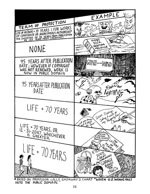
Reader Chris Little wrote in to point out this terrific comic book — Tales from the Public Domain: BOUND BY LAW? It’s prepared by Duke University’s Center for the Study of the Public Domain. Not only does it describe situations where you have to be careful, it points out the absurdities of modern copyright law, where a cell phone ringing in the background can cost you $10,000.

A lot of the information skews toward documentary filmmaking, but it’s useful for anyone interested in portraying reality, and the near-impossibility of doing it as long as everything is protected by copyright.

You can read it all (for free!) here.

  • Digg
  • Facebook
  • Reddit
  • SphereIt
  • StumbleUpon
  • Twitter
March 16, 2006 @ 4:08 pm | Comments (11)
Filed under: Rights and Copyright

11 Responses to “Copyright: The Comic Book”

  1. Steve Levy

    sounds quite interesting.

  2. Matt Waggoner

    Amen. “Eternity minus a day,” indeed. Copyrighting everything weakens our culture. Big Copyright won’t ever voluntarily give up the ground they’ve lobbied for; it’s going to have to be taken back by (political) force.

    Check out Spider Robinson’s Melancholy Elephants for a good short story on the subject.

  3. Jeff

    I had no idea it gets that ridiculous.

  4. Noah Brand

    Wow, that’s one terrific, comprehensible overview. Clear, entertaining, short on legalese and long on solid examples.

    I, of course, spent most of the time reading it ogling the documentarian and thinking “Finally, a woman in comics drawn with a decent tuchis!”

    Someday I’m going to wind up like the sinner in a Chick tract, wishing I’d paid attention to the message when I had the chance…

  5. Sean

    Great link, John. I have been developing a doc and rights and releases is a big part of the equation.

    The whole fair use vs. liscense thing has grown a bit absurb in many cases. And big corporations controlling copyrights have the pockets deep enough to scare off most attempts at litigation.

    There needs to be an addendum to the laws bridging the gap between short snippet fair use/background and incendental renumeration. I think it should be based on revenue, versus flat fee. It’s a shame so many of the small filmmakers are getting hurt by this. That seems to be the prevailing theme in all walks of life these days, though……

    Here’s a link to the Doc Filmmaker’s Statement referenced: http://www.documentary.org/resources/src/Fair_Use/bestpractices.pdf

  6. Andrew

    John, I bet you are an avid Groklaw reader :-) Here’s the link to the lively discussion there about this book:

    http://www.groklaw.net/article.php?story=20060315071105132

    Writers need to know their I.P. law. Reading the fine print is not enough for entertainment property contracts. You need to understand what rights you have as an author and how to manage them. You need to know about licensing your works through time and across geographies. It’s not as simple as creating a story and selling it outright (although it can be that simple if you wish it so). Understanding how your creative rights work is the difference between getting a one-time check for 200K versus five 100K checks over five years.

    Generally, when you are a creator, know what you are getting into when you get into the business. How do you think Prince (artist formerly known as) felt when he realised he was locked into a contract that he hated? Scrawling the word ’slave’ across your forehead and changing your name to a symbol are not signs of an artist who fully understood the contract he or she signed!

    Although it’s not a rights issue, one of the most delicious bits of advice I received was: “When they buy your screenplay, tell them you want producer credit too, then let them buy you out for an extra 50K!”

  7. Josh Boelter

    There was a conversation about this at DVXuser.com (a video camera and filmmaking forum) recently. An independent filmmaker wanted to include a Dunkin Donuts sign in his movie. He was going to be filming on public property, but because it’s a corporate logo, he would have to get Dunkin Donuts’ permission to show the sign. That’s copyright and permissions gone ridiculous. If it’s a piece of art inside the property, that’s one thing. But when a company puts their logo and sign on public display, that’s another matter, in my opinion.

  8. Johnny

    Off topic: “Your” ‘Playing obscurity for depth’ insight is quoted top page of CS Weekly’s electronic newsletter. Right below George Lucas, who offers one of his trivialisms: Big screens are better than small screens. What a genius.

  9. Sean

    Josh, the DD sign usage can easily fall under fair use. But only in a documentary. If it is a narrative, then everything is deliberate and consciously chosen, which is why one must pay or get permission for everything. However in narratives, such choices now bring in ancillary income, but usually only for big films. And when shown in a favorable light.

    It would be nice to see indie films get some kind of break here.

    Now, in my little doc, local bars and restuarants are all ready to pony up free grub (and drinks, yeehaw!) if I shoot them. I hope to put on about ten pounds for the six week shoot!

  10. Fred

    Funny to hear people in the film industry commenting critically about copyright laws. I believe that it was the film industry that lobbied hard for the amendments to extend copyright protection (The late senator Bono spearheaded the efforts). That change in the law is, I believe, the reason you don’t see It’s A Wonderful Life on television as widely as you did about ten years ago. The rights to that film were recaptured by the studio under one of the changes in the law. So, again it costs to air it on TV and fewer stations are willing to pay for something that was once free. But if they air it, the studio gets its royalty.

    Ultimately, the changes provide for more royalty payments to everyone in the film industry at the expense of the public’s rights to material that would otherwise fall into the public domain.

    Keep a close eye on the copyright law. The film industry is bound to begin lobbying for more protection soon. The film industry has the deepest pockets, most to gain and the least to lose if protection is extended, even if it means producers have to worry about cell phones ringing in the background. Motorola makes its money off patents (technology), not copyrights (ringtones). Paramount makes its money off copyrights (films).

    So, that “Goliath” you fear, stomping in the distance, will be arriving with big bags of cash for some talented and lucky writers, directors, actors, etc. I don’t think it is really appropriate on this website to take a moral stand regarding how the law effects the indie “Davids.” Ultimately, it is your film industry that instigated, and benefits most from, these “absurdities” in modern copyright law.

  11. Kate Coe

    I do clearance for a living, as well as being a producer/director myself. and there’s some distinctions that should be made.

    The ring tones (in Mad Hot Ballroom) were used by the filmmaker to make a story point–just as if she’s put in the actual song–while she didn’t set it up, her use was intentional. I’m not saying that the cost wasn’t too high, but but she really wanted that song in the film, so the rights had to be obtained.

    Dunkin Donuts–in a doc., no need to license, in a scripted film that will be be shown to make money–you need a release.

    Most filmmakers are far better off hiring someone like me to wade through the quagmire of R & C. Most filmmakers, instead, wait until the 11th hour and then think the intern can take care of releases.


About

This site is run by screenwriter John August. Mostly, he answers reader-submitted questions about the craft, but occasionally he goes on tangents that run far afield of writing and filmmaking. You'll also find info on past, present and future projects.

Follow Me

On Twitter: @johnaugust

Ask a Question

If you have a question about screenwriting or my movies that hasn't been answered, by all means ask. There are a few guidelines to follow.

Featured Articles

101: Some screenwriting basics


There are more than 900 articles on the site. You can find category archives at the bottom of every page.

Read Me

  • The Variant
  • A new short story available for download, Kindle and iPhone.

Feeds